
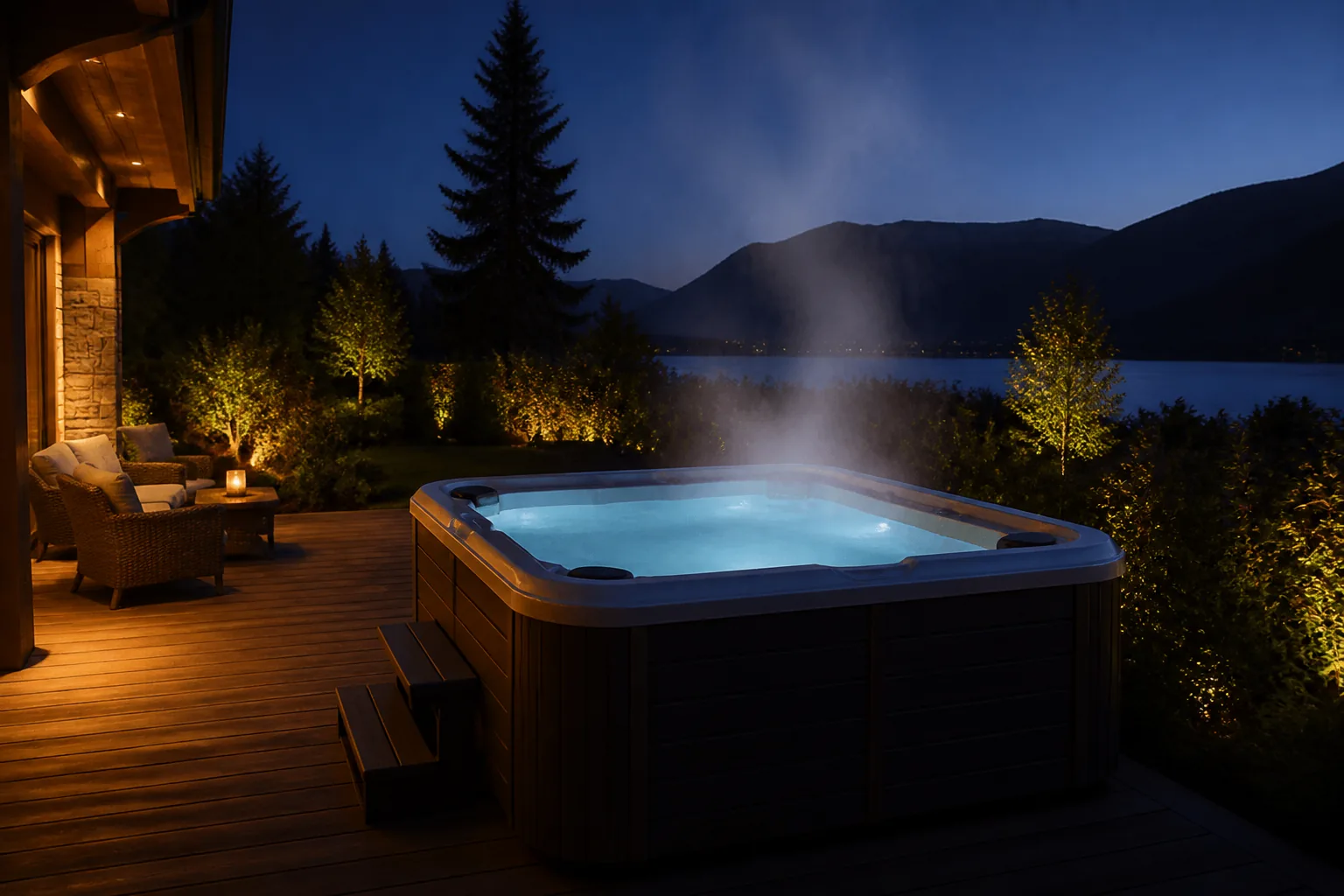
I bought my first hot tub completely blind. No research, no planning, just a weekend sale at a local dealer and a credit card I probably shouldn’t have used. Three months later, I had a 500-gallon portable spa sitting on a deck that couldn’t support its weight, wired to a panel that kept tripping breakers, and a water chemistry bill that made me want to cry. That experience is exactly why I wrote this hot tub buying guide — because the information I needed didn’t exist in one place, and I paid for that gap with real money and real frustration.
Over the past decade, I’ve installed, maintained, and upgraded four different spas. I’ve owned a basic plug-and-play inflatable, a mid-range portable acrylic spa, a full-size 8-person cabinet spa, and most recently a 19-foot swim spa. Each one taught me something the last didn’t. I’ve crawled under decks running conduit in January. I’ve balanced water chemistry at midnight. I’ve argued with contractors about load-bearing specs. All of that experience is baked into what you’re about to read.
This guide covers everything: types, sizes, features, real costs, installation, electrical requirements, maintenance, and the mistakes that first-time buyers make most often. Whether you’re considering a $1,200 inflatable or a $20,000 luxury acrylic spa, you’ll find what you need here. Bookmark this page. Come back to it. Let’s do this right.
Types of Hot Tubs — Understanding Your Options Before You Shop
The hot tub market is broader than most people realize. Walking into a showroom without knowing the categories is a fast track to buying the wrong thing. In my experience, most first-timers don’t even know that “hot tub” is an umbrella term covering several very different products.
Inflatable and Soft-Sided Spas
These are the entry-level option. They typically run $500–$1,500, plug into a standard 120V outlet, and can be set up in under an hour. However, they have real limitations. Heating is slow — often 1–2°F per hour — and jet pressure is minimal compared to hard-sided units. That said, they’re excellent for first-time owners who want to test the lifestyle before committing serious money. I started here, and I don’t regret it.
Portable Acrylic Hot Tubs
This is the category most people picture when they say “hot tub.” These are the freestanding, cabinet-enclosed spas you see on showroom floors. They range from $3,500 to $18,000+, require 240V electrical service, and seat 2–8 people. Most have powerful jet systems, built-in filtration, and energy-efficient insulation. Specifically, look for full-foam insulation rather than perimeter-only — it makes a measurable difference in heating costs over time.
In-Ground and Custom Spas
These are permanent installations, often integrated into a pool or landscaping project. Costs start around $15,000 and can exceed $50,000 depending on materials and features. They add significant property value but require professional installation and significant lead time. I haven’t gone this route personally, but I’ve helped two neighbors plan theirs. They’re a serious commitment.
Swim Spas
Swim spas are the hybrid option — part lap pool, part hot tub. My current unit is a 19-foot dual-temperature model, meaning one end stays warm for soaking while the other stays cooler for exercise. They range from $10,000 to $35,000. For anyone wanting year-round exercise plus hydrotherapy, they’re hard to beat. [INTERNAL LINK: swim spa buying guide]
Hot Tub Sizes — Matching Capacity to Your Real Needs
Dealers love to advertise seat count. “8-person spa” sounds impressive. What they don’t mention is that those eight seats include one person folded into a corner footwell. Always sit in a floor model before you buy. Fit matters enormously for long-term enjoyment.
Here’s a realistic breakdown of size categories and what they actually mean:
- 2–3 person (compact): Typically 5–6 feet square, 300–400 gallons. Great for couples with limited space.
- 4–5 person (mid-size): Around 7 feet square, 350–450 gallons. The most popular category for families.
- 6–8 person (large): Often 8 feet square or oval, 450–550 gallons. Entertaining-friendly but expensive to heat and chemically treat.
Water weight is the factor most buyers ignore. A 400-gallon spa holds roughly 3,340 pounds of water alone — before you add the shell weight and occupants. My second spa nearly destroyed my deck because I didn’t account for that. Always check your installation surface’s load-bearing capacity before purchasing. A structural engineer consultation costs $200–$500 and is absolutely worth it.
Real Hot Tub Costs — Purchase Price Is Just the Beginning
Every first-time buyer I’ve talked to underestimates the total cost of ownership. The sticker price is just one line item. Here’s an honest breakdown of what you’re actually paying for.
Purchase and Delivery
Entry-level portable acrylic spas start around $3,500–$5,000. Mid-range models from established manufacturers run $6,000–$12,000. Premium and luxury configurations reach $15,000–$20,000+. Delivery fees vary by region and access difficulty. Expect $200–$800 for standard delivery. Add crane costs — sometimes $500–$1,500 — if there’s no direct access path to your install location.
Installation Costs
This is where budgets blow up. Electrical installation for a 240V/50-amp circuit runs $800–$2,500 depending on panel distance and local labor rates. A concrete pad runs $1,000–$3,000. Permits vary by municipality but budget $100–$500. If you need deck reinforcement, add $500–$2,000. My third spa installation cost me $4,200 in site prep alone. I wish someone had warned me to budget 20–30% of the spa’s purchase price for installation.
Ongoing Operating Costs
Monthly electricity for a well-insulated 400-gallon spa averages $30–$75 in mild climates and $75–$150 in cold climates. Chemical maintenance runs $50–$100 per month depending on usage and water source. Annual service visits cost $150–$400. Filter replacements run $30–$80 per filter, typically twice a year. Add it up honestly before you commit. [INTERNAL LINK: hot tub running costs breakdown]
Electrical Requirements — The Part Nobody Talks About Enough
This section could save you thousands of dollars and a genuine safety hazard. Hot tub electrical is one of the areas where I see the most dangerous shortcuts taken by both DIYers and under-qualified contractors. Pay close attention here.
120V vs. 240V — Plug-and-Play vs. Hard-Wired
Inflatable and small soft-sided spas often run on 120V standard household current. They plug directly into a GFCI-protected outlet. Convenient — but limited in power and heating speed. Virtually all full-size portable acrylic spas require a dedicated 240V circuit. Specifically, most require a 50-amp, 4-wire circuit with a dedicated GFCI breaker. Some smaller models use 30-amp service. Always verify with the manufacturer’s installation manual before running wire.
NEC Requirements and Local Codes
The National Electrical Code (NEC) Article 680 governs hot tub wiring. Key requirements include a 5-foot minimum setback from the spa for the disconnect switch, a GFCI-protected circuit, and proper bonding of all metal components. However, local codes may be stricter than NEC minimum standards. Always pull permits and use a licensed electrician. I learned this lesson when a previous owner’s unpermitted wiring caused a failed home inspection years later. It cost me a sale.
⚠️ Safety callout: Never operate a hot tub with a compromised GFCI or bypass any electrical safety device. Electric shock drowning (ESD) is a real and deadly risk. If your GFCI trips frequently, have a licensed electrician diagnose the cause before using the spa again.
Key Features to Evaluate — Separating Must-Haves from Marketing Fluff
Hot tub showrooms are designed to overwhelm you with features. LED lighting, Bluetooth speakers, aromatherapy ports, waterfall features — the list is long. Some of it genuinely adds value. Some of it is expensive noise. Here’s how I think through the feature checklist.
Jet Systems and Pump Configuration
Jet count is a marketing number. What matters is pump power (measured in horsepower), jet placement, and whether jets are adjustable and directional. A 30-jet spa with two 3HP pumps will outperform a 60-jet spa with a single 2HP pump every time. Ask specifically about the pump configuration, not the jet count. Targeted therapy jets for neck, back, and calf positions matter more than raw numbers.
Insulation Quality
Full-foam insulation fills the entire cabinet cavity with high-density foam. This is the gold standard for heat retention and energy efficiency. Perimeter-only insulation uses a reflective barrier and partial foam — cheaper to manufacture but significantly less efficient. In colder climates, full-foam insulation can reduce heating costs by 30–50% over perimeter-only systems. Ask to see the insulation before you buy, or request specification sheets.
Filtration and Water Management
The filtration system determines how often you need to change water and how easy maintenance stays. Look for large-capacity filter cartridges with an easily accessible housing. Some premium models include UV-C or ozone sanitation systems as secondary sanitizers — these genuinely reduce chemical demand. That said, they don’t replace chlorine or bromine entirely. Circulation pumps that run 24/7 on low speed dramatically improve water clarity compared to on-demand-only systems.
Cover Quality and Heat Retention
The cover is one of the most underrated components. A high-quality spa cover has a 4–6-inch tapered foam core with a vapor barrier, marine-grade vinyl exterior, and secure locking straps. Poor covers waterlog within 2–3 years, becoming heavy and ineffective. Budget $400–$800 for a replacement quality cover if the dealer’s included cover seems flimsy. A good cover can reduce heating costs by 60–70%. It’s not glamorous, but it matters.
Hot Tub Maintenance — What You’re Committing To Weekly
I’ll be honest: maintenance is the part that surprises most new owners. It’s not hard, but it does require consistency. Neglect it for two weeks and you’ll be draining and refilling 400 gallons of water. I’ve done that more times than I’d like to admit during my first year of ownership.
Weekly Chemical Maintenance Routine
- Test water chemistry with a reliable test strip or drop kit — check pH, alkalinity, and sanitizer levels.
- Adjust pH to 7.4–7.6 and total alkalinity to 80–120 ppm before correcting sanitizer levels.
- Add chlorine or bromine to maintain 1–3 ppm (chlorine) or 3–5 ppm (bromine).
- Shock the water weekly with non-chlorine shock or chlorine shock depending on your sanitizer system.
- Rinse filter cartridges with a garden hose every 2–4 weeks and chemically clean every 3 months.
Water changes should happen every 3–4 months depending on usage. Calculate your water change schedule using the TDS (total dissolved solids) method or simply follow the 3-month rule. Draining, cleaning the shell, and refilling typically takes 2–3 hours. Factor that into your lifestyle before buying.
Winterization — If You’re Not Using It Year-Round
If you live in a climate where temperatures drop below freezing and you plan to shut the spa down seasonally, proper winterization is non-negotiable. Residual water in plumbing lines will freeze, expand, and crack pipes or equipment. Winterization involves draining the spa completely, blowing out the lines with a shop vac or air compressor, removing filters, and treating the shell. A professional winterization service typically costs $150–$300. In my experience, it’s worth every dollar if you’re not confident doing it yourself. [INTERNAL LINK: how to winterize a hot tub]
Common Hot Tub Buying Mistakes — And How to Avoid Them
These are the mistakes I see most often — either from my own experience or from the dozens of first-time buyers I’ve helped over the years. None of them are complicated to avoid. You just need to know they exist.
Mistake 1 — Buying on Impulse at a Tent Sale
Hot tub tent sales are expertly engineered buying environments. High pressure, time-limited deals, and enthusiastic salespeople create a perfect storm for impulsive decisions. I bought my first spa this way. The deal felt urgent. It wasn’t. Reputable dealers offer similar pricing year-round. Take your time, visit multiple dealers, and never purchase the day you first walk in. Always ask to see the warranty documentation before agreeing to anything.
Mistake 2 — Ignoring the Total Cost of Ownership
As detailed in the costs section above, the purchase price is one-third of the true financial commitment. Installation, electrical, ongoing chemicals, and energy costs add up quickly. Budget for all of it before you commit. A $5,000 spa with $4,000 in installation costs and $100/month in operating expenses is a $9,000 first-year commitment. That’s not a reason not to buy — it’s a reason to go in with your eyes open.
Mistake 3 — Underestimating the Delivery and Access Challenge
Hot tubs are large, heavy, and awkward to move. A standard 7-foot spa weighs 600–900 pounds empty. Delivery crews need a clear, level path at least 36 inches wide to the installation site. Fences, gates, stairs, and landscaping all create obstacles. If there’s no clear path, you’re looking at crane delivery — which is expensive and not always logistically possible. Measure every gate, doorway, and path before you finalize your purchase location.
Mistake 4 — Choosing the Wrong Location
Hot tub placement affects enjoyment, privacy, safety, and maintenance access every single day. Consider: proximity to the house (longer walks in winter = less use), privacy from neighbors, wind exposure, overhead obstructions like trees or power lines, and access for service technicians. Most manufacturers recommend leaving at least 24–36 inches of clearance on all sides for service access. Plan this before you buy, not after delivery.
Mistake 5 — Skipping the Dealer Vetting Process
Your dealer relationship doesn’t end at purchase. You’ll rely on them for warranty service, chemical advice, parts, and troubleshooting. A discount dealer who disappears after the sale is a serious problem when your heater element fails at 11PM on a January Friday. Research dealer reviews specifically for post-sale service, not just the buying experience. Ask existing customers directly. Check how long the dealer has been in business locally. This step is more important than the brand name on the spa.
Final Thoughts — Your Hot Tub Buying Guide Checklist
If there’s one thing I want you to take away from this hot tub buying guide, it’s this: buying a hot tub well is about preparation, not perfection. You don’t need to know everything before you start. You need to know enough to ask the right questions and avoid the most expensive mistakes.
Here’s a quick reference checklist before you make any decisions:
- Determine your type (inflatable, portable acrylic, swim spa, in-ground) based on budget and lifestyle
- Assess your installation site: surface load capacity, access path, utility proximity
- Budget for total cost of ownership, not just purchase price
- Confirm electrical panel capacity and get an electrician quote before finalizing budget
- Evaluate insulation quality, pump configuration, and cover quality — not jet count
- Research your dealer’s post-sale service reputation as carefully as the product itself
- Pull required permits and use licensed tradespeople for electrical and structural work
- Sit in floor models before committing to size and seating configuration
Every hot tub I’ve owned has given me something — relaxation, therapy after hard workouts, a backyard space that my family actually uses. Even my first one, the impulsive purchase on that deck that couldn’t hold it, taught me something I couldn’t have learned from reading. That said, you don’t need to learn everything the hard way. That’s what this guide is for.
Take your time. Do the homework. Buy the right spa for your specific life — and then actually use the thing. The water will be warm and waiting.