
Picture this: it’s Super Bowl Sunday in Columbus, Ohio, and your neighbor rolls up to the tailgate with a bubbling casserole dish of the most addictive appetizer you’ve ever tasted. Layers of spiced chili, creamy cheese, sour cream, and onions stacked like edible architecture. You dig in with a chip and suddenly understand why this one dish has conquered potlucks, church basements, and football watch parties across the entire Midwest for decades. Welcome to the fascinating history of layered chili dip — a story that starts in 1922 Cincinnati and somehow became America’s most underrated regional comfort food.
This isn’t just about dip. It’s about how one immigrant family’s culinary innovation sparked a regional obsession, how church potlucks became the internet of the pre-digital era, and how a humble appetizer became the edible ambassador of an entire region. Stick around as we uncover how Cincinnati’s legendary chili culture gave birth to one of the most craveable party foods ever created.
Where It All Started: Cincinnati Chili in 1922
The year was 1922. Cincinnati, Ohio. Two Macedonian immigrant brothers named Tom and John Kiradjieff opened a small restaurant called the Empress Chili and changed the Midwest forever — though they had no idea it would happen.
Their chili wasn’t like the thick, bean-heavy Texas style that most Americans knew. The Kiradjieff brothers created something uniquely their own: a thin, spice-forward chili built on a savory beef base and flavored with warm spices that felt almost Mediterranean. Cinnamon. Allspice. Cloves. Even chocolate. It was weird. It was unconventional. It was absolutely genius.
This wasn’t chili trying to be Texan. This was chili being authentically Cincinnati — a fusion of Eastern European and Mediterranean flavors that somehow made perfect sense on a cold Ohio winter night.
The Empress Chili’s success sparked something in Cincinnati’s DNA. By 1929, a rival institution called Dixie Chili opened its doors, deepening the city’s obsession with this regional variation. But the real game-changer came in 1949 when Skyline Chili launched and eventually began canning and distributing their chili nationally in the 1960s and 70s. Cincinnati chili wasn’t staying local anymore — it was going to America.
The “Ways” System: How Cincinnati Chili Built a Foundation for Layered Dips
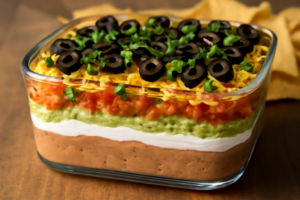
Here’s where things get really interesting for understanding the history of chili dip layered format. Cincinnati didn’t just invent a new type of chili — they invented an entirely new way of thinking about how to serve and layer food.
In Cincinnati chili restaurants, chili is served in “ways” — a stacking system that builds flavor and texture as you go:
- 2-way: Spaghetti topped with chili
- 3-way: Spaghetti, chili, and beans
- 4-way: Spaghetti, chili, beans, and onions
- 5-way: Spaghetti, chili, beans, onions, and shredded cheddar cheese
This layered philosophy wasn’t just a menu gimmick — it fundamentally changed how Cincinnatians (and eventually Midwesterners) thought about building flavor. Each layer mattered. Each element was distinct but worked in harmony with the others. When you ate a 5-way, you weren’t just eating chili. You were experiencing a carefully orchestrated composition.
That concept of intentional, beautiful layering? It directly inspired the party food format we know and love today.
From Restaurant to Casserole Dish: The Church Potluck Revolution
By the 1960s and 70s, something magical was happening in Midwestern church basements and community potlucks. Home cooks — many of them from Ohio, Kentucky, and Indiana — were adapting Cincinnati’s layered philosophy into a brand new party food format: the baked layered chili dip.
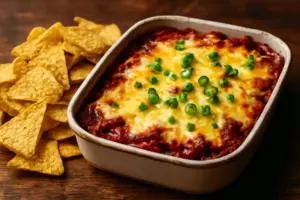
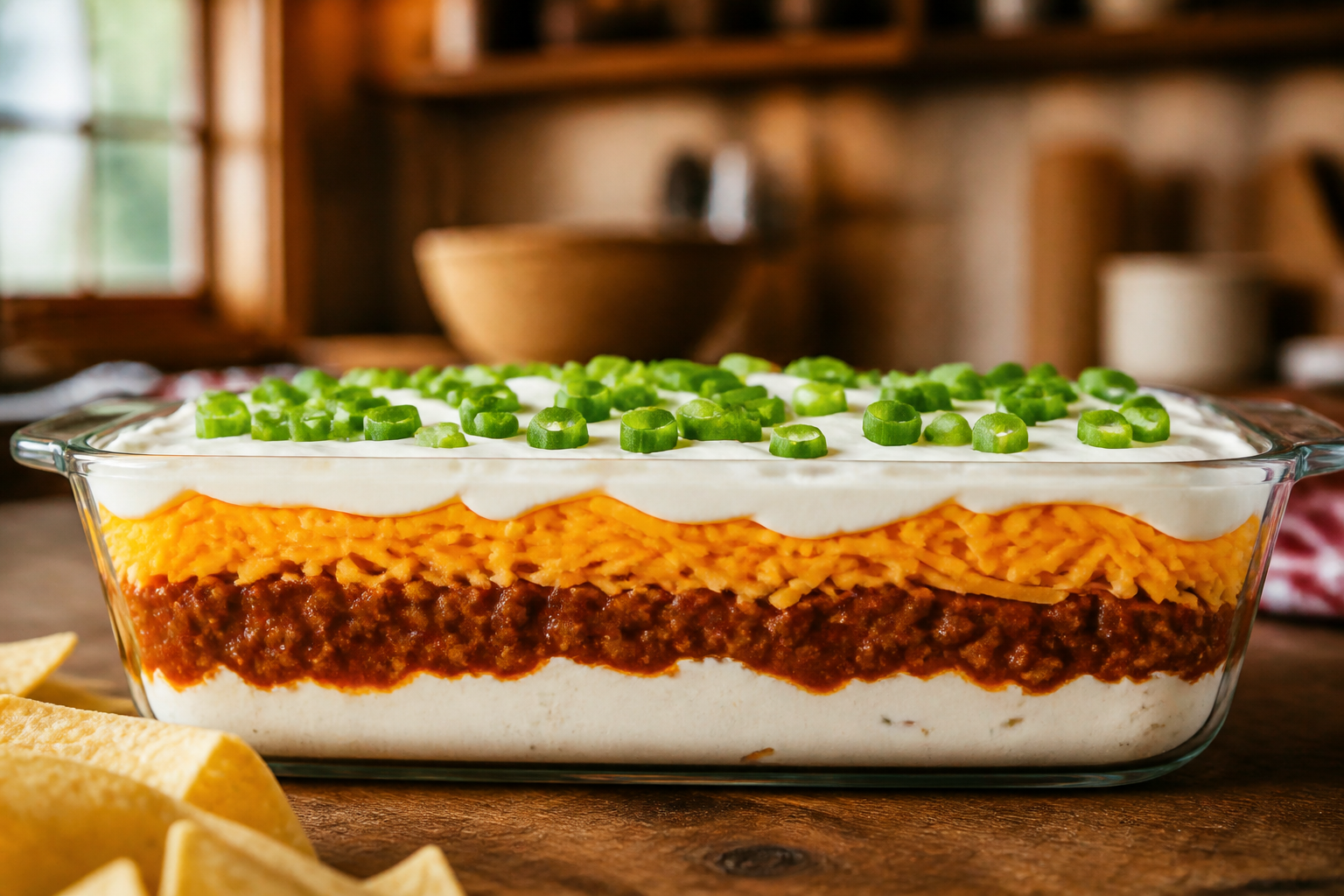
Instead of serving chili over spaghetti, these clever home cooks began layering chili into casserole dishes with cream cheese, shredded cheddar, sour cream, and diced onions, then baking everything until it was hot, bubbling, and irresistible. It was practical. It fed a crowd. And most importantly, you could make it ahead of time.
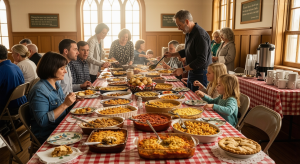
Church cookbooks from this era are absolutely packed with these recipes. Funeral receptions. Wedding showers. Sunday potlucks. These weren’t just social events — they were the original viral distribution network. Before the internet, food traveled through community gatherings and word-of-mouth recommendations. A recipe that won raves at your church? Everyone was asking for it. Someone brought it to a neighboring town for a cousin’s wedding? Now it’s spreading to the next county.
This is how layered chili dip conquered the Midwest. One casserole dish at a time.
The Cream Cheese Layer That Makes This Dip Actually Hold Together
Cream cheese is the secret structural layer that keeps layered chili dip from turning into a soupy mess by the end of the party. It’s what separates a dip that looks beautiful at hour two from one that’s still creamy and spreadable come halftime.
What works
- Creates a moisture barrier between the hot chili and the sour cream layer, so your dip doesn’t weep liquid all over the serving dish.
- Stays smooth and creamy at room temperature for hours—no weird separation or curdling, even under the broiler.
- Blends seamlessly with the chili when you soften it first, so you get even distribution instead of hard chunks guests have to dig around.
What doesn’t
- If you don’t let it soften to room temperature first, it won’t mix into the chili smoothly and you’ll end up with lumpy streaks throughout.
- Using cream cheese straight from the fridge and trying to layer it cold is a fight—it won’t spread evenly and can tear the chili layer underneath.
I learned this the hard way at my first Super Bowl party when I skipped the softening step and ended up with a lumpy, separated mess that I had to stir into oblivion—but now I always give my cream cheese thirty minutes on the counter before layering, and the dip stays picture-perfect from kickoff to the final commercial break.

About This Article

Written by Rachel Thompson. Rachel Thompson is a home cook who has spent over 10 years making an unreasonable number of dips, appetizers, and party spreads — no culinary training, just a decade of trial and error and a reputation among friends for always being asked to "bring a dip." She focuses on approachable recipes that combine bold flavors with simple techniques, making entertaining at home accessible to everyone. More about this site.
Scope and limits. Rachel is a home cook with no culinary training. Follow current food safety guidance for holding temperatures and time limits whenever you are serving people other than yourself.
Verify this against a primary source
Specifics change, and your situation may differ from the one described here. These are the authorities worth checking directly:
- FoodSafety.gov — cold holding, hot holding and the two-hour rule
- USDA FoodData Central — ingredient composition and nutrition data
- USDA Food Safety and Inspection Service — safe minimum temperatures and leftovers