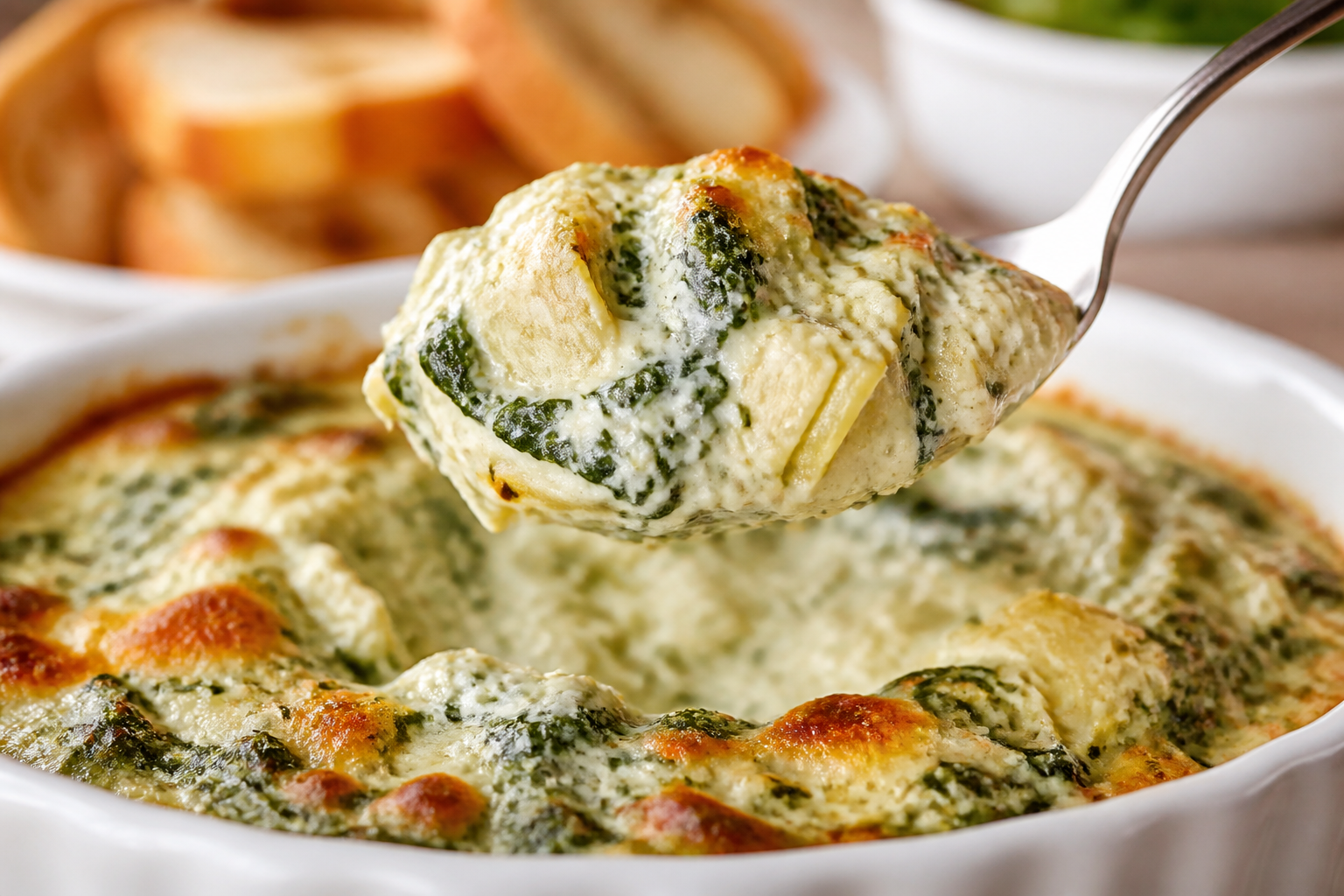

Your spinach artichoke dip comes out of the oven perfect. Golden. Bubbly at the edges. The kind of thing that makes people actually excited about vegetables. You set it on the party table at 6 p.m., and by 6:40 p.m., it has become one continuous rubbery sheet that lifts out of the dish in a single piece and snaps back at the chip like a rubber band. That is not a baking failure. That is a cheese chemistry problem, and it is completely fixable.
If you’ve experienced the stringy spinach artichoke dip disaster, you’re not alone. The good news is that once you understand what’s happening inside the cheese, you can prevent it—or rescue it if it happens again. Let me walk you through the science, the five most common causes, and the exact recipe and serving strategy that will keep your spinach artichoke dip scoopable from the moment it comes out of the oven until the last chip is gone.
Why Your Spinach Artichoke Dip Gets Stringy (The Cheese Science)
Here’s what’s happening at the molecular level. Cheese is fundamentally a protein matrix—mostly casein proteins—holding fat and water in suspension. When cheese melts, heat loosens these protein bonds, which is why it goes from solid to creamy.
But as the dip cools on your party table, those casein proteins start re-linking with each other. The problem is that they don’t just reconnect randomly. In stretchy, high-protein cheeses like mozzarella and provolone, they form long, elastic chains. Those chains are what make string cheese string. And if your spinach artichoke dip is full of these cheeses, it’s going to do the same thing—turn into one long protein network that feels rubbery and snaps back when you try to scoop it.
Two things make this worse: overbaking (which drives water out and squeezes the protein network tighter) and the absence of acid (which would normally interrupt those protein chains). This is why processed cheese product never strings—it’s full of emulsifying salts and acid that keep the casein proteins from linking up in the first place.
The Five Reasons Your Spinach Artichoke Dip Is Stringy (And How to Fix Each One)
Cause 1: Too Much Mozzarella or Provolone
These are the stretchiest cheeses by design. They’re supposed to be stringy. If your recipe relies on mozzarella as the main cheese, your dip will too.
The Fix: Cap mozzarella at 25 percent of your total cheese amount, and let cream cheese, fontina, or young gouda carry the rest of the load. Your dip will be infinitely less rubbery.
Cause 2: Pre-Shredded Bagged Cheese
That stuff is coated with potato starch and cellulose anti-caking agents. These don’t dissolve smoothly into the dip the way actual cheese does. Instead, they encourage separation, clumping, and stringiness as the dip cools.
About This Article

Written by Rachel Thompson. Rachel Thompson is a home cook who has spent over 10 years making an unreasonable number of dips, appetizers, and party spreads — no culinary training, just a decade of trial and error and a reputation among friends for always being asked to "bring a dip." She focuses on approachable recipes that combine bold flavors with simple techniques, making entertaining at home accessible to everyone. More about this site.
Scope and limits. Rachel is a home cook with no culinary training. Follow current food safety guidance for holding temperatures and time limits whenever you are serving people other than yourself.
Verify this against a primary source
Specifics change, and your situation may differ from the one described here. These are the authorities worth checking directly:
- FoodSafety.gov — cold holding, hot holding and the two-hour rule
- USDA FoodData Central — ingredient composition and nutrition data
- USDA Food Safety and Inspection Service — safe minimum temperatures and leftovers