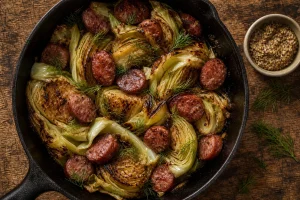
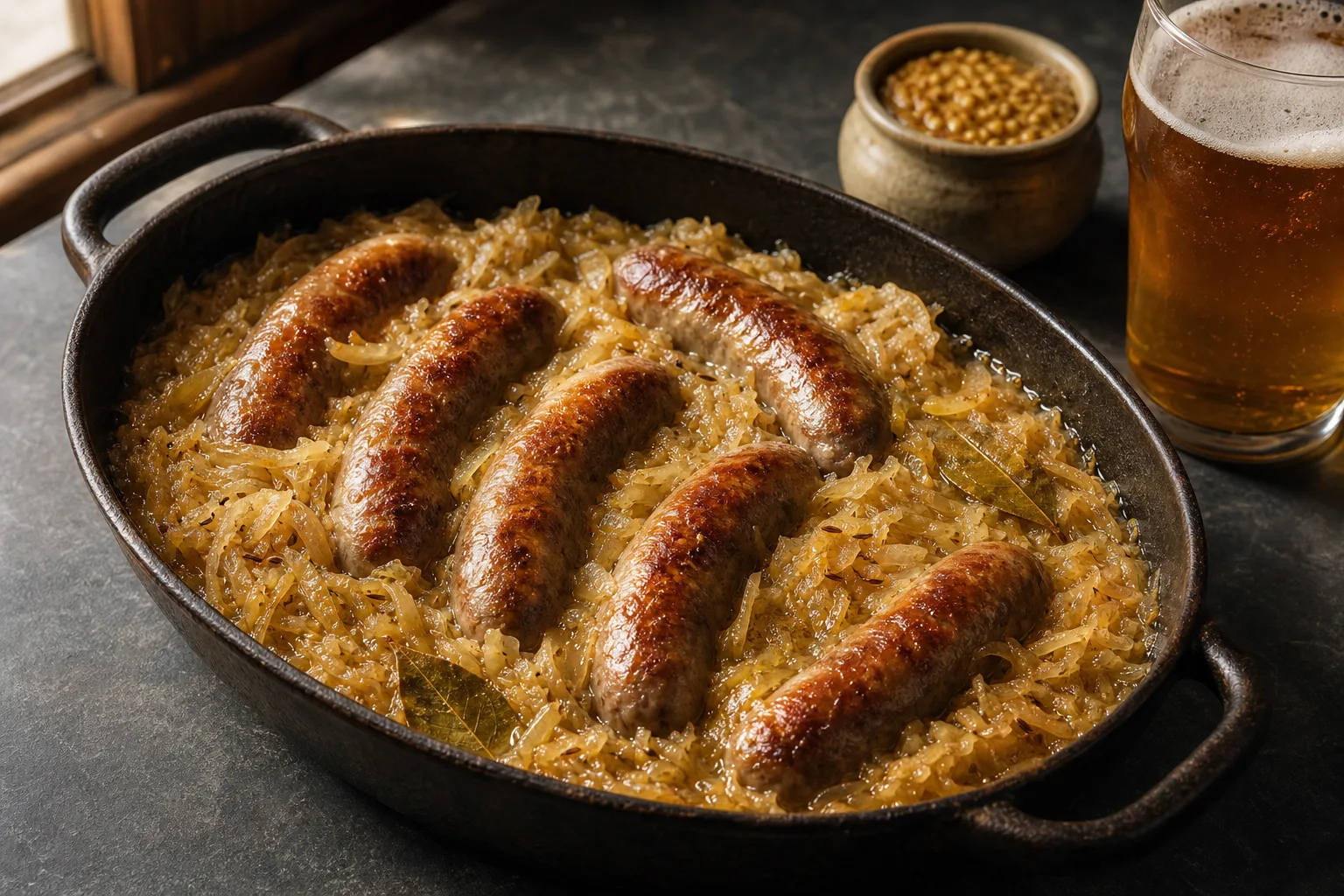

The first time I made this I used the beer that was in the door of the refrigerator, which happened to be a very hoppy IPA. What came out was aggressive in a way I could not fix at the table — sharp kraut, bitter liquid, and nothing in between them. I added butter, then sugar, then more butter, and it stayed harsh.
That is the whole problem with this dish in one sentence: sauerkraut is already sharply acidic, so the beer has to bring the sweetness that sits under it. Pour in something bitter and you have stacked two loud flavors on top of each other with no floor. A malty beer gives you the floor.
The other half of it is that these are raw brats, not smoked sausage, so they genuinely have to cook through — which is why they finish in the braise instead of getting simmered to death first. One braiser, six links, about an hour and fifteen minutes from the cutting board.
Why This Works
A malty beer — a bock, a dunkel, a Märzen, an amber lager — carries residual sweetness and bread-crust flavor that lands directly underneath the kraut’s acid and makes it read bright instead of sour. Hop bitterness does the opposite, and it concentrates as the liquid reduces rather than cooking off, so a bitter beer gets more bitter in the oven, not less.
Ingredients
This fills a 12-inch braiser or a 9×13 dish and feeds six, one brat each. Buy raw bratwurst, not the fully cooked kind.
For the Casserole
- 2 pounds raw bratwurst (about 6 links), uncooked
- 2 tablespoons neutral oil
- 1 large yellow onion, thinly sliced
- 2 pounds jarred or bagged sauerkraut, drained (about 4 cups packed)
- 1 tart apple, such as Granny Smith, peeled and coarsely grated
- 2 tablespoons packed light brown sugar
- 1 1/2 cups malty beer — bock, dunkel, Märzen, or amber lager
- 2 tablespoons whole-grain mustard
- 1 teaspoon caraway seeds, lightly crushed
- 1 bay leaf
- 3/4 teaspoon black pepper
- 2 tablespoons unsalted butter, cut into bits
To Finish
- 2 tablespoons chopped fresh parsley or dill
- 1 teaspoon apple cider vinegar, only if you rinsed the kraut
- Grainy mustard and boiled potatoes, for the table
Easy Swap
No beer, or none in the house: use 1 cup unsweetened apple cider plus 1/2 cup beef or chicken stock, and drop the brown sugar to 1 tablespoon since the cider is already sweet. This is the better choice than a nonalcoholic IPA, which has the same bitterness problem. A nonalcoholic amber or dark lager, if you can find one, works almost exactly like the real thing.
How to Make It
Prep: 25 minutes | Bake: 50 minutes | Serves: 6
- Heat the oven to 350°F. Drain the sauerkraut in a colander and press it with the back of a spoon. Taste a pinch raw — that taste decides whether you rinse it, and the section below covers how to tell.
- Heat the oil in a 12-inch oven-safe braiser or Dutch oven over medium. Brown the brats 8 minutes, turning, until two or three sides are deeply colored. They should still be raw in the middle. Do not prick the casings. Move them to a plate and keep the juices.
- Add the onion to the fat left in the pan and cook 6 minutes, until soft and starting to take color, scraping up the browned bits as it releases water.
- Stir in the drained kraut, grated apple, brown sugar, caraway, pepper, and bay leaf. Cook 2 minutes, just until it smells sweet rather than raw.
- Pour in the beer, scrape the bottom of the pan, and bring it to a simmer. Stir in the mustard. Nestle the brats into the kraut with any juices from the plate — the liquid should come about halfway up the links, so add a splash of water if it is short.
- Dot the butter over the top, cover tightly, and bake 35 minutes.
- Uncover and bake 15 minutes more, until the liquid has pulled back into a glossy band around the kraut and the tops of the brats have browned again. Check one for doneness before you stop.
- Rest 10 minutes off the heat, scatter the parsley, and taste. If the kraut was rinsed it may want the teaspoon of vinegar now.
Don’t Do This
Do not prick the casings. People do it out of habit from grilling, where it is also a mistake, and in a braise it is worse — every hole lets fat and juice run straight into the liquid, and you get pale, dry links floating in a greasy pan. And do not boil the brats in beer to cook them through first. They will be done twice over by the time the dish comes out, with gray, crumbly interiors.
Can You Make It the Night Before?
Not Fully — Here Is What You Can Prep
Make the kraut base up to three days ahead, through the end of step 5 but without the brats, and refrigerate it. Brown the brats and assemble the day you bake. Leftovers keep four days. What you cannot do is let raw bratwurst sit overnight in sauerkraut brine — the acid works on the surface of the meat like a cure, and the links come out firm and faintly rubbery instead of juicy.
A cold base straight from the refrigerator adds about 12 minutes to the covered bake, so figure 45 minutes covered and the same 15 uncovered. Spread it in the dish cold, brown the brats, and nestle them in — do not reheat the base first or you will overshoot the liquid.
The base freezes genuinely well for a month, better than a fresh cabbage version would. Fermentation has already broken down the cabbage, so freezing and thawing does not turn it slippery and translucent the way it does raw cabbage. Thaw it overnight before you build the dish.
Why an IPA Fails Here and a Bock Does Not
Strong beer sounds right for a dish this assertive, and that instinct sends people straight to an IPA. But bitterness is not the same kind of strength as sauerkraut’s acidity. They do not balance each other, they compound. You end up with two sharp notes and nothing holding the middle, which tastes thin and harsh rather than bold.
There is a mechanical reason it gets worse in the oven, too. Hop bitterness is not volatile in the way alcohol and aroma are — it does not cook off. The water around it does, so as the liquid reduces over 50 minutes, the bitterness concentrates. A beer that tasted merely assertive in the glass tastes punishing in the pan.
What you want is a beer built on malt: a bock, a dunkel, a Märzen, a Vienna or amber lager, a brown ale. They carry a faint sweetness and a toasted bread-crust flavor that reads as the floor underneath the kraut. In the beer aisle, look for a dark amber color and no hop varieties on the label. Skip a heavy stout too — roasted malt is its own bitterness, and it muddies the color to something unappetizing. A plain American lager is not the wrong answer, just a quiet one — it will not fight the kraut or sweeten it, so add an extra tablespoon of brown sugar if that is what you have.
Rinsing the Sauerkraut, and What It Costs You
Sauerkraut’s liquid is not the same problem as the water in a head of fresh cabbage. Fresh cabbage holds water inside intact cells and dumps it when heat breaks them down, which is why a fresh cabbage bake floods late and has to be roasted dry first. Kraut has already been through that — fermentation broke the cells weeks ago, and what is left is brine sitting on the outside of the shreds. Draining and pressing in a colander takes most of it out in thirty seconds, and nothing new appears in the oven.
So the decision about rinsing is not about moisture at all. It is about salt and acid. Rinse if the kraut makes you flinch when you taste it raw, which usually means a shelf-stable jar or a long-fermented deli kraut — those can be startlingly sour and salty, and in a dish with cured-adjacent sausage and reduced mustard you will overshoot. A quick pass under cold water, then press hard.
What you lose is real, though, which is why I do not rinse by default. The brine carries most of the lactic tang that makes this taste like sauerkraut rather than like warm shredded cabbage, and some of it rinses away for good. If you do rinse, hold back a tablespoon of the brine before you start and stir it in at the end, or use the teaspoon of cider vinegar in step 8 to put the brightness back.
Raw Brats That Actually Cook Through
Browning is for color and for the fat it leaves in the pan, not for cooking. Eight minutes over medium gets you a deeply colored casing and a center that is still completely raw, and that is correct — the links then spend 50 minutes in a simmering braise, which is more than enough. Cook them through in the skillet and the braise just dries them out.
The honest doneness cue is a thermometer: 160°F in the thickest part of the thickest link, pushed in from the end so you are not making a hole in the side. Without one, cut a link in half at its thickest point — the cut face should be uniformly pale and matte all the way through, with no translucent pink, and the juice should run clear. I will say plainly that the visual check is less reliable on dark, heavily spiced brats, where a little pink can persist in meat that is fully cooked. If a link reads low, cover the dish and give it another 8 minutes; the kraut will not suffer.
Rachel’s Tip
Taste the kraut raw in step 1 and match the brown sugar to it, not to the recipe. A mild refrigerated kraut needs maybe 1 tablespoon. A shelf-stable jar that makes you squint needs the full 2, sometimes a little more. I taste the pan liquid again right after the beer goes in, which is the last easy moment to adjust anything.
Questions People Ask
Does the alcohol cook off?
Not fully, and less than people expect in a covered bake — a lid condenses the alcohol vapor and returns most of it to the pan. The 15 uncovered minutes drive off more, but assume a small amount remains in the finished dish. Worth knowing if that matters to you. If you want none at all, use the apple cider and stock version above, which is a good dish on its own terms rather than a compromise.
Can I use fully cooked bratwurst instead of raw?
You can, and nothing will go wrong, but it becomes a different dish — a reheat rather than a braise, and the links give much less of themselves to the kraut. Brown them 4 minutes instead of 8 and cut the covered bake to 25 minutes, keeping the 15 uncovered. If precooked smoked sausage is what you actually want, the kielbasa and cabbage bake below is built for it.
Why does my sauerkraut casserole taste harsh?
Usually a bitter beer, an unrinsed very sour kraut, or no sweet counterweight at all. Those stack. The fix at the table is a tablespoon of butter stirred into the hot kraut and a teaspoon of brown sugar, in that order, tasting between. Fat rounds the acid off faster than sugar does.
Why apple, specifically?
Apple and sauerkraut are traditional together across German and Alsatian cooking for a practical reason: apple brings sweetness and its own mild acid at once, so it softens the kraut without flattening it the way straight sugar can. Grating it means it dissolves into the kraut instead of sitting there as fruit. A tart apple, not a sweet one — a Honeycrisp turns cloying.
About This Article

Written by Rachel Thompson. Rachel Thompson is a home cook who has spent over 10 years making an unreasonable number of dips, appetizers, and party spreads — no culinary training, just a decade of trial and error and a reputation among friends for always being asked to "bring a dip." She focuses on approachable recipes that combine bold flavors with simple techniques, making entertaining at home accessible to everyone. More about this site.
Scope and limits. Rachel is a home cook with no culinary training. Follow current food safety guidance for holding temperatures and time limits whenever you are serving people other than yourself.
Verify this against a primary source
Specifics change, and your situation may differ from the one described here. These are the authorities worth checking directly:
- FoodSafety.gov — cold holding, hot holding and the two-hour rule
- USDA FoodData Central — ingredient composition and nutrition data
- USDA Food Safety and Inspection Service — safe minimum temperatures and leftovers