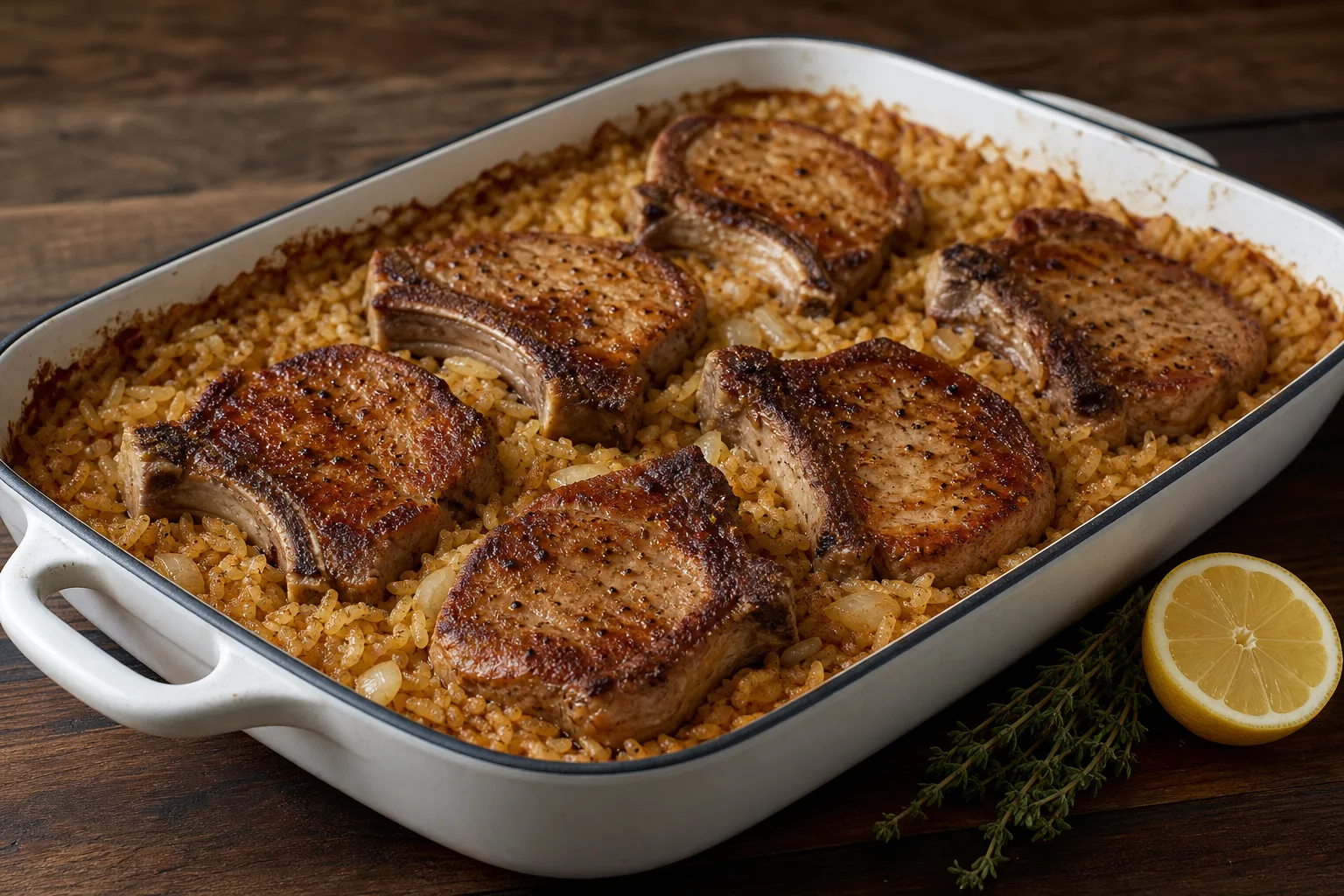

This dish has a bad reputation and it earns it honestly. The usual version is thin chops laid on raw rice, covered, and left in the oven for an hour. The rice comes out fine. The chops come out like something you could sand a table with.
The problem is arithmetic, not technique. A half-inch pork chop is cooked through in about eight minutes. Long-grain rice needs forty-five. Put them in the same dish at the same time and one of them loses, and it is always the pork.
There are two fixes and this recipe uses both. Buy chops thick enough to survive, and do not put them in until the rice is nearly done.
Why This Works
The rice bakes covered and alone for the first 35 minutes, and the seared chops go in only for the last 25. A sealed dish of rice is a steam environment, which is a gentle place for pork — it comes up to temperature slowly and holds its moisture instead of drying out over an hour of oven heat.
Ingredients
This fits a 9×13 dish or a wide shallow roaster and feeds six, one chop each.
For the Pork
- 6 bone-in center-cut pork chops, 1 to 1 1/4 inches thick
- 1 1/2 teaspoons kosher salt, for dry-brining
- 1 teaspoon black pepper
- 2 tablespoons neutral oil
For the Rice
- 3 tablespoons unsalted butter
- 2 medium yellow onions, diced small
- 4 cloves garlic, minced
- 1 1/2 cups long-grain white rice
- 3 cups chicken stock, heated
- 2 teaspoons onion powder
- 1 teaspoon dried thyme
- 1 teaspoon paprika
- 1 teaspoon kosher salt
- 1/2 teaspoon celery seed
- 2 bay leaves
- 1 tablespoon chopped parsley
Easy Swap
Thick-cut boneless pork shoulder chops are a good substitute and more forgiving than loin, because they carry more fat and connective tissue. Give them 35 minutes under the foil instead of 25. What I would not substitute is brown rice — it needs about 50 minutes on its own, and by then the chops have been in too long.
How to Make It
Prep: 20 minutes | Bake: 60 minutes | Serves: 6
- At least 45 minutes ahead — up to overnight — pat the chops dry, sprinkle both sides with the salt and pepper, and leave them uncovered on a rack in the refrigerator. This is the biggest single improvement you can make to a pork chop.
- Heat the oven to 350°F. Melt the butter in a large skillet over medium heat and cook the onions 8 minutes, until soft and coloring at the edges, then the garlic for 30 seconds.
- Stir in the rice and toast it 2 minutes, until the grains look chalky rather than translucent. Add the onion powder, thyme, paprika, salt, and celery seed for 30 seconds.
- Scrape all of it into a 9×13 dish, pour the hot stock over, tuck in the bay leaves, and stir once to level it. Cover tightly with foil and bake 35 minutes.
- Meanwhile, pat the chops dry again. Heat the oil in a heavy skillet until it just smokes and sear the chops 2 minutes per side — color, not cooking. Work in two batches; a crowded pan steams.
- At 35 minutes, pull the foil back. The rice should have absorbed most of the liquid and be nearly tender. Lay the chops on top, fat cap up, with their juices.
- Re-cover tightly and bake another 20 to 25 minutes, until the thickest part of a chop reads 140°F on an instant-read thermometer. Start checking at 20. A thermometer is the only reliable way to call it.
- Rest the dish covered for 10 minutes. The chops climb to about 145°F as it sits, the rice finishes steaming, and the pork reabsorbs juice it would lose on the plate. Pull the bay leaves and scatter the parsley.
Don’t Do This
Do not use thin chops, and do not leave the dish uncovered to brown the pork at the end. Thin chops cannot be saved by anything in this recipe. And uncovering for the last stretch is exactly how chops dry out — the sear in step 5 is where the color comes from, so there is nothing to gain from dry heat.
Can You Make It the Night Before?
Not Fully — Here Is What You Can Prep
Not as a finished dish. Pork chops reheated after a full bake go dry and stringy, and no technique gets around it. What you can do ahead is the prep: dry-brine the chops up to 24 hours out, and cook the rice base a day ahead.
If you made the rice base ahead, let it sit out for 30 minutes, add the hot stock, and give it 40 minutes covered instead of 35. A cold base takes noticeably longer to come up to a boil under the foil, and rice that starts slowly cooks unevenly.
If you end up with leftovers anyway, take the chops off the bone and slice the meat thin against the grain, kept separate from the rice. Reheat the rice with a splash of stock and lay the cold slices on top to warm through. It beats putting a whole chop back in the oven.
Thickness, Bone, and Why Boneless Loin Fails Here
An inch is the floor. At an inch to an inch and a quarter, a chop needs roughly 20 to 25 minutes in a covered dish to reach 140°F, which lines up with how long the rice needs. At half an inch it hits that temperature in under ten minutes and then keeps climbing for another fifteen.
Bone-in is better for two reasons. The bone conducts heat differently than meat and slows the rise in the thickest section, which widens the window between done and overdone. And bone-in chops come from the rib or center, so they carry a fat cap that bastes the meat.
Boneless loin chops are the most common thing in the case and the worst choice here. They are the leanest cut on the animal, they have no cap, and they are usually cut thin. If that is what you have, keep the dry brine, cut the covered time to 15 minutes, and pull them at 140°F even if the rice needs five more.
Check the Label First
A lot of supermarket pork is sold enhanced, meaning it was injected with a salt solution — the package will say something like “contains up to 12% of a solution.” That pork is already brined, and salting it again makes it taste like ham. Skip step 1 and season with pepper only.
The Rice Can Fail Independently of the Pork
Everything above is about the chops, but the rice has its own two failure modes and neither one is the pork’s fault. It comes out crunchy in places, or it comes out gummy and collapsed. Both are usually the liquid.
Two to one is the ratio this recipe uses — three cups of stock to a cup and a half of rice — and it is deliberately a little lean for a stovetop pot, because almost nothing evaporates under tight foil and the chops release juice into the dish on top of it. If you measure three and a half cups in because that is what the bag says, you will get rice that is soft on the bottom and swimming in the middle.
The stock going in hot is the other half of it. Cold stock poured over toasted rice in a cold dish has to climb to a boil before any absorption starts, and the grains at the edges of the dish get there several minutes before the grains in the middle. That is where crunchy corners and mush in the center come from. Heat it in the same pan you cooked the onions in, or in the microwave — it does not need to boil, just to be hot to the touch.
Toasting the rice in the butter for two minutes in step 3 is worth the two minutes. It firms the outside of each grain slightly, which makes the rice hold its shape through a long covered bake instead of blowing out into starch. You can taste the difference as a faint nuttiness, but the real reason to do it is texture.
If the Rice Is Gummy Anyway
Take the foil off, lift the chops onto a plate and cover them, and put the uncovered dish back in the oven for 8 to 10 minutes. Dry heat with the lid off drives off the extra moisture, and because the chops are out of the dish they are not paying for it. Fluff the rice with a fork before the chops go back on.
Why This Dish Stays Covered
The foil does two jobs. It traps the steam the rice needs to hydrate evenly, and it keeps the air around the chops humid, which slows the rate at which the surface of the meat dries and tightens.
Seal it properly. A loose tent lets steam escape and you will find undercooked rice in the corners and liquid standing in the middle. Press the foil down over the rim, and go around the handles rather than over.
If the rice is clearly still wet at 35 minutes — which happens when the stock went in cold — give it 10 more minutes uncovered, then add the chops and re-cover.
Rachel’s Tip
Lay the chops fat cap up, not down. The cap renders slowly and the fat runs down over the meat and into the rice. The other way up it renders into the bottom of the dish and the top gets nothing.
Questions People Ask
Why are my pork chops always dry in a casserole?
Because they were in the oven as long as the rice was. Lean pork goes from juicy to dry across about ten degrees, and an hour at 350°F blows straight through it. Stage the chops in late, buy them thick, and use a thermometer instead of a timer.
Can I use instant or parboiled rice?
You can, and it changes the schedule entirely. Instant rice needs about 10 minutes, so there is no point staging — sear the chops, build the rice with 2 1/2 cups of stock, lay the chops on, and bake covered 25 minutes total.
Is 145°F really safe for pork?
Yes. The USDA lowered its recommendation for whole cuts of pork to 145°F with a three-minute rest back in 2011. Pork cooked to that point is faintly pink in the center and that is correct. The 160°F habit most of us grew up with produced a generation of dry chops.
Can I use canned cream of mushroom soup like the old version?
You can, and plenty of people prefer that taste. Use one can plus 2 cups of stock in place of the 3 cups, and skip the added salt — condensed soup carries plenty. The rice comes out creamier and heavier, and you lose the toasted-grain texture.
Can I use pork tenderloin instead of chops?
You can, but it needs a different schedule, because tenderloin is even leaner than loin chops and has no bone or fat cap at all. Cut it into medallions about an inch and a half thick, sear them the same way, and add them for only the last 12 to 15 minutes. Pull them at 140°F. A whole tenderloin laid on the rice does not work — the thin tail end is dry long before the thick end is done.
About This Article

Written by Rachel Thompson. Rachel Thompson is a home cook who has spent over 10 years making an unreasonable number of dips, appetizers, and party spreads — no culinary training, just a decade of trial and error and a reputation among friends for always being asked to "bring a dip." She focuses on approachable recipes that combine bold flavors with simple techniques, making entertaining at home accessible to everyone. More about this site.
Scope and limits. Rachel is a home cook with no culinary training. Follow current food safety guidance for holding temperatures and time limits whenever you are serving people other than yourself.
Verify this against a primary source
Specifics change, and your situation may differ from the one described here. These are the authorities worth checking directly:
- FoodSafety.gov — cold holding, hot holding and the two-hour rule
- USDA FoodData Central — ingredient composition and nutrition data
- USDA Food Safety and Inspection Service — safe minimum temperatures and leftovers