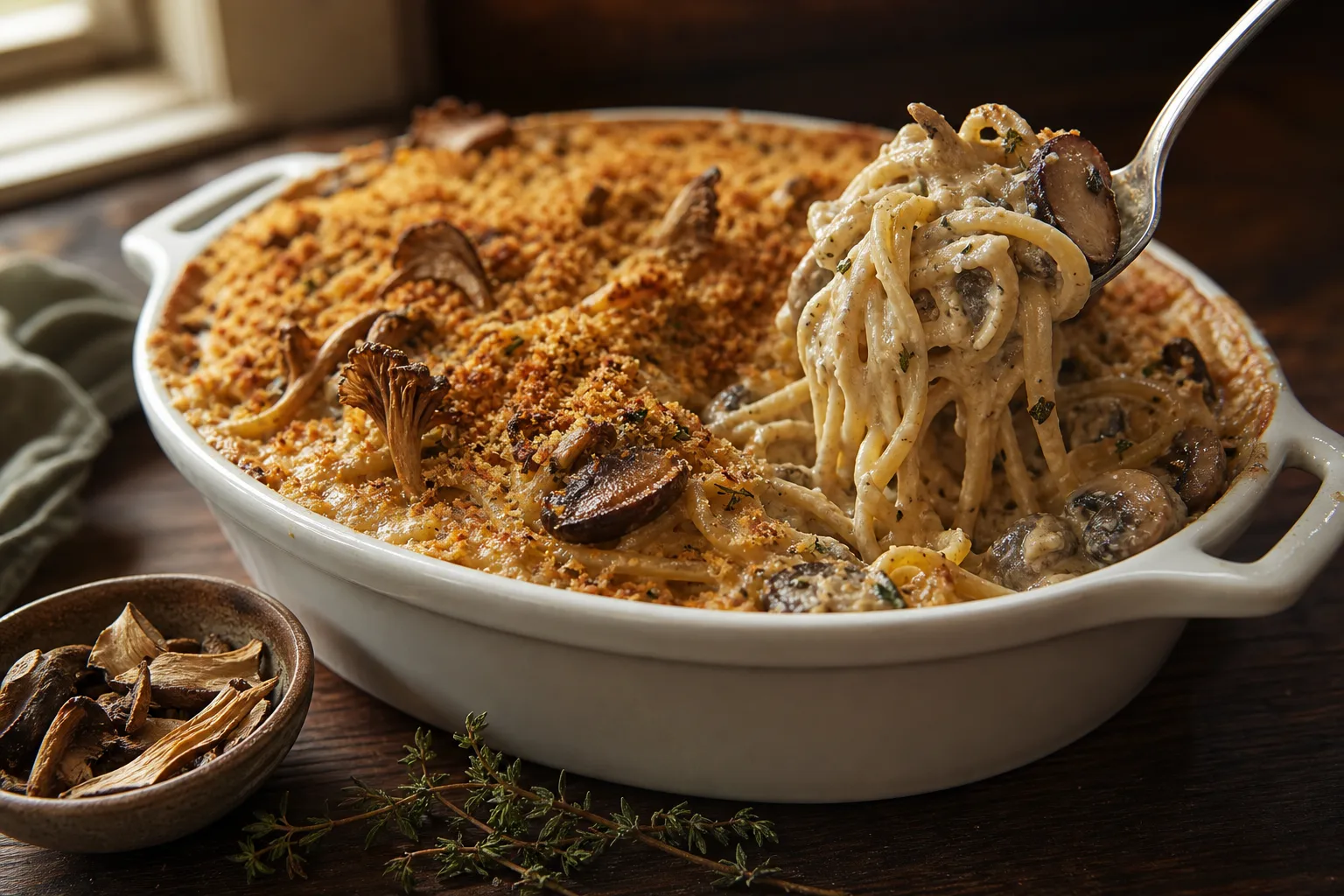

The usual vegetarian tetrazzini is chicken tetrazzini with the chicken left out. It looks right coming out of the oven and tastes like cream sauce on noodles — polite, pale, half as interesting as it should be. The chicken was doing three jobs, and only one was being the chicken.
In the original the chicken is poached and the poaching broth becomes the sauce, so the meat supplies savory depth, a little fat, and the whole liquid base. Take it out and the backbone goes with it. Mushrooms replace all three, but only as the main ingredient rather than the garnish they are in the chicken version: two pounds browned hard in batches, an ounce of dried porcini, and the dark liquid the porcini soak in.
This is not a stand-in for the original. It is darker and earthier, closer to a creamy mushroom ragu. Serve it to somebody expecting chicken tetrazzini and they will notice.
Why This Works
Browning is the whole dish. Fresh mushrooms are about ninety percent water, and in a crowded pan that water comes out and they simmer in it — gray, shrunken, tasting of almost nothing. In two batches in a hot pan with space between the pieces, the water boils off and the surfaces finally meet dry heat. That roasted flavor is what stands in for the chicken, and no later step adds it back.
Ingredients
This fills a 9×13 dish, eight generous portions. Two pounds of mushrooms sounds absurd until they cook down to a quart.
For the Mushrooms
- 1 ounce dried porcini mushrooms
- 1 1/2 cups boiling water, for soaking
- 1 pound cremini, sliced 1/2 inch thick
- 1/2 pound shiitake, stems discarded, caps quartered
- 1/2 pound oyster mushrooms, torn into strands
- 3 tablespoons unsalted butter, divided
- 1 tablespoon neutral oil
- 3/4 teaspoon kosher salt, for after browning
For the Sherry Cream Sauce
- 4 tablespoons unsalted butter
- 1 large shallot, minced
- 4 cloves garlic, minced
- 1/2 cup dry sherry (not cooking sherry)
- 1/3 cup all-purpose flour
- 2 cups strained porcini soaking liquid
- 1 cup vegetable broth
- 1 cup heavy cream
- 1 cup finely grated Parmesan
- 1 tablespoon white miso, or 2 teaspoons soy sauce
- 1 1/2 teaspoons chopped fresh thyme
- 1/4 teaspoon freshly grated nutmeg
- Zest of 1 lemon
- 1 teaspoon kosher salt
- 3/4 teaspoon black pepper
For the Pasta and the Top
- 12 ounces spaghetti or linguine
- 1 cup frozen peas, straight from the freezer
- 1 cup panko breadcrumbs
- 3 tablespoons unsalted butter, melted
- 1/2 cup grated Parmesan
- 2 tablespoons chopped flat-leaf parsley
Easy Swap
Worth knowing if you are cooking for a strict vegetarian: imported Parmigiano-Reggiano is made with calf rennet, so it does not technically qualify. Several domestic parmesan-style wedges use microbial rennet and say so on the label. Those are milder, so add an extra 2 teaspoons of miso.
How to Make It
Prep: 40 minutes | Bake: 30 minutes | Serves: 8
- Pour the boiling water over the porcini and leave them 20 minutes. Lift them out, squeeze, and chop. Strain the liquid through a paper coffee filter and stop while a tablespoon is still in the bowl — the grit settles there. You want 2 cups.
- Heat the oven to 375°F. Melt half the butter with the oil in your largest skillet over medium-high. Add half the mushrooms in as close to one layer as you can and leave them alone 5 minutes. Stir and cook 4 minutes more, until the liquid has gone and the edges are deep brown. Salt them, scrape them out, repeat.
- Meanwhile, boil the pasta 3 minutes less than the package time for al dente — it should still show a pale core. Drain, rinse under cool water, toss with a little oil.
- In the same skillet, melt the 4 tablespoons of butter over medium. Cook the shallot 2 minutes, the garlic 30 seconds, the chopped porcini 1 minute. Add the sherry and reduce until the pan is nearly dry, about 3 minutes.
- Sprinkle the flour over the top and stir constantly 90 seconds. Add the porcini liquid and broth in three additions, whisking smooth each time, then the cream. Simmer 5 minutes, until it coats a spoon.
- Off the heat, whisk in the Parmesan and miso, then the thyme, nutmeg, lemon zest, salt, and pepper. Taste it and be hard on it — it should be faintly too salty and too lemony alone, because a pound of pasta is about to flatten it.
- Fold in the mushrooms, pasta, and peas with tongs and a light hand, holding back a cup of mushrooms. Transfer to a buttered 9×13 dish and scatter those over the top, where they stay crisp.
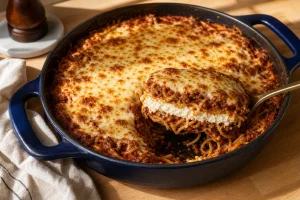
- Spread the panko, tossed with the melted butter, Parmesan, and parsley, over the top. Bake 25 to 30 minutes, until the crust is deep golden and the sauce bubbles at the edges. Rest 10 minutes — the sauce sets as it cools.
Don’t Do This
Do not salt the mushrooms as they go into the pan, and do not brown all two pounds at once. Salt pulls water out of the cells immediately, and both mistakes end the same way: a flooded skillet and no browning anywhere.
Can You Make It the Night Before?
Yes — Assemble Up to 24 Hours Ahead
Assemble up to 24 hours ahead with two changes: pull the pasta 4 minutes early instead of 3, and let the sauce cool 20 minutes before the pasta goes in. Hold back the crumb topping and the mushrooms meant for the top, and add 15 minutes to the bake.
Folding hot sauce into drained pasta that is then refrigerated cooks the pasta a third time, on the counter, where you are not watching. By morning the strands are soft before the oven has done anything.
A cold 9×13 wants 45 minutes on the counter and 45 minutes at 375°F — check at 40 and tent it with foil if the crust browns first. It freezes better than the chicken version: assemble untopped in a foil pan, freeze up to two months, thaw overnight, then top and bake 50 minutes. Leftovers keep four days, reheated covered at 300°F.
Three More Things That Keep It From Tasting Thin
A mix of varieties, not two pounds of one thing. Cremini give body and the most browning per dollar. Shiitake caps stay firm and chewy through a 30-minute bake, the most meat-like texture available here — discard the stems, which stay woody. Oyster mushrooms tear into strands that catch sauce.
Dried porcini and their soaking liquid, which replace the broth. Most vegetarian versions skip this and it is the part that matters most. Drying concentrates the savory compounds, so an ounce carries more weight than its size suggests, and the soaking water comes out dark brown and meaty. Use it for two of the three cups of liquid — vegetable broth alone tastes of carrot and celery.
Miso or soy sauce, and more sherry than you think. A tablespoon of white miso off the heat adds fermented depth without reading as miso. And the sherry matters more here, not less: in the chicken version it is a top note over roast poultry, but with no poultry it is the brightness that keeps cream and mushrooms from collapsing into one brown note.
Alternative Pastas and Whole Grains: What Survives a Bake
The people most likely to want a meatless tetrazzini are also the most likely to be cooking with whole wheat, gluten-free or legume pasta, which is the hard version of this problem. The three-minutes-early rule in the original assumes durum semolina, where a strong gluten network holds the strand together while the starch inside hydrates in the oven.
Whole wheat is the best of the alternatives. The bran cuts through the gluten network, so there is less structure, but whole wheat also drinks more water, so it does not go slack the way you would expect — it goes from firm straight to grainy, with a short window in between. Pull it 2 minutes early rather than 3, since it needs longer in the water to stop tasting raw. The nutty flavor is a real upgrade with mushrooms.
Brown rice pasta works, with adjustments. There is no gluten at all; the strand holds on a starch gel, and that gel keeps hydrating and softening after the pasta leaves the water — gluten-free pasta is not finished when you drain it. Pull it 4 minutes early, rinse in cold water until the strands are cool to the touch, and bake at 400°F for 20 minutes instead of 375°F for 30. Less time in hot liquid is the only real lever.
Chickpea pasta is usable if you pick the shape. It holds for the first 20 minutes, better than its reputation, then gives up fast and turns pasty rather than mushy. Strands fray into a cloudy sauce, so use rotini or penne, pulled 4 minutes early. The bean flavor fights cream, though mushrooms and sherry mask it well.
Red lentil pasta does not work in a casserole. I have tried twice and both times it disintegrated — not softened, disintegrated — into an orange mush that colored the sauce and tasted like soup. Corn-and-quinoa blends fail the other way, going brittle and fracturing into short chalky bits.
Rice is a real option, and which rice is the whole question. White rice drinks the sauce and offers no textural contrast; the result reads like a risotto that went wrong. A wild rice blend is a genuinely good match rather than a compromise: wild rice is not rice at all but the seed of an aquatic grass, and its tough hull stays chewy through 45 minutes of cooking and a bake after that.
To do it, cook 1 1/2 cups of a wild rice blend in the 2 cups of strained porcini liquid plus water to cover, until the grains are two-thirds done and still firm, about 30 minutes. Drain, use broth for all 3 cups of sauce liquid, and cut the cream to 3/4 cup, since rice absorbs more than pasta.
The Gluten-Free Mistake to Avoid
Do not cook gluten-free pasta to the package time, and do not skip the cold rinse. Both are the same error: assuming the pasta stops cooking when the water stops. It keeps absorbing on the counter, so a box cooked to dead-on al dente is past its best before the sauce is mixed.
Rachel’s Tip
Cut the mushrooms thicker than feels right — a full half inch on the cremini, shiitake caps in quarters, oyster mushrooms torn with your fingers. The first two times I made this I sliced everything thin and it vanished into the sauce; what came out was mushroom-flavored cream with noodles in it.
Questions People Ask
Can I just leave the chicken out of a regular tetrazzini recipe?
You can, and that is the version that tastes thin. Adapting a recipe you own, the minimum changes are: double the mushrooms and brown them in two batches, replace two cups of the liquid with the soaking water from an ounce of dried porcini, add a tablespoon of white miso off the heat, and keep the sherry.
Can I use only white button mushrooms?
Yes. They brown perfectly well and the technique is identical. What you lose is textural range, since shiitake chew and oyster strands are doing real work and buttons alone give one texture throughout. Compensate by cutting them extra thick and going up to an ounce and a half of porcini.
What can I use instead of sherry?
Dry vermouth is closest, then dry white wine, both reduced until the pan is nearly dry. Without alcohol, use 1/3 cup of broth plus 2 teaspoons of sherry vinegar off the heat and an extra half teaspoon of lemon zest. Do not simply skip it — the acid is the only thing between you and a very heavy brown casserole.
How do I make the whole thing gluten-free?
Two changes. For the sauce, skip the roux and whisk 3 tablespoons of cornstarch into the cold porcini liquid before it goes in the pan, or use a measure-for-measure gluten-free blend in place of the flour. For the pasta, brown rice is the most reliable choice. Use gluten-free panko on top, and check the miso, since some brands contain barley.
About This Article

Written by Rachel Thompson. Rachel Thompson is a home cook who has spent over 10 years making an unreasonable number of dips, appetizers, and party spreads — no culinary training, just a decade of trial and error and a reputation among friends for always being asked to "bring a dip." She focuses on approachable recipes that combine bold flavors with simple techniques, making entertaining at home accessible to everyone. More about this site.
Scope and limits. Rachel is a home cook with no culinary training. Follow current food safety guidance for holding temperatures and time limits whenever you are serving people other than yourself.
Verify this against a primary source
Specifics change, and your situation may differ from the one described here. These are the authorities worth checking directly:
- FoodSafety.gov — cold holding, hot holding and the two-hour rule
- USDA FoodData Central — ingredient composition and nutrition data
- USDA Food Safety and Inspection Service — safe minimum temperatures and leftovers