
The first several times I made this I did what the recipes said and covered the dish with foil. What came out was pale, gray, and sitting in half an inch of its own liquid. Not bad exactly, just sad — cabbage soup with sausage in it, served on a plate.
A head of cabbage is overwhelmingly water. Trap that water under foil and it has nowhere to go, so you steam the cabbage into limpness and dilute everything the kielbasa brought. Leave the dish open and that same water leaves as steam, the cut edges brown, and what is left tastes concentrated and faintly sweet.
So this version never gets covered, and the cabbage goes into a hot oven on its own before the sausage joins it. One head of cabbage, one ring of kielbasa, about an hour to the table.
Why This Works
Roasting the cabbage uncovered at 425°F before anything else touches it drives off most of its water and browns the cut edges. Everything after that is assembly. By the time the sausage and the mustard cream go in, the cabbage has already given up the liquid that would otherwise have ruined the dish.
Ingredients
This fills a 12-inch skillet or a 9×13 dish and feeds six. The stock is low-sodium on purpose — see below.
For the Bake
- 1 medium head green cabbage (about 2 1/2 pounds), cut into 1 1/2-inch chunks
- 1 1/2 pounds smoked kielbasa, cut into 1/2-inch coins
- 3 tablespoons olive oil
- 1 large yellow onion, cut into thick half-moons
- 1 tart apple, such as Granny Smith, cored and cut into 1/2-inch dice
- 3 cloves garlic, minced
- 1 teaspoon caraway seeds, lightly crushed
- 3/4 teaspoon black pepper
- 1 cup low-sodium chicken stock
- 2 tablespoons whole-grain mustard
- 1/2 cup sour cream, at room temperature
- 1 tablespoon apple cider vinegar
- 2 tablespoons chopped fresh dill
For the Top
- 1 cup coarse rye breadcrumbs from stale rye bread
- 2 tablespoons unsalted butter, melted
- 3 ounces Gruyère or Swiss cheese, grated (optional)
Easy Swap
Any smoked sausage works — andouille brings heat, a smoked bratwurst is milder. Savoy cabbage is excellent and roasts faster, so check it at 18 minutes. Red cabbage tastes right but bleeds purple into the sour cream, and the dish comes out the color of a bruise.
How to Make It
Prep: 20 minutes | Bake: 45 minutes | Serves: 6
- Heat the oven to 425°F. Toss the cabbage, onion, and apple with the olive oil, caraway, and pepper on a large sheet pan. Do not salt it. Spread the pieces out so none are stacked.
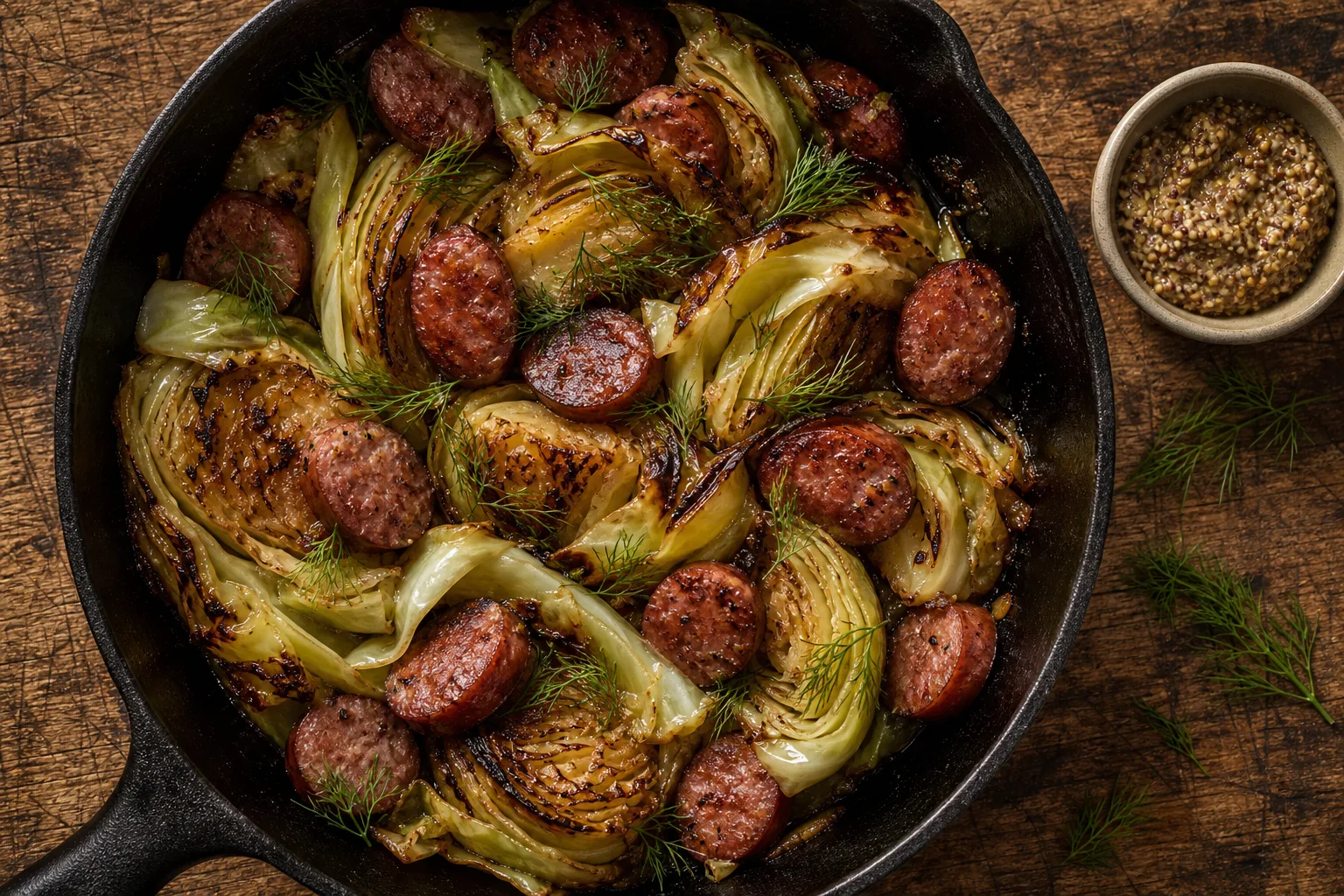
- Roast 25 minutes, turning once halfway. You want browned, slightly charred edges and cabbage shrunk by about a third. Pale cabbage means the pan was crowded.
- While that roasts, brown the kielbasa coins in a dry skillet over medium-high heat, about 7 minutes, until both cut faces have color. Move them to a plate, leaving the rendered fat in the pan.
- Add the garlic to that fat for 30 seconds, then the stock. Scrape the pan and reduce by half, 3 to 4 minutes. Off the heat, whisk in the mustard, then the sour cream.
- Taste the sauce, then taste a coin of the kielbasa on its own. The sausage is doing most of the seasoning, so adjust the sauce against it, not on its own terms.
- Combine the roasted vegetables and the sausage in the skillet or a 9×13 dish, pour the sauce over, and fold together. Toss the breadcrumbs with the melted butter and scatter them over the top with the cheese.
- Bake uncovered 20 minutes, until the crumbs are deep golden and the sauce bubbles.
- Off the heat, spoon the cider vinegar over the top and scatter the dill. The vinegar is not optional — it keeps a dish this rich from tasting heavy. Rest 10 minutes.
Don’t Do This
Do not cover the dish with foil at any stage, and do not use a bag of pre-shredded coleslaw mix. The foil traps the water you spent 25 minutes driving off. The shredded mix is cut far too fine to stay firm, and it collapses into strands within ten minutes in the oven.
Can You Make It the Night Before?
Yes — Assemble Up to 24 Hours Ahead
Roast the cabbage and brown the sausage up to two days ahead and refrigerate them separately. Make the sauce the day you bake. Fully assembled overnight it still works, but the crumbs go soft and the cabbage loses the chew that was the point — add 10 minutes to the bake and hold the crumbs back until the last 12 minutes.
The roasted cabbage keeps better than almost any other roasted vegetable I store. It firms up cold and reheats without going to mush, because the water is already gone.
The sauce is the part that will not wait. Sour cream whisked into reduced stock splits if you hold it hot, and it goes grainy after a night in the refrigerator. It takes four minutes to make. Make it fresh.
I would not freeze this. Cabbage that has been frozen and thawed turns translucent and slippery, and the sour cream separates on top of that. Leftovers keep three days covered and reheat best spread out in a skillet, not a microwave.
Smoked Sausage Is Already Seasoned For You
Kielbasa is cured, which means it was salted before you bought it, and salted at a level meant to stand on its own as a slice of sausage. Then it renders that salt into the dish along with its fat. A pound and a half seasons three pounds of vegetables almost completely.
That is why the cabbage goes into the oven bare. Salting cut cabbage is the standard way to pull water out of it, and in any other recipe I would do exactly that. Here it stacks on top of the sausage, and the result is harsh in a way you cannot undo once the sauce is in.
It is also why the stock is low-sodium. Regular stock reduced by half, plus cured sausage, plus mustard, is three salty things in one pan. If low-sodium is all you have in a carton you do not want to open, use water and an extra teaspoon of mustard — it works better than you would expect.
Worth Knowing
Fresh kielbasa — the pale, uncured kind sometimes labeled white kielbasa — is a different ingredient. It is raw, much less salty, and it needs actual salt in the dish. Brown it all the way through in step 3 and season the sauce as you normally would.
Cutting Cabbage So It Roasts Instead of Steaming
Chunks, not shreds, and bigger than feels right — about an inch and a half. Quarter the head through the core, cut the core out, then cut across the quarters. Some pieces fall apart into leaves and some stay as wedges, and that mix is what you want: the leaves char, the wedges stay sweet and firm.
Space matters more than size. Cabbage on a crowded pan steams itself even at 425°F, and you will know because it comes out uniformly pale. One large sheet pan per medium head. Two pans beat one crowded one.
Buying and Browning the Kielbasa
Most supermarket kielbasa is sold as a cooked, smoked ring, which is what this recipe is built on. It is already safe to eat cold, so browning it is purely about flavor and about getting the fat out of the casing and into the pan where you can use it.
Coins, about half an inch. Thinner than that and they curl into cups and dry out at the edges; much thicker and they do not get enough surface area on the cut faces to brown properly. Cut them straight across rather than on a bias — a bias cut looks better on a board but gives you a thin tapered end that burns while the middle is still pale.
Brown them in a dry skillet, with no oil at all. There is more than enough fat in the sausage and it starts rendering within the first minute. Adding oil just means you end up with more grease than the dish can absorb, and you will be pouring some off. Medium-high heat, one layer, and leave them alone for the first three minutes so the cut face actually takes color.
Turkey Kielbasa
Turkey kielbasa works, but it behaves differently in two ways worth planning for. It renders almost no fat, so you will need an extra tablespoon of butter in the pan before the garlic goes in. And it is often saltier than pork kielbasa to compensate for the missing fat, so taste it in step 5 before you add anything else.
Rachel’s Tip
The rendered fat left in the skillet after browning the kielbasa is the best-tasting thing in this recipe. Use it for the garlic and the stock as written, and if you want to go further, hold back a tablespoon of the olive oil in step 1 and toss the cabbage in warm sausage fat.
Questions People Ask
Why is my kielbasa and cabbage bake watery?
Either it was covered, or the cabbage went in raw. Those are the only two causes I have run into. Uncovered roasting first is the fix. If you are already looking at a watery dish, pour the liquid into a skillet, reduce it hard for five minutes, and pour it back.
Can I skip the pre-roasting step?
You can, but you will have a different dish. Raw cabbage baked in sauce for 45 minutes comes out soft and mild, closer to a braise, and much wetter. If that is what you want, cut the stock to 1/2 cup and bake uncovered for 50 minutes.
Does this work in a slow cooker?
Not well. A slow cooker is a sealed, moist environment, which is the opposite of what cabbage needs — you get the gray soup version. If you want hands-off, roast the cabbage as written and hold the finished bake warm on low for up to two hours.
Can I add potatoes?
Yes, and it is a good addition. Use a pound of baby potatoes, halved, and add them to the sheet pan in step 1 — they need the same 25 minutes. You may want an extra 1/4 cup of stock, since potatoes absorb rather than release.
What do I do with the leftovers?
Three days in the refrigerator, and the best reheat is a hot skillet with the lid off, spread in a thin layer, until the edges crisp again. A microwave steams it and undoes the texture you worked for. It is also genuinely good cold, chopped smaller, as a filling for a rye sandwich with extra mustard.
About This Article

Written by Rachel Thompson. Rachel Thompson is a home cook who has spent over 10 years making an unreasonable number of dips, appetizers, and party spreads — no culinary training, just a decade of trial and error and a reputation among friends for always being asked to "bring a dip." She focuses on approachable recipes that combine bold flavors with simple techniques, making entertaining at home accessible to everyone. More about this site.
Scope and limits. Rachel is a home cook with no culinary training. Follow current food safety guidance for holding temperatures and time limits whenever you are serving people other than yourself.
Verify this against a primary source
Specifics change, and your situation may differ from the one described here. These are the authorities worth checking directly:
- FoodSafety.gov — cold holding, hot holding and the two-hour rule
- USDA FoodData Central — ingredient composition and nutrition data
- USDA Food Safety and Inspection Service — safe minimum temperatures and leftovers