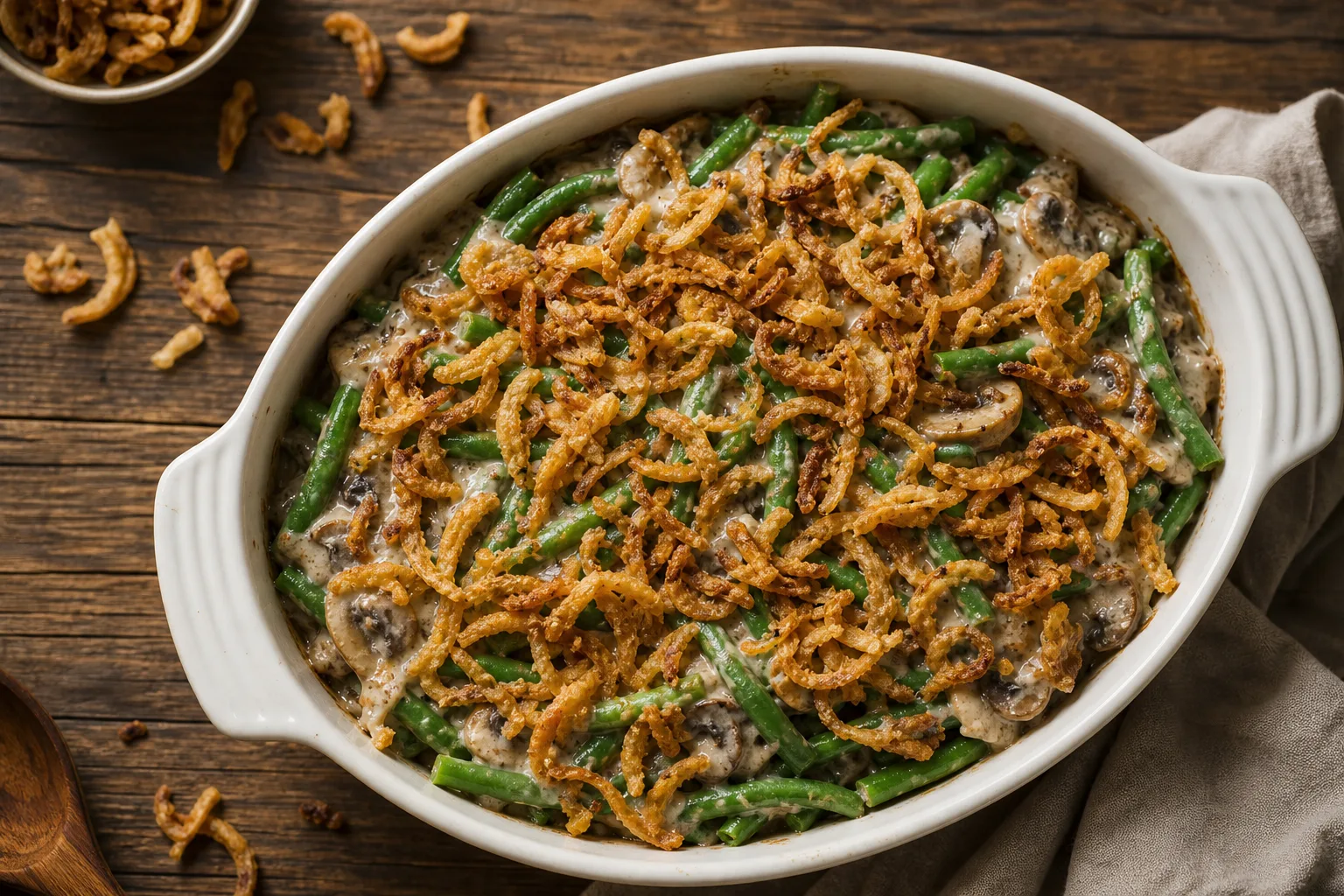

The version most of us grew up with comes from a can of condensed soup, and honestly, it works. But it also tastes like a can of condensed soup — a little gluey, a little gray, with beans that gave up somewhere around the second hour of the oven.
This is the from-scratch version I now make every November. The sauce is a real mushroom cream sauce that takes about twelve minutes. The beans stay bright and snappy because they get blanched and shocked instead of boiled into submission. And the fried onions on top stay crunchy, because they go on at the right moment instead of the beginning.
Why This Works
Blanching the beans for exactly four minutes and then dunking them in ice water locks in both color and bite. From that point on the beans only ever get warmed, never cooked again — so a 35-minute bake can’t turn them to mush.
Ingredients
This makes a 9×13 dish, which is roughly ten holiday-sized side portions or eight if your family treats it as a main event.
For the Casserole
- 2 pounds fresh green beans, ends trimmed, snapped into 2-inch pieces
- 4 tablespoons unsalted butter
- 1 pound cremini mushrooms, sliced thin
- 1 medium yellow onion, diced small
- 3 cloves garlic, minced
- 1/4 cup all-purpose flour
- 1 1/2 cups whole milk, warmed
- 1 cup heavy cream
- 1 teaspoon soy sauce
- 1/2 teaspoon freshly grated nutmeg
- 1 1/2 teaspoons kosher salt, plus more for the blanching water
- 1/2 teaspoon black pepper
For the Topping
- 6 ounces store-bought crispy fried onions, or 2 cups homemade
- 1/2 cup grated Parmesan (optional, but good)
Easy Swap
No cremini? Plain white button mushrooms work and cost less. What you can’t swap in is canned mushrooms — they bring water and a tinny flavor, and the whole point here is the browning you can’t get from a can.
How to Make It
Prep: 25 minutes | Bake: 35 minutes | Serves: 8 to 10
- Bring a large pot of heavily salted water to a boil and set a big bowl of ice water next to the stove. Boil the green beans for exactly 4 minutes, then move them straight into the ice water. Once they’re cold, drain them and spread them on a towel to dry.
- Melt the butter in a large skillet over medium-high heat. Add the mushrooms in a single layer and do not stir for three minutes — you want them browned, not steamed. Then stir and cook another 5 minutes until they’ve given up their liquid and it has cooked away.
- Add the onion and cook 4 minutes until soft, then the garlic for 30 seconds more.
- Sprinkle the flour over everything and stir constantly for 90 seconds. It will look like wet sand. That’s correct.
- Pour in the warm milk slowly, whisking the whole time, then the cream. Bring it to a bare simmer and cook 4 to 5 minutes until it coats the back of a spoon. Stir in the soy sauce, nutmeg, salt, and pepper. Taste it — it should taste slightly too salty on its own, because two pounds of beans are about to dilute it.
- Fold the dried green beans into the sauce and transfer everything to a buttered 9×13 baking dish.
- Bake at 375°F for 25 minutes, until the edges are bubbling.
- Scatter the fried onions and Parmesan over the top and bake another 8 to 10 minutes, just until the onions are deep golden. Let it sit 10 minutes before serving.
Don’t Do This
Do not use frozen green beans straight from the bag without thawing and drying them. They carry a surprising amount of water, and it will pool in the bottom of the dish and thin your sauce into soup.
Can You Make It the Night Before?
Yes — Assemble Up to 24 Hours Ahead
Assemble it completely through step 6, cover, and refrigerate up to 24 hours. Hold the fried onions back until the last 10 minutes of baking — if they go on cold and bake the whole time, they turn to soft brown paste.
Pull the dish out of the refrigerator about 40 minutes before it goes in the oven. A fridge-cold 9×13 dish of dairy sauce needs roughly 10 extra minutes of bake time, and going straight from cold into a 375°F oven is also how glass dishes crack.
The sauce will look thick and a little set when it comes out of the fridge. That’s fine. It loosens the moment it warms up.
If you want to get further ahead than a day, blanch the beans up to three days early and keep them in a zip-top bag with a paper towel in it. The sauce is best made the day before at the earliest, because flour-thickened dairy sauces get grainy after about 48 hours.
How to Tell When It’s Actually Done
Bubbling at the edges is the signal, not browning on top. Because the onions go on late, the surface won’t give you much information. Look at the corners of the dish — you want to see the sauce actively bubbling up, not just steaming.
If the center still looks slack when the edges are going, give it another 5 minutes. A 9×13 dish of cold-started casserole heats from the outside in, and the middle is always last.
Making the Fried Onions Yourself
The canned ones are genuinely good and I use them most years. But if you want to make them, slice two medium onions paper-thin, toss them in flour seasoned with salt, and fry them in a half-inch of neutral oil at 350°F in small batches until they’re the color of a brown paper bag. Drain on a rack, not paper towels, or the bottoms go soft.
They keep three days in an airtight container at room temperature. Don’t refrigerate them — they pick up moisture and lose the snap.
Worth Knowing
Homemade fried onions are about 40% larger in volume than the canned equivalent by weight, so 2 cups homemade is roughly right for a 6-ounce can.
Reheating Leftovers Without Ruining Them
The oven is the only good answer here, and it needs to be covered. Put the leftovers in an oven-safe dish, lay foil over the top, and heat at 325°F for about 20 minutes. The foil keeps the sauce from splitting and stops the beans drying into little green twigs.
The onions will have gone soft overnight no matter what you do — they sat on wet sauce for twelve hours. Don’t try to crisp the old ones back up. Pull the foil off for the last 5 minutes and scatter a fresh handful over the top instead. A 6-ounce can is enough for the original casserole plus two rounds of leftovers, which is the actual reason I buy the big one.
The microwave works if you’re reheating a single portion and you’re not precious about it, but go at 50% power in one-minute bursts. Full power splits a flour-thickened cream sauce fast, and you’ll get a greasy layer on top that won’t stir back in.
Doubling It for a Bigger Crowd
Two 9×13 dishes, not one enormous roasting pan. This is the mistake I made the first Thanksgiving I hosted more than eight people. A deeper casserole doesn’t bake proportionally longer — it bakes badly, because the center is insulated by everything around it while the edges keep cooking. I ended up with scorched corners and a lukewarm middle.
If you genuinely only have one oven, stagger them: the second dish can sit assembled on the counter while the first bakes, and it’ll be closer to room temperature when its turn comes, which actually shortens its bake time by about 5 minutes.
The sauce is the part that scales awkwardly. Doubling a roux-based sauce in a single pan takes noticeably longer than twice as long to thicken, because you’ve doubled the volume without doubling the surface area it evaporates from. Use your widest pan, and judge it by the spoon-coating test rather than the clock.
Rachel’s Tip
The teaspoon of soy sauce is the thing people always ask about. You won’t taste soy sauce — you’ll taste mushrooms that taste more like mushrooms. It’s doing the same job that canned condensed soup does with additives, just honestly.
Questions People Ask
Can I use canned green beans instead?
You can, but skip the blanching step entirely and cut the bake time to 20 minutes before the onions go on. Canned beans are already fully cooked and soft, so the texture won’t be snappy no matter what you do. Frozen is a much better shortcut than canned here.
Why is my green bean casserole watery?
Almost always undried beans. Blanched beans hold a lot of surface water, and frozen beans hold even more. Spread them on a clean towel and pat them properly dry before they go into the sauce. The second most common cause is undercooked mushrooms that release their liquid in the oven instead of in the pan.
Can I freeze it?
Not well. Flour-and-dairy sauces split when they thaw, and the beans go limp. If you need freezer-friendly, freeze the mushroom sauce on its own for up to two months and blanch fresh beans the day you serve it.
Can I make this in a slow cooker instead?
You can, and it’s a reasonable move when the oven is full on Thanksgiving, but understand the trade. Build the sauce on the stove as written, fold in the blanched beans, and hold it on low for up to two hours. What you lose is the baked top — there’s no browning and no bubbling edge, so it reads more like creamed green beans than a casserole. Add the fried onions in the serving dish at the very end, never in the cooker, where steam turns them to paste within minutes.
Do I have to blanch the beans first?
If you want them bright and with some bite, yes. You can skip it and just bake raw beans in the sauce for about 55 minutes, but they come out olive-colored and soft — essentially the canned-soup texture you were trying to avoid.
About This Article

Written by Rachel Thompson. Rachel Thompson is a home cook who has spent over 10 years making an unreasonable number of dips, appetizers, and party spreads — no culinary training, just a decade of trial and error and a reputation among friends for always being asked to "bring a dip." She focuses on approachable recipes that combine bold flavors with simple techniques, making entertaining at home accessible to everyone. More about this site.
Scope and limits. Rachel is a home cook with no culinary training. Follow current food safety guidance for holding temperatures and time limits whenever you are serving people other than yourself.
Verify this against a primary source
Specifics change, and your situation may differ from the one described here. These are the authorities worth checking directly:
- FoodSafety.gov — cold holding, hot holding and the two-hour rule
- USDA FoodData Central — ingredient composition and nutrition data
- USDA Food Safety and Inspection Service — safe minimum temperatures and leftovers