
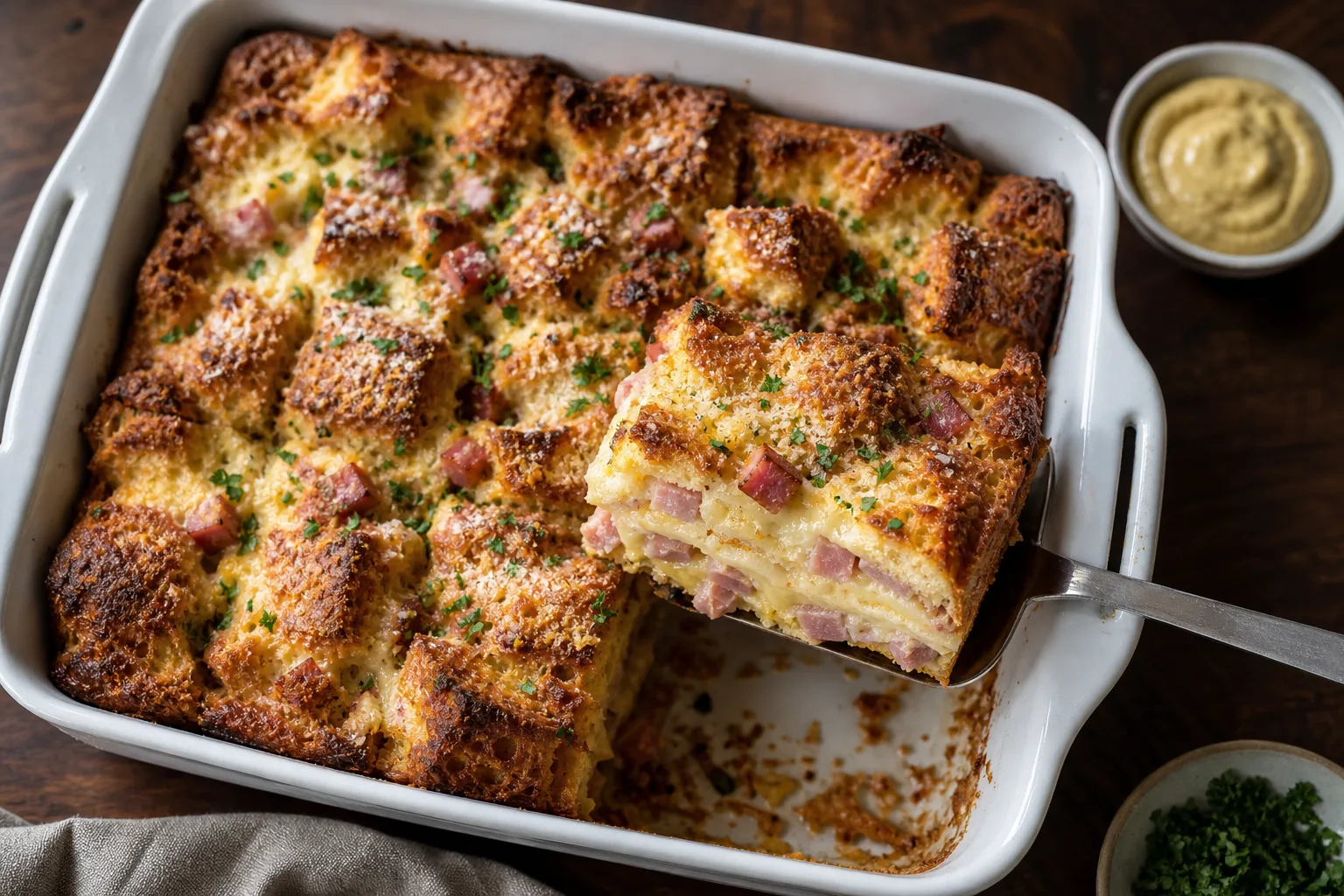

A strata and a breakfast casserole get talked about as the same thing, and they are not. A casserole is bread cubes tossed with everything else and flooded with custard — a single uniform material once it bakes. A strata is built in flat layers, like a lasagna, and the whole point is that you can still see them on the cut edge.
That difference changes the timing more than people expect. A cube absorbs custard from six faces. A half-inch slice absorbs from two, and it has to travel further to reach the middle. So a strata is the one dish in this category with a genuinely long minimum rest, and it is also the most forgiving if your morning slips by a few hours.
This is the ham and Gruyère version I make the day after a holiday ham, when there is a pound of it in the refrigerator and nobody wants another sandwich. Sharp mustard in the custard, two cheeses that actually melt, and a loaf of good bread doing the structural work.
Why This Works
Flat slices float and they absorb slowly, which is why a strata gets covered, weighted with a plate, and left for twelve hours. The weight holds every layer under the custard line so the bread saturates evenly instead of leaving a dry raft on top — and the long rest is what lets the liquid reach the center of each slice rather than just its two surfaces.
Ingredients
This is a 9×13 dish built in three bread layers. It cuts into ten clean squares, and because the layers hold together it travels better than any other casserole here.
For the Layers
- 1 pound country white bread or sourdough, cut into 1/2-inch slices (about 14 slices), crusts left on
- 3 tablespoons unsalted butter, softened, plus more for the dish
- 1 pound thick-cut ham, cut into 1/2-inch dice (about 3 cups)
- 2 cups shredded Gruyere (about 8 ounces)
- 1 cup shredded sharp white cheddar (about 4 ounces)
- 1 large shallot, minced
For the Custard
- 9 large eggs
- 3 cups whole milk
- 2 tablespoons Dijon mustard
- 1 1/2 teaspoons kosher salt
- 3/4 teaspoon black pepper
- 1/4 teaspoon freshly grated nutmeg
- A pinch of cayenne pepper
To Finish
- 1/4 cup finely grated Parmesan
- 2 tablespoons chopped flat-leaf parsley
Cheese and Meat Swaps
Swiss or Emmental stands in for the Gruyere at a lower price with slightly less nuttiness. Smoked ham, Canadian bacon, or diced leftover pork loin all work. For a meatless version, use two large leeks cooked slowly in butter until completely soft, plus a pound of asparagus cut into 1-inch pieces and blanched for 2 minutes and dried — raw asparagus releases too much water.
How to Make It
Prep: 30 minutes | Bake: 60 minutes | Serves: 8 to 10
- Butter a 9×13 dish. Spread the softened butter thinly over one side of every bread slice. This takes a few minutes and it is the step most recipes leave out — the film of fat slows absorption just enough that the slices stay distinct sheets instead of merging into one mass.
- Toss the Gruyere and cheddar together in a bowl so you can divide them evenly by eye. Lay about a third of the bread slices in the dish, buttered side up, overlapping them like shingles and tearing pieces to fill the gaps and corners.
- Scatter half the ham, a third of the cheese mixture, and half the shallot over that layer. Add a second layer of bread, then the rest of the ham, another third of the cheese, and the rest of the shallot. Finish with a final layer of bread and the last of the cheese.
- Whisk the eggs alone for a full minute until completely uniform, then whisk in the milk, Dijon, salt, pepper, nutmeg, and cayenne. The Dijon will not fully dissolve and that is fine.
- Pour the custard over the dish in three separate additions, waiting about a minute between them and pressing the surface down with a spatula each time. Poured all at once it simply sits on top and runs over the sides while the bottom layer stays dry.
- Press a sheet of plastic wrap directly onto the surface, set a dinner plate or a smaller baking dish on top of that, and weight it with a couple of cans. Refrigerate 12 to 24 hours.
- In the morning, lift off the weight and plastic and let the dish stand on the counter 40 minutes. Heat the oven to 350°F and scatter the Parmesan over the top.
- Bake uncovered 55 to 65 minutes, until the top is deeply browned and domed, the center jiggles as one piece rather than sloshing, and a knife in the middle comes out clean. Tent loosely with foil after 45 minutes if the top is getting ahead of the center.
- Rest 15 minutes, scatter the parsley over, and cut into squares with a thin knife, wiping the blade between cuts to keep the layers clean.
Don’t Pour the Custard All at Once
Three cups of milk and nine eggs hitting a tightly packed dish of bread will pool on the surface and spill over the rim before any of it reaches the bottom layer. Pour it in thirds, press the top down between pours, and give it a minute each time. This is the single most common reason a strata comes out with a dry bottom layer.
Can You Make It the Night Before?
Yes — Assemble Up to 24 Hours Ahead
Overnight is not optional here, it is the method — and this is the one dish in the category with a real minimum rather than a suggestion. Build it completely, weight it, and refrigerate 12 to 24 hours. Eight hours is the absolute floor and the layers will be noticeably drier in the middle. The Parmesan is the only thing held back.
Of everything in this category, a strata tolerates the widest window. A lean custard on sturdy, crusty bread holds its structure for a long time, and I have had good results as far out as 36 hours — the layers soften and the cut edge gets glossier, but nothing collapses. That is the opposite of a sweet brioche French toast casserole, where the sugar and the soft crumb start breaking down after about eighteen hours.
The 40-minute counter rest matters more here than in a shallower dish. A fully soaked, weighted 9×13 strata is dense and heavy, and going straight from the refrigerator into the oven can add 15 minutes to the bake while the edges overcook waiting for the middle. It is also the setup that cracks glass dishes. If you are short on time, start it cold and plan on 70 minutes, checking the center from 60 onward.
Freezing is for baked portions only. Cool it completely, cut it, wrap the squares tightly, and freeze up to two months; reheat covered at 325°F for about 25 minutes from frozen. An unbaked strata should never go in the freezer — the raw custard separates as it thaws, and the water it sheds has nowhere to go in a dish this densely packed.
What Makes a Strata a Strata
The defining feature is the layering, and it is worth protecting. Whole slices laid shingle-style with filling between them bake into something you can cut into a square that holds its shape on a plate, with visible bands of bread, ham, and cheese. Cubed bread tossed with everything gives you a uniform, pudding-like texture — good, but it is a breakfast casserole, and it needs about half the resting time.
If you want the layers to read clearly on the cut edge, two things matter. Keep the slices at a consistent half-inch, because thin slices disappear and thick ones never saturate. And do not let the fillings get too deep between layers; a thin even scatter knits the bread together, while a thick drift of cheese and ham becomes a slip plane that makes the squares slide apart.
Why the Mustard Is Not Optional
Two tablespoons of Dijon in three cups of milk does not make the strata taste like mustard. What it does is cut through a lot of fat — a pound of ham and three cups of cheese is rich, and without an acidic edge the whole dish reads heavy and flat by the second square. The nutmeg and the pinch of cayenne are doing related work from different directions.
If you only have yellow mustard, use half the amount, since it is more aggressively vinegary and less complex. Whole-grain Dijon also works and leaves visible seeds in the custard, which some people like and some do not. What you cannot usefully substitute is dry mustard powder — it needs liquid and time to bloom, and stirred into a cold custard it stays dusty and bitter.
Skip the Pre-Shredded Cheese Here
Bagged shredded cheese is coated in potato starch or cellulose to keep it from clumping, and in a custard that starch turns slightly grainy and holds the fat back from melting smoothly. It is a small thing in a dip and a noticeable one across three cheese layers. Grate the Gruyere yourself — it takes about four minutes on a box grater.
Questions People Ask
How long does a strata need to sit?
Twelve hours is the target and eight is the floor. Below that the centers of the slices are still dry and the texture is patchy. The useful upside is that it holds well in the other direction — up to about 36 hours the strata only gets softer and more uniform, so an unexpected delay is not a crisis.
Can I use cubed bread instead of slices?
You can, but then you have made a breakfast casserole rather than a strata. Cubes absorb much faster, so cut the rest to 8 hours, skip the weighting, and expect a uniform pudding-like texture instead of distinct layers. Both are good. They are just not the same dish.
Why was the top layer of my strata dry?
Bread floats, so the top layer sits above the custard line and dries out in the refrigerator air overnight. Press plastic wrap directly onto the surface and set a weighted plate on top. Pouring the custard all at once makes it worse, because the liquid runs down the sides instead of soaking into the upper layers.
Can I use leftover holiday ham?
That is what this recipe is for. Glazed ham brings some sugar with it, which browns nicely, but trim the heavily glazed outer edge if it is sweet — a sugary crust fights the mustard. A spiral-cut ham is already in thin slices, so stack and dice it rather than trying to cube it.
Can I bake it in two smaller dishes?
Yes, and it is a reasonable move if you want one now and one later. Two 8×8 dishes bake in about 45 to 50 minutes. Build and weight both the night before, bake one in the morning, and bake the second within the next day — do not hold the unbaked one past 36 hours.
If you would rather cube the bread and toss everything together, that is the faster build and it is ready after an eight-hour soak: Overnight Sausage, Egg, and Cheese Breakfast Casserole: Assemble Tonight, Bake Tomorrow.
About This Article

Written by Rachel Thompson. Rachel Thompson is a home cook who has spent over 10 years making an unreasonable number of dips, appetizers, and party spreads — no culinary training, just a decade of trial and error and a reputation among friends for always being asked to "bring a dip." She focuses on approachable recipes that combine bold flavors with simple techniques, making entertaining at home accessible to everyone. More about this site.
Scope and limits. Rachel is a home cook with no culinary training. Follow current food safety guidance for holding temperatures and time limits whenever you are serving people other than yourself.
Verify this against a primary source
Specifics change, and your situation may differ from the one described here. These are the authorities worth checking directly:
- FoodSafety.gov — cold holding, hot holding and the two-hour rule
- USDA FoodData Central — ingredient composition and nutrition data
- USDA Food Safety and Inspection Service — safe minimum temperatures and leftovers