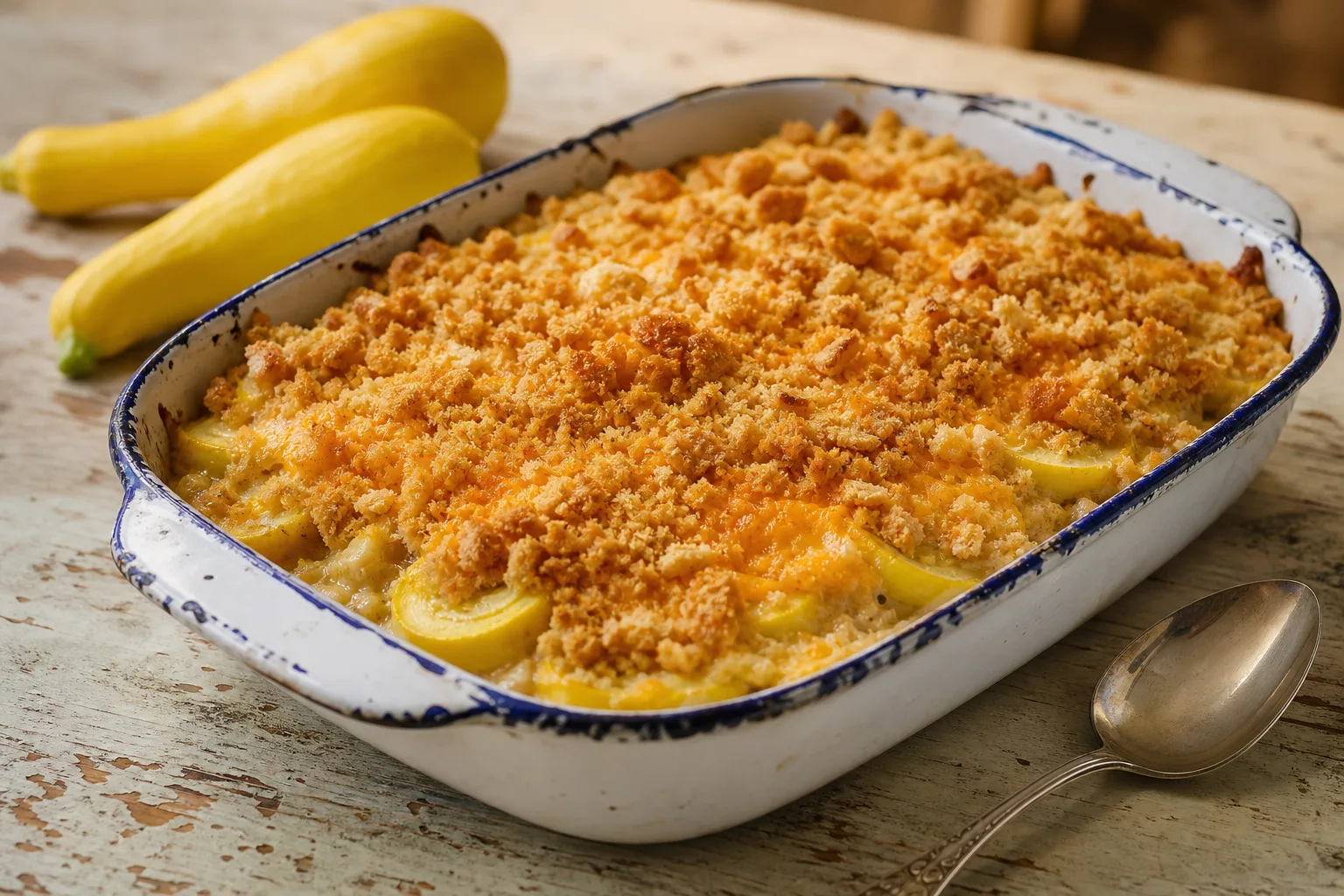

The traditional recipe for this dish, the one handed down on index cards across the South, tells you to boil the squash. That instruction is why so many people have decided they do not like squash casserole. You boil a vegetable that is already ninety-plus percent water, drain it in a colander for thirty seconds, and then bake it in a dish where all that water has nowhere to go but out of the squash and into the bottom of the pan.
The casserole I make now takes one extra half hour of almost entirely unattended time and comes out thick enough to hold the shape of the spoon. Same ingredients, same flavor, same buttery cracker top. The only real difference is that the water comes out before baking instead of during.
Why This Works
Tossing the sliced squash with salt and letting it sit for 30 minutes pulls water out through the cell walls, and then wringing it in a kitchen towel removes close to a cup more. You are taking out the liquid that would otherwise pool under the topping. Nothing else you do to this dish matters half as much.
Ingredients
This fills a 9×13 or a 2 1/2-quart baker. Three pounds of raw squash cooks down to roughly 4 1/2 cups, so do not be alarmed by the size of the pile you start with.
For the Casserole
- 3 pounds yellow summer squash, sliced into 1/4-inch coins
- 1 tablespoon kosher salt, for drawing out water
- 3 tablespoons unsalted butter
- 1 large sweet onion, diced small
- 2 cloves garlic, minced
- 2 large eggs, beaten
- 3/4 cup sour cream
- 1 1/2 cups grated sharp cheddar
- 1/2 cup crushed buttery round crackers, stirred into the filling
- 3/4 teaspoon black pepper
- 1/4 teaspoon cayenne
- 1/2 teaspoon kosher salt, or to taste, after you have tasted it
For the Topping
- 1 1/4 cups coarsely crushed buttery round crackers (about one sleeve)
- 3 tablespoons unsalted butter, melted
- 1/2 cup grated sharp cheddar
Easy Swap
Half yellow squash and half zucchini is a good-looking version and behaves identically — zucchini is just as wet, so salt and squeeze it the same way. For the topping, saltines give you a flatter, saltier crust, panko stays crisp the longest but tastes of nothing on its own, and crumbled day-old cornbread tossed with the melted butter is the most Southern option of the three. Buttery round crackers are what I keep coming back to.
How to Make It
Prep: 40 minutes | Bake: 50 minutes | Serves: 8 to 10
- Toss the sliced squash with the tablespoon of kosher salt in a colander set over a bowl, and leave it on the counter for 30 minutes. You should see between a half and three quarters of a cup of liquid collect underneath. This is unattended time — make the topping or set the table.
- Working in two or three batches, pile the squash into the middle of a clean kitchen towel, gather the corners, and squeeze firmly over the sink until it stops dripping. Do not rinse the salt off first; you lose the whole effect and add water back. The slices will look bruised and broken and that is exactly right.
- Melt the 3 tablespoons of butter in a large skillet over medium-high heat. Cook the onion 5 minutes until soft and translucent, then add the garlic for 30 seconds.
- Add the squash and cook 8 to 10 minutes, stirring every couple of minutes, until it is fully tender and whatever liquid appears in the pan has cooked away. The bottom of the pan should look dry and a little browned when you are done. Scrape it all into a large bowl and let it cool 10 minutes.
- Heat the oven to 350°F and butter the baking dish. Stir the eggs, sour cream, 1 1/2 cups of cheddar, the 1/2 cup of crushed crackers, pepper, and cayenne into the cooled squash. Now taste it, and only then add the remaining 1/2 teaspoon of salt if it needs it — the squash arrives already seasoned from step one.
- Spread the filling in the dish in an even layer, about an inch and a half deep.
- Toss the topping crackers with the melted butter until every crumb is coated, stir in the 1/2 cup of cheddar, and scatter it over the surface. Bake 35 to 40 minutes, until the edges bubble and the topping is deep golden brown.
- Rest 10 minutes before serving. The filling tightens as it cools and a scoop will come out clean rather than sliding across the plate.
Don’t Do This
Do not boil or steam the squash, even though your grandmother’s card says to. Boiling floods the vegetable with the one thing you are trying to get rid of, and thirty seconds in a colander does not reverse it. If you have already boiled it, dump it into a towel and squeeze hard — you can rescue the dish, you just cannot un-waterlog it completely.
Can You Make It the Night Before?
Yes — Assemble Up to 24 Hours Ahead
This is one of the best make-ahead casseroles on the Thanksgiving table, specifically because you have already removed the water. Assemble the filling in the dish through step 6, cover, and refrigerate up to 24 hours. Keep the buttered cracker topping in a separate container at room temperature and scatter it on just before the dish goes in the oven.
Take the dish out of the refrigerator 40 minutes before baking, and add 10 to 12 minutes to the bake time. A cold 9×13 of egg-bound filling heats from the edges in, so check the middle before you trust the bubbling corners.
A buttered cracker topping sitting overnight on top of a wet filling is the one thing that will ruin the make-ahead version. The butter in the crumbs goes solid, the crumbs absorb moisture from below, and instead of a crisp layer you get a dense, slightly greasy crust. The topping itself can be mixed up to three days early and kept covered on the counter, so you are not saving any real time by putting it on sooner.
You can also go further back than a day: salt, squeeze, and sauté the squash with the onion up to three days ahead and refrigerate it in a covered container, then mix in the eggs, sour cream, and cheese on the day. That splits the work in exactly the right place, because the squash step is the long one and the mixing step takes four minutes.
Three Ways to Get the Water Out
Salting and pressing is the method in this recipe because it is the most reliable and the half hour is hands-off. The downside is that the slices break apart under the towel, so the finished casserole is soft and uniform rather than showing distinct rounds of squash.
Roasting is the alternative if you want the squash to keep its shape. Toss the raw coins with oil and a teaspoon of salt, spread them on two sheet pans so they are not crowded, and roast at 425°F for 25 minutes until the edges are browned. Water leaves as steam instead of as liquid, and you get a nuttier flavor. It costs you two sheet pans and oven space, which in late November is not a small thing.
The dry-skillet method is the fastest: no salting, just slice the squash and cook it in a wide hot pan in two batches for about 12 minutes each, until the pan goes dry. It works, but it is the one that needs watching, and a crowded pan steams the squash instead of driving water off, which leaves you exactly where you started.
Pick Smaller Squash
Squash the size of your forearm is mostly seed and water, and the seed cavity turns to mush no matter which method you use. Look for squash six to eight inches long and no thicker than a soda can, and you will start the recipe with less water to fight.
Keeping the Cracker Top Crisp
Coat the crumbs in melted butter before they ever touch the casserole. Butter is fat, fat repels water, and a coated crumb resists the steam coming up from the filling for a good deal longer than a dry one. Scattering plain crumbs over the top and then dotting butter on them is the common shortcut and it produces patches that are crisp and patches that are damp.
Crush the crackers coarsely, to pieces about the size of a pea, not to dust. Dust packs into a solid layer that seals steam underneath it, and a sealed layer goes soggy from below. And leave the dish uncovered on the table — foil over a hot casserole puts every bit of that steam straight back into the topping within ten minutes.
Rachel’s Tip
The half cup of crushed crackers that goes inside the filling is cheap insurance, not filler. It soaks up whatever moisture the squash still holds as the casserole bakes and keeps the bottom from going loose. I started adding it after one November when my squash had clearly been watered heavily the week it was picked, and I have never left it out since.
Questions People Ask
Why is my squash casserole watery?
Because the squash went into the dish wet. Yellow summer squash is over ninety percent water and boiling it adds more. Salt the slices for 30 minutes, wring them in a towel, and then cook them in a skillet until the pan runs dry, and the problem simply does not occur. The other common culprit is a thin pan sauce from undercooked onions releasing liquid in the oven.
Do I have to peel the yellow squash?
No, and I would not. The skin on summer squash is thin, it softens completely in the oven, and it holds the slices together through the salting and squeezing. Peeling also takes away the yellow, which is most of the reason this casserole looks appealing. Trim the stem and blossom ends and leave the rest.
Can I make this with zucchini instead?
Yes, one for one, and the method is identical since zucchini carries just as much water. The finished dish is greener and slightly more vegetal, and the skins are a little tougher so slice a touch thinner. A half-and-half mix of the two looks better than either one alone.
Can I freeze squash casserole?
Not well, and this is the one place I would not try to get ahead. Freezing ruptures what is left of the squash cell walls, so it thaws into something closer to a puree and releases liquid as it reheats. The cracker topping goes soft on the first reheat as well. Make the filling up to three days ahead in the refrigerator instead — that gets you most of the convenience with none of the damage.
About This Article

Written by Rachel Thompson. Rachel Thompson is a home cook who has spent over 10 years making an unreasonable number of dips, appetizers, and party spreads — no culinary training, just a decade of trial and error and a reputation among friends for always being asked to "bring a dip." She focuses on approachable recipes that combine bold flavors with simple techniques, making entertaining at home accessible to everyone. More about this site.
Scope and limits. Rachel is a home cook with no culinary training. Follow current food safety guidance for holding temperatures and time limits whenever you are serving people other than yourself.
Verify this against a primary source
Specifics change, and your situation may differ from the one described here. These are the authorities worth checking directly:
- FoodSafety.gov — cold holding, hot holding and the two-hour rule
- USDA FoodData Central — ingredient composition and nutrition data
- USDA Food Safety and Inspection Service — safe minimum temperatures and leftovers