
Everybody has eaten the bad version of this. The top is pale and a little leathery, and underneath it there is a dense wet layer where all the stock went and stayed. It is the most common casserole failure I know of, and it happens for one reason: the liquid goes in all at once, and bread cannot absorb that fast.
The fix is not a different ratio. It is a pause. You pour in about two-thirds of the liquid, toss it, and then walk away for ten minutes. The cubes drink from the outside in, and when you come back you can see whether they actually need the rest. Most of the time they take some of it. Sometimes they take none.
The other half of the job is the bread itself. Not stale bread — dried bread. Those are different things, and the difference is why this recipe starts with the oven at 300°F and a sheet pan of cubes.
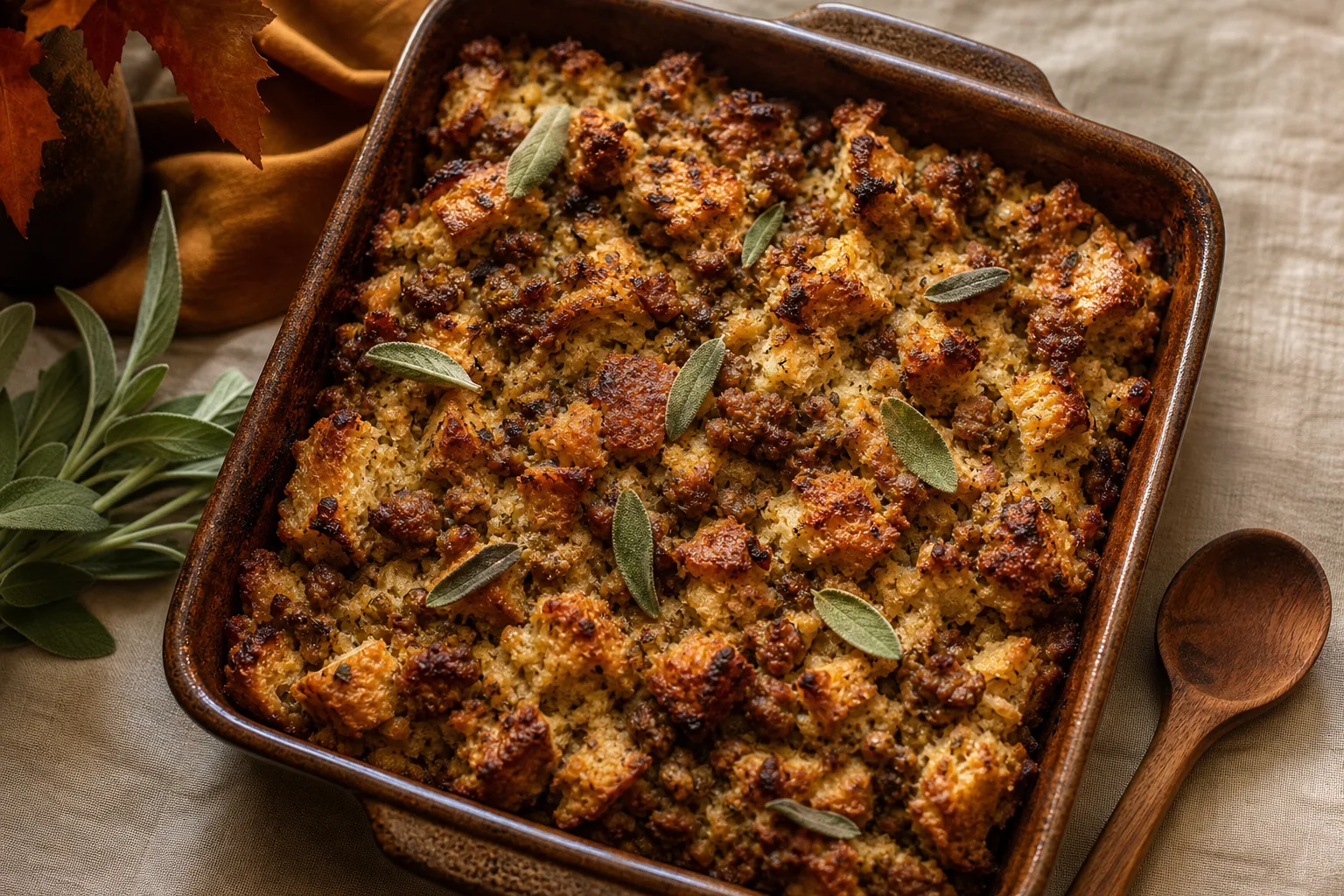
What comes out is somewhere between a stuffing and a savory bread pudding: a craggy crisp top, a center that holds its shape when you cut it, and a pound of browned sausage running through it. I make it as dinner in January as often as I make it in November.
Why This Works
Oven-dried bread cubes absorb liquid evenly and slowly, where bread left out on the counter goes tough on the outside and stays soft inside. Dry the cubes, then add the liquid in two stages with a ten-minute wait between them, and the bottom of the dish never ends up holding stock the bread refused to take.
Ingredients
This fills a deep 9×13 dish. It feeds eight as a main course or ten alongside something else. Nothing in the ingredient list is salted, and that is on purpose.
For the Casserole
- 1 pound bulk pork breakfast sausage
- 1 pound sturdy country white bread, cut into 3/4-inch cubes (about 12 cups)
- 4 tablespoons unsalted butter
- 1 large yellow onion, diced small
- 3 ribs celery, diced small
- 3 cloves garlic, minced
- 1 tablespoon chopped fresh sage, or 1 teaspoon dried
- 2 teaspoons fresh thyme leaves, or 3/4 teaspoon dried
- 3/4 teaspoon black pepper
- 1/4 teaspoon freshly grated nutmeg
- 2 1/2 cups low-sodium chicken stock
- 3 large eggs
- 1/2 cup heavy cream
- 1/4 cup chopped flat-leaf parsley
For the Top
- 2 tablespoons unsalted butter, melted
- A few whole sage leaves, optional
Easy Swap
Cornbread makes a very good version of this, but it is not a one-for-one trade: it crumbles instead of cubing and it drinks more liquid, so skip the oven-drying, start with 2 cups of stock, and expect a softer, more pudding-like result with less crisp on top. Hot Italian sausage also works well in place of breakfast sausage — you lose the sage note, so double the fresh sage to make up for it.
How to Make It
Prep: 30 minutes | Bake: 45 minutes | Serves: 8 to 10
- Heat the oven to 300°F. Spread the bread cubes over two sheet pans and bake 20 to 25 minutes, tossing once, until they are dry and crisp all the way through but barely colored. Break one open to check the middle. Raise the oven to 350°F.
- While the bread dries, cook the sausage in a large skillet over medium-high heat, breaking it into pieces about the size of a nickel. Give it 8 minutes and let it brown properly in places rather than stirring constantly. Lift it out with a slotted spoon into a large mixing bowl and leave the fat in the pan.
- Add the 4 tablespoons of butter to the sausage fat, then the onion and celery. Cook 8 minutes over medium heat until soft and translucent. Add the garlic, sage, thyme, pepper, and nutmeg and stir 1 minute more.
- Whisk the eggs, cream, and 2 cups of the stock together in a measuring cup. Now taste a piece of the cooked sausage on its own, and taste a bread cube. Between the two of them there is already a lot of salt in this dish, which is why no salt goes into the liquid.
- Add the bread cubes, the vegetables with all their butter, and the parsley to the bowl with the sausage, and toss. Pour about two-thirds of the egg mixture over the top, fold it through, and then stop and wait 10 minutes.
- Come back and squeeze a cube. If it gives like a damp sponge, you are done. If the center is still dry and crunchy, add the rest of the liquid, including the remaining 1/2 cup of stock, a quarter at a time until it does. Different loaves drink very differently and this is the only way to know.
- Butter a deep 9×13 dish and transfer the mixture in loosely. Do not pack it down. You want a lumpy, uneven surface with peaks — those peaks are what crisp. A flattened, pressed-down casserole steams itself.
- Cover with foil and bake 25 minutes. Pull the foil, drizzle the melted butter over the top, lay on the sage leaves if you are using them, and bake another 20 to 25 minutes, until the peaks are deep brown and the center no longer wobbles when you nudge the dish.
- Rest 10 minutes before cutting. It firms up considerably and goes from scoopable to sliceable.
Don’t Do This
Do not dump all the liquid in at once, and do not press the mixture flat in the dish. Those two moves cause almost every bad stuffing casserole. Dumping the liquid drowns the bottom third while the top stays dry. Pressing it flat seals the surface so steam cannot escape, and instead of a crisp top you get a smooth, damp, slightly gray one.
Can You Make It the Night Before?
Yes — Assemble Up to 24 Hours Ahead
Assemble it fully through step 7, cover, and refrigerate up to 24 hours — this one genuinely improves overnight, because the bread has all night to hydrate evenly. Let the dish sit out 40 minutes before baking, add 10 minutes to the covered stage, and hold the butter drizzle until the foil comes off.
The one adjustment worth making for an overnight rest: hold back about 1/2 cup of the liquid and add it in the morning if the top layer looks dry. Bread keeps absorbing in the refrigerator, and a mixture that looked perfectly damp at midnight can look thirsty by eight.
You can also split the work the other way. The bread cubes can be dried up to a week ahead and kept in a paper bag at room temperature — not a sealed plastic one, which traps the little moisture they have left and softens them back up. The sausage and vegetable base keeps three days in the refrigerator.
It freezes well, which surprised me the first time. Bake it fully, cool completely, and freeze it whole in the dish, wrapped, up to two months. Reheat covered at 325°F for about 45 minutes from frozen, then uncover for 15 to bring the top back. The custard holds because the eggs set before it ever went in the freezer — an unbaked frozen assembly comes out weeping.
There Are Three Salty Things in This Dish Already
Breakfast sausage is seasoned to be eaten on its own as a patty, which means it carries a lot of salt along with the sage and the pepper. A pound of it, broken up and distributed through twelve cups of bread, seasons the dish on its own.
Bread is the one people forget. A commercial sandwich loaf or a bakery country loaf is salted — it has to be, salt controls the yeast and the gluten — and twelve cups of it is a pound of salted bread. Then stock is the third source. Standard canned or boxed stock is aggressive on its own, and here it is being added to two things that were already seasoned.
So the recipe uses low-sodium stock and unsalted butter and adds no salt at all, and in dozens of batches I have never once wanted more at the table. If you taste the mixture in step 6 and it genuinely needs something, reach for pepper or another spoonful of sage first — nine times out of ten what the dish is missing is aroma, not salt.
If You Use a Boxed Stuffing Mix
Throw the seasoning packet away, or use half of it at most. Those packets are built on the assumption that the bread cubes are the only seasoned thing in the pan, and they are mostly salt and dried onion. Added on top of a pound of breakfast sausage they push the dish past the point where anybody will go back for seconds.
Getting a Crisp Top and a Center That Holds
The two stages of baking are doing two different jobs, and swapping them does not work. Covered, the dish is a steam box: the custard comes up to temperature gently and sets without the surface getting ahead of it. Uncovered from the start, the top dries and browns in fifteen minutes while the middle is still liquid, and by the time the center sets the peaks have gone from brown to black.
Twenty-five minutes covered is about right for a deep 9×13 at 350°F. The signal to move on is not the clock but the surface — it should be set enough that a spoon does not sink into it, even with no color on it yet.
For the uncovered stage, go by the center, not the top. Nudge the side of the dish; if the middle moves as a single wobbly mass, it needs another five minutes. If it moves not at all, or only the surface shifts a little, it is done. The butter drizzle at the start of that stage is what gets you an actual crisp rather than a dry crust — fat conducts heat into the peaks faster than air does.
Rachel’s Tip
Leaving bread out on the counter overnight is not the same as drying it in the oven. Counter-stale bread loses moisture from the surface and goes tough, while the interior stays soft — so it absorbs unevenly and the tough outsides never fully soften. Twenty-five minutes at 300°F dries it all the way through, and that is what makes the texture consistent from cube to cube.
Questions People Ask
Can I use a bag of stuffing mix instead of cutting bread?
Yes, and it is a reasonable shortcut. Use two 12-ounce bags, skip the oven-drying entirely since the cubes are already dry, and discard the seasoning packets or use half of one. The cubes are smaller than hand-cut ones, so they absorb faster — check them after 5 minutes of resting in step 6 instead of 10.
Why is the bottom of my stuffing casserole soggy?
The liquid went in faster than the bread could take it, so gravity moved the excess to the bottom and it sat there. Staging it in two additions with a ten-minute pause fixes it. The second cause is pressing the mixture flat, which compacts the bottom layer into something closer to dough.
Do I really need the eggs?
They are what makes this a casserole you can slice rather than a pan of loose stuffing. Without them you get something softer and more scattered, which is fine if that is what you want — cut the stock back to 2 cups if you leave them out, since there is nothing to set the extra liquid.
Is this a main course or a side dish?
Both, honestly. With a pound of sausage in it there is enough protein to run it as dinner for eight with a sharp green salad, which is how I serve it most often. On a holiday table next to a roast it stretches to ten as a side, and you could cut the sausage to 12 ounces if it is sharing the plate with another meat.
Can I add apple, cranberry, or mushrooms?
Mushrooms, yes — a half pound sliced and browned hard in the sausage fat before the onions go in, and no change to the liquid. Dried cranberries, a half cup, added with the parsley. Fresh apple I would skip; it releases water as it bakes and lands you back at a soggy bottom.
About This Article

Written by Rachel Thompson. Rachel Thompson is a home cook who has spent over 10 years making an unreasonable number of dips, appetizers, and party spreads — no culinary training, just a decade of trial and error and a reputation among friends for always being asked to "bring a dip." She focuses on approachable recipes that combine bold flavors with simple techniques, making entertaining at home accessible to everyone. More about this site.
Scope and limits. Rachel is a home cook with no culinary training. Follow current food safety guidance for holding temperatures and time limits whenever you are serving people other than yourself.
Verify this against a primary source
Specifics change, and your situation may differ from the one described here. These are the authorities worth checking directly:
- FoodSafety.gov — cold holding, hot holding and the two-hour rule
- USDA FoodData Central — ingredient composition and nutrition data
- USDA Food Safety and Inspection Service — safe minimum temperatures and leftovers