
Stuffed shells have a failure mode that nothing else in this category shares: the pasta tears while you are filling it. You boil a box of shells, go to spoon ricotta into the first one, and it splits down the side. By the time you have twenty-four filled you have also thrown out six, and the ones that made it are already soft enough that forty minutes in the oven will finish them off.
The fix is the same correction that every baked pasta dish needs, just more dramatic here. Shells are thick, so the gap between underdone and done is wide, and you can take them out of the water a full five minutes early. They come out stiff, slightly leathery, and genuinely hard to tear — which is exactly the state you want when you are prying them open with a spoon.
The second half of this is the filling. Ricotta and spinach both carry a lot of water, and water inside a shell has nowhere to go but out into the sauce. This version deals with that before anything goes in the oven.
Why This Works
Jumbo shells go into the sauce five minutes short of the package time — around 8 minutes instead of 13. Underdone shells are rigid and resist tearing, they hold their shape instead of collapsing under the filling, and they still have enough unfinished starch left to absorb sauce during the bake. Shells boiled to the package number arrive at the oven already done and leave it slumped.
Ingredients
A 12-ounce box of jumbo shells holds about 36 shells, and you will realistically fill 24 — count on breaking a few and on a few being too small to bother with. Twenty-four shells fit snugly in a 9×13 dish, three to four per person.
For the Sauce
- 2 tablespoons olive oil
- 1 small yellow onion, diced fine
- 4 cloves garlic, thinly sliced
- 1 (28-ounce) can crushed tomatoes
- 1 (15-ounce) can tomato sauce
- 1/2 cup water
- 1 teaspoon dried basil
- 1/2 teaspoon red pepper flakes
- 1 1/2 teaspoons kosher salt
- 1/2 teaspoon black pepper
For the Filling
- 32 ounces whole-milk ricotta
- 10 ounces frozen chopped spinach, thawed and squeezed completely dry
- 2 cups grated low-moisture whole-milk mozzarella
- 1 cup grated Parmesan
- 1 large egg plus 1 yolk
- 1/2 cup chopped fresh parsley
- 2 cloves garlic, grated or minced to a paste
- 1/2 teaspoon freshly grated nutmeg
- 1 teaspoon kosher salt
- 1/2 teaspoon black pepper
For Assembly
- 1 (12-ounce) box jumbo pasta shells
- 1 1/2 cups grated low-moisture whole-milk mozzarella
- 1/4 cup grated Parmesan
- Fresh basil for serving
Easy Swap
No jumbo shells at the store? Manicotti tubes take the same filling and the same timing, and they are easier to pipe because both ends are open. Cannelloni works too. What does not work is substituting part-skim ricotta — it has more water and less fat, and the filling goes grainy and weeps where whole-milk ricotta stays creamy.
How to Make It
Prep: 40 minutes | Bake: 40 minutes | Serves: 6 to 8
- If the ricotta looks loose in the tub, tip it into a fine strainer set over a bowl and leave it while you do everything else. Thirty minutes can pull out a half cup of whey, and that is a half cup that would otherwise end up in your sauce.
- Heat the oil in a saucepan over medium. Cook the onion 6 minutes until soft, add the garlic for 1 minute, then add the crushed tomatoes, tomato sauce, water, basil, pepper flakes, salt, and pepper. Simmer 15 minutes, uncovered. It should stay thin enough to pour easily, closer to a soup than a sauce — the shells and the filling will both thicken it in the oven. Heat the oven to 375°F.
- Bring a large pot of heavily salted water to a boil. Check the package time on the shells, subtract 5 minutes, and boil them for that long, usually 8 minutes. Stir gently at the start so they do not nest inside each other. Lift them out with a spider or a slotted spoon rather than dumping them into a colander, and lay them open-side down on a sheet pan so they drain and stay open.
- Squeeze the thawed spinach in a clean kitchen towel until no more water comes out. Keep squeezing past the point where you think you are done — a 10-ounce box can give up nearly a cup of liquid.
- Mix the drained ricotta, spinach, 2 cups mozzarella, 1 cup Parmesan, egg and yolk, parsley, garlic, nutmeg, salt, and pepper. Taste it. Filling that is correctly seasoned tastes just slightly too salty on its own, because it is about to be surrounded by tomato.
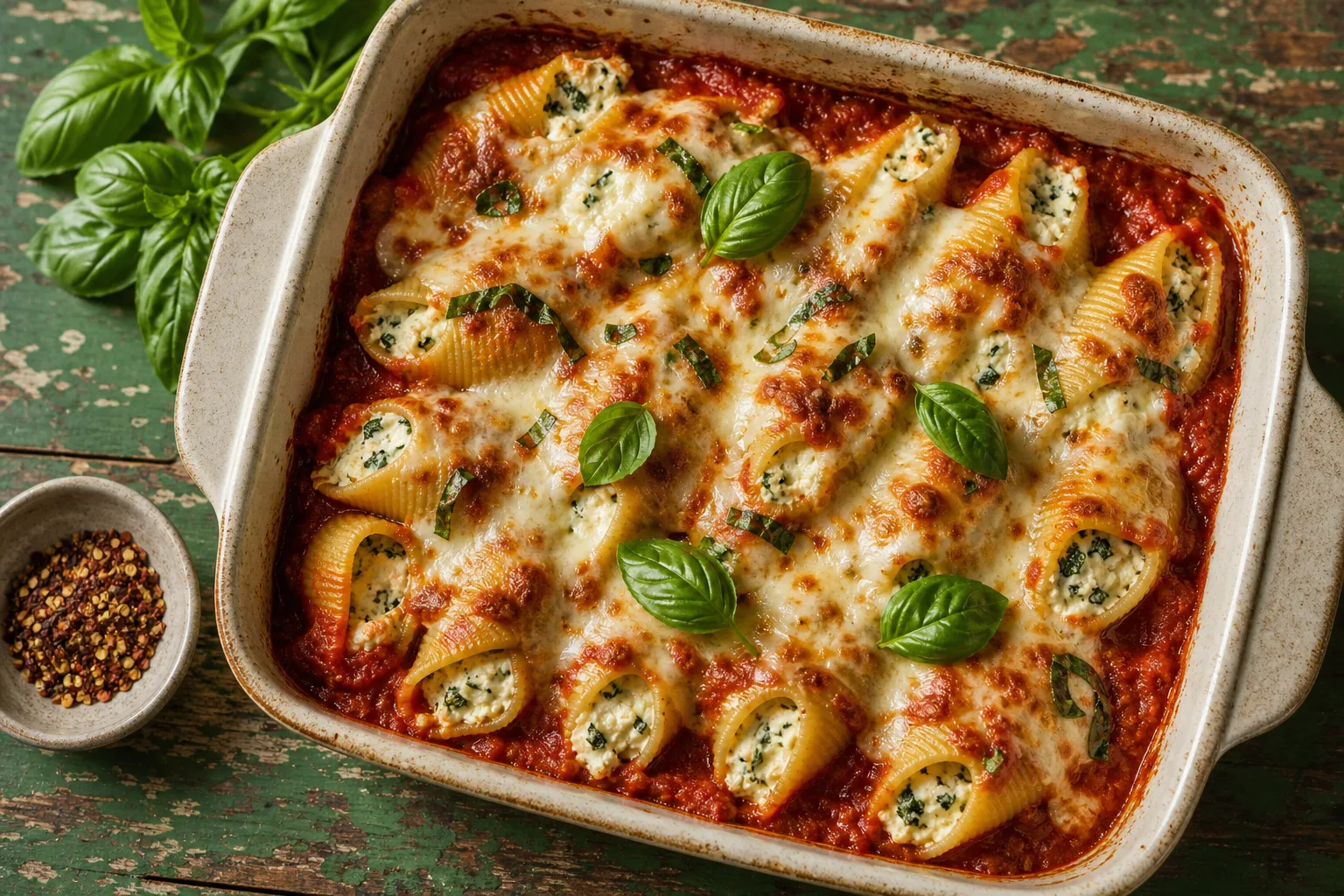
- Spread about two-thirds of the sauce across the bottom of a 9×13 dish. Scoop the filling into a zip-top bag, snip off a corner, and pipe about 3 tablespoons into each shell — a spoon works but takes twice as long and tears more shells. Nestle each one open-side up in the sauce as you go.
- Spoon the remaining sauce over and between the shells, leaving the filling itself mostly exposed. Cover tightly with foil and bake 25 minutes.
- Remove the foil, scatter the 1 1/2 cups mozzarella and the Parmesan over the top, and bake 13 to 15 minutes more until the cheese is browned in spots and the sauce bubbles around the edges. Rest 10 minutes, then tear basil over the top.
Don’t Do This
Do not leave any shell poking up out of the sauce with bare pasta exposed. Exposed pasta dehydrates in dry oven heat and turns hard and translucent at the edges, like a chip. The filling can and should be visible — it has its own moisture — but every bit of bare shell wants either sauce or a blanket of cheese on it.
Can You Make It the Night Before?
Yes — Assemble Up to 24 Hours Ahead
This is the best make-ahead dish in the category. Assemble fully through step 7 without the top cheese, cover, and refrigerate up to 24 hours. Add an extra quarter cup of water to the sauce before it goes in, and add 15 minutes to the covered bake.
Let the pan sit out 45 minutes first. Stuffed shells are essentially twenty-four insulated pockets of cold dairy, and the center of each one takes real time to heat. Rushing it gives you browned cheese on top of cool filling, which is the single most common way this dish disappoints.
You can also split the work without assembling anything. The sauce keeps five days and gets better. The filling keeps two days, covered tightly. But boil the shells the day you bake — cooked shells stored overnight stick to each other and tear when you separate them, no matter how much oil you toss them in.
It freezes well, and this is the version I keep in the freezer. Assemble in a foil pan, no top cheese, wrap in plastic and then foil, and freeze up to three months. Bake from frozen, covered, at 350°F for 60 minutes, then add the cheese and bake uncovered at 400°F for 20 more. The filling comes out slightly firmer than fresh, which honestly makes it easier to serve.
Why Underdone Shells Are Easier to Fill
This is the part that surprised me. I had assumed a tear meant the pasta was too stiff and that I should boil it longer to make it pliable. It is the reverse. A fully cooked shell is soft and slack, so when you push filling in, the walls stretch until they split.
An eight-minute shell has a firm, slightly springy wall that pushes back. It holds an open mouth instead of folding shut, and it takes the filling without deforming. The edges are also sturdy enough to handle with your fingers, which matters when you are placing two dozen of them.
Laying them open-side down on a sheet pan after boiling is the other half of this. Shells left in a colander collect water inside and curl closed as they cool, and prying a closed shell open is how most of the remaining damage happens.
Pipe, Don’t Spoon
A zip-top bag with a corner cut off fills twenty-four shells in about five minutes with no tearing at all, because the pressure goes straight in rather than sideways from the edge of a spoon. Cut an opening about three-quarters of an inch wide — small enough to control, big enough that the spinach and cheese do not jam it.
The Filling Has to Be Drier Than Seems Reasonable
Every bit of water in the filling becomes steam, and steam inside a sealed shell pushes out into the sauce and thins it. Then it thins the sauce exactly where the shell edges are sitting, which is why the shells in a watery version look like they are floating.
Two places that water comes from. First the ricotta, which varies enormously between brands — some are thick enough to stand a spoon in and some are nearly pourable. Strain any ricotta that is not clearly thick. Second the spinach, which is the bigger offender: thawed frozen spinach holds close to a cup of water and will give up most of it if you wring it in a towel like you mean it.
The egg and extra yolk bind what is left. Without them the filling has no structure and runs out of the shells as soon as it warms through; with them it sets just enough to stay where you put it. One whole egg and one yolk for two pounds of ricotta is the ratio that works for me — the extra yolk adds richness without the slightly rubbery set that two whole eggs give.
Sauce Under, Sauce Over, Filling Exposed
Build it in that order and the geometry does the work. The bed of sauce underneath insulates the shells from the hot bottom of the dish and gives them something to drink. The spoonfuls over the top protect the bare pasta. The filling stays visible, so it browns slightly and you can see when the dish is properly hot.
Do not bury the shells completely. Fully submerged shells poach rather than bake, and you lose the distinction between pasta, filling, and sauce that makes the dish worth the labor.
Rachel’s Tip
Boil the whole box, not just twenty-four shells. There is no way to do this without casualties: a few arrive broken in the box, a few split in the pot, and a few tear when you fill them. Having a dozen spares means you never have to decide whether a cracked shell is good enough, and the extras cost about forty cents.
Questions People Ask
Why do my stuffed shells tear?
They were boiled too long. A shell cooked to the package time is soft and slack and splits under the pressure of filling. Pull them five minutes early, around eight minutes, and they stay firm enough to resist. Piping the filling from a zip-top bag instead of pushing it in with a spoon also cuts the damage substantially.
Why is my sauce watery after baking?
Water came out of the filling. Undrained ricotta and under-squeezed spinach are the two sources, and together they can add more than a cup of liquid to the dish. Strain loose ricotta for thirty minutes and wring the thawed spinach in a towel until nothing more comes out.
Can I use fresh spinach instead of frozen?
Yes, but you need a lot of it — about a pound and a half of fresh to equal 10 ounces of frozen. Wilt it in a dry pan, cool it, then chop and squeeze it just as hard. Frozen is genuinely the better choice here, which is not something I say often.
Do I have to cover it with foil?
For the first 25 minutes, yes. The trapped steam is what finishes the underdone pasta and heats the center of each filled shell. Uncovered the whole way, the exposed edges harden and the filling in the middle shells stays cool while the top browns.
How many shells should I plan per person?
Three to four as a main course with bread and a salad, which is where twenty-four shells serving six to eight comes from. Leftovers keep four days and reheat well, covered, at 350°F for about 20 minutes.
About This Article

Written by Rachel Thompson. Rachel Thompson is a home cook who has spent over 10 years making an unreasonable number of dips, appetizers, and party spreads — no culinary training, just a decade of trial and error and a reputation among friends for always being asked to "bring a dip." She focuses on approachable recipes that combine bold flavors with simple techniques, making entertaining at home accessible to everyone. More about this site.
Scope and limits. Rachel is a home cook with no culinary training. Follow current food safety guidance for holding temperatures and time limits whenever you are serving people other than yourself.
Verify this against a primary source
Specifics change, and your situation may differ from the one described here. These are the authorities worth checking directly:
- FoodSafety.gov — cold holding, hot holding and the two-hour rule
- USDA FoodData Central — ingredient composition and nutrition data
- USDA Food Safety and Inspection Service — safe minimum temperatures and leftovers