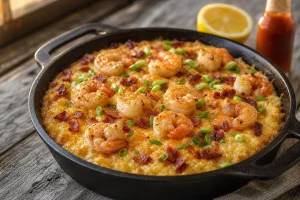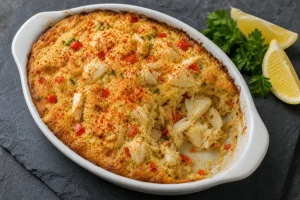
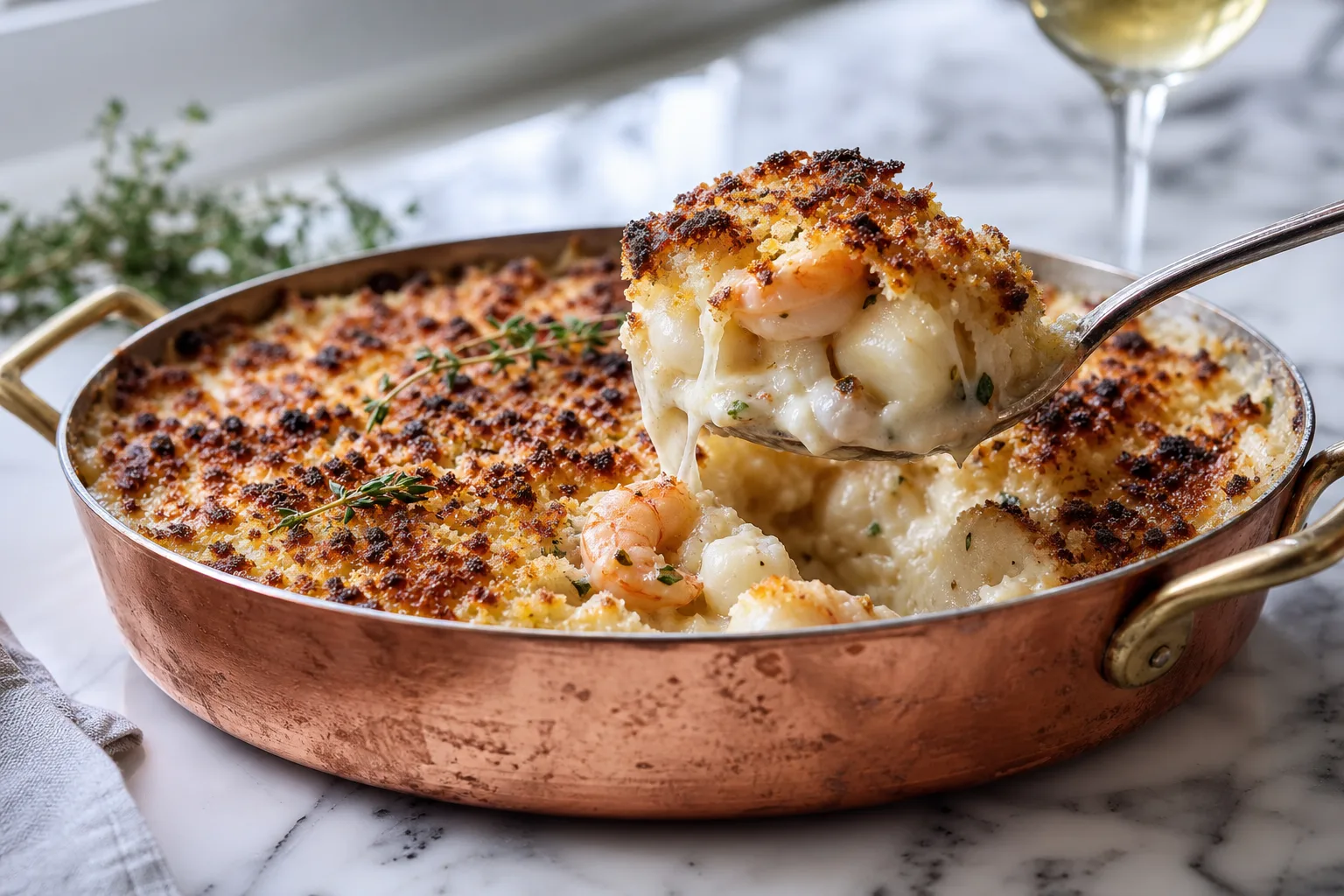

Seafood au gratin is where the rubbery-casserole problem gets expensive. You are combining three or four things that each cook in under three minutes — shrimp, scallops, flaky white fish, maybe crab — and committing all of them to the same half hour in the oven. The scallops lose by the widest margin, going from sweet and barely set to small white erasers at twenty dollars a pound.
The version I make now barely goes in the oven at all. The seafood poaches in milk, gently, for two minutes each, pulled out in stages as it finishes. That milk then becomes the sauce, so nothing is wasted and everything the seafood gave up ends up back on the plate. Assembly happens in a warm pan, and the dish spends six minutes under the broiler — long enough to blister the cheese and nothing else.
It is not a slow-baked dish pretending to be fast. It is a fast dish that looks slow-baked at the table.
Why This Works
Poaching the seafood in the milk that becomes the béchamel does two jobs at once: it cooks each kind for exactly the time it needs, and it puts that flavor into the sauce instead of down the drain. After that the dish only needs top heat to brown — so the broiler, not a thirty-minute bake.
Ingredients
A shallow 2-quart gratin dish or a 10-inch skillet. Shallow matters twice: more surface to brown, and nothing deep enough to need oven time.
For the Poach and the Sauce
- 3 cups whole milk
- 1 shallot, halved
- 1 bay leaf
- 3 sprigs thyme
- 6 black peppercorns
- 5 tablespoons unsalted butter
- 1/4 cup all-purpose flour
- 4 ounces Gruyère, grated
- 1/3 cup grated Parmesan
- 2 teaspoons Dijon mustard
- 2 tablespoons dry sherry
- 1 1/4 teaspoons kosher salt
- Pinch of cayenne
- 1 tablespoon fresh lemon juice
For the Seafood
- 3/4 pound large shrimp, peeled and deveined
- 3/4 pound sea scallops, side muscle removed, halved crosswise
- 1/2 pound cod or haddock, cut into 1 1/2-inch chunks
- 8 ounces lump crab meat, picked over and drained
For the Crust
- 3/4 cup panko
- 2 ounces Gruyère, grated
- 2 tablespoons unsalted butter, melted
- 2 tablespoons chopped chives
Easy Swap
The ratios matter more than the species. Keep it to about two pounds of seafood total, split between something firm, something sweet, and something flaky. Halibut, monkfish and bay scallops all slot in — just adjust the poach. Bay scallops need 45 seconds.
How to Make It
Prep: 35 minutes | Bake: 8 minutes | Serves: 6
- Put the milk, shallot, bay leaf, thyme, and peppercorns in a wide saucepan and bring it up until it steams with a few bubbles at the edge. Never let it boil. Hold it there 10 minutes, then fish out the aromatics.
- Poach in stages, lifting each batch onto a paper-towel-lined tray: the cod first, 2 minutes, until it just begins to flake; then the shrimp, 2 minutes, until pink and curled into a loose C; then the scallops, 90 seconds only, until the outside turns from glassy to white.
- Pour the poaching milk through a fine strainer into a measuring cup. You should have about 2 1/2 cups; top it up with fresh milk if you are short.
- Wipe the pan, melt the 5 tablespoons of butter over medium heat, whisk in the flour, and cook 90 seconds. Add the strained milk in three additions, whisking each smooth, and simmer 4 minutes until it coats a spoon.
- Off the heat, stir in both cheeses, the Dijon, sherry, salt, cayenne, and lemon juice. Heat the broiler with a rack 6 inches below the element. Toss the panko, Gruyère, and melted butter together for the crust.
- Fold the poached cod, shrimp, and scallops into the warm sauce, then the crab last and most gently — it was never poached and does not need to be, so it only has to be coated. Pour everything into the gratin dish.
- Scatter the crust over and broil 5 to 6 minutes, turning the dish once, until the surface is blistered and deep brown in patches. Watch it the whole time — the gap between golden and burnt is about forty seconds.
- Rest 5 minutes, scatter the chives, and serve. The sauce tightens noticeably in those five minutes, so do not panic if it looks loose coming out.
Don’t Do This
Do not boil the poaching milk and do not walk away from it. Milk at a real boil toughens the outside of a scallop in under a minute and scorches on the bottom of the pan, and scorched milk is a flavor you cannot strain out.
Can You Make It the Night Before?
Not Fully — Here Is What You Can Prep
No, not assembled. Poached seafood held overnight in a cream sauce keeps firming up, sheds water into the sauce, and reheats straight past where you so carefully stopped it. What you can do is make the infused béchamel up to two days ahead, mix the crust, and clean and portion all the seafood the day before. That leaves fifteen minutes of poaching and six of broiling between you and dinner.
Reheat the sauce gently with a splash of milk before the seafood goes in — a cold béchamel is stiff enough to tear the fish apart when you fold. It should be loose and warm, about the texture of heavy cream.
If you genuinely need it done in advance, the compromise I would accept is poaching the seafood, cooling it uncovered on a tray, and refrigerating it separately from the sauce for up to a day. Fold them together cold, broil 8 minutes instead of 6, and accept firmer scallops. Do not freeze it in any configuration — poached scallops in dairy come out grainy and the sauce splits.
The Broiler Is Doing a Different Job Than the Oven
A 375°F oven heats a casserole all the way through, which is what you want for raw potatoes and exactly what you do not want for seafood that is already cooked. A broiler is directional. It puts intense heat on the top inch and leaves the rest of the dish mostly alone.
That is why the sauce goes in warm and the seafood goes in cooked. There is nothing left for the middle of the dish to accomplish, so only the surface needs to change — and six minutes of top heat gives you the blistered, patchy, dark-gold crust that is the whole visual appeal of a gratin.
Turn the dish once halfway through. Almost every home broiler has a hot spot, and the result otherwise is one burnt corner and one pale one.
Why the Crab Goes In Last and Uncooked
Lump crab is sold cooked and pasteurized, so poaching it would be a third cooking and would break the lumps apart in the pan besides. It goes into the finished sauce purely to be coated and warmed.
Fold it in at the very end with three or four strokes and then stop, even if it looks unevenly distributed. It evens out when you spread the mixture in the dish. Stirring to distribute crab is how crab stops being crab.
This is also why the crab goes in after the poached fish rather than with it. By then the sauce has cooled slightly from the cold seafood folded through it, so the crab meets warm sauce instead of hot sauce, and warm is all it needs.
Scaling It Up Without Losing the Method
The constraint when you double this is not the oven, it is the broiler — and specifically the amount of surface that sits close enough to the element to brown. Doubling into one deep dish defeats the whole recipe: a four-inch-deep gratin cannot be heated through by top heat alone, so you would have to bake it, and baking it is what we are avoiding. Two shallow dishes, broiled one after the other, is the only version of doubling that works.
Poach in batches too, and keep them small. Dropping two pounds of cold shrimp into the milk at once will take it from bare steam down to lukewarm, and then it climbs back up while the shrimp sit in it — which is a slow poach, the opposite of what you want. Half a pound at a time keeps the milk steady, and the whole exercise is faster than it sounds because nothing stays in for more than two minutes.
The sequencing that works for eight or ten people: poach everything, make one batch of sauce for both dishes, fill both, then broil the first while the second waits on the counter. Cover the finished one loosely with foil and it will still be properly hot six minutes later when the second comes out. Do not try to broil both at once on two racks — the lower dish gets no color and you end up leaving it in long enough to overcook the scallops.
Worth Knowing
If you only own one gratin dish, a rimmed quarter sheet pan broils beautifully and holds about the same volume spread even thinner. It browns faster, so start checking at four minutes.
Rachel’s Tip
Pull every piece of seafood a shade earlier than you think. All of it gets folded into hot sauce and then spends six minutes under a broiler, and both are still cooking it. The first two times I made this I poached to perfect and served to overdone.
Questions People Ask
Why are my scallops rubbery in a gratin?
Because they finished cooking before the dish went in the oven and kept going. A sea scallop is done in about ninety seconds of gentle poaching; after that the proteins contract and squeeze out water. In a baked gratin they spend half an hour past done.
Can I use frozen seafood?
Yes, and most scallops and shrimp in the case were frozen anyway. Thaw overnight in the refrigerator, then dry everything well — surface water dilutes the poaching milk, and the sauce is made from that milk. Avoid anything labeled wet-packed.
What if I don’t have a broiler?
Bake it at 475°F on the top rack for 10 to 12 minutes instead. You get less blistering and a slightly drier result, so add a quarter cup of cream to the sauce for margin. A toaster oven’s broil setting works well for a dish this shallow.
Can I add potatoes or pasta to stretch it?
Pasta yes, potatoes carefully. Fold in a pound of cooked small shells with the seafood and increase the sauce by half. For potatoes, cook them fully separately — par-cooked potatoes need real oven time, which is what this recipe avoids.
Do leftovers reheat at all?
Not really, and I would plan around that. Everything in the dish is cooked to the edge of done, so any reheating takes it past. What I do with leftovers is eat them cold the next day, or warm a portion very gently in a small pan on the stove with a splash of milk, stopping while it is barely hot. The microwave is the one thing that reliably turns the scallops to rubber.
About This Article

Written by Rachel Thompson. Rachel Thompson is a home cook who has spent over 10 years making an unreasonable number of dips, appetizers, and party spreads — no culinary training, just a decade of trial and error and a reputation among friends for always being asked to "bring a dip." She focuses on approachable recipes that combine bold flavors with simple techniques, making entertaining at home accessible to everyone. More about this site.
Scope and limits. Rachel is a home cook with no culinary training. Follow current food safety guidance for holding temperatures and time limits whenever you are serving people other than yourself.
Verify this against a primary source
Specifics change, and your situation may differ from the one described here. These are the authorities worth checking directly:
- FoodSafety.gov — cold holding, hot holding and the two-hour rule
- USDA FoodData Central — ingredient composition and nutrition data
- USDA Food Safety and Inspection Service — safe minimum temperatures and leftovers