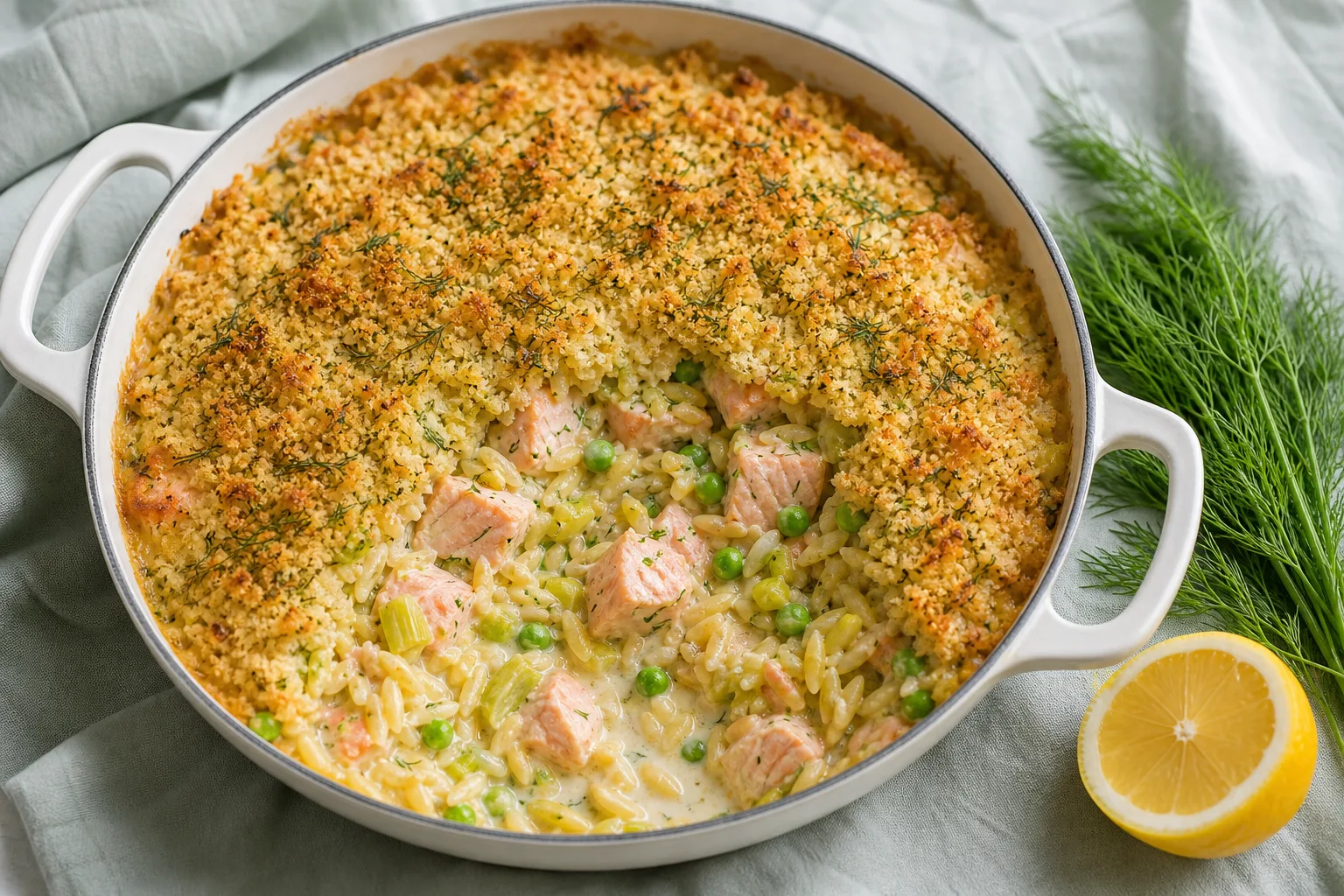

Baked salmon is a fifteen-minute proposition. A casserole is a thirty-minute one. Most salmon casserole recipes resolve that by splitting the difference at twenty-five minutes, which is how you get the thing I ate at a potluck a few years ago: dry, pale, slightly grainy cubes of fish sitting in a sauce that was fine on its own.
What finally fixed it for me was borrowing the move you already use on a roast. You do not cook a roast until it is done. You pull it before it is done and let the heat already inside it finish the job while it rests. Salmon is small, so the window is shorter, but the principle holds exactly.
So this bakes for eighteen minutes — not twenty-five, not thirty — and then sits on the counter under foil for ten. The cubes come out still faintly translucent at the center, and by the time I am carrying the dish to the table they are opaque, warm through, and still falling into soft flakes.
Why This Works
Salmon keeps cooking after it leaves the oven. A dish this size holds enough heat to carry the fish another five degrees of doneness during a ten-minute covered rest, so the oven only has to take it most of the way. Bake to done and the rest takes it past done, which is where dry, chalky salmon comes from.
Ingredients
Use a wide, shallow 3-quart dish — a 9×13 is ideal. Wide and shallow is what lets an eighteen-minute bake reach the middle.
For the Casserole
- 1 3/4 pounds skinless salmon fillet, cut into 1-inch cubes
- 12 ounces orzo
- 3 tablespoons unsalted butter
- 2 medium leeks, white and light green parts, sliced thin and rinsed well
- 2 cloves garlic, minced
- 1/4 cup all-purpose flour
- 2 1/2 cups chicken or fish stock, warmed
- 3/4 cup crème fraîche or full-fat sour cream
- 1 tablespoon Dijon mustard
- 2 tablespoons capers, rinsed and roughly chopped
- Zest and juice of 1 lemon
- 1/3 cup chopped fresh dill
- 1 1/2 cups frozen peas, straight from the freezer
- 1 1/2 teaspoons kosher salt, plus more for the orzo water
- 1/2 teaspoon black pepper
For the Dill Crumb Topping
- 1 cup panko
- 2 tablespoons unsalted butter, melted
- 2 tablespoons chopped fresh dill
- Zest of 1/2 lemon
- 1/4 teaspoon kosher salt
Easy Swap
Arctic char and steelhead trout behave almost identically and often cost less; both want the same eighteen minutes. Thick cod or halibut works but is leaner, so add two tablespoons of butter to the sauce. Canned salmon is a different recipe — already cooked, so fold it in at the end and bake 15 minutes just to brown the crumbs.
How to Make It
Prep: 30 minutes | Bake: 18 minutes | Serves: 6 to 8
- Heat the oven to 400°F and butter a 9×13 dish. Toss the panko with the melted butter, dill, lemon zest, and salt in a small bowl and set it aside.
- Boil the orzo in well-salted water for 5 minutes — about half the package time. Drain it, rinse briefly under cold water, and leave it in the colander. It will finish cooking in the sauce.
- Pat the salmon cubes dry and leave them on the cutting board at room temperature while you make the sauce. Cold fish out of the refrigerator will not make the eighteen-minute window.
- Melt the butter in a large deep skillet over medium heat. Cook the leeks with a pinch of salt for 7 to 8 minutes, stirring, until completely soft but not browned. Add the garlic for 30 seconds.
- Sprinkle the flour over the leeks and stir constantly for 90 seconds. Add the warm stock in three additions, whisking each one smooth, and simmer 4 minutes until it thickly coats a spoon.
- Take the pan off the heat and whisk in the crème fraîche, Dijon, capers, lemon zest and juice, dill, salt, and pepper. Taste it and make it slightly too bright and too salty — the orzo and nearly two pounds of fish will mute it.
- Fold in the orzo and the frozen peas, then add the salmon cubes and fold just enough to distribute them, five or six strokes. Pour it into the dish, nudge any cubes sitting proud of the surface down into the sauce so they are covered, and scatter the crumbs over the top.
- Bake 18 minutes. The sauce should be bubbling at the edges and the crumbs golden. Cut into one of the larger cubes — you want the very center still a shade darker and slightly translucent.
- Cover the dish loosely with foil and rest it on the counter for a full 10 minutes. Do not skip this and do not shorten it; this is where the salmon finishes. Serve straight from the dish.
Don’t Do This
Do not leave salmon cubes exposed on top of the sauce. Anything sitting above the surface gets direct oven heat with no insulation, and those pieces will be dry and crusted while the buried ones are perfect. Push every cube down until sauce closes over it before the crumbs go on.
Can You Make It the Night Before?
Not Fully — Here Is What You Can Prep
No, and this is the one where making ahead does the most damage. Raw salmon sitting overnight in a salted cream sauce half-cures: the outside of each cube goes firm and opaque and faintly hammy. Worse, a fridge-cold dish needs closer to thirty minutes to heat through, which destroys the short bake the whole recipe is built around. What you can prep is everything except the fish — sauce up to two days ahead, orzo a day ahead, crumbs whenever.
Keep the par-cooked orzo tossed with a teaspoon of oil in a covered container so it does not weld into a brick, and store the sauce separately. Rewarm the sauce in a saucepan over low heat with a splash of stock until it is loose and steaming before anything else goes in — folding raw salmon into a cold sauce guarantees you will need extra oven time, which is the exact thing you are protecting.
The buffer I actually use when I need to be hands-off at dinner time is different: sauce, orzo, and peas combined and warm in the dish, crumbs mixed, salmon cubed, and then I assemble and bake while people are having a drink. Eighteen minutes plus ten resting is twenty-eight minutes out of the kitchen.
Leftovers keep two days and reheat badly, which is true of all baked salmon. If you have them, I would eat them cold or barely warmed — flaked over greens with a squeeze of lemon is genuinely better than anything the microwave will do. Freezing is not worth attempting: crème fraîche splits on thawing and the salmon turns dense and fibrous.
Carryover Heat Is Doing the Last Few Minutes
A 9×13 dish coming out of a 400°F oven is a serious amount of stored heat: hot ceramic, two quarts of near-boiling sauce, and a crust that is hotter still. None of that stops working when the oven door closes. The temperature at the center of each salmon cube keeps climbing for several minutes before it starts to fall.
You can test this on yourself once and never doubt it again. Bake it the full twenty-five minutes some recipes call for, rest it the ten minutes the sauce needs anyway, and taste it. It will be dry. Twenty-five was not wrong because it is a bad number, but because it never accounted for what happens afterward.
The foil matters more than it looks like it should. Uncovered, the top of the dish sheds heat fast and the crumb crust goes slightly soft from the steam it traps underneath. Loosely tented foil keeps enough heat in to drive the carryover while still letting the crust breathe.
Worth Knowing
If your dish is glass rather than ceramic or enamel, start checking at sixteen minutes. Glass transmits heat to the contents faster and holds less of it afterward, so you get a quicker bake and a weaker rest.
Buying and Cutting the Salmon
Ask for a center-cut piece if you can. The tail end tapers, which means you cannot cut even cubes from it, and uneven cubes are the fastest way to get some pieces overdone and others raw in the same dish. A center cut of about an inch and a quarter thick gives you clean one-inch cubes with almost no trimming.
Buy it skin-on and remove the skin yourself, or ask the counter to do it — skin-on fillets are handled less and hold their moisture better. Run your fingers along the thickest part for pin bones before you cut; most farmed fillets are pin-boned already, but wild ones frequently are not. Then cut planks along the length and cross-cut the planks into cubes.
What Belongs in This Sauce
The sauce here is built on stock rather than milk, with crème fraîche stirred in off the heat. That is deliberate. A heavy milk-and-cream béchamel is lovely under tuna or in a gratin, but it coats salmon in a way that flattens it, and salmon has enough fat of its own that you are not adding richness so much as hiding the fish.
Acid and salt are what this dish actually wants: lemon juice, capers, Dijon, and more dill than feels reasonable. Those four are not garnish — they are the counterweight to the fat in the fish, and without them the whole thing tastes muffled no matter how well you cooked the salmon.
Add the crème fraîche off the heat and never let the sauce boil afterward. Cultured dairy curdles at a simmer, and a split sauce around pale pink fish looks exactly as bad as it sounds.
No Crème Fraîche?
Full-fat sour cream is the closest substitute and the one I use most often. Plain whole-milk Greek yogurt also works but is thinner and more sour, so cut it to half a cup and add two extra tablespoons of butter to the sauce.
Rachel’s Tip
Cut the cubes bigger than feels natural — a full inch, not half an inch. Small pieces have nowhere to hide from the heat and no mass to carry a rest, and they go from raw to overdone inside about three minutes. Big cubes are the single easiest insurance policy in this recipe.
Questions People Ask
How do I know the salmon is done if I’m pulling it early?
Cut a large cube in half at eighteen minutes. The outer two-thirds should be pale pink and flaking, and the very center still a deeper, slightly glassy pink. That center is what the rest converts. If the cube is uniformly opaque when you cut it, serve immediately rather than resting it the full ten minutes.
Can I use canned or leftover cooked salmon?
Yes, but it becomes a different recipe. Both are already cooked, so fold them in at the very end and bake 15 minutes purely to heat the base and brown the crumbs — and skip the ten-minute rest, since there is no carryover left to use. Leftover roasted salmon is better than canned here because it stays in larger flakes.
What is the white stuff that came out of my salmon?
Albumin, a protein that liquefies and gets squeezed to the surface when salmon cooks hard or fast. It is harmless and tasteless, but it is a useful signal: a lot of white curd means the fish went too hot for too long, and is a sign to pull the dish two minutes earlier next time.
Can I use frozen salmon?
Yes. Thaw it overnight in the refrigerator rather than in water, then pat it very dry and let the cubes sit out fifteen minutes first. Thawed salmon sheds more liquid than fresh, so if the sauce looks thin coming out of the oven, that is why — it tightens during the rest.
Why did my orzo turn to mush?
It was boiled too long before it went into the dish. Orzo is small and keeps absorbing liquid in a hot sauce, so five minutes in the water is genuinely enough — it should still be firm, almost crunchy, when you drain it. The same goes for any small pasta here. Half the package time, drain, rinse, done.
For the pantry version of this idea, built on canned tuna and egg noodles instead of fresh fish and orzo, see: Tuna Noodle Casserole Without the Chalky Tuna.
About This Article

Written by Rachel Thompson. Rachel Thompson is a home cook who has spent over 10 years making an unreasonable number of dips, appetizers, and party spreads — no culinary training, just a decade of trial and error and a reputation among friends for always being asked to "bring a dip." She focuses on approachable recipes that combine bold flavors with simple techniques, making entertaining at home accessible to everyone. More about this site.
Scope and limits. Rachel is a home cook with no culinary training. Follow current food safety guidance for holding temperatures and time limits whenever you are serving people other than yourself.
Verify this against a primary source
Specifics change, and your situation may differ from the one described here. These are the authorities worth checking directly:
- FoodSafety.gov — cold holding, hot holding and the two-hour rule
- USDA FoodData Central — ingredient composition and nutrition data
- USDA Food Safety and Inspection Service — safe minimum temperatures and leftovers