
Everybody has eaten the bad version of this. The noodles have gone to paste, the sauce is faintly grainy, and the tuna has turned into dry gray flakes that squeak against your teeth. Then somebody says the dish is just like that, and we all eat it anyway.
It isn’t just like that. The tuna is the problem, and the problem is simple: the tuna in your can was already cooked twice before you bought it — once before canning, once in the can under pressure. Forty minutes in a hot oven is the third cooking, and the third cooking is where it goes chalky.
So this version treats the tuna as the last ingredient instead of the first. Sauce on the stove, noodles pulled underdone, tuna folded in off the heat, and twenty minutes in the oven — long enough to brown the crumbs and no longer.
Why This Works
Canned tuna arrives fully cooked, so every minute in the oven is a minute of overcooking. Building the sauce on the stove and folding the tuna in off the heat means the casserole only needs twenty minutes to brown and heat through — short enough that the fish stays in flakes.
Ingredients
This fills a 9×13 dish and feeds six generously, or eight with a salad. It halves cleanly into an 8×8 with no change to the oven time.
For the Casserole
- 12 ounces wide egg noodles
- 4 tablespoons unsalted butter
- 1 medium yellow onion, diced small
- 2 ribs celery, diced small
- 8 ounces cremini mushrooms, sliced
- 2 cloves garlic, minced
- 1/4 cup all-purpose flour
- 2 1/2 cups whole milk, warmed
- 1/2 cup heavy cream
- 6 ounces sharp cheddar, grated
- 2 teaspoons Dijon mustard
- 1 tablespoon fresh lemon juice
- 1 1/2 cups frozen peas, straight from the freezer
- Three 5-ounce cans oil-packed tuna, drained well
- 1 1/4 teaspoons kosher salt, plus more for the noodle water
- 1/2 teaspoon black pepper
- 1/4 teaspoon freshly grated nutmeg
For the Crumb Topping
- 1 cup panko
- 1/2 cup crushed buttery crackers
- 3 tablespoons unsalted butter, melted
- 1/4 cup grated Parmesan
- 2 tablespoons chopped parsley, for serving
Easy Swap
Canned salmon drops into exactly the same place — two 6-ounce cans, and crush the soft vertebrae into the sauce rather than picking them out. What does not work is imitation crab, which goes watery and faintly sweet under a cheese sauce.
How to Make It
Prep: 25 minutes | Bake: 25 minutes | Serves: 6 to 8
- Heat the oven to 400°F and butter a 9×13 dish. Toss the panko, crackers, melted butter, and Parmesan together and set aside.
- Boil the noodles in well-salted water for two minutes less than the shortest time on the box — bendy but still chalky in the middle. Drain, rinse under cold water fifteen seconds, and leave them in the colander.
- Melt the butter in a large deep skillet over medium-high heat. Add the mushrooms in close to a single layer, leave them alone 3 minutes, then stir and cook 4 minutes more until their liquid has cooked off and the edges brown.
- Add the onion and celery, drop to medium, cook 5 minutes until soft. Add the garlic for 30 seconds.
- Sprinkle the flour over the vegetables and stir constantly 90 seconds. Add the warm milk in three additions, whisking each smooth before the next, then the cream. Simmer 4 minutes until it coats a spoon thickly.
- Take the pan off the heat. Stir in the cheddar a handful at a time, then the Dijon, lemon juice, salt, pepper, and nutmeg. Taste it — it should read slightly too salty and too sharp, because a pound of noodles and a pound of fish are about to flatten it out.
- Fold in the frozen peas and the noodles. Now break the tuna into large flakes with a fork straight over the pan and fold it through with no more than six strokes. Stop while you can still see distinct pieces of fish.
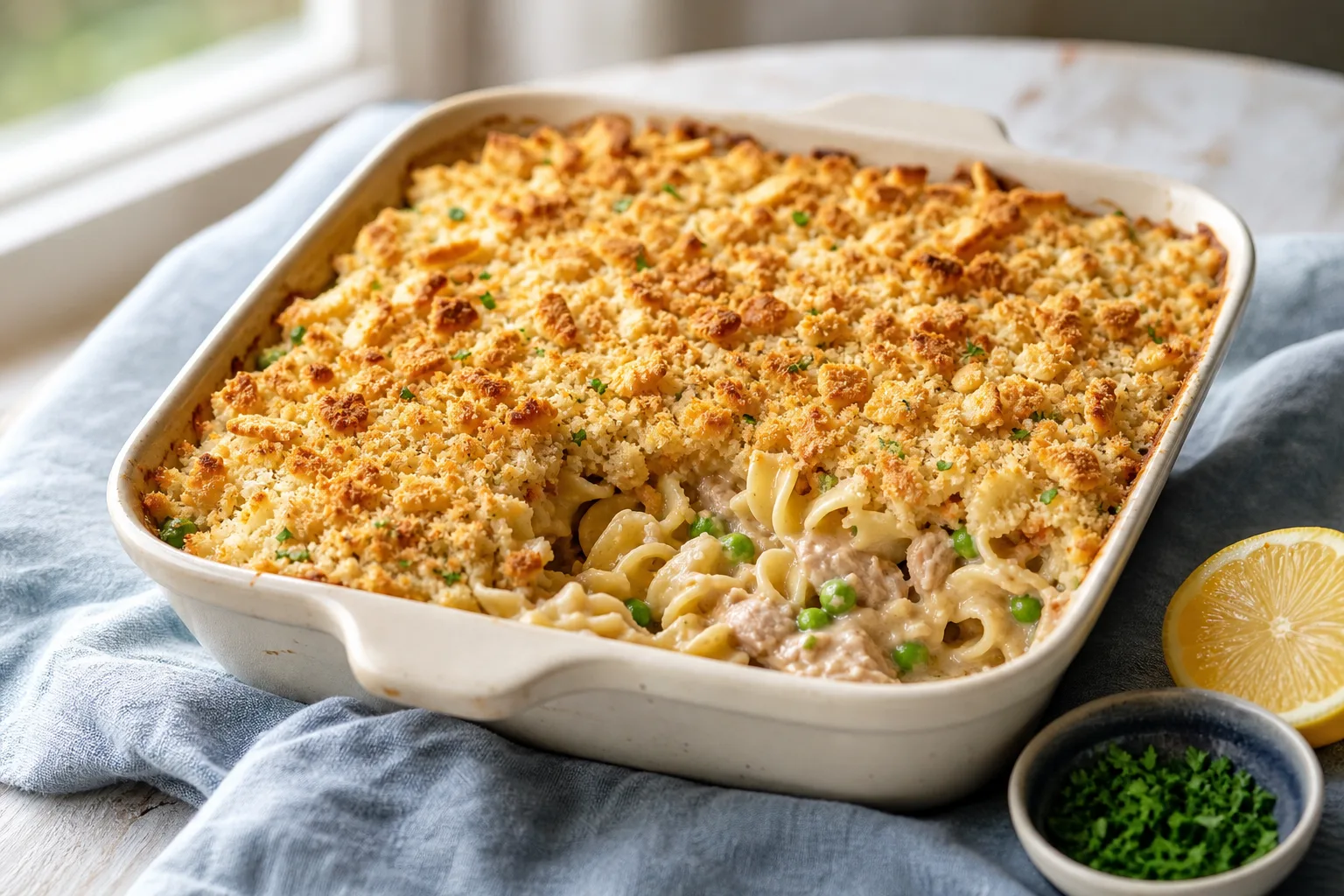
- Scrape it into the dish, level it without packing it down, and scatter the crumbs over the top. Bake 20 minutes, until the crumbs are deep golden and the sauce bubbles around the edge. Rest 10 minutes, scatter the parsley, serve.
Don’t Do This
Do not stir the tuna in while the pan is still on the burner, and do not use a whisk or a wooden spoon on it. Both are how tuna goes from flakes to paste. Off the heat, rubber spatula, count your strokes.
Can You Make It the Night Before?
Yes — Assemble Up to 24 Hours Ahead
This is the one seafood casserole in my rotation that genuinely makes ahead, because the tuna is already cooked and cannot be ruined by sitting. Assemble fully through step 7, cover, and refrigerate up to 24 hours — but keep the crumb topping separate at room temperature, and add 10 minutes to the bake.
Take the dish out of the refrigerator 30 to 40 minutes before it bakes. A cold 9×13 needs about 30 minutes to heat through instead of 20, and that extra time is the one window where the tuna can dry out. Do not make the oven do work the counter will do for free.
The noodles drink up a noticeable amount of sauce overnight, which is exactly why they went in underdone. If it looks tight when you pull the wrap off, stir in two or three tablespoons of milk before the crumbs go on. That is the whole correction.
It freezes better than most dairy casseroles, with one caveat: freeze it without the topping and thaw overnight in the refrigerator. The sauce looks slightly split when it first warms and comes back together as it bakes. The pea color does not come back — it goes army green in the freezer and stays there.
The Noodles Matter More Than You Think
Egg noodles are traditional here and also the most fragile pasta in the cupboard: thin, soft, and still cooking in hot sauce long after the water is gone. Boiling them to package directions and then baking them forty minutes is how you get the sticky noodle mat people remember from school lunch.
Pull them two minutes early and rinse them. The rinse is not optional even though it washes off starch — you are trading a little sauce cling for noodles that still have edges, and the extra cream buys the cling back. Cavatappi and medium shells are sturdier and need no change to the timing. Avoid anything long; spaghetti tangles into one unservable lump.
A Shortcut Worth Knowing
If you forgot to warm the milk, microwave it 90 seconds rather than pouring it in cold. Cold milk into a hot flour paste is the main cause of lumps, and you will spend longer whisking them out than you would have spent warming it.
Oil-Packed Tuna Is Not a Snob Thing
I used to buy water-packed because it was cheaper and I assumed the oil was fat I did not need. Then I made this twice in one week with one of each, and the oil-packed version was moister in a way that was hard to argue with.
Water-packed tuna leaches its own moisture into the packing water and you pour that away. Oil-packed tuna can’t leach into oil the same way, so more of it stays in the fish. Drain the oil off anyway. If water-packed is all you have, fork a tablespoon of olive oil through it first.
Taking It to a Potluck Without Ruining It
Here is the thing nobody warns you about: a casserole sitting on a warming tray is still cooking. A 9×13 dish of dairy sauce holds an enormous amount of heat, and tuna that was perfect at the oven door will be chalky an hour into a buffet. If the dish has to hold, underbake it by five minutes and then get it off the heat source entirely. A covered dish on a counter stays hot enough to serve for a good forty-five minutes without cooking anything further.
Doubling it for a bigger table means two 9×13 dishes side by side, not one deep pan. A deep pan needs thirty-five to forty minutes to heat through, and that extra time lands squarely on the fish. Two shallow dishes bake in the same twenty minutes the single recipe does — rotate them halfway through if your oven has a hot spot, which most do.
For transport, bake it at home, cover it with foil and then a kitchen towel, and resist reheating it when you arrive. Reheating is the third cooking all over again. If the drive was long enough that it has gone lukewarm, twelve minutes at 325°F under foil is the most I would give it.
Rachel’s Tip
Drain the cans, then drain them again — press the lid down into the can over the sink for a slow count of ten. A badly drained can leaves nearly two tablespoons behind, and six tablespoons of fishy water is the difference between a sauce that clings and one that pools.
Questions People Ask
Why is my tuna noodle casserole dry?
Two causes, and they stack. Past about 25 minutes at 400°F the tuna has given up its moisture into a sauce that is itself evaporating. And the noodles keep absorbing liquid for as long as they are hot, so a casserole that looked saucy going in can come out dry with nothing having leaked anywhere.
Can I use canned cream of mushroom soup instead?
You can, and the classic recipe does: two cans plus a cup of milk, no roux. It saves twelve minutes and tastes distinctly of canned soup. Either way, brown the mushrooms separately and fold the tuna in off the heat.
Do I have to cook the mushrooms first?
Yes, or leave them out. Raw mushrooms are mostly water, and in a casserole that water has nowhere to go but your sauce. Browning them in butter drives it off and adds the savory depth that makes this taste like more than cheese and noodles.
How do I reheat leftovers without wrecking them?
Individual portions in a 325°F oven under foil for about 15 minutes, with a teaspoon of milk spooned over first. The microwave heats unevenly and the tuna takes the hit — hot edges, chalky fish in the middle. Leftovers keep three days.
Can I use a crunchy topping other than crumbs?
Crushed potato chips are the old-school answer and they work, though they soften faster than panko — put them on for the last ten minutes only. Crushed cornflakes stay crisp the longest of anything I have tried. I would skip crispy fried onions here; they fight with the lemon and the Dijon rather than adding anything.
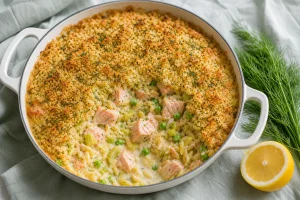
For a fresh-fish take with orzo, leeks and dill, where the bake is cut short and carryover heat finishes the fish, see: Salmon Casserole: Pull It Early and Let It Finish on the Counter.
About This Article

Written by Rachel Thompson. Rachel Thompson is a home cook who has spent over 10 years making an unreasonable number of dips, appetizers, and party spreads — no culinary training, just a decade of trial and error and a reputation among friends for always being asked to "bring a dip." She focuses on approachable recipes that combine bold flavors with simple techniques, making entertaining at home accessible to everyone. More about this site.
Scope and limits. Rachel is a home cook with no culinary training. Follow current food safety guidance for holding temperatures and time limits whenever you are serving people other than yourself.
Verify this against a primary source
Specifics change, and your situation may differ from the one described here. These are the authorities worth checking directly:
- FoodSafety.gov — cold holding, hot holding and the two-hour rule
- USDA FoodData Central — ingredient composition and nutrition data
- USDA Food Safety and Inspection Service — safe minimum temperatures and leftovers