
French toast for a crowd is a bad deal for whoever is cooking. Four slices at a time in a skillet, the first batch going cold and leathery in the oven while you dip the next one, and a kitchen that smells like scorched butter by the end of it. Nobody has ever enjoyed making French toast for nine people.
A casserole fixes the logistics, but the versions that circulate tend to have one of two problems. Some of them are just bread sitting in sweetened milk — the cubes stay distinct and chewy, the bottom is wet, and it tastes like the idea of French toast rather than the thing. Others go so far the other way that they turn into a dense, wet pudding you eat with a spoon.
What separates the good ones is that the custard is a genuine custard, with enough egg to actually set, and that it gets the hours it needs to move into the bread. This is the one category of breakfast casserole where making it the night before is not a convenience. It is the recipe.
Why This Works
Enriched bread like challah or brioche takes hours to absorb custard all the way to the middle of a one-inch cube. Give it eight, and the cube is uniformly saturated and sets into something custardy and sliceable. Give it forty minutes and the custard only penetrates the outer eighth of an inch, which is why short-soak versions have a wet layer underneath and dry, chewy cubes on top at the same time.
Ingredients
This is a 9×13 dish. It cuts into ten portions, which is generous — it is rich enough that most people do not go back for seconds.
For the Casserole
- 1 pound challah or brioche, cut into 1-inch cubes (about 10 cups, one standard loaf)
- 8 large eggs
- 2 cups whole milk
- 1 cup heavy cream
- 2/3 cup packed light brown sugar
- 2 tablespoons pure maple syrup
- 1 tablespoon vanilla extract
- 2 teaspoons ground cinnamon
- 1/2 teaspoon freshly grated nutmeg
- 3/4 teaspoon kosher salt
- 1 tablespoon unsalted butter, softened, for the dish
For the Brown Sugar Streusel
- 3/4 cup all-purpose flour
- 2/3 cup packed light brown sugar
- 1 teaspoon ground cinnamon
- 1/4 teaspoon kosher salt
- 6 tablespoons cold unsalted butter, cut into small cubes
For Serving
- Warm maple syrup
- Powdered sugar, for dusting
- Fresh berries, if you have them
Bread Options, Ranked Honestly
Challah is my first choice and brioche is a close second — both are rich enough to taste like French toast on their own. A plain country loaf or sourdough works and gives a less sweet, more structured result that I actually prefer with a lot of syrup. Cinnamon raisin bread is good if you like it. Soft sliced sandwich bread is the one real failure: it has no crumb to speak of and dissolves.
How to Make It
Prep: 25 minutes | Bake: 55 minutes | Serves: 8 to 10
- Cube the bread and butter a 9×13 dish. If the loaf is fresh, spread the cubes on a sheet pan and dry them in a 300°F oven for 15 minutes, then cool them completely. Challah and brioche are soft and sweet, and fresh ones turn to mush in a long soak.
- Whisk the eggs alone for a full minute, until there is no trace of clear white left. Then whisk in the milk, cream, brown sugar, maple syrup, vanilla, cinnamon, nutmeg, and salt, and keep going until the brown sugar has fully dissolved rather than settled on the bottom of the bowl.
- Pile the bread into the dish and pour the custard evenly over it. Press the whole surface down with a spatula in slow passes until the top cubes have gone wet and darker. Cover tightly and refrigerate 8 to 14 hours.
- Make the streusel now, while you are already in the kitchen. Stir the flour, brown sugar, cinnamon, and salt together, add the cold butter, and rub it in with your fingertips until the mix holds together in clumps ranging from crumbs to pea-sized. Refrigerate it in a separate bag or container overnight. It does not go on the casserole yet.
- In the morning, take the dish out of the refrigerator and let it sit on the counter 30 minutes. Heat the oven to 350°F.
- Press the top down one more time — overnight the bread floats slightly and the top layer can dry out — then break up the cold streusel with your fingers and scatter it evenly over the whole surface.
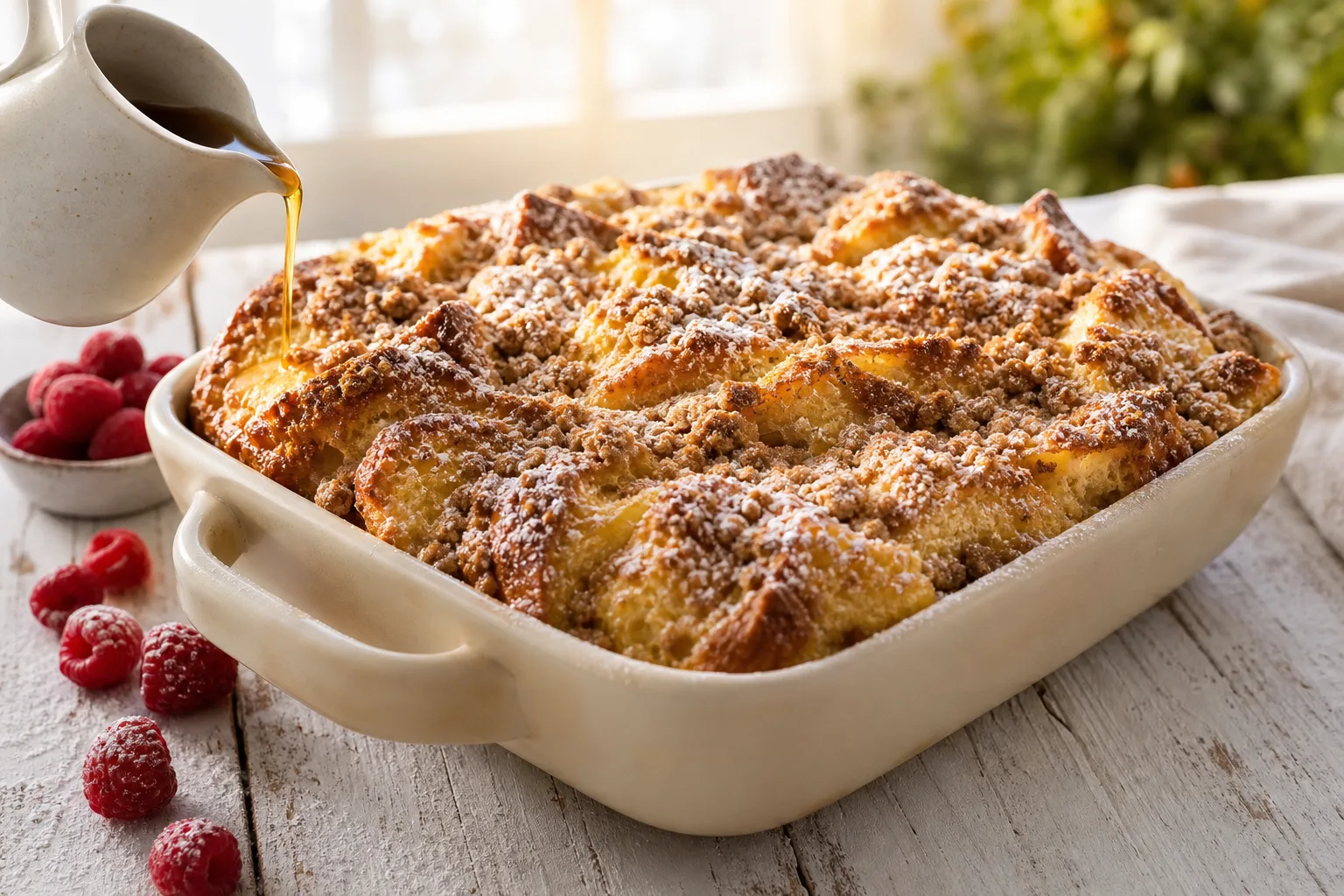
- Bake uncovered 45 to 55 minutes. You want a puffed top, a deeply browned and crisp streusel, and a knife that comes out of the center clean. If the streusel is getting dark before the center sets, tent a sheet of foil loosely over the dish for the last 10 minutes.
- Rest it 15 minutes. It will deflate, which is normal and expected. Dust with powdered sugar, cut into squares, and pass the warm maple syrup at the table rather than pouring it over the pan.
Don’t Soak It Longer Than Overnight
Unlike a savory bread-and-egg casserole, this one has a real ceiling. Sweet enriched bread plus a sugary custard breaks down fast, and two full days in the refrigerator leaves you with a pan of wet paste and a layer of separated liquid. If you need to get further ahead than one night, make the streusel and cube the bread early and leave the custard for the evening before.
Can You Make It the Night Before?
Yes — Assemble Up to 24 Hours Ahead
This one is not just make-ahead friendly, it genuinely requires it. Assemble through the custard pour and refrigerate 8 to 14 hours, with 6 as the hard floor. Make the streusel the same night but keep it in a separate container and scatter it on just before the dish goes in the oven — that is the one component that must not soak.
Streusel mixed into the surface overnight does not survive. The butter softens, the brown sugar dissolves into the custard underneath, and what should be a craggy crisp crust bakes into a flat sweet skin that is indistinguishable from the casserole below it. Scattered on cold in the morning, the butter pieces are still solid when they hit the oven, and that is what gives you the crumb texture.
There is an upper limit here, and it is lower than people expect. Challah and brioche are soft to start with. At 8 to 14 hours the cubes are saturated but still hold their shape at the edges, which is what makes the cut surface interesting to look at and to eat. Push past about 18 hours and the bread stops being bread — the whole pan turns into one dense, uniform pudding, pleasant enough with syrup but closer to a steamed cake than French toast.
Freezing is best done after baking. Bake it fully, cool completely, then cut and freeze portions wrapped tightly for up to two months, and reheat covered at 325°F for 20 to 25 minutes. The streusel loses some snap but it survives. Freezing it unbaked does not work at all: the custard separates on thawing and the bread, already saturated, turns to slurry.
Getting the Sweetness Right
The custard here is moderately sweet on its own, on the assumption that maple syrup is coming at the table. If you serve it without syrup, push the brown sugar in the custard up to a scant cup. If your crowd drowns everything in syrup, pull it back to half a cup — the streusel is already carrying a lot of sugar, and oversweetened French toast casserole gets cloying by the third bite in a way that plain French toast does not.
The salt is doing more work than the quantity suggests. Three-quarters of a teaspoon in a sweet custard reads as depth rather than saltiness, and leaving it out is the usual reason a dish like this tastes flat and one-note despite having plenty of sugar and vanilla in it.
What a Set Custard Looks Like Here
The streusel hides everything, so you cannot judge this one by color. Nudge the dish and watch the middle: a set custard moves as a single mass, and liquid ripples. A knife slid into the center should come out with moist crumbs clinging to it but no wet streaks of raw egg.
Expect a dramatic rise and an equally dramatic fall. This bakes up puffed and domed and then settles back down within five minutes of coming out of the oven. That is the custard firming as it cools, and it is also why the fifteen-minute rest matters — cut it hot and the squares slump into each other on the plate.
Weight the Top Down
Bread floats. After you cover the dish, set a smaller baking dish or a dinner plate directly on the surface so the top layer stays submerged all night. Without it, the cubes sticking up above the custard line dry out in the refrigerator air and bake into hard little bricks in an otherwise soft casserole.
Questions People Ask
Can I make it the same morning instead?
You can, with adjustments, but it is a different dish. Cut the bread into 1/2-inch cubes, warm the milk and cream to about body temperature before whisking them in, and give it 90 minutes on the counter with two rounds of pressing the top down. It comes out closer to a bread pudding with visible cubes. The overnight version is better, and this is the one recipe where I would genuinely plan around it.
Why is the top dry and crunchy but the bottom soggy?
The top cubes were above the custard line all night. Bread floats, so the surface layer sits in air in the refrigerator, dries out, and bakes hard, while all the liquid pools at the bottom. Press the top down before covering and weight it with a plate, and the problem goes away.
Can I use regular sandwich bread?
I would not. Soft sliced bread has almost no crumb structure and after eight hours in custard there is nothing left to give the casserole any texture — it bakes into a uniform dense layer. If sandwich bread is what you have, dry the cubes hard in a 300°F oven for 20 minutes first and cut the soak to three hours.
Can I prepare it two nights ahead?
No. Sweet enriched bread in a sugary custard breaks down much faster than savory bread does, and by 36 to 48 hours the bread has disintegrated and the custard has started to separate. One night is the plan. Cube the bread and make the streusel earlier if you need to spread the work out.
Can I add fruit to it?
Yes, but add it dry and add it on top rather than folding it through. Blueberries and sliced strawberries release a lot of juice, and buried in the custard overnight they stain the bread gray-purple and thin the liquid. Scatter them over the surface with the streusel in the morning, or just serve the fruit fresh alongside.
About This Article

Written by Rachel Thompson. Rachel Thompson is a home cook who has spent over 10 years making an unreasonable number of dips, appetizers, and party spreads — no culinary training, just a decade of trial and error and a reputation among friends for always being asked to "bring a dip." She focuses on approachable recipes that combine bold flavors with simple techniques, making entertaining at home accessible to everyone. More about this site.
Scope and limits. Rachel is a home cook with no culinary training. Follow current food safety guidance for holding temperatures and time limits whenever you are serving people other than yourself.
Verify this against a primary source
Specifics change, and your situation may differ from the one described here. These are the authorities worth checking directly:
- FoodSafety.gov — cold holding, hot holding and the two-hour rule
- USDA FoodData Central — ingredient composition and nutrition data
- USDA Food Safety and Inspection Service — safe minimum temperatures and leftovers