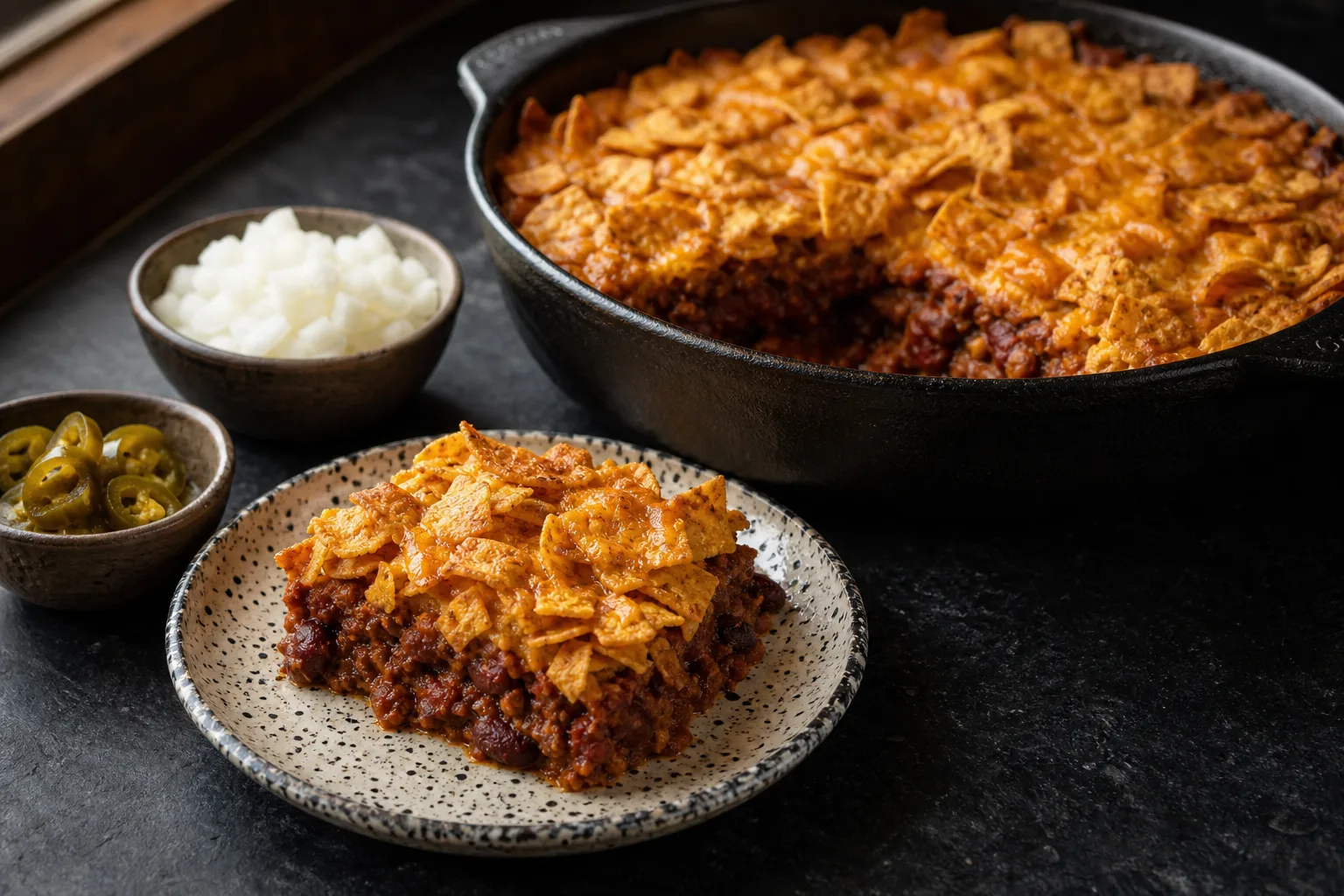

Frito pie casserole fails in one specific way, and you only find out once you cut into it: the bottom third has turned to gray paste. The chili tasted great in the pot. The chips came out of a fresh bag. Somewhere in twenty minutes the two of them became wet cornmeal.
The chips are rarely the problem. The chili is. Most of us reduce chili to the consistency we want in a bowl, which is correct when there is a bowl holding it up. Here the chips are the vessel, and a vessel made of fried masa has very little tolerance for standing liquid.
So this is a recipe for chili reduced further than you would otherwise take it, plus a layering order that protects the top chips. The gap between the loose version and the thick one is the difference between serving this with a spatula and serving it with a ladle and an apology.
Why This Works
Chili in a bowl can be as loose as you like, because the bowl does the structural work. Here the chips are the structure, and standing liquid dissolves fried masa from the inside within minutes. Reduce until a spoon dragged across the pot bottom leaves a channel that stays open for a slow count of three, and the bottom layer softens into something closer to a tamale than to sludge.
Ingredients
This fills a 9×13 dish — six main-course servings, eight with a salad. Do not use an 8×8: a deeper chili layer puts more moisture on the same bottom crust.
For the Chili
- 2 pounds ground beef, 80/20
- 1 large yellow onion, diced small
- 4 cloves garlic, minced
- 3 tablespoons chile powder (the mild dark blend sold as chili powder)
- 1 tablespoon ground cumin
- 1 teaspoon dried oregano, crumbled between your fingers
- 1/2 teaspoon ground chipotle or cayenne
- 2 tablespoons tomato paste
- 1 (15-ounce) can tomato sauce
- 1 (14.5-ounce) can diced tomatoes, drained well
- 1 (15-ounce) can pinto beans, drained and rinsed
- 1 cup beef broth
- 1 tablespoon masa harina or fine cornmeal
- 1 tablespoon cider vinegar
- 2 teaspoons kosher salt, plus more to taste
- 1 teaspoon black pepper
For Layering and the Top
- 9 to 10 ounces corn chips (about 7 cups, loosely packed)
- 12 ounces sharp cheddar, grated from a block (about 3 cups)
- 1/2 small white onion, diced fine, for serving
- 1/3 cup pickled jalapeno slices, drained, for serving
- 2 tablespoons chopped cilantro, optional, for serving
Easy Swap
Beans in or out is a real argument, not a silly one. Texas chili purists leave them out, and a bean-free version is darker and meatier but noticeably looser, because the beans were quietly doing part of the thickening. If you skip them, raise the beef to 2 1/2 pounds and reduce four or five minutes longer. Kidney beans hold their shape better than pinto over a twenty-minute bake.
How to Make It
Prep: 60 minutes | Bake: 20 minutes | Serves: 6 to 8
- Heat the oven to 350°F. Dice the onion, mince the garlic, and measure the chile powder, cumin, oregano, and chipotle into one small bowl together — they hit hot fat fast and you will not have time to hunt for jars.
- Brown the beef in the widest heavy pot you own over medium-high heat, in two batches. Press each batch flat, leave it alone for 4 minutes, then break it into chunks and cook 3 minutes more. You want deep brown patches, not uniform gray. Scrape each batch into a colander.
- Pour off all but about 2 tablespoons of the rendered fat. Cook the onion in it over medium heat for 6 minutes, then add the garlic and the tomato paste and stir for 2 full minutes, until the paste darkens from red to brick.
- Bloom the spices. Tip the whole bowl of spice into the hot fat and stir constantly for 45 seconds. It smells raw, then suddenly toasted. Stop there — chile powder turns bitter fast, and fifteen extra seconds shows up in the finished dish.
- Add the tomato sauce, drained diced tomatoes, broth, vinegar, salt, and pepper, then return the beef to the pot. Simmer uncovered for 20 minutes, stirring every 5 so the bottom does not catch. Stir in the beans and simmer 5 minutes more.
- Now reduce it. Sprinkle the masa harina over the surface, stir it in, and hold an active simmer, uncovered, for 8 to 12 minutes, stirring often. Drag a wooden spoon across the bottom of the pot: when the channel stays open for a slow count of three before filling in from the sides, it is ready. Fix the salt now — once the chips are in you cannot stir anything.
- Spread about 4 cups of chips across the bottom of a 9×13 dish. Ladle all the chili over and level it into the corners so no patch sits under a deep puddle. Scatter 2 cups of cheddar over the chili, then the remaining chips in a loose layer, then the last cup of cheese over the chips.
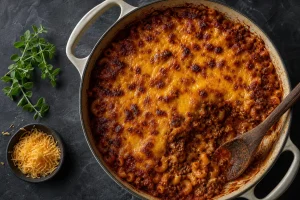
- Bake uncovered for 18 to 20 minutes, until the top cheese browns at its edges and the chili bubbles up the sides. Rest 5 minutes — no longer, this one does not improve with sitting — then scatter the raw onion, pickled jalapenos, and cilantro over the top.
Don’t Do This
Do not put the cheese under the top layer of chips. Cheese melted over chips works as a lid, keeping the steam off the chili from condensing on them. Cheese melted under them is a hot wet layer with chips sitting on it, and twenty minutes later there is no crunch left in the pan.
Can You Make It the Night Before?
Not Fully — Here Is What You Can Prep
Not as an assembled dish. Chips sitting in cold chili overnight come out of the refrigerator already ruined, and oven time does not bring them back. What you can do is make the chili up to three days ahead — it genuinely improves — then reheat it, re-check the thickness, and layer and bake on the day.
The chili is the hour-long part, so making it ahead takes nearly all the work off the day of. Cook it through the reduction step, cool it uncovered for half an hour, and refrigerate it sealed up to three days. The chile powder and cumin keep settling into the fat overnight, and the second-day version tastes rounder.
Reheat it in a wide pot over medium-low, not the microwave, and expect the thickness to have moved — cold chili sets up hard and then loosens unpredictably as it warms. Taste it, add a splash of broth if it has gone past spreadable into stiff, and run the spoon-drag test once more before committing it to a pan of chips.
Freeze the chili alone up to three months; thawed chili weeps water, so plan on five extra minutes of simmering. Do not freeze the assembled casserole either way — corn chips do not survive it.
How Thick Is Thick Enough
The closest description is canned refried beans straight out of the can: spreadable, holding its own shape, not pourable. Thickness is hard to judge by eye in a dark pot, so I stopped trying. Pull a wooden spoon across the bottom in one straight line and watch the channel it leaves. Closes instantly means soup, and about ten more minutes. Stays open for a slow count of three and then fills in lazily — that is the dish.
If the channel stays open indefinitely and its edges look dry, you have gone past it. Stir in a quarter cup of broth, because chili that stiff crushes chips instead of spreading over them. What those last minutes remove is free water, not flavor. A cup of chili that is perfect over rice can release a tablespoon of standing liquid into a baking dish, and one tablespoon takes the chips under it from firm to paste.
The Test Beats the Clock
Any reduction time I give you is half a lie, because reduction is surface area, not minutes. The same chili tightens up in eight minutes in a wide Dutch oven and twenty-five in a tall saucepan. Widest pot you own, lid off, trust the spoon.
The Bottom Layer Will Soften — The Only Question Is Into What
There is no version of this dish where the bottom chips stay crisp, so crunch down there is not the goal. The good kind of soft is. The good kind tastes like a tamale: fried masa that has taken on chili fat and a controlled amount of moisture goes dense and slightly chewy, with a browned, almost crusted underside where it met the hot dish. The bad kind is what standing liquid does — the masa goes past saturated and collapses into a gray paste with no corn flavor left in it, because the flavor leached out into the liquid it was sitting in.
All of your leverage is before the dish goes in. Thick chili, spread level so no corner sits under a puddle. A generous bottom layer rather than a thin scattering, because a single layer has nothing to sacrifice. And a hot enough oven: chips at 350°F for twenty minutes are fine, the same chips at 300°F for forty are not.
Where Frito Pie Comes From, and Why Nobody Can Settle It
Two origin stories circulate widely and I can verify neither. One credits the lunch counter at a Woolworth’s in Santa Fe, where a version served in a split-open bag became a local institution. The other credits the Frito company itself, and that telling gets repeated just as confidently.
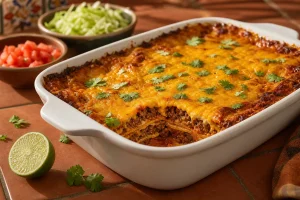
I am not going to pick. The claims conflict, both have long-standing defenders, and food history gets repeated in recipe introductions far more often than it gets checked. What is not disputed is the shape of the thing: chili, corn chips, cheese, raw onion, eaten hot and fast. The casserole is a later convenience, a 9×13 dish instead of a bag. If you want the same flavors on tortillas instead of chips, taco casserole is the tortilla-layered relative, and it handles sogginess a completely different way.
Rachel’s Tip
Crush a handful of chips into coarse crumbs and stir them into the chili two minutes before it comes off the heat. It sounds like a shortcut and it is actually a thickener — corn chips are fried masa, so they do the masa harina’s job while tasting like what is already in the dish.
Questions People Ask
Why did my Frito pie casserole turn to mush?
The chili was too loose. Bowl-consistency chili carries enough free water to saturate the bottom chips within minutes, and nothing later undoes it. Reduce uncovered until a dragged spoon leaves a channel that holds for a slow count of three. The other culprits are a pan that is too small, which deepens the chili layer, and an oven below 350°F, which stretches the chips’ time in contact with moisture.
Can I use canned chili instead of making it?
Yes, but not straight from the can — canned chili is built to be eaten as a bowl of chili, which is thinner than this dish can carry. Simmer three 15-ounce cans uncovered in a wide pot for 10 to 15 minutes until it passes the spoon test, then wake it up with a tablespoon of cider vinegar and half a teaspoon of cumin.
Can I use tortilla chips instead of corn chips?
They behave differently, and not in your favor. Corn chips are dense extruded masa, thick all the way through, which is what lets the bottom layer take on fat and still hold together. Tortilla chips are thin pressed sheets with far less to give, and they go limp almost immediately. Use thick restaurant-style ones if they are what you have.
How do I reheat leftovers?
Oven, uncovered, 350°F for about 15 minutes, with a fresh handful of chips and a little cheddar over the portion first. The original chips will not come back, but the new ones give back the contrast, and the chili itself reheats beautifully.
About This Article

Written by Rachel Thompson. Rachel Thompson is a home cook who has spent over 10 years making an unreasonable number of dips, appetizers, and party spreads — no culinary training, just a decade of trial and error and a reputation among friends for always being asked to "bring a dip." She focuses on approachable recipes that combine bold flavors with simple techniques, making entertaining at home accessible to everyone. More about this site.
Scope and limits. Rachel is a home cook with no culinary training. Follow current food safety guidance for holding temperatures and time limits whenever you are serving people other than yourself.
Verify this against a primary source
Specifics change, and your situation may differ from the one described here. These are the authorities worth checking directly:
- FoodSafety.gov — cold holding, hot holding and the two-hour rule
- USDA FoodData Central — ingredient composition and nutrition data
- USDA Food Safety and Inspection Service — safe minimum temperatures and leftovers