
The first three times I made John Wayne casserole, the crust was raw. Not undercooked in the oven-timer sense — genuinely wet, a pale gray layer of dough at the bottom of the dish that had been sitting in beef fat for half an hour and had given up entirely.
That is the whole difficulty with this dish, and almost nobody mentions it. A biscuit crust is flour and fat and leavening, and it gets its structure from steam pushing the layers apart in a hot, dry environment. Pile two pounds of insufficiently drained ground beef on top of it and you have taken away both the heat and the dry.
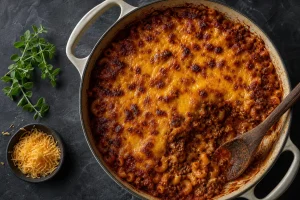
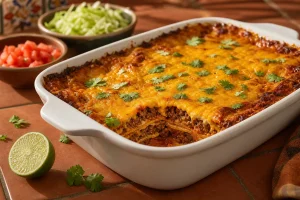
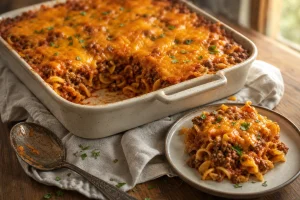
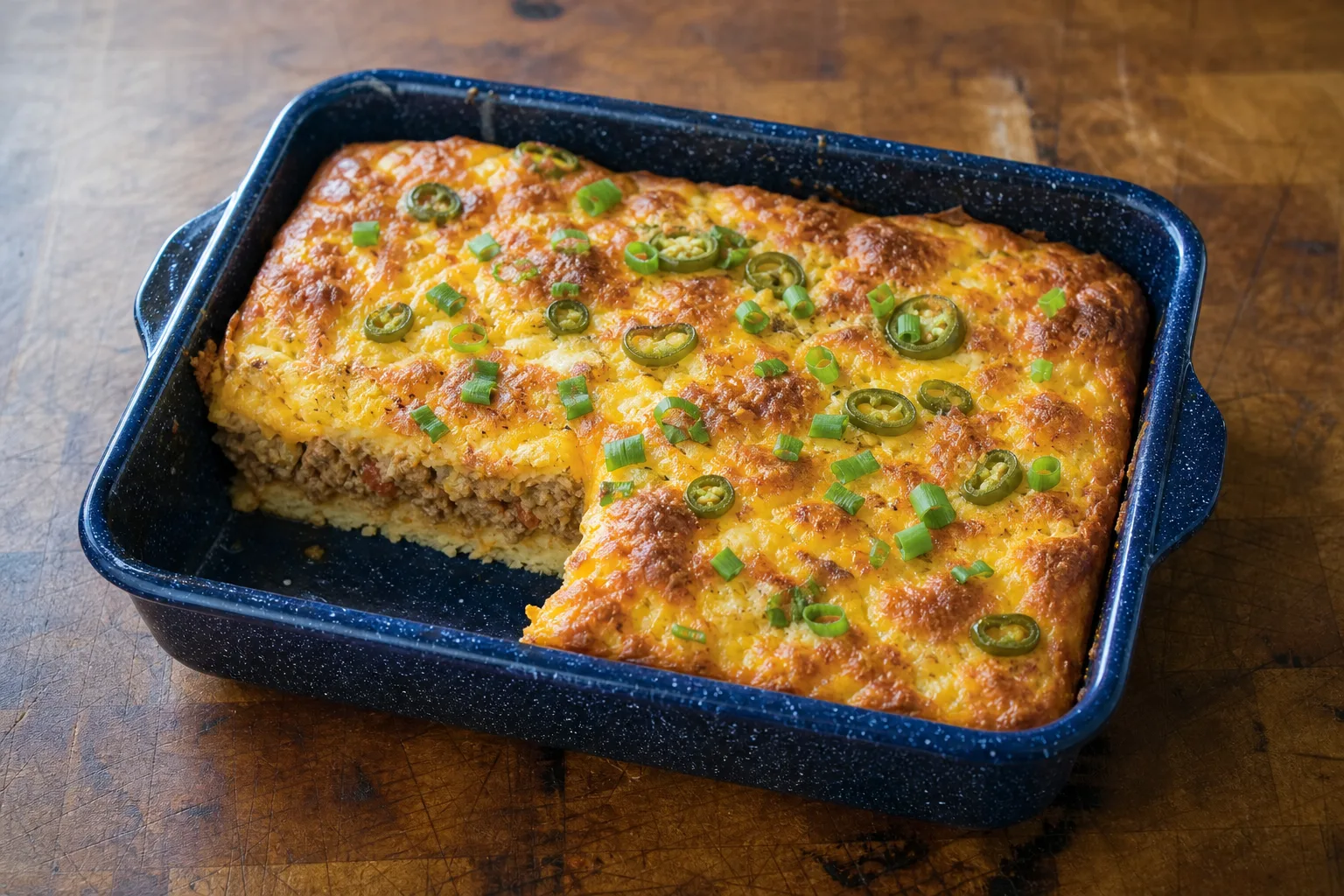
Fixed, it is one of the best things in this whole category: a crisp bottom, a layer of chile-spiked beef, and a puffed cheddar-and-sour-cream top that browns in peaks. It is also enormous, which is part of why people bring it to things.
Why This Works
The crust gets par-baked naked for ten minutes before anything touches it, and the beef goes on bone dry. Those two moves let the dough set its structure in dry heat first, so when the fat and moisture do arrive, the crust is already a crust and can only soften at the very surface rather than all the way through.
Ingredients
This is a full 9×13 and it is heavy — figure eight large portions, or ten alongside a slaw or a green salad.
For the Crust
- 2 (16-ounce) cans refrigerated biscuits, 8 biscuits each
- 1 tablespoon unsalted butter, for the dish
For the Beef Layer
- 2 pounds ground beef, 85/15
- 1 large yellow onion, diced
- 1 poblano pepper, seeded and diced
- 1 (4-ounce) can diced green chiles, drained
- 3 cloves garlic, minced
- 1 tablespoon chili powder
- 2 teaspoons ground cumin
- 1 teaspoon dried oregano
- 1 tablespoon tomato paste
- 1 (14.5-ounce) can diced tomatoes, drained very well
- 2 teaspoons kosher salt
- 1/2 teaspoon black pepper
For the Top
- 1 cup sour cream, at room temperature
- 3/4 cup mayonnaise
- 12 ounces sharp cheddar, grated from a block (about 3 cups)
- 1 to 2 jalapenos, sliced thin, seeds in or out as you like
- 4 green onions, sliced, white and green parts separated
Easy Swap
No refrigerated biscuits, or you would rather not use them: a batch of cornbread batter baked in the dish for 15 minutes makes a very good base and is sturdier against moisture than biscuit dough. What does not work is crescent roll dough, which is too thin and too sweet, or pressing in raw pie crust, which turns to paste under the beef.
How to Make It
Prep: 30 minutes | Bake: 45 minutes | Serves: 8 to 10
- Heat the oven to 350°F and butter a 9×13 baking dish. Open both cans of biscuits, press them into the bottom of the dish, and pinch the seams closed with your fingers until it is one continuous sheet of dough with no gaps. Bake it empty for 10 minutes, until it is set and dry on top but barely colored. Leave the oven on.
- While the crust par-bakes, set a cast-iron or other heavy skillet over medium-high heat for 3 minutes. Add half the beef, press it flat, and let it sit untouched for 4 minutes. Break it up, cook 3 minutes more, and move it to a colander set over a bowl. Repeat with the second pound.
- This is the step that decides whether the crust survives: let the beef sit in the colander and drain for a full 2 minutes, then lay a folded paper towel on top and press down gently. You are looking for beef that no longer glistens. Discard the fat once it has cooled.
- Wipe the skillet, leaving the browned film on the bottom. Add a teaspoon of the reserved fat and cook the onion and poblano over medium heat for 7 minutes until soft. Add the garlic, chili powder, cumin, and oregano and stir for 45 seconds — the spices will smell toasted and the pan will look dry.
- Add the tomato paste and stir it for a minute, then the drained diced tomatoes and green chiles. Scrape up the browned bits, add the salt and pepper, and simmer 6 to 8 minutes until there is no loose liquid left in the pan at all. Stir the drained beef back in.
- In a bowl, mix the sour cream, mayonnaise, 2 1/2 cups of the cheddar, the jalapenos, and the white parts of the green onions. It will be thick, more like a spread than a sauce. That is right.
- Spread the beef mixture over the par-baked crust in an even layer, then dollop the cheese mixture over it and spread it gently to the edges. Scatter the last 1/2 cup of cheddar on top.
- Bake 28 to 30 minutes, until the top is puffed with brown peaks and the edges have pulled slightly from the dish. Rest it 10 minutes — the top is molten straight out of the oven and will slide off the slice — then scatter the green onion tops over it and cut into squares.
Don’t Do This
Do not skip draining the canned tomatoes, and do not substitute undrained canned tomatoes with green chiles for the two separate cans. A 14.5-ounce can holds nearly half a cup of liquid. It has nowhere to go in a covered-over casserole, so it goes down into the crust, and you will be eating the crust.
Can You Make It the Night Before?
Not Fully — Here Is What You Can Prep
Not as a finished casserole. Biscuit dough will not sit under a wet filling in the refrigerator overnight and recover — you get the raw gray layer this recipe exists to avoid. What you can do is make the entire beef layer up to three days ahead and keep it cold, which is most of the work.
Cooled beef filling keeps three days covered in the refrigerator and actually tastes better on day two, once the chili powder and cumin have settled into it. Warm it in a skillet before it goes on the crust, or the center of the casserole will lag badly behind the edges.
The sour cream and cheddar topping can also be mixed a day ahead. Keep it covered and let it sit out for twenty minutes before you spread it, because fridge-cold topping tears the beef layer when you push it around.
On the day, then, you are looking at about 15 minutes of assembly and 40 minutes of oven: press the biscuits in, par-bake, layer, bake. The beef layer freezes well on its own for two months. The assembled casserole does not freeze at all well — the topping separates into oil and curds on thawing, and the crust never comes back.
Where the Name Comes From
The dish circulates under John Wayne’s name because of a recipe attributed to him in a celebrity recipe collection, and the version that spread from there has drifted a long way from whatever it originally was. I would not put much weight on the provenance. What is clear is that the shape of it — a dough base, seasoned beef, a rich dairy-and-cheddar top, green chiles — is squarely Tex-Mex potluck cooking of the mid-twentieth century, and it behaves like it.
That matters practically, not just as trivia. Recipes from that era assume canned convenience products and a 350°F oven, and they generally do not tell you what to do about grease, because the mayonnaise-and-sour-cream school of casserole cooking did not consider grease a problem. We do.
Browning Two Pounds Without Steaming It
Here is the thing about the browning step that took me an embarrassingly long time to learn: the sound tells you everything. Beef hitting a properly hot pan makes a loud, sustained sizzle that does not let up. If the noise fades to a quiet bubbling within thirty seconds, the pan is too cool or too full, and what you are now doing is boiling beef in its own juices.
Cast iron helps more here than in most things because of how much heat it holds. A thin stainless pan drops thirty or forty degrees the instant a pound of cold beef lands on it and takes a minute or two to recover. Cast iron sags less and comes back faster, so the crust forms while you are still in the first batch.
The other half of it is resisting the spatula. Ground beef needs contact time with hot metal, undisturbed, to build fond. Four minutes feels like a long time to stand there watching raw-looking beef, and it is the single highest-value four minutes in the recipe.
Don’t Do This
Do not brown the beef in the same dish the casserole bakes in, even if it is a cast-iron or enameled pan that could technically go on the stove. You cannot drain a baking dish, and without the colander step you are back to a wet crust.
Why the Topping Puffs Instead of Breaking
The sour-cream-and-mayonnaise top is doing something closer to what a hot cheese dip does than what a cream sauce does. There is no flour in it and nothing to thicken, so what holds it together is the egg and oil emulsion in the mayonnaise plus the sheer volume of grated cheese. It sets rather than thickens.
Two things break it. One is heat above about 375°F, which pushes the emulsion past where it can hold and leaves a layer of clear oil on the surface. The other is low-fat sour cream, which carries more water and less fat and separates almost on principle. Use the full-fat stuff; this is not a dish where that choice is the decisive one for the day’s eating.
If it does weep a little oil at the edges, which happens on the thinner outside inch, blot it with a paper towel while it rests. It is cosmetic, not a sign the dish is ruined.
Rachel’s Tip
Pinch the biscuit seams harder than feels necessary. Any gap you leave is a hole that beef fat drips through onto the bottom of the dish, where it fries the underside of the crust into something leathery. I go around the whole sheet twice with wet fingertips before it goes in the oven.
Questions People Ask
Why is the bottom of my John Wayne casserole soggy?
Three causes, in order of how often they are the culprit: undrained beef, undrained canned tomatoes, and skipping the 10-minute par-bake of the crust. All three put liquid against raw dough. Fix all three and the bottom comes out crisp enough to pick a square up with your fingers.
Can I use ground turkey or a leaner beef?
Ground turkey works and makes the draining step nearly unnecessary, though you should brown it in a tablespoon of oil since it brings so little fat of its own. Very lean beef like 93/7 is a worse trade than it sounds: it browns poorly and goes dry under a 30-minute bake. If grease is the concern, 85/15 drained properly ends up leaner on the plate than 93/7 cooked carelessly.
How spicy is this?
As written, mild to medium. The poblano and canned green chiles are both essentially not spicy. All of the real heat is in the jalapenos in the topping, so you control it precisely: seeds and ribs removed is barely warm, one jalapeno with seeds is noticeable, two with seeds will get comments.
Can I make it in a different size dish?
A 9×13 is what the quantities are built for. If you only have two 8×8 dishes, split everything evenly between them and cut the final bake to about 22 minutes, since the shallower depth heats through faster. Do not try to crowd it into a 9×9 — the topping overflows and the crust in the middle will not cook.
Do I have to par-bake the biscuit crust?
Yes, if you want it to be a crust. Without the par-bake the dough has to cook through from underneath while covered by two inches of wet filling, and it cannot — the top sets and the bottom third stays pasty. Ten minutes empty in the oven is the cheapest insurance in the whole recipe.
If you want the same seasoned beef under layered tortillas instead of a biscuit crust, that is a different dish entirely: Taco Casserole: Season the Beef After You Drain It, Not Before.
About This Article

Written by Rachel Thompson. Rachel Thompson is a home cook who has spent over 10 years making an unreasonable number of dips, appetizers, and party spreads — no culinary training, just a decade of trial and error and a reputation among friends for always being asked to "bring a dip." She focuses on approachable recipes that combine bold flavors with simple techniques, making entertaining at home accessible to everyone. More about this site.
Scope and limits. Rachel is a home cook with no culinary training. Follow current food safety guidance for holding temperatures and time limits whenever you are serving people other than yourself.
Verify this against a primary source
Specifics change, and your situation may differ from the one described here. These are the authorities worth checking directly:
- FoodSafety.gov — cold holding, hot holding and the two-hour rule
- USDA FoodData Central — ingredient composition and nutrition data
- USDA Food Safety and Inspection Service — safe minimum temperatures and leftovers