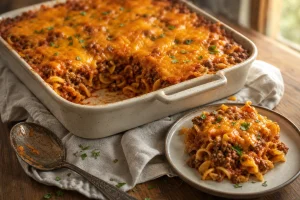
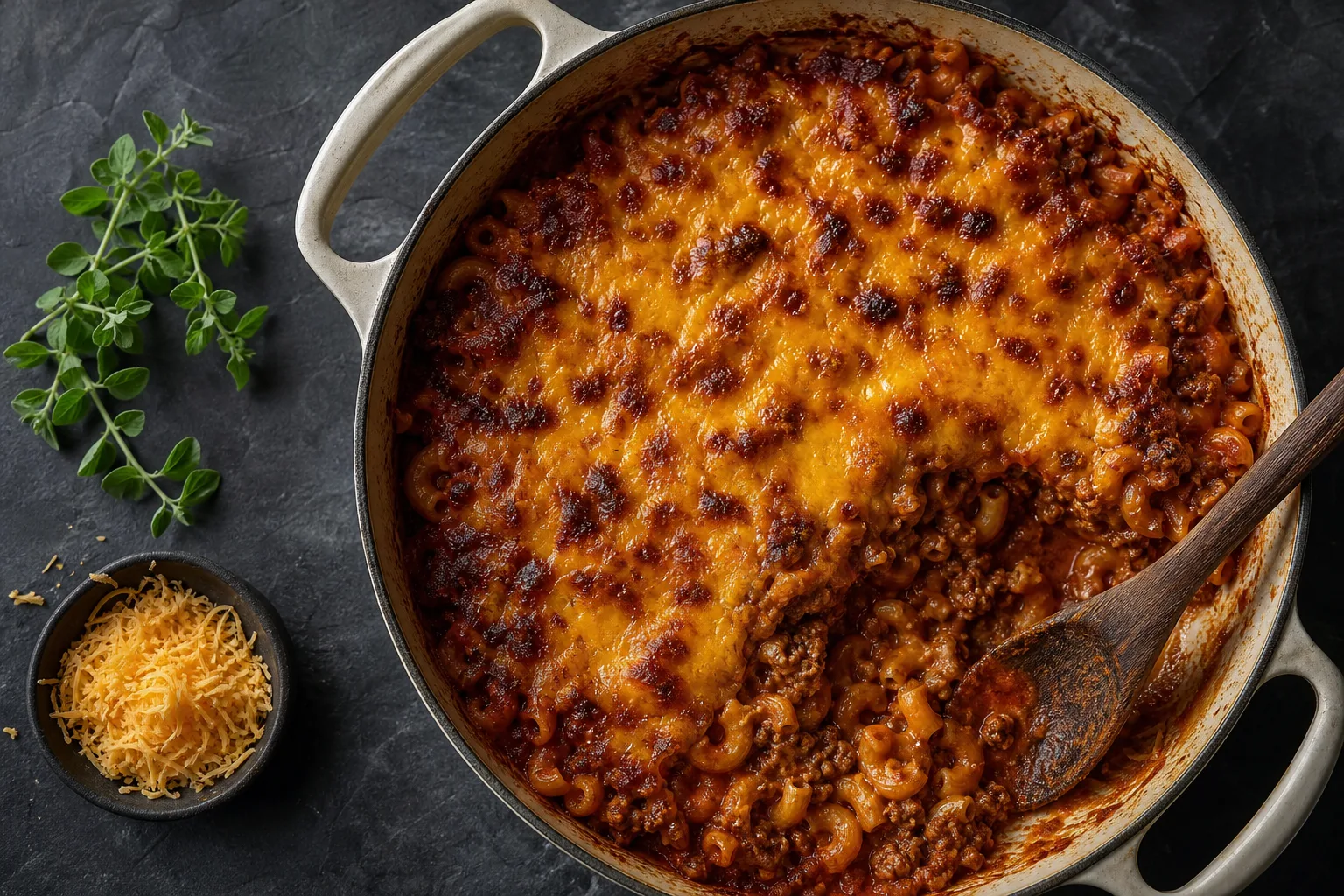

If you grew up anywhere between Cleveland and Indianapolis you have eaten Johnny Marzetti, probably out of a hotel pan at a church supper, and you may not have known it had a name. Beef, macaroni, tomato sauce, a cheddar lid. It is the plainest possible description of a dish, and it has also always been a surprisingly dirty-pot dinner: a skillet for the meat, a saucepan for the sauce, a pasta pot, a colander, and then a baking dish to put it all in and bake it a second time.
I got tired of cooking this dish twice. The macaroni gets boiled until nearly done, then spends half an hour in a 350°F oven finishing the job it already did. That is the part of the recipe that can simply go away. Dry macaroni, stirred into a sauce with enough liquid, cooks through in the oven under a lid, and it comes out better for it, because it soaks up tomato and beef instead of plain salted water.
So this version is one pot and one trip into the oven. The only thing that happens on the stove beyond heating the sauce is browning the meat, which I did not try to cut, for reasons I will get to below. Everything else goes in raw, the lid goes on, and you go do something else for 45 minutes.
Why This Works
Dry pasta is a sponge that wants about four cups of liquid per pound before it is tender, and tomato sauce is liquid with flavor in it. When the macaroni cooks inside the sauce, the starch it releases thickens the dish from within, with no roux and no cheese sauce, and every noodle ends up seasoned all the way through instead of just coated on the outside.
Ingredients
A 5- or 6-quart oven-safe Dutch oven is what I use, so everything happens in one pot. Eight to ten servings. A 9×13 dish works too if you transfer the mixture and cover it tightly with foil.
For the Sauce
- 1 1/2 pounds ground beef, 80/20
- 1/2 pound ground pork
- 1/2 cup water, for loosening the browned bits
- 1 large yellow onion, diced no larger than 1/4 inch
- 1 green bell pepper, diced 1/4 inch
- 8 ounces cremini mushrooms, thinly sliced
- 3 cloves garlic, minced
- 2 tablespoons tomato paste
- 1 (28-ounce) can crushed tomatoes
- 1 (15-ounce) can tomato sauce
- 2 teaspoons dried oregano
- 1 teaspoon dried basil
- 1/2 teaspoon red pepper flakes
- 1 bay leaf
- 3 teaspoons kosher salt
- 1 teaspoon black pepper
For the Casserole
- 1 pound dry elbow macaroni, straight from the box
- 10 ounces sharp cheddar, grated from a block (about 2 1/2 cups)
- 4 ounces mild cheddar or Monterey Jack, grated (about 1 cup)
Easy Swap
All beef instead of beef and pork is completely fine and is how plenty of Ohio families make it. Bump to two pounds of beef and add a teaspoon of fennel seed, crushed, which is most of what the pork was contributing. Skip Italian sausage unless you want a different dish entirely — it has enough fennel, garlic, and sugar in it to take the sauce over.
How to Make It
Prep: 35 minutes | Bake: 60 minutes | Rest or cool: 15 minutes | Serves: 8 to 10
- Put a rack in the middle of the oven and heat it to 350°F. Set an oven-safe 5- or 6-quart Dutch oven over medium-high heat for 4 minutes. Brown the beef half a pound at a time, pressed into a flat layer: let each batch sit untouched for 4 minutes, then break it up and give it 3 more. Move each batch to a colander set over a bowl. Brown the pork the same way. Dice the onion, pepper, and mushrooms while the first batches are sitting.
- Pour the fat out of the pot, but do not wash or scrub it. There will be a dark brown film welded to the bottom. Pour in the 1/2 cup water and scrape hard with a wooden spoon for a minute or so until the film dissolves into it. Leave that brown water in the pot. It is the best seasoning in the recipe.
- Stir in the tomato paste, crushed tomatoes, tomato sauce, oregano, basil, red pepper flakes, bay leaf, salt, and pepper. Add the raw onion, bell pepper, mushrooms, and garlic, then the drained meat. Stir until everything is evenly distributed.
- Pour in all the dry macaroni and stir. Push it down so every piece is under the sauce. Taste the liquid: it should seem a little too salty and a little too thin, because the pasta is about to drink both. Bring it to a bare simmer over medium heat for 3 minutes, just to get it hot. You are not cooking anything here. A hot start gives the pasta a head start.
- Cover with the lid (or a tight layer of foil) and bake for 30 minutes. Take it out, stir thoroughly, scrape the bottom, and push any noodles that have crept above the surface back under. Cover again and bake 15 more minutes.
- Uncover and bite a piece of macaroni from the middle of the pot. It should be nearly tender, with a little bite left in it. If it is still hard, re-cover it for 10 more minutes before going on. Scatter the sharp and mild cheddar over the top and bake uncovered for 15 minutes, until the surface is bubbling and blistered brown in spots.
- Rest it 15 minutes. The pasta keeps absorbing sauce as it sits, and straight out of the oven the dish is loose. After a quarter of an hour it holds a square. Fish out the bay leaf when you serve.
Don’t Do This
Do not let macaroni sit above the liquid line. Dry pasta poking out of the sauce does not steam under the lid so much as bake into hard, leathery elbows, and the first stir will not fix them all. Push everything under before the lid goes on, stir at the 30-minute mark, and if the pot looks dry when you stir, add a half cup of hot water rather than hoping.
Can You Make It the Night Before?
Not Fully — Here Is What You Can Prep
This is the one version of Johnny Marzetti that you cannot assemble the night before. Raw macaroni sitting in cold sauce overnight drinks unevenly, so some of it turns gummy while some stays hard, and by morning there is not enough liquid left to finish cooking in the oven. What you give up is the overnight head start. What you get is a dish where nothing is ever cooked twice.
There is still plenty you can do ahead. Brown the beef and pork up to three days in advance and keep them in the refrigerator; that is the longest part of the prep and the easiest to separate from the rest. Dice the onion and pepper, slice the mushrooms, and grate both cheeses a day ahead and store them in separate containers. On the night, the work shrinks to loosening the fond, stirring everything into the pot, and baking.
Do not mix the sauce and the dry pasta together ahead of time, even if you intend to keep it in the refrigerator for only a few hours. If you must hold it, keep the sauce, meat, and pasta in separate containers and combine them straight from the refrigerator, adding 10 to 15 minutes to the covered bake since the sauce will start cold.
Leftovers are another story, and a good one. The finished casserole refrigerates for four days and reheats well in a 325°F oven, covered, with a splash of water or tomato sauce stirred in, because the pasta will have continued to absorb. It also freezes acceptably for three months, a little softer than the original, and is best thawed overnight in the refrigerator before reheating.
Where Johnny Marzetti Came From
The dish traces back to Marzetti’s, a restaurant in Columbus, Ohio, near the Ohio State campus, run by Teresa Marzetti, an Italian immigrant who opened it in the 1890s. The casserole is named for her brother-in-law Johnny, and by most accounts it appeared on the menu in the 1920s. The family’s food business outlasted the restaurant: the salad dressings still sold under the Marzetti name grew out of it.
What happened next is the more interesting part. The dish escaped the restaurant and became institutional food — school cafeterias, church basements, Grange halls, community cookbooks across Ohio, Indiana, and Michigan. That is why the name survives in some families and not others, and why no two people from the Midwest describe it quite the same way. Some versions use egg noodles, some use mushrooms, some add a layer of cheese in the middle, and a lot of them lean on canned tomato soup.
I keep the mushrooms and the green pepper because they are in most of the older versions I have seen, and because they do real work in a baked dish: raw, they soften under the lid and release their liquid right into the sauce, so you get the savory depth of a sautéed base without ever turning on a second burner.
The One Step I Kept: Browning the Meat
I cut a lot of steps from this recipe, and I tried cutting this one too. Raw ground meat does reach a safe temperature in a covered casserole, but it behaves badly while it gets there. It renders its fat straight into the sauce and steams in it, so the beef turns gray and crumbly and the whole dish ends up greasy, which is exactly the flat, faintly sweet cafeteria taste I was trying to get away from. Browning the meat first is the only step in here worth the trouble.
Two pounds of meat is a lot to brown, and the temptation with a deep Dutch oven is to put it all in at once because it fits. It fits and it does not brown. A Dutch oven has a smaller cooking surface than a skillet of the same capacity and tall sides that trap steam, so a full pot of ground meat sits in its own moisture and poaches.
Small batches, pressed flat, is slower and it is also the difference between this tasting like a restaurant dish and tasting like cafeteria food. I do four rounds: three of beef, one of pork, a half pound each. Each one is seven minutes, four of them untouched, and I use that time to chop the vegetables. You will notice the pork browns differently — it goes pale golden rather than deep brown and renders faster. That is normal. It is contributing fat and a softer texture rather than crust.
Reading the Pot
The fond should be mahogany brown and stuck fast. If it is black and flaking, the pot ran too hot and those pieces will make the sauce bitter — pour off the fat, wipe out the worst of it, and accept a slightly less savory sauce. If there is no film at all, the meat never got hot enough and the batches were too big.
How Pasta Cooks Without Being Boiled
The thing that makes or breaks a no-boil casserole is liquid. One pound of dry macaroni absorbs about four cups as it cooks, and the can of crushed tomatoes and the can of tomato sauce here add up to a little over five cups of sauce. That deliberately looks too wet when you pour in the pasta. The mushrooms release even more once they are in the oven. By the time it comes out, the pasta has drunk the difference and the sauce has thickened around it. Start short on liquid and you get a dry, tough casserole that no amount of resting will rescue.
The lid matters as much as the liquid. For the first 45 minutes the pot is a closed steamer: the sauce stays hot, nothing evaporates, and the pasta cooks evenly. Uncover too early and the top layer dries out before the macaroni underneath is done. That is why the cheese goes on after the lid comes off. Under a cover it would melt into the sauce and go grainy instead of browning.
The bake runs about half an hour longer than the boiled version did, and I do not think of that as a cost. It is passive time. Nobody is at the stove, nobody is draining anything, and the dish is simply sitting in the oven doing what it needs to.
Rachel’s Tip
Use two cheeses on top, and add them only after the lid comes off. Sharp cheddar has the flavor but it is also drier and breaks into oil more readily under a long bake; a cup of something milder and younger, like Jack, melts smoothly and holds the sharp cheddar together. I landed on this after a few casseroles with a greasy orange slick on top and no idea why.
Questions People Ask
What is the difference between Johnny Marzetti and American goulash?
Very little in practice, and the names are regional more than anything. Johnny Marzetti is the Ohio name and is usually baked with cheese on top; American goulash is more often finished entirely on the stovetop and left uncheesed. Both are beef, macaroni, and tomato. If someone tells you one has paprika and the other does not, that varies family to family.
Does the macaroni really cook through in the oven without boiling it first?
Yes, as long as two things are true: the pasta is fully under the sauce, and the pot is covered for the first 45 minutes. Dry elbow macaroni takes about 45 minutes to tenderize in hot tomato sauce at 350°F. If a bite from the middle at the 45-minute check is still hard, cover it again for 10 more minutes before adding the cheese.
Can I use egg noodles instead of macaroni?
I would not for this version. Wide egg noodles are far more absorbent than durum macaroni, and baked raw for 45 minutes they turn to mush before the sauce has finished thickening. If you want egg noodles, boil them briefly the traditional way and use the original, shorter bake, or stick with macaroni.
Why is some of my pasta hard and some soft?
Almost always because part of the pasta was sitting above the sauce. Pasta that is not submerged steams unevenly and bakes dry at the surface. Stir at the 30-minute mark, push everything under the liquid, and if the pot looks dry, add a half cup of hot water. A deep Dutch oven makes this easier than a wide, shallow dish.
How do I keep the cheese on top from going greasy?
Grate it from a block, mix a milder cheese in with the sharp cheddar, and add it only after the lid comes off, with the oven kept at 350°F rather than higher. Cheddar past about 375°F breaks and releases oil, and the drier and sharper the cheddar, the lower the temperature at which that happens.
About This Article

Written by Rachel Thompson. Rachel Thompson is a home cook who has spent over 10 years making an unreasonable number of dips, appetizers, and party spreads — no culinary training, just a decade of trial and error and a reputation among friends for always being asked to "bring a dip." She focuses on approachable recipes that combine bold flavors with simple techniques, making entertaining at home accessible to everyone. More about this site.
Scope and limits. Rachel is a home cook with no culinary training. Follow current food safety guidance for holding temperatures and time limits whenever you are serving people other than yourself.
Verify this against a primary source
Specifics change, and your situation may differ from the one described here. These are the authorities worth checking directly:
- FoodSafety.gov — cold holding, hot holding and the two-hour rule
- USDA FoodData Central — ingredient composition and nutrition data
- USDA Food Safety and Inspection Service — safe minimum temperatures and leftovers