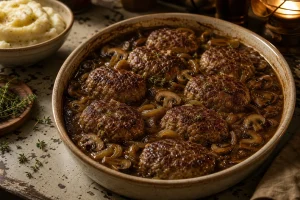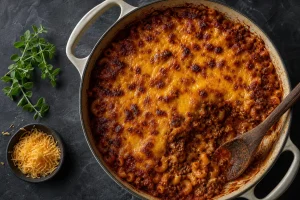
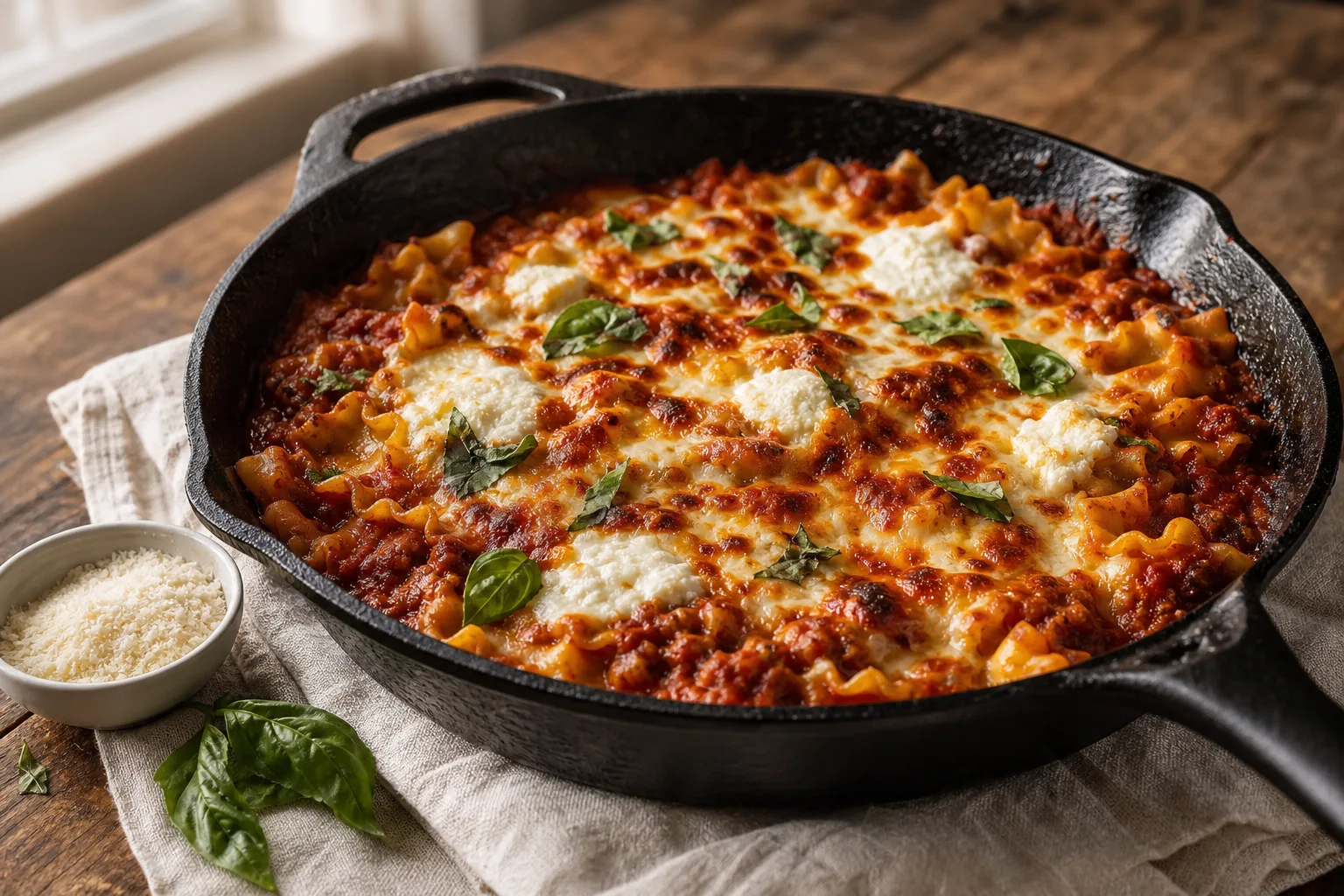

The box version was called Lasagna, it took one skillet and half an hour, and it tasted mostly of dried onion and sugar. What it got right was the structure: broken flat noodles cooked directly in a tomato-beef sauce, thickened by a packet, finished with cheese. This is the same dinner without the packet — fifteen minutes of prep, twenty-five at the stove, one pan.
The part that takes attention is the noodles. Flat sheets behave nothing like elbow macaroni in sauce — they find each other, stick in pairs, and come out as a two-ply slab. The first few times I made this I was prying noodles apart with two forks at the table. The fix is not a different noodle. It is how you break them, how you stir, and how much liquid goes in the pan.
Why This Works
Pasta cooked in sauce keeps its starch. Everything that would have gone down the sink with the boiling water stays in the pan and thickens the sauce from the inside, which is why this has body without a roux. The tablespoon of cornstarch covers the first few minutes, before the noodles have given anything up.
Ingredients
A 12-inch skillet with a lid. Scaling up needs a wider pan, not a deeper one — the noodles have to lie in a shallow layer.
For the Seasoning Blend
- 1 tablespoon cornstarch
- 2 teaspoons onion powder
- 1 1/2 teaspoons garlic powder
- 1 1/2 teaspoons dried oregano
- 1 teaspoon dried basil
- 1 teaspoon sweet paprika
- 1/2 teaspoon fennel seed, crushed under the flat of a knife
- 1 teaspoon granulated sugar
- 1 1/2 teaspoons kosher salt
- 1/2 teaspoon black pepper
- 1/4 teaspoon red pepper flakes, optional
For the Skillet
- 1 pound ground beef, 85/15
- 1 medium yellow onion, diced small
- 3 cloves garlic, minced
- 2 tablespoons tomato paste
- 1 (15-ounce) can tomato sauce
- 1 1/2 cups water
- 6 ounces lasagna noodles (about 6 sheets), broken into 1- to 2-inch pieces
For Finishing
- 1 cup whole-milk ricotta
- 1 1/2 cups low-moisture mozzarella, grated from a block
- 1/4 cup grated parmesan
- A handful of fresh basil, torn, optional
Easy Swap
Cottage cheese stands in for the ricotta and is what a lot of lasagna recipes used before ricotta was in every dairy case. Use small-curd whole milk and drain it in a sieve for ten minutes first — undrained it thins the sauce right at the end, when there is no time left to cook it back down.
How to Make It
Prep: 15 minutes | Cook: 25 minutes | Serves: 4 to 5
- Stir the seasoning blend together in a small bowl until no cornstarch streaks the bottom, about 3 minutes. Mixing it dry is the only way it disperses evenly; sprinkled into a wet pan the cornstarch seizes into pellets.
- Break the noodles inside a large bowl, not over the skillet. Hold a sheet down in the bowl and keep snapping the halves until the pieces are 1 to 2 inches. Four minutes for six sheets. Keep the dust and splinters — they thicken the sauce.
- Set the skillet over medium-high heat for 2 minutes, add the beef, and press it flat. Leave it alone 4 minutes, break it up, give it 2 more. Spoon the fat off until about a tablespoon is left.
- Drop to medium. Cook the onion 2 minutes, scraping the browned film off the bottom. Add the garlic, tomato paste, and the whole blend and stir constantly 1 minute, until the paste darkens a shade and the herbs smell like oregano instead of dust.
- Pour in the tomato sauce and water, scrape the bottom clean, and bring it to a lively simmer. Add the noodles in three handfuls, stirring between each one so every handful lands in moving liquid rather than on a stack of its own kind.
- Cook 12 minutes uncovered at a steady simmer. Stir almost constantly for the first 3 minutes, lifting from the bottom and folding over rather than swirling — this is when surface starch gelatinizes and two touching noodles weld. After that, fold every 2 minutes. Done when a piece bends without snapping.
- Off the heat, taste for salt. Drop the ricotta over the top in eight or ten spoonfuls and do not stir it in. Scatter the mozzarella and parmesan across the surface.
- Broil 6 inches from the element for 3 to 4 minutes, until the mozzarella is melted through with brown blisters. It goes from pale to burnt in under a minute at the end, so stand there and watch it.
- Rest 5 minutes. The sauce is loose off the heat and sets to something you can lift out in sections.
Don’t Do This
Do not stir the ricotta through the sauce. It looks like it should give you a creamy tomato skillet; what it gives you is a uniform dull pink dish with a grainy texture. Fresh curd cheese, in hot acidic tomato, under agitation, breaks into solids and whey — the whey thins the sauce and the solids go chalky. Dollops left whole stay white and taste like lasagna.
Can You Make It the Night Before?
Not Fully — Here Is What You Can Prep
Not assembled. Pasta cooked in sauce keeps absorbing it in the refrigerator, and six ounces of flat noodles in three cups of liquid has nothing left to give by morning — it sets into a pale, solid slab. Front-load everything dry and chopped instead.
Make the blend in a quadruple batch and keep it in a 4-ounce jar. Shake it before each use, because the cornstarch settles and the first unshaken scoop is mostly thickener. One skillet takes 3 tablespoons plus a teaspoon, worth writing on the lid. Noodles can be broken days ahead, onion and garlic diced the night before, cheese grated and bagged.
Leftovers reheat better than they have any right to, with help: a portion in a saucepan with 2 to 3 tablespoons of water per cup, covered, over low heat for 6 to 8 minutes, folded once. The water reverses most of the overnight absorption, where a microwave with nothing added gives you dry noodles in a tight paste. I would not freeze it — the ricotta goes grainy on thawing.
The Seasoning Blend, and What Each Thing Is Doing
The packet did three jobs at once: thickening, seasoning, and covering for a dried tomato component. Separated out it is a short list, and nothing on it is exotic.
Cornstarch is the structural one: a tablespoon gives the sauce body in the first two minutes, before the noodles have given up any starch. Onion and garlic powder do a different job from the fresh onion and garlic in the pan — fresh aromatics give sweetness from the bottom up, while the powders disperse through every drop and build a savory floor fresh alone cannot reach in twenty-five minutes.
Oregano and basil carry the lasagna signal, and the ratio matters more than the amounts: oregano is assertive and faintly bitter, basil soft and sweet, and 1 1/2 to 1 in oregano’s favor reads as Italian-American red sauce. Reverse it and you have marinara. Crushed fennel seed is the thing nobody can name when they taste this — half a teaspoon is most of what Italian sausage contributes to a real lasagna, and it lets plain ground beef read as sausage. Crush it; whole seeds stay whole for twenty-five minutes.
Paprika is color, not flavor. And a teaspoon of sugar is doing real work: canned tomato is sharply acidic, an hour of simmering rounds that off, and you do not have an hour. One teaspoon in three cups sits below the threshold where you taste sweetness. Two is where the box went wrong.
Why Flat Noodles Stick and Elbows Never Do
An elbow touches its neighbors at a point. Two flat lasagna pieces lying against each other touch across their whole face, and in that contact area there is no sauce — the surfaces squeeze the liquid out from between themselves. Dry starch plus heat plus no water is how you make glue, and by the time you notice, the seam is cooked shut.
This is why you break them over a bowl and not into the pan. Snapping a sheet above a hot skillet sends pieces in at different moments, in a stack, into one spot, and a stack that lands in simmering sauce is face-to-face before a spoon can reach it. In the bowl you can see what you have and feed the lot in as three loose handfuls. Break to 1 to 2 inches, not in half: a long plank has more face to stick with, drapes over the pan rim instead of submerging, and cooks unevenly end to end.
The stirring pattern is the other half. Fold from the bottom up, in sections, turning the layer over instead of pushing it in a circle — a circular stir moves the whole mass together and the noodles inside it never separate. Use a flat spatula rather than tongs, which pick up one noodle at a time and leave the rest sitting still against each other. The first three minutes count most: the exterior starch has gone tacky but the noodle is still floppy enough to lie flat against its neighbor. After minute four the pieces stiffen and curl, and they stop seeking each other out.
The Liquid Is Higher Here on Purpose
Three cups plus the beef juices for six ounces of pasta is about a third more liquid than the same weight of elbows would want. Flat noodles trap sauce between their faces and in their ruffled edges and hold onto it, so a ratio tuned for macaroni leaves this tight and underdone in the middle. If the pan looks soupy at minute six, that is correct — it tightens hard in the last four minutes.
This Is Not Baked Ziti, and It Is Not Million Dollar Spaghetti
Baked ziti is boiled-then-baked. The pasta cooks in salted water, drains short of done, and goes into a sauce with a long simmer behind it, with ricotta layered through and a cheese lid browned in the oven. Two pots, a colander, a baking dish, an hour or more — and you get something that cuts into squares and serves ten.
This skillet is one pan and twenty-five minutes of cooking. The noodles never see water, the sauce never gets a long simmer, and it is spooned out loose — softer and saucier by design, and it will not cut into squares no matter how long you rest it. Different occasion, different effort, different texture.
Million dollar spaghetti is a third thing, built on a cream cheese and sour cream layer under the pasta — richer, tangier, not trying to taste like lasagna. Do not borrow the cream cheese into this one. It will not break the way ricotta does, but it will flatten the oregano and fennel you spent a minute blooming.
Questions People Ask
Can I use no-boil lasagna noodles?
Yes, with less liquid and less time. No-boil sheets are pre-cooked and dried thin, so they hydrate in roughly 7 minutes instead of 12 and want about 2 1/2 cups of liquid rather than 3. They also break into flatter shards that stick to each other more readily.
Why were my noodles gummy outside and chalky in the middle?
The pan was at a boil instead of a simmer. A hard boil gels the exterior starch before water has reached the core, and that gelled outside slows the rest of the hydration down. Keep it at bubbles breaking across the surface for the full 12 minutes.
Do I need the broiler step?
No. The alternative is the lid on, off the heat, for 5 to 6 minutes, which melts the mozzarella into the surface without browning it. You lose the blistered top and get a cleaner, stringier melt.
How is this different from cheeseburger macaroni made the same way?
The blend and the noodle shape. Cheeseburger macaroni leans on paprika and mustard powder over a cheese sauce built in the pan, with elbows that need less liquid and almost no stirring discipline. This one is oregano, basil, and fennel over a tomato base.
About This Article

Written by Rachel Thompson. Rachel Thompson is a home cook who has spent over 10 years making an unreasonable number of dips, appetizers, and party spreads — no culinary training, just a decade of trial and error and a reputation among friends for always being asked to "bring a dip." She focuses on approachable recipes that combine bold flavors with simple techniques, making entertaining at home accessible to everyone. More about this site.
Scope and limits. Rachel is a home cook with no culinary training. Follow current food safety guidance for holding temperatures and time limits whenever you are serving people other than yourself.
Verify this against a primary source
Specifics change, and your situation may differ from the one described here. These are the authorities worth checking directly:
- FoodSafety.gov — cold holding, hot holding and the two-hour rule
- USDA FoodData Central — ingredient composition and nutrition data
- USDA Food Safety and Inspection Service — safe minimum temperatures and leftovers