
Every taco seasoning packet in America tells you to brown the beef, drain it, then add the seasoning and three-quarters of a cup of water. Half the people I know skip the draining and most of them skip it in the same way: they tip the pan, pour off what runs out, and call it done. In a soft taco you can get away with that. In a casserole you cannot, because there is nowhere for the fat to go and twenty-five minutes in the oven for it to find the bottom of the dish.
The other thing the packet gets wrong for casserole purposes is the water. Water is there so the seasoning makes a sauce that clings, which is a reasonable goal, but adding it to beef that has not been properly drained gives you simmering grease. The beef poaches in it and goes from browned to beige.
So the order here is: brown hard, drain completely, return one spoonful of the fat to the pan on purpose, bloom the spices in that, and build the sauce from drained tomato juice rather than tap water. Same number of steps, a different dish entirely.
Why This Works
Chili powder, cumin, and smoked paprika carry most of their flavor in fat-soluble compounds, which is why spices dumped into a watery pan taste dusty. Draining the beef and then deliberately putting one tablespoon of fat back gives those spices thirty seconds in hot oil to open up — and gives you a dish seasoned with a tablespoon of grease instead of a third of a cup.
Ingredients
A 9×13 dish, eight real portions. The cold toppings are listed separately because they go on at the table, not in the oven.
For the Beef
- 2 pounds ground beef, 80/20
- 1 medium yellow onion, diced small
- 4 cloves garlic, minced
- 2 tablespoons chili powder
- 1 tablespoon ground cumin
- 2 teaspoons smoked paprika
- 1 teaspoon dried oregano
- 1/2 teaspoon cayenne, or less
- 1 tablespoon tomato paste
- 1 (14.5-ounce) can diced tomatoes, drained with the juice reserved
- 1 (15-ounce) can black beans, drained and rinsed
- 2 teaspoons kosher salt
- 1 teaspoon black pepper
For the Layers
- 12 corn tortillas, 6-inch
- 1 cup salsa verde or red salsa, whatever you like
- 16 ounces Monterey Jack or a Jack-cheddar mix, grated from a block (about 4 cups)
For the Table
- Shredded iceberg or romaine
- Diced tomato, sliced radish, pickled jalapenos
- Sour cream and lime wedges
- Chopped cilantro and sliced green onion
Easy Swap
Flour tortillas work and give you a softer, more lasagna-like result. Crushed tortilla chips also work but need a different plan: they go in only as the bottom layer and the top, never the middle, and you lose about half their crunch regardless. Corn tortillas are the sturdiest option and the only one that holds a visible layer after an overnight sit.
How to Make It
Prep: 30 minutes | Bake: 35 minutes | Serves: 8
- Heat the oven to 375°F. Set a wide heavy skillet over medium-high heat for 3 minutes, then add half the beef, press it into a flat layer, and leave it completely alone for 4 minutes. Break it apart, cook 3 minutes more, and tip it into a colander set over a bowl. Repeat with the rest of the beef.
- Let it drain 2 minutes. You should collect somewhere around a third of a cup of fat in the bowl below — that is the amount that would otherwise have ended up in the casserole. Keep 1 tablespoon of it and discard the rest once cool.
- Wipe the skillet out, return the reserved tablespoon of fat, and cook the onion over medium heat for 6 minutes. Add the garlic for 1 minute, then all the spices and the salt and pepper, and stir constantly for 30 to 45 seconds. The pan will look almost dry and smell sharply of toasted cumin. Do not let it go past a minute or the chili powder turns bitter.
- Add the tomato paste, stir it for a minute, then pour in the reserved tomato juice from the can — about 1/2 cup. Scrape the bottom of the pan clean. Add the drained tomatoes and black beans and simmer 6 minutes, until the mixture holds its shape when you push it to one side.
- Stir the drained beef back in, taste, and adjust the salt. It should taste slightly aggressive on its own; twelve tortillas and four cups of cheese flatten seasoning fast.
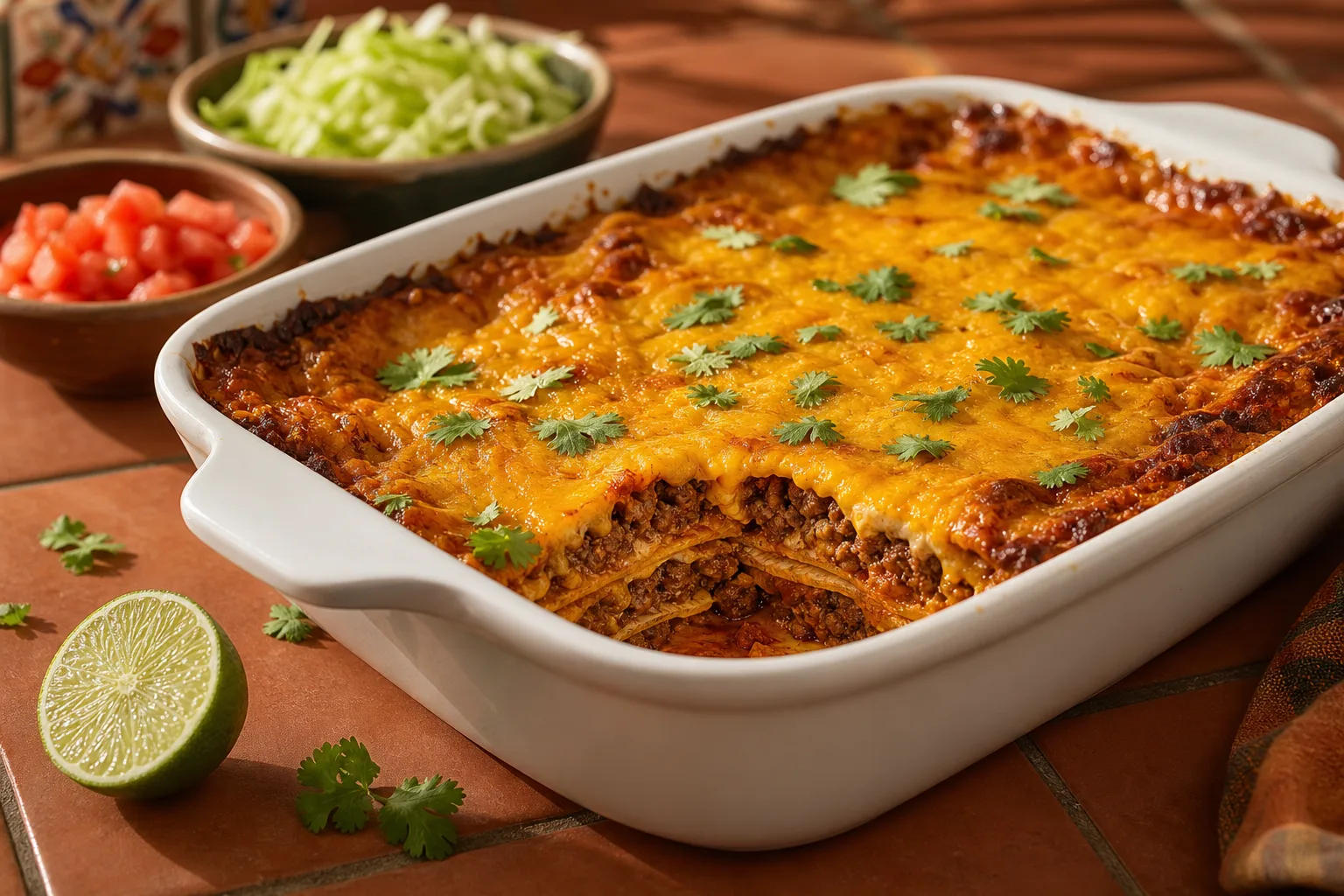
- Spread 1/3 cup of the salsa across the bottom of a 9×13 dish. Lay down 4 tortillas, overlapping and tearing a couple to fill the corners. Add a third of the beef, then a cup of cheese. Repeat twice more, finishing with the last cup of cheese and the rest of the salsa dotted over the top.
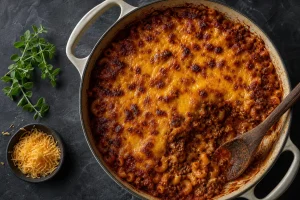
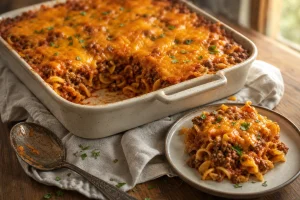
- Cover with foil and bake 20 minutes, then uncover and bake 12 to 15 minutes more, until the cheese has browned at the edges and the whole dish is bubbling rather than steaming.
- Rest it 10 minutes before cutting, which is what lets the layers hold together instead of sliding. Put the cold toppings on the table in bowls and let people build their own squares.
Don’t Do This
Do not add the water the seasoning packet calls for. You are already adding half a cup of reserved tomato juice, and the two together make a casserole that pools. If you are using a packet rather than the spice mix here, add the packet dry to the fat along with the onions and skip its water step entirely.
Can You Make It the Night Before?
Yes — Assemble Up to 24 Hours Ahead
Assemble it completely, cover, and refrigerate up to 24 hours. Tortillas hold up to an overnight sit far better than pasta or biscuit dough does — they soften but they do not dissolve. Hold back the top layer of cheese and the surface salsa until just before it bakes so the top still browns properly.
Out of the refrigerator 45 minutes ahead, then foil-covered for 30 minutes instead of 20, then uncovered for the last 15. A cold 9×13 needs that extra ten minutes under foil to get the middle hot without drying the top.
The corn tortillas will have absorbed sauce overnight, which is mostly a good thing — the layers behave more like a lasagna and cut more cleanly. What you lose is any remaining distinct tortilla texture. If you want that, use the extra half hour on the day instead.
The beef mixture on its own is the real make-ahead win: three days in the refrigerator, two months in the freezer, and it is also most of a taco night, a quesadilla filling, and a baked potato topping. I make a double batch of it roughly every other week in the winter and only turn half into casserole.
The Tablespoon of Fat You Put Back
This feels contradictory at first: drain the beef carefully, then deliberately add fat back. But the amounts are what matter. Two pounds of 80/20 beef sheds roughly a third of a cup of rendered fat, which is more than five tablespoons. Putting one of them back means you have removed about eighty percent of it and kept exactly as much as the spices need.
You could use oil instead and it would work. I use the beef fat because it already tastes like beef and because it is sitting right there. What you cannot do is leave all five tablespoons in, which is the default outcome of tipping the pan rather than using a colander.
The blooming itself is quick and easy to overshoot. Thirty to forty-five seconds in hot fat, stirring the whole time, is what you want — the smell shifts from raw and dusty to toasted. At about ninety seconds chili powder starts going bitter, and that bitterness does not cook out later.
A Way to Tell You Drained Enough
Look at the bowl under the colander after the beef has sat for two minutes. If there is less than a quarter cup of fat in it from two pounds of 80/20 beef, the beef is still holding it and needs a gentle press with a paper towel. If there is a third of a cup or more, you are done.
Browning Hard Enough to Matter
Taco-seasoned beef hides a lot. Two tablespoons of chili powder will put flavor on almost anything, which is why so many versions of this get away with gray, steamed crumbles. But there is a specific taste that only comes from beef that actually browned, savory and faintly roasted, and once you have had the casserole both ways the difference is not subtle.
The practical rule is a hot wide pan and no more than a pound at a time, pressed flat and left alone. Four minutes untouched, then broken up and turned twice over three more minutes. You are not aiming for uniformly brown beef, which is impossible with ground meat; you are aiming for a good proportion of deeply browned surfaces mixed through.
If your pan is crowded you will know within a minute. A loud continuous sizzle means the moisture coming out is evaporating as fast as it appears. A quiet simmer means it is pooling, the pan has dropped to boiling temperature, and you are now steaming. The fix is to pull half the beef out and finish it separately.
Hot Layers, Cold Toppings
Lettuce, sour cream, and fresh tomato have no business in the oven. Lettuce wilts into something slick and khaki, sour cream splits, and tomatoes release water onto the cheese. All three go on at the table.
This is also the reason this casserole does well for feeding people over a long window, which is most of what I use it for. The baked part holds its quality for an hour on the counter and reheats fine. The toppings stay crisp in their bowls. Someone eating at eight gets the same thing as someone eating at six-thirty. A squeeze of lime over the pan after the rest is the only thing I add in the kitchen.
Rachel’s Tip
Warm the corn tortillas for fifteen seconds a side in the dry skillet before you layer them, right after the beef comes out. They go pliable, they pick up a little of the fond left in the pan, and they stop cracking into shards when you try to overlap them. It adds three minutes and it is the difference between layers and rubble.
Questions People Ask
Why is my taco casserole greasy?
Almost certainly the draining. Tipping the pan removes maybe half the rendered fat because the crumbles hold the rest in every crevice — a colander and two full minutes of gravity get it out. The second cause is adding the packet’s water to undrained beef, which just simmers it in its own fat and makes the problem invisible until it bakes.
Can I use tortilla chips instead of tortillas?
Yes, with a caveat: put them on the bottom and on top, never in the middle, and accept that the bottom layer will soften. Chips in the middle of a casserole turn to paste within fifteen minutes. If what you want is the crunch, the better move is tortillas in the layers and a handful of crushed chips scattered on each square at the table.
Can I leave out the beans?
Easily. Drop them and add an extra half pound of beef, or a cup of frozen corn added in the last two minutes of the simmer. They add bulk, not structure, so nothing falls apart without them.
How do I keep the layers from sliding apart when I cut it?
Rest it a full ten minutes, and cut with a thin knife rather than a spatula edge. The cheese needs that time to set from molten to merely soft. If it still slides, your beef mixture was too wet going in — it should hold a shape in the pan when you push it to one side, not flow back.
Can I freeze the assembled casserole?
It freezes better than most things in this category, because corn tortillas and a tomato-based beef mixture both thaw well. Assemble it without the top cheese layer, wrap tightly, and freeze up to two months. Thaw overnight in the refrigerator, add the cheese, and bake as written plus about 12 minutes.
If you would rather have a puffed biscuit crust than tortilla layers, and a sour cream and cheddar top, make this one instead: John Wayne Casserole: The Biscuit-Crusted Beef Bake That Needs a Dry Skillet.
About This Article

Written by Rachel Thompson. Rachel Thompson is a home cook who has spent over 10 years making an unreasonable number of dips, appetizers, and party spreads — no culinary training, just a decade of trial and error and a reputation among friends for always being asked to "bring a dip." She focuses on approachable recipes that combine bold flavors with simple techniques, making entertaining at home accessible to everyone. More about this site.
Scope and limits. Rachel is a home cook with no culinary training. Follow current food safety guidance for holding temperatures and time limits whenever you are serving people other than yourself.
Verify this against a primary source
Specifics change, and your situation may differ from the one described here. These are the authorities worth checking directly:
- FoodSafety.gov — cold holding, hot holding and the two-hour rule
- USDA FoodData Central — ingredient composition and nutrition data
- USDA Food Safety and Inspection Service — safe minimum temperatures and leftovers