
Most Salisbury steak casserole recipes dirty three pans before anything goes in the oven: one to brown the patties, one to sauté the onions and mushrooms, and a saucepan for a roux. Then the whole thing bakes for half an hour on top of all that, so everything gets cooked twice. I wanted to see how much of that was doing real work, and the honest answer is not much of it.
In this version the onions and mushrooms go into the dish raw. The gravy is flour whisked into cold broth and poured over them, with no roux and no saucepan. It thickens during a covered bake and finishes with a few uncovered minutes. The only thing you do on the stove is sear the patties, and I’ll explain why that one step stays.
The other half of the recipe is the patties, which fail in a different way than crumbled beef does. Overworked ground beef turns springy and dense, and the first few times I made this I was turning out something closer to a meatball than a steak without understanding why. The panade below fixes that.
Why This Works
Whisking flour into cold broth before any heat spreads the starch evenly, so there are no dry pockets to clump. A tightly covered bake then hydrates it gently and thickens it into a smooth gravy, which does everything a roux does without a saucepan. The raw onions and mushrooms melt into it as they cook, adding their own flavor and body.
Ingredients
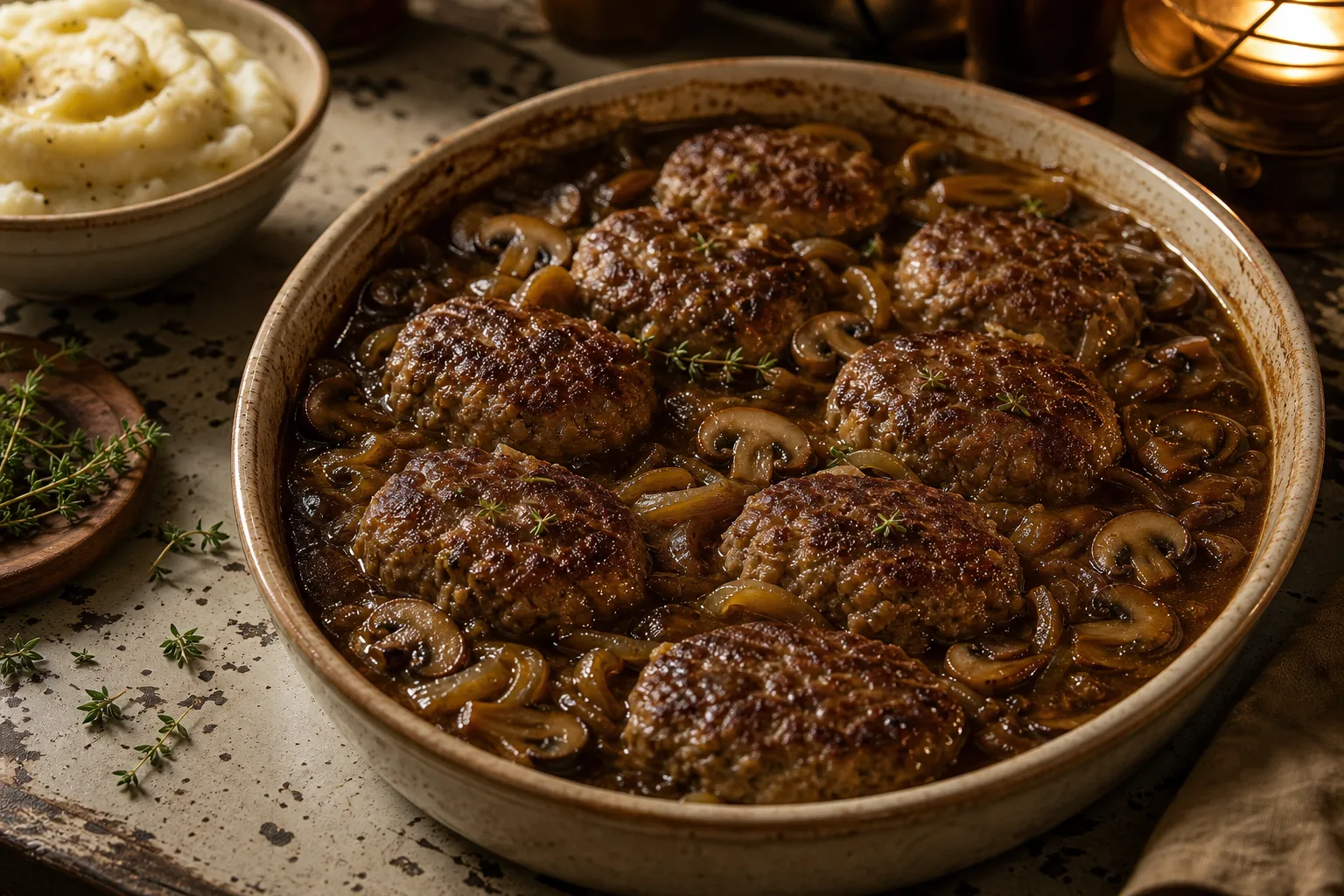
Eight oval patties in a 9×13 dish. Serve it over mashed potatoes or buttered noodles. The gravy quantity assumes you will want some to spoon over them.
For the Patties
- 2 pounds ground beef, 85/15
- 2/3 cup plain dried breadcrumbs
- 1/3 cup whole milk
- 1 large egg
- 1 tablespoon Worcestershire sauce
- 1 teaspoon onion powder
- 1/2 teaspoon garlic powder
- 1 3/4 teaspoons kosher salt
- 1 teaspoon black pepper
- 1 tablespoon neutral oil, for the skillet
For the Gravy
- 2 large yellow onions, halved and sliced about 1/4 inch thick
- 10 ounces cremini mushrooms, sliced 1/4 inch thick
- 1/3 cup all-purpose flour
- 3 1/2 cups beef broth, low sodium, divided
- 1 tablespoon Worcestershire sauce
- 2 teaspoons Dijon mustard
- 2 teaspoons tomato paste
- 4 sprigs fresh thyme, or 1/2 teaspoon dried
- 1/2 teaspoon kosher salt, plus more to taste
- 1/2 teaspoon black pepper
- 2 tablespoons chopped parsley, for serving
Easy Swap
For a one-dish version, spoon four cups of mashed potatoes over the top for the last 10 minutes, after the foil comes off, leaving the gravy visible around the edges. The potato browns slightly and the whole thing becomes something close to a shepherd’s pie.
How to Make It
Prep: 30 minutes | Bake: 50 minutes | Rest or cool: 10 minutes | Serves: 8
- Heat the oven to 375°F. Stir the breadcrumbs and milk together in a small bowl and leave them for 5 minutes, until the crumbs are completely soft with no dry patches. In a larger bowl, combine the beef, the soaked crumbs, the egg, Worcestershire, onion powder, garlic powder, salt, and pepper.
- Mix it with your hands only until the ingredients are evenly distributed, about thirty seconds, and stop. Shape eight oval patties roughly 3/4 inch thick and press a shallow dimple into the center of each one with your thumb so they do not dome in the oven.
- Heat the oil in a large heavy skillet over medium-high for 3 minutes. Sear the patties in two batches, 3 minutes per side, without moving or pressing them. They are browned for color and flavor only and are still raw in the middle, which is right. Move them to a plate as they come out.
- Pour all the fat out of the skillet into a bowl and leave the dark browned film on the bottom. Return the pan to medium heat, pour in 1 cup of the broth, and scrape the bottom with a wooden spoon for about a minute, until the browned bits have dissolved. Turn off the heat.
- In a large bowl, put the flour and add 1/2 cup of the remaining cold broth a splash at a time, whisking to a smooth paste before each addition. Whisk in the rest of the cold broth, then the tomato paste, Worcestershire, Dijon, salt, and pepper. Slowly whisk in the warm liquid from the skillet.
- Spread the sliced onions and mushrooms in an even layer across the bottom of a 9×13 dish. Pour the gravy over them, then nestle the patties on top and tuck in the thyme sprigs.
- Cover the dish tightly with foil and bake 40 minutes. This covered stretch is what hydrates the flour and softens the raw onions and mushrooms. Remove the foil and bake 10 minutes more, until the gravy is thick and bubbling and a patty cut open shows no pink in the center.
- Rest 10 minutes. The gravy thickens as it cools. Pull out the thyme sprigs, taste the gravy and adjust the salt, and scatter the parsley over the top.
The One Step You Can’t Skip
Do not put raw patties straight into the gravy. Raw ground beef cooks through safely in a covered dish, but it steams gray instead of browning and renders its fat into the gravy, so you end up with a greasy dish and pale, flat-tasting meat. The three-minute sear is the only stovetop step in the recipe, and it supplies both the browned crust and the browned bits that flavor the gravy.
Can You Make It the Night Before?
Yes — Assemble Up to 24 Hours Ahead
Assemble it completely through the point where the patties are sitting on the gravy, cover, and refrigerate up to 24 hours before baking. This is one of the better make-ahead casseroles in the category: nothing in it is a noodle or a crust, and the patties improve from a night in gravy.
Before it goes in the oven, run a spoon through the gravy around the patties, because some of the flour will have settled to the bottom overnight. Then give the dish 45 minutes on the counter and bake it covered for 50 minutes instead of 40, followed by the same 10 minutes uncovered. The gravy insulates the patties, which is good for texture and slow for heating, so the extra ten minutes is not optional.
You can also split the work another way. Shape the patties, keep them raw and covered on a tray for a day, and sear them right before you assemble. Or sear them ahead and refrigerate for two days, then deglaze the pan and build the gravy when you are ready to bake.
It freezes well, which surprised me, since flour-thickened gravy usually separates on thawing. Here it comes back with a whisk. Freeze it after baking for up to three months, thaw overnight in the refrigerator, and reheat covered at 325°F for about 35 minutes.
Why the Sear Stays, and Everything Else Goes
Pre-cooking is worth it when it changes the food and a waste when it only adds a step. Boiling pasta before baking is the second kind. So is sautéing onions that will spend 50 minutes in hot gravy anyway, and so is a roux, which only exists to keep the flour from clumping.
Searing the patties is the first kind, because browning is a flavor reaction. It only happens on a dry, hot metal surface, and a covered casserole is wet and steamy by design. If the patties never touch the pan, nothing in the dish ever browns. I tried skipping it once. The patties were safe to eat but pale and soft, and the gravy had no depth and an oily sheen from fat that had nowhere else to go.
The skillet gets a second job too. A cup of broth poured into it while it is still hot dissolves the browned film into the gravy base, and that film is where most of the savory flavor comes from. Pour off all the fat first. A roux needs a measured amount of fat, but this gravy does not, and anything left in the pan just floats on top later.
Why Patties Go Rubbery
Ground beef mixed too long develops the same kind of protein network that makes a sausage springy. It cannot be undone later, and no amount of gravy rescues a patty that was kneaded like dough. Thirty seconds of mixing with your hands, until you no longer see streaks of egg or dry crumbs, is the entire window.
The panade is the other half. Breadcrumbs soaked in milk bring water into the patty held in a starch gel, which is much harder to squeeze out under heat than free water is. The patties come out of a baking dish still soft, and the difference against a plain beef-and-egg patty is obvious side by side.
Use plain dried breadcrumbs rather than panko. Panko is coarser and stays identifiable as bread, which is fine in a meatball but reads as filler in something you are calling a steak. Fresh bread torn and soaked works too, and is what I use when I have a heel of sandwich bread going stale.
A Gravy Without a Roux, and Raw Mushrooms
Flour clumps when it hits hot liquid, because the outside of each lump gelatinizes into a waterproof skin before the inside gets wet. Flour in cold liquid has time to disperse. Add the broth to the flour a splash at a time and whisk to a smooth paste before each addition. A paste handles flour much better than a pile of flour in a pool of broth does. Once it is smooth, the rest of the liquid goes in without a fight.
The cover matters just as much. Under foil the gravy heats evenly and the starch hydrates and thickens without a skin forming on top. Uncovered for the whole bake it dries at the surface and stays thin underneath, which is why the foil only comes off for the last ten minutes.
Raw mushrooms are the one thing in the dish that behaves differently from the usual version. They are mostly water and release a lot of it as they bake, so this recipe uses 3 1/2 cups of broth instead of 4 to account for it. If the mushrooms are especially wet, the gravy will be a little looser, and an extra five minutes uncovered tightens it.
Rachel’s Tip
Chill the shaped patties for fifteen minutes before they hit the pan if you have the time. Cold patties hold their shape through the sear and release from the skillet more cleanly, which matters because the main way these fall apart is being flipped too early while still stuck to the pan.
Questions People Ask
Why did my Salisbury steak patties fall apart?
Either they were flipped too early while still stuck to the pan, or there was not enough binder. The egg and the soaked breadcrumbs together are what hold them, and dropping the egg to make them lighter is the most common cause. Chilling the shaped patties for fifteen minutes and leaving them alone for a full three minutes per side solves nearly all of it.
What is the difference between Salisbury steak and hamburger steak?
Salisbury steak has a binder and seasoning mixed into the beef, usually breadcrumbs, egg, onion, and Worcestershire, and is served in gravy. Hamburger steak is plain seasoned ground beef, often just salt and pepper, and is not necessarily served in a sauce. The binder is the real dividing line.
Do the onions and mushrooms really cook through without sautéing first?
Yes, as long as they are sliced about 1/4 inch thick and the dish is covered for the first 40 minutes. They soften and sweeten in the hot gravy and lose their raw bite. Cutting them thicker than that leaves the onions crunchy, so keep the slices thin.
Why is my gravy thin or lumpy?
Thin gravy is usually wet mushrooms or too much time under the foil. Take the foil off and bake it another 5 to 10 minutes. Lumps come from adding the broth to the flour too fast, so make the paste first and whisk until it is smooth before adding more. If it is still lumpy after baking, a quick whisk or a pass through a strainer evens it out.
Can I use a slow cooker instead of the oven?
You can, but sear the patties and deglaze the skillet first either way, because a slow cooker will not brown anything. Then cook it covered for four hours on low. The patties come out very soft, closer to a braise than a steak, and the gravy thins from trapped condensation, so plan on thickening it with a cornstarch slurry at the end.
About This Article

Written by Rachel Thompson. Rachel Thompson is a home cook who has spent over 10 years making an unreasonable number of dips, appetizers, and party spreads — no culinary training, just a decade of trial and error and a reputation among friends for always being asked to "bring a dip." She focuses on approachable recipes that combine bold flavors with simple techniques, making entertaining at home accessible to everyone. More about this site.
Scope and limits. Rachel is a home cook with no culinary training. Follow current food safety guidance for holding temperatures and time limits whenever you are serving people other than yourself.
Verify this against a primary source
Specifics change, and your situation may differ from the one described here. These are the authorities worth checking directly:
- FoodSafety.gov — cold holding, hot holding and the two-hour rule
- USDA FoodData Central — ingredient composition and nutrition data
- USDA Food Safety and Inspection Service — safe minimum temperatures and leftovers