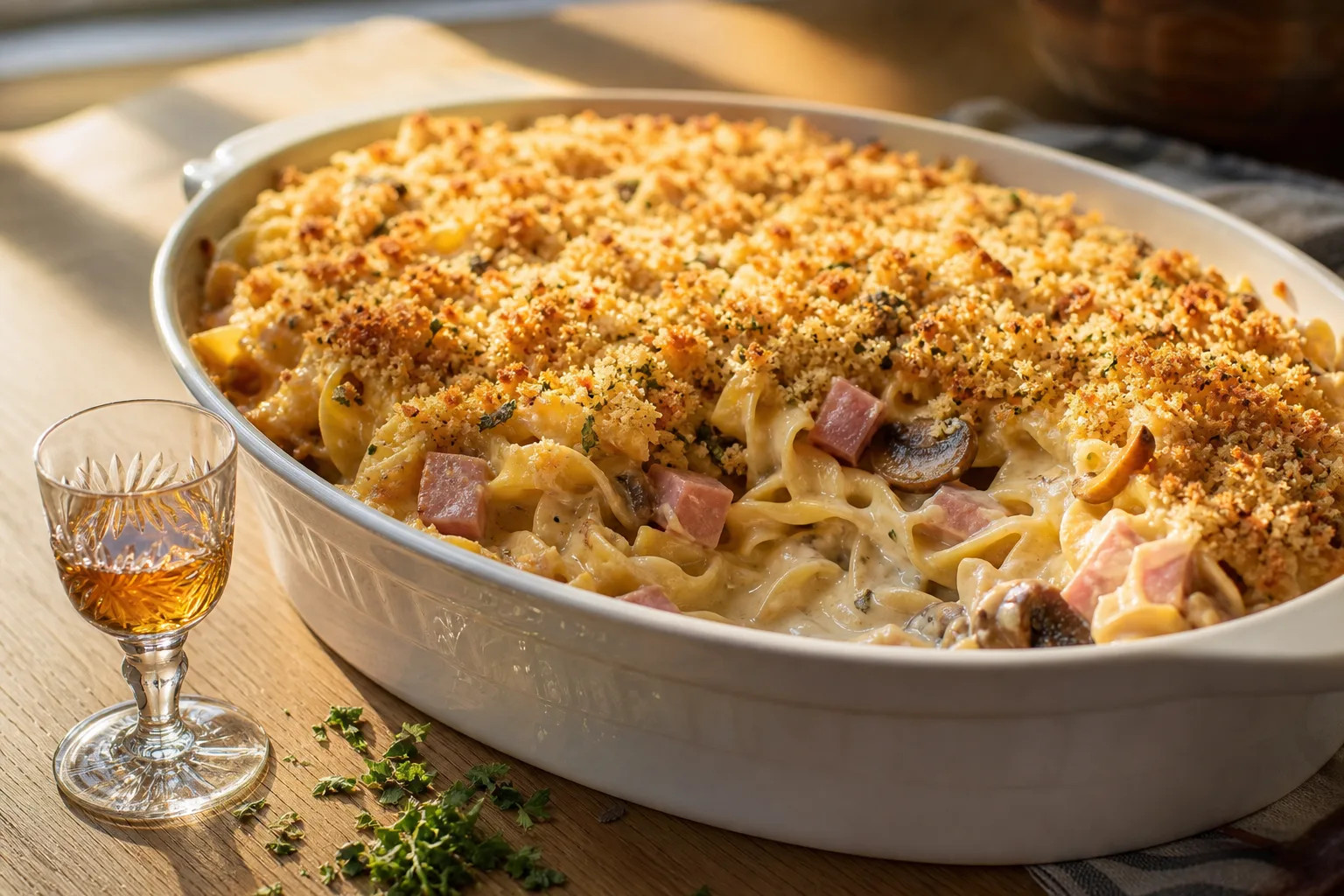

Tetrazzini is a chicken dish by default and a turkey dish for four days every November, and ham almost never comes up — which is odd, because a holiday ham leaves more usable meat than a turkey does. It works. It is not the chicken version with ham swapped in.
Two things change. The ham arrives cured, salted to the point where salt is a preservative rather than a seasoning, so anything you add to the sauce lands on top of it. And ham does not shred. It cubes, and those cubes stay where you put them.
The base version is Chicken Tetrazzini: Firm Pasta, Real Sherry Sauce, No Mush, linked at the bottom, and the method is the same: brown the mushrooms hard, reduce real sherry, pull the pasta short. The original puts a teaspoon and a half of kosher salt in the sauce. This one puts in none.
Why This Works
The sauce is built completely unsalted — unsalted butter, unsalted stock, nothing in the roux or at the finish — because a pound of cured ham carries more salt than the dish needs and gives it up into the sauce as it bakes. The wide noodles do the rest: a flat ribbon holds far more sauce per bite than a round strand.
Ingredients
This fills a 9×13 and serves eight. Three cups of half-inch dice is about a pound, a quarter of a holiday ham.
For the Casserole
- 3 cups cooked ham in 1/2-inch dice (about 1 pound)
- 12 ounces wide egg noodles
- 1 pound cremini mushrooms, sliced 1/4 inch thick
- 1 cup frozen peas, straight from the freezer
- 2 tablespoons kosher salt, for the pasta water only
For the Sherry Cream Sauce
- 5 tablespoons unsalted butter
- 1 large shallot, minced
- 3 cloves garlic, minced
- 1/2 cup dry sherry (not cooking sherry, which is salted)
- 1/3 cup all-purpose flour
- 3 cups unsalted or low-sodium chicken stock, warmed
- 1 cup heavy cream
- 3/4 cup finely grated Parmesan
- 2 teaspoons Dijon mustard
- 1/4 teaspoon freshly grated nutmeg
- Zest of 1 lemon
- 3/4 teaspoon black pepper
For the Top
- 1 cup panko breadcrumbs
- 3 tablespoons unsalted butter, melted
- 1/3 cup grated Parmesan
- 2 tablespoons chopped flat-leaf parsley
Easy Swap
Smoked turkey breast substitutes straight across, cured on about the same scale. Leftover roast pork is the opposite case — not cured at all — so put 1 1/2 teaspoons of kosher salt back in the sauce, as the chicken version does.
How to Make It
Prep: 30 minutes | Bake: 30 minutes | Serves: 8
- Heat the oven to 375°F. Boil the noodles in heavily salted water for 3 minutes less than the package says for al dente — they should still have a pale, chalky core. Drain, rinse cool, and toss with a teaspoon of oil.
- Melt the butter in a large skillet over medium-high heat. Add the mushrooms in close to one layer and leave them alone for 4 minutes. Do not salt them. Stir and cook 5 minutes more, until their liquid has gone and the edges brown.
- Add the shallot and cook 2 minutes, then the garlic for 30 seconds. Pour in the sherry and let it bubble down until the pan is nearly dry, about 3 minutes.
- Sprinkle the flour over everything and stir constantly for 90 seconds. Add the warm stock in three additions, whisking smooth each time, then the cream. Simmer 5 minutes, until it coats the back of a spoon.
- Off the heat, once it has stopped steaming, stir in the Parmesan, Dijon, nutmeg, lemon zest, and pepper. Add no salt. It should taste slightly flat and a little too lemony. That is correct. Taste a cube of your ham too.
- Fold in the noodles, the ham, and the frozen peas with tongs and a light hand. The noodles are sturdy underdone, but stirring them like batter will tear them.
- Taste the mixture now, before it goes in the oven. This is the only moment salt can go in, and usually it should not. If it is still flat with the ham in it, add 1/4 teaspoon. Pepper is usually the better answer.
- Scrape it into a buttered 9×13. Mix the panko with the melted butter, Parmesan, and parsley and scatter it over the top. Bake 25 to 30 minutes, until the crust is deep golden and the edges bubble.
- Let it rest 10 minutes. The sauce is loose at minute zero and sets as it cools, which is the difference between a portion that holds and a puddle.
Don’t Do This
Do not season the sauce to taste while it is alone in the pan. A cream sauce that tastes right by itself is inedible once a pound of cured ham is folded in, and you cannot take salt out — only add volume. Boxed broth is the same trap, at 600 to 800 mg per cup.
Can You Make It the Night Before?
Yes — Assemble Up to 24 Hours Ahead
Assemble up to 24 hours ahead with two changes: pull the noodles four minutes early instead of three, since they keep absorbing sauce overnight, and hold the crumb topping back until just before it bakes. Add 15 minutes to the bake.
Let the sauce cool 20 minutes before the noodles go in if the dish is going into the refrigerator, because hot sauce over drained noodles keeps cooking them on the counter. A cold 9×13 wants 45 minutes out, then 45 at 375°F.
The overnight salt migration is the part I would not improvise. Ham sitting in cream sauce for twelve hours gives up salt and takes on sauce, which is pleasant for the ham and alarming for the sauce. If it tastes sharp in the morning, stir in 1/4 cup of cream before it bakes.
It freezes decently unbaked, because the noodles are underdone enough that freezer damage has less to work with. Assemble without the topping, freeze two months, thaw 24 hours, then top and bake about 50 minutes.
Wide Noodles or Rice: The Salt Difference Nobody Mentions
The shape is the easy half. A wide flat noodle suits ham specifically: a half-inch egg noodle ribbon, or pappardelle torn into thirds, has a broad face for sauce to sit on, where a round strand sheds most of what you toss it in. Ham is smoky enough to need that extra cream in the same bite.
Then there is rice, which gets asked constantly, because ham and rice is a real casserole tradition and because rice is what is in the pantry. You can build this over rice and it is good. But one change matters more than anything else, and almost no version mentions it.
Pasta is drained. Rice is not. Noodles go into a gallon of water carrying two tablespoons of kosher salt, which seasons them from the outside in, and then nearly all of that salt goes down the sink. They arrive seasoned but not salty. Rice is cooked in a measured amount of liquid and absorbs every bit of it — that is not a side effect, that is the method. All the sodium in the stock, plus everything the cured ham releases while it bakes, stays in the dish. Nothing leaves. Then it concentrates: thirty minutes at 375°F drives off water as steam, and the salt does not go with it.
So the adjustment has to be deliberate. Use unsalted or low-sodium stock, reading the carton rather than the front of the box. Add no salt anywhere, and drop the Parmesan to half a cup. And taste it before it goes in the oven, which is the step people skip. Unbaked, with the ham folded in, it should taste slightly bland. If it tastes right then, it will be too salty coming out.
The Rice Version, Written Out
Skip the noodles and the pasta water. Toast 1 1/2 cups of long-grain white rice in the butter before the mushrooms go in, build the sauce with 3 cups of unsalted stock and 1/2 cup of cream, cut the Parmesan to 1/2 cup, and add no salt. Cover tightly and bake 45 minutes at 375°F, then uncover, top, and give it 15 more.
Diced Ham Sits in Pockets, and You Season for That
Poached chicken and roast turkey pull apart into irregular wisps, and a wisp is mostly surface, so folded into a cream sauce they blur into the dish. Ham will not do that for you. It has been through a brine and a long low cook, so it comes off a knife in cubes.
So the salt is not evenly distributed and cannot be made so. You have a mild sauce with a couple of hundred small salty objects suspended in it, and every bite is either sauce-and-noodle or sauce-and-ham. That is the dish, not a flaw. But the fix is geometric: cut the dice at a half inch, not three-quarters. A pound at half an inch gives nearly twice as many pieces, halving the distance between pockets.
Ham behaves differently in the sauce too. Poached chicken contributes water and thins it; wet-cured ham gives up two or three tablespoons over the bake, barely noticeable as thinning but carrying real salt with it. The seasoning shifts between the fold and the table.
Sherry and Mushrooms Earn More Here Than With Chicken
Dry sherry is an oxidized wine, which is where the nutty, faintly bruised-apple note comes from, and that note has an obvious affinity with cured pork. Reduce it until the pan is nearly dry or you keep the alcohol and lose the payoff. What you must not reach for is the bottle labeled cooking sherry: it is salted to make it shelf-stable, and half a cup carries over a thousand milligrams of sodium into a dish designed around adding none.
The mushrooms are the counterweight to a cup of cream, and the browning in step two is most of the depth here. One departure from habit: do not salt them in the pan. That puts salt into the one part of this dish that cannot shed it, and creminis brown on their own in four undisturbed minutes.
Rachel’s Tip
Got a heavily glazed spiral-cut ham? Drop the dice into boiling water for 60 seconds and drain it well before it goes near the sauce. That pulls the sticky glaze and some surface salt off the cut faces — the faces that hand salt to the sauce.
Questions People Ask
Can I make ham tetrazzini with rice instead of noodles?
Yes, with one change: use unsalted or low-sodium stock and add no salt at all. Rice is not drained the way pasta is, so it absorbs every bit of liquid it cooks in, and the sodium from the stock and the cured ham stays in the dish and concentrates as it bakes. Taste it before it bakes; it should be slightly bland.
Do I really add no salt to the sauce at all?
With wet-cured ham, none, literally. A pound of it brings more sodium than a teaspoon and a half of kosher salt would, and it releases that into the sauce over thirty minutes in the oven. The one place salt belongs is the pasta water, which gets drained.
What kind of ham works best?
A plain wet-cured city ham is the easy case: salty but neutral, and it dices into cubes that hold their shape. A spiral-cut glazed ham works if you trim the sugary outer face off first. Dry-cured country ham will overwhelm three cups of anything — use one cup as seasoning and make up the bulk with diced chicken.
Why did my noodles come out mushy?
They were cooked too long before they went in. Egg noodles sit in a 375°F oven absorbing sauce for 30 minutes, so anything that started at al dente finishes well past it. Pull them a full three minutes early and rinse them cool.
Can I use stock made from the ham bone?
For the noodle version yes, diluted — ham-bone stock is often saltier than boxed broth, so start with half stock and half water and taste it before it goes into the roux. For the rice version I would not, because nothing gets drained and there is no walking it back.
About This Article

Written by Rachel Thompson. Rachel Thompson is a home cook who has spent over 10 years making an unreasonable number of dips, appetizers, and party spreads — no culinary training, just a decade of trial and error and a reputation among friends for always being asked to "bring a dip." She focuses on approachable recipes that combine bold flavors with simple techniques, making entertaining at home accessible to everyone. More about this site.
Scope and limits. Rachel is a home cook with no culinary training. Follow current food safety guidance for holding temperatures and time limits whenever you are serving people other than yourself.
Verify this against a primary source
Specifics change, and your situation may differ from the one described here. These are the authorities worth checking directly:
- FoodSafety.gov — cold holding, hot holding and the two-hour rule
- USDA FoodData Central — ingredient composition and nutrition data
- USDA Food Safety and Inspection Service — safe minimum temperatures and leftovers