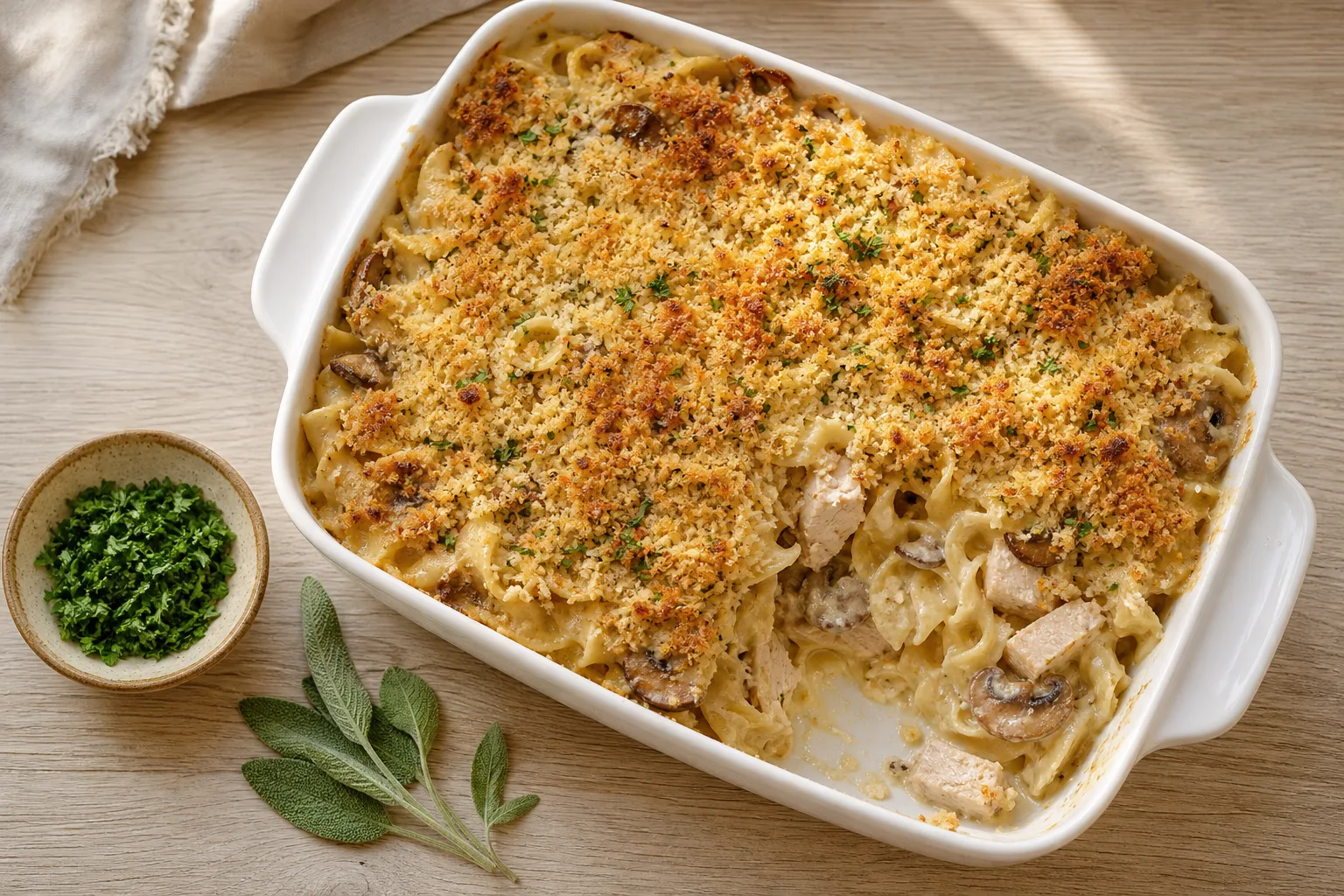

By the Saturday after Thanksgiving, the turkey in your refrigerator is not the turkey that came out of the oven on Thursday. It has given up moisture to the air in the container and more to its own cooling, and whatever you do next costs it more. That is the honest starting point, and it is harder than the poached chicken in the base version.
Tetrazzini is still the right answer, because a sherry cream sauce is good at carrying meat that has nothing left to give. But two things have to change: the bake gets shorter and the sauce gets thicker. Run the base chicken version as written with leftover turkey and you will pull out soft noodles and stringy meat.
Everything below follows from those two changes: which noodle survives a 22-minute bake, why the dark meat is worth fighting your relatives for, and what to do with the bowl of rice someone left next to the bird.
Why This Works
The bake is short because nothing in the dish needs cooking. The turkey was done days ago, and the oven is only heating it through and browning the top. That drives the other two changes: the noodles come out of the water closer to done, because there is less oven time to finish them, and the sauce leaves the stove thicker, because 22 minutes evaporates almost nothing.
Ingredients
This fills a 9×13 and feeds eight as a main course, sized around 4 cups of picked meat — about what comes off a 12-pound bird after dinner.
For the Turkey and Noodles
- 4 cups leftover roast turkey in 3/4-inch chunks, dark meat if you have it
- 12 ounces wide egg noodles
- 1 cup frozen peas, straight from the freezer
For the Sherry Cream Sauce
- 8 tablespoons unsalted butter
- 1 pound cremini mushrooms, sliced 1/4 inch thick
- 1 medium onion, finely chopped
- 3 cloves garlic, minced
- 1/2 cup dry sherry (not cooking sherry)
- 1/2 cup all-purpose flour
- 3 1/2 cups turkey carcass stock or chicken broth, warm
- 1 1/4 cups heavy cream
- 1 cup finely grated Parmesan
- 2 teaspoons Dijon mustard
- 1/4 teaspoon freshly grated nutmeg
- Zest of 1 lemon plus 1 tablespoon juice
- 1 1/2 teaspoons kosher salt, less if the stock is salted
- 3/4 teaspoon black pepper
For the Top
- 1 cup panko breadcrumbs
- 3 tablespoons unsalted butter, melted
- 1/2 cup grated Parmesan
- 2 tablespoons chopped flat-leaf parsley
Easy Swap
If you have leftover gravy, use it. Replace up to 1 cup of the stock with gravy and cut the flour by 2 tablespoons, since the gravy is already thickened. It carries the drippings, more flavor than any carton has. Strain the lumps out and taste before you salt; gravy is seasoned harder than broth.
How to Make It
Prep: 25 minutes | Bake: 25 minutes | Serves: 8
- Pull the turkey into 3/4-inch chunks while the oven heats to 400°F. Ice-cold turkey adds about ten minutes to the bake, which is time this dish cannot spare.
- Melt 5 tablespoons of the butter in a large skillet over medium-high heat. Add the mushrooms in close to a single layer and leave them alone for 4 minutes, then stir and cook 5 minutes more, until their liquid is gone and the edges are brown.
- Add the onion and cook 3 minutes, then the garlic for 30 seconds. Pour in the sherry and let it bubble down until the pan is nearly dry, about 3 minutes.
- Add the remaining 3 tablespoons of butter, sprinkle the flour over everything, and stir constantly for 2 minutes. Whisk in the warm stock in three additions, then the cream. Simmer 6 minutes, until a spoon drawn across the bottom leaves a track that closes slowly.
- Off the heat, stir in the Parmesan, Dijon, nutmeg, lemon zest and juice, salt, and pepper. It should taste too strong on a spoon; a pound of noodles and four cups of turkey are about to flatten it.
- Boil the egg noodles in well-salted water for 2 minutes less than the package says for al dente — not three, as the chicken version calls for. Drain, rinse briefly under cool water, and toss with a teaspoon of oil.
- Fold the noodles and frozen peas into the warm sauce, then add the turkey last and stir only enough to coat it. Transfer to a buttered 9×13 dish.
- Mix the panko with the melted butter, Parmesan, and parsley and scatter it over the top. Bake 22 to 25 minutes, until the sauce bubbles at the edges and the crust is deep golden.
- Rest it 10 minutes. The sauce is loose out of the oven and sets as it cools.
Don’t Do This
Do not bake this 30 or 35 minutes because that is what the chicken recipe says. Your turkey was roasted, chilled, and warmed in the sauce, so a long bake is a fourth cook on meat that finished days ago — the most common reason this dish comes out stringy. Pull it when the edges bubble and the crumbs are brown, even at 20 minutes.
Can You Make It the Night Before?
Yes — Assemble Up to 24 Hours Ahead
Yes, with two changes: pull the noodles a full 3 minutes early instead of 2, because they keep softening overnight in sauce, and hold the turkey and the topping back until bake time. Fold the turkey in right before it goes in the oven, and add 15 minutes.
If the dish is headed for the refrigerator, let the sauce cool 20 minutes before the noodles go in. Hot sauce keeps cooking them right there on the counter, and egg noodles have less structure to spare than spaghetti.
A cold 9×13 wants 40 minutes on the counter, then 35 to 40 minutes at 400°F. Check at 30. If the crumbs darken before the middle is hot, tent it with foil — a cool center is worse than a dark crust.
It freezes acceptably unbaked and without the topping, up to two months; thaw 24 hours, top, and bake 45 minutes. One caveat: if the turkey was frozen and thawed before it got here, do not freeze it again — twice-frozen poultry comes back mealy, and cream sauce does not hide it.
Egg Noodles, Spaghetti, or Rice When the Protein Is Already Cooked
Every starch decision here comes back to one fact: nothing in the pan needs cooking except the noodles. In the chicken version the bake finishes pasta that went in three minutes underdone. Here it only has 22 minutes to heat the dish through and brown a crust, and that is the whole budget. Wide egg noodles win for leftover turkey, and not out of tradition. They are thicker in cross-section than spaghetti but they hydrate faster, thanks to the egg and the softer wheat, so a short bake is enough to carry them from slightly underdone to right.
Spaghetti and linguine both work with one adjustment. They hold their bite better over a long bake, which is why the original uses spaghetti and pulls it three full minutes early. Try that margin here and you get chalky strands with a pale line down the middle, because 22 minutes at 400°F will not finish them. Pull long pasta two minutes early, not three, and cut linguine in half before it hits the water, since long strands lift out in clumps with no long bake to settle them. The rule underneath it: your undercook margin has to match your oven time, and when oven time drops by a third, so does the margin.
Rice is a real option — there is so often a bowl left from the holiday table — and it carries the biggest trap. A raw-rice casserole works by having the grains drink most of the liquid over 50 or 60 minutes — that is the whole mechanism of a chicken and rice bake. Cooked rice has already done that drinking. It has taken on roughly two and a half times its weight in water and its starch is swollen, so in a loose sauce it cannot take much more: the liquid stays liquid and you serve soup with rice in it.
So with 4 cups of cooked rice, tighten the sauce before it goes near the dish: cut the stock from 3 1/2 cups to 2 1/2 and leave the flour and cream alone. You want it dropping off a spoon in a blob rather than a ribbon, thicker than looks right, because the rice will not pull it together the way noodles do. Break the clumps up with your fingers, fold gently, and bake the same 22 to 25 minutes. Long-grain and jasmine do well; risotto and sticky short-grain do not.
Test the Noodle, Not the Clock
Package times are a range, and egg noodle brands vary more than spaghetti brands do. At two minutes under, bite one: bendable, with a thin firm line through the middle, not a chalky core. If it is already soft, drain it that second and accept a softer dish, because nothing in a 22-minute bake walks it back.
Dark Meat Holds Up, White Meat Needs Help
If you have a choice, use the dark meat. Thigh and leg are worked muscle: more fat marbled through them, more connective tissue that turned to gelatin during the roast, and both survive a second heating. Breast meat is lean, and the roast already took it past the point where its fibers contracted and squeezed water out. A day in the refrigerator pulls out more, and the sauce and bake each take a little. That is why white-meat tetrazzini from leftovers can taste like good cream sauce with sawdust in it.
If white meat is what you have, three things help, and none involve putting water back, because a contracted fiber will not reabsorb it. Cut it bigger. Three-quarter-inch chunks have far less surface for their volume than shreds, so they give up moisture more slowly. Fold it in last and off the heat. Every minute above roughly 150°F costs you something. Lean on fat, salt, and acid. The cream, the Parmesan, and the lemon coat dry fibers so they read as rich. That is a compensation, not a cure, and poached chicken is plainly an easier starting point than a bird that has already been to the table.
Rachel’s Tip
Make stock from the carcass even if you do not feel like it the next morning. Break the frame up, cover it with water by an inch, add an onion and two celery ribs, and hold a bare simmer for three hours. Roasted bones give up gelatin, which is why homemade stock coats a spoon and boxed stock does not. On dry meat, that body matters more than flavor.
Questions People Ask
Can I use white meat only?
Yes, and most people do, because the breast is what is left. Cut it into 3/4-inch chunks rather than slices or shreds, fold it in off the heat, and add 2 extra tablespoons of cream. It will still be drier than dark meat, but chunked and barely heated it stays pleasant rather than stringy.
Why is my tetrazzini soupy?
Usually the sauce was built for a long bake and then given a short one. Twenty-two minutes evaporates very little, and noodles that went in two minutes underdone absorb only so much, so the sauce has to leave the stove thicker than the chicken version’s. If it is already baked, rest it a full 15 minutes.
Can I use leftover rice instead of noodles?
Yes, with 4 cups of cooked rice and the stock cut from 3 1/2 cups to 2 1/2. Cooked rice has already absorbed what it can hold, so it will not thicken the sauce the way noodles do — it has to arrive thick. Long-grain and jasmine are fine; risotto and sticky short-grain turn it to paste.
Do I have to use sherry?
No, but put something acidic in its place. Dry vermouth or dry white wine reduce the same way. Without alcohol, 1/3 cup of stock plus 2 teaspoons of white wine vinegar off the heat gets most of the way there. Skip the acid and the sauce tastes like cream and nothing else, which leftover turkey cannot rescue.
About This Article

Written by Rachel Thompson. Rachel Thompson is a home cook who has spent over 10 years making an unreasonable number of dips, appetizers, and party spreads — no culinary training, just a decade of trial and error and a reputation among friends for always being asked to "bring a dip." She focuses on approachable recipes that combine bold flavors with simple techniques, making entertaining at home accessible to everyone. More about this site.
Scope and limits. Rachel is a home cook with no culinary training. Follow current food safety guidance for holding temperatures and time limits whenever you are serving people other than yourself.
Verify this against a primary source
Specifics change, and your situation may differ from the one described here. These are the authorities worth checking directly:
- FoodSafety.gov — cold holding, hot holding and the two-hour rule
- USDA FoodData Central — ingredient composition and nutrition data
- USDA Food Safety and Inspection Service — safe minimum temperatures and leftovers