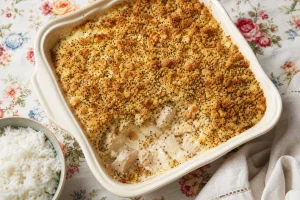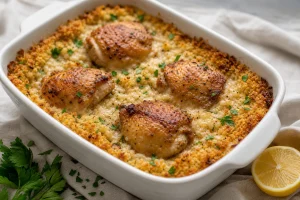
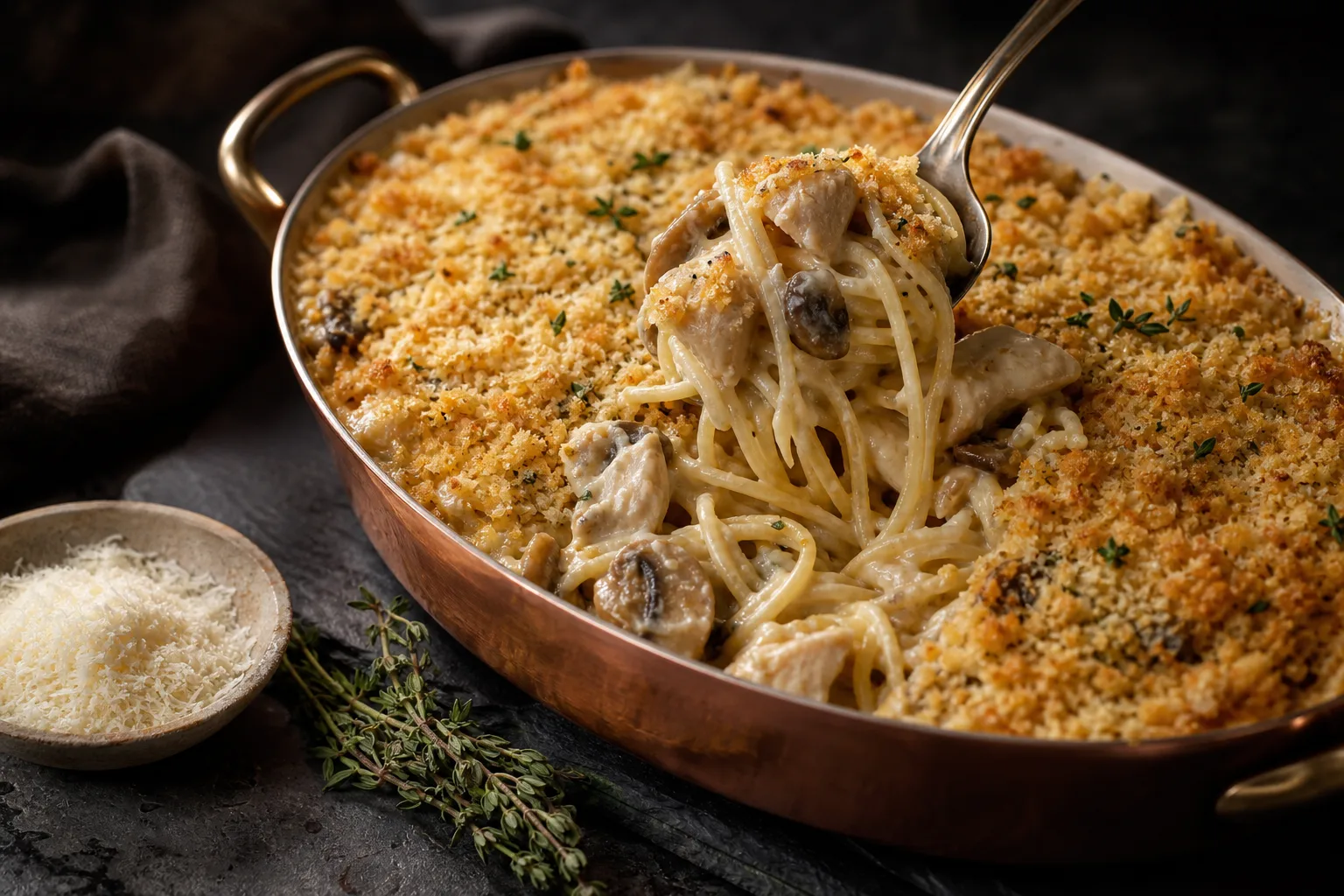

Tetrazzini has a bad reputation and it has earned about half of it. The version that deserves the reputation is beige, soft all the way through, and made of pasta that has been cooked twice — once in water and once again in sauce in the oven, until the strands have no structure left and the whole thing cuts like a slice of cake.
The pasta problem is fixed by a single decision you make eight minutes into cooking: pull the spaghetti three minutes before the box says it is al dente. It will seem aggressively underdone. It needs to be. In the oven it will absorb about a half cup of sauce and finish cooking there, and that is the only way a baked pasta casserole comes out with any bite.
The other half of the reputation comes from the chicken, and specifically from the reheat. Tetrazzini is a leftovers dish — almost nobody eats eight servings at once — so the day-two version matters as much as the day-one one. That is what I go deep on below.
Why This Works
Pulling the pasta three minutes early leaves the starch granules in the center of each strand still firm. Those centers keep absorbing liquid through the whole bake, which is both how the pasta finishes cooking and how the sauce thickens without flour. Fully cooked pasta has nothing left to absorb, so it just sits in the sauce and softens.
Ingredients
This fills a 9×13 or a large oval gratin dish. Eight generous portions, or ten if there is a salad and bread on the table.
For the Chicken and Pasta
- 1 1/2 pounds boneless, skinless chicken breasts or thighs
- 4 cups chicken broth (you will poach in it, then use it in the sauce)
- 12 ounces spaghetti or linguine
- 1 cup frozen peas, straight from the freezer
For the Sherry Cream Sauce
- 5 tablespoons unsalted butter
- 1 pound cremini mushrooms, sliced 1/4 inch thick
- 1 large shallot, minced
- 3 cloves garlic, minced
- 1/2 cup dry sherry (not cooking sherry)
- 1/3 cup all-purpose flour
- 3 cups of the warm poaching broth
- 1 cup heavy cream
- 1 cup finely grated Parmesan
- 1/4 teaspoon freshly grated nutmeg
- Zest of 1 lemon
- 1 1/2 teaspoons kosher salt
- 3/4 teaspoon black pepper
For the Top
- 1 cup panko breadcrumbs
- 3 tablespoons unsalted butter, melted
- 1/2 cup grated Parmesan
- 2 tablespoons chopped flat-leaf parsley
Easy Swap
Dry sherry is the flavor people recognize as tetrazzini, but dry white wine or dry vermouth work, reduced the same way. Skipping the alcohol, use 1/3 cup broth plus 2 teaspoons white wine vinegar off the heat — you need the acid, or the sauce tastes like cream and nothing else. Avoid the bottle labeled cooking sherry, which is salted and faintly sweet.
How to Make It
Prep: 30 minutes | Bake: 30 minutes | Serves: 8
- Put the chicken in a saucepan with the broth covering it by an inch and a big pinch of salt. Bring it up until the surface is just trembling — small bubbles at the edge of the pan, never a boil. Cut the heat, cover, and leave it 15 minutes for breasts or 20 for thighs. Lift the chicken out, drain and cool it 10 minutes, then pull it into bite-sized pieces. Keep the broth.
- Heat the oven to 375°F. Boil the spaghetti in heavily salted water for 3 minutes less than the package says for al dente. Drain it, rinse it briefly under cool water to stop the cooking, and toss it with a teaspoon of oil so it does not weld together.
- Melt the butter in a large skillet over medium-high heat. Add the mushrooms in as close to one layer as you can and leave them alone for 4 minutes. You want browning, which means contact with a dry hot pan. Then stir and cook another 5 minutes, until the liquid they released has cooked away completely.
- Add the shallot and cook 2 minutes, then the garlic for 30 seconds. Pour in the sherry and let it bubble down until the pan is almost dry, about 3 minutes — this is where the raw alcohol edge goes.
- Sprinkle the flour over everything and stir constantly for 90 seconds. Add 3 cups of the warm poaching broth in three additions, whisking smooth each time, then the cream. Simmer 5 minutes, until it coats the back of a spoon.
- Off the heat, stir in the Parmesan, nutmeg, lemon zest, salt, and pepper. Taste it. It should be assertive — slightly too salty and noticeably lemony on its own, because a pound of pasta is about to flatten it.
- Fold in the pasta, the chicken, and the frozen peas. Do this with tongs and a light hand; the underdone spaghetti is sturdy, but stirring it like batter will still shred it. Transfer to a buttered 9×13 dish.
- Mix the panko with the melted butter, Parmesan, and parsley and scatter it evenly over the top. Bake 25 to 30 minutes, until the crust is deep golden and the sauce is bubbling around the edges.
- Let it rest 10 minutes. The sauce is still thin at minute zero and sets as it cools, which is the difference between a spoonable portion and a puddle.
Don’t Do This
Do not add the Parmesan while the sauce is on the heat. Above a simmer, the proteins in hard cheese tighten and squeeze out their fat, and you get a greasy sauce with gritty strings in it. Pull the pan off, let it stop steaming, then stir the cheese in. This is the same failure that makes a baked cheese dip go stringy as it cools.
Can You Make It the Night Before?
Yes — Assemble Up to 24 Hours Ahead
Assemble it up to 24 hours ahead, with one change: pull the pasta four minutes early instead of three, because it will keep absorbing sauce overnight in the refrigerator. Hold the crumb topping back entirely and scatter it on right before baking. Add 15 minutes to the bake.
Let the sauce cool for 20 minutes before you fold in the pasta if the dish is going into the refrigerator. Hot sauce on cold-bound pasta keeps cooking it on the counter, and by morning the strands will have gone soft before the oven ever sees them.
A cold 9×13 needs 45 minutes on the counter before it goes in the oven, then about 45 minutes at 375°F. Check at 40 — you want bubbling at the edges and a golden crust, and if the crust browns before the middle is hot, tent it with foil and keep going.
It freezes better unbaked than most pasta casseroles, because the pasta is underdone enough that freezer damage has less to work with. Assemble in a foil pan without the topping, freeze up to two months, thaw 24 hours in the refrigerator, then top and bake 50 minutes. Baked-then-frozen comes back as paste.
Why Reheated Chicken Goes Dry and Stringy, and How to Stop It
Chicken muscle is bundles of long fibers held in a protein matrix, and the water that makes it taste juicy is held inside those bundles. When you heat chicken past about 160°F the proteins contract and squeeze that water out. On the first cook that is fine, because the water ends up in the dish. On a reheat it is a disaster, because the meat has already lost its margin — it gives up a second round of moisture, the fibers pull tight against each other, and what you chew is a dry rope.
Three things prevent it, and all three are about keeping the chicken below the temperature where it contracts again. Pull it in chunks, not shreds. A thumb-end piece has a small surface-to-volume ratio and loses water slowly; a wispy shred is almost all surface and dries out in seconds. Reheat at reduced power or low oven heat. Full-power microwaving drives the chicken to 180°F internally while the pasta beside it is still lukewarm, which is precisely the mismatch that ruins it. Add liquid back before you start, not after. Once the fibers have tightened they will not reabsorb anything; the liquid has to be there as steam while the dish is warming.
In practice, for a single portion: shallow bowl, a tablespoon of broth or cream around the edge, loosely covered, 50 percent power for three minutes, stirred once halfway. Three minutes at half power is gentler than ninety seconds at full even though the total energy is similar, because the heat has time to even out instead of cooking the chicken while the pasta catches up.
For the whole dish, add a quarter cup of broth or cream in a ring around the inside edge, cover with foil, and bake at 300°F for 30 to 35 minutes — low and slow is the entire point — then pull the foil for the last five minutes to re-crisp the crumbs. It keeps four days, and done this way day three is genuinely good rather than obligatory.
The One Reheat to Skip
Do not reheat tetrazzini uncovered at 400°F to crisp the top faster. The crumbs will brown beautifully in twelve minutes and the chicken underneath will be sawdust. If the crust matters that much, reheat it covered at 300°F until hot, then run it under the broiler for 90 seconds.
Mushrooms Are Not Optional, but They Are Negotiable
A pound of mushrooms cooks down to about a third of that. They do two jobs: they are the savory counterweight to a cup of cream, and the browning from step three is most of the depth in the finished dish. Mushrooms that were steamed instead of browned turn the sauce gray and taste of nothing.
If you dislike them, the substitution that works is 3 cups of thinly sliced leeks cooked slowly in the butter for 12 minutes until jammy, plus 2 teaspoons of soy sauce stirred in at the end. Canned mushrooms are the one option I would rule out — packed in water, unable to brown, and faintly tinny in a way cream cannot hide.
Rachel’s Tip
Poach the chicken in the broth you will build the sauce from — one pot of liquid doing two jobs. The chicken comes out seasoned instead of bland, and the broth picks up body no carton can match. The first several times I made this I poached in water and poured it down the drain, which was throwing away the best ingredient in the dish.
Questions People Ask
Why did my tetrazzini come out mushy?
The pasta was cooked too long before it was baked. Boxed spaghetti goes into a 375°F oven for 30 minutes and absorbs sauce the whole time, so anything that started at al dente ends well past it. Pull it a full three minutes early — it should still have a visible pale core when you bite a strand — and it will be right when the casserole comes out.
Can I use rotisserie chicken instead of poaching?
Yes, and about 3 cups of pulled rotisserie meat is the right amount. You lose the flavored poaching broth, so use a good store-bought broth and add an extra 1/4 teaspoon of salt to the sauce. The texture is slightly firmer than poached, which is actually an advantage on the reheat. Keep the bake time the same.
Why is my sauce grainy or greasy?
The Parmesan went in too hot. Hard cheeses break above a simmer, releasing fat and leaving tight protein strands behind. Take the pan off the burner and wait until it stops actively steaming before the cheese goes in, and grate the cheese finely so it melts fast. Pre-shredded cheese makes this worse, because the anti-caking starch on it clumps.
Can I make this with turkey?
That is arguably the original point of the dish. Use 3 cups of pulled dark and light meat, skip the poaching, and add a half cup extra broth since roast turkey is drier than poached chicken. Do not skip the lemon zest — turkey needs the lift more than chicken does.
Do I need to rinse the pasta?
In this one case, yes. Rinsing normally washes off starch that helps sauce cling, but here the pasta sits for ten or fifteen minutes while you finish the sauce, and residual heat keeps cooking it. A quick cool rinse stops that clock, and this sauce has flour and cheese in it already.
Which Pasta Shape — and Can You Use Rice Instead?
Spaghetti is traditional, and it is traditional for a reason: a cream sauce clings along the whole length of a strand, so every forkful carries sauce without any of it pooling. But the shape is not sacred, and a few of the alternatives are genuinely better depending on what else is in the dish.
Whatever you choose, the number that matters is the same. The pasta cooks twice — once in water and once in the oven — so it comes out of the pot meaningfully short of done. Three minutes under the package time is the working figure for a 30-minute bake. It should still have a chalky core when you drain it.
- Spaghetti — the default. Break it in half before boiling; full-length strands are miserable to portion out of a casserole dish.
- Linguine — flatter, so it carries slightly more sauce per strand, and it is a little more forgiving if you overshoot the boil.
- Fettuccine or wide egg noodles — the richest option and the softest. Egg pasta hydrates faster than semolina, so pull it four minutes early rather than three.
- Short shapes (cavatappi, medium shells, campanelle) — worse for the classic twirl, but much better if there is something chunky in the dish that you want in every bite.
- Skip angel hair and capellini. They are too thin to survive a second cooking and will be mush before the top browns.
Rice is a real option rather than a compromise, but it is a different recipe, not a substitution — and the mistake is treating it like one. Raw long-grain rice needs about two cups of liquid per cup of rice in a covered bake, which is more than the stovetop ratio because a casserole loses water to steam. Build the sauce deliberately thin, cover the dish, and give it 45 minutes before anything else goes near it.
Cooked rice is the opposite problem. It has already absorbed roughly two and a half times its weight in water and cannot take on much more, so a sauce built at the usual consistency will stay loose and never set. Thicken it well beyond what looks right, and bake only long enough to heat through.
The One-Line Rule
Pasta is boiled in salted water and drained, so it arrives seasoned but not salty. Rice absorbs every drop it cooks in, so all the salt in your stock stays in the dish and concentrates as it bakes. Switching to rice means cutting the salt, not just the liquid.
Each of these questions gets worked out properly in a version of its own, because the answer genuinely changes with what is in the dish:
- Turkey Tetrazzini — what survives a second bake when the protein is already cooked, and why the undercook margin shrinks to two minutes.
- Shrimp Tetrazzini — why long strands and shrimp fight each other on the fork, and how to resolve the 45-minute rice versus 7-minute shrimp conflict.
- Ham Tetrazzini — the drained-versus-absorbed salt problem in full, with the wide-noodle case.
- Mushroom Tetrazzini — how whole wheat, chickpea and gluten-free pasta behave in a bake, and why a wild rice blend suits mushrooms.
About This Article

Written by Rachel Thompson. Rachel Thompson is a home cook who has spent over 10 years making an unreasonable number of dips, appetizers, and party spreads — no culinary training, just a decade of trial and error and a reputation among friends for always being asked to "bring a dip." She focuses on approachable recipes that combine bold flavors with simple techniques, making entertaining at home accessible to everyone. More about this site.
Scope and limits. Rachel is a home cook with no culinary training. Follow current food safety guidance for holding temperatures and time limits whenever you are serving people other than yourself.
Verify this against a primary source
Specifics change, and your situation may differ from the one described here. These are the authorities worth checking directly:
- FoodSafety.gov — cold holding, hot holding and the two-hour rule
- USDA FoodData Central — ingredient composition and nutrition data
- USDA Food Safety and Inspection Service — safe minimum temperatures and leftovers