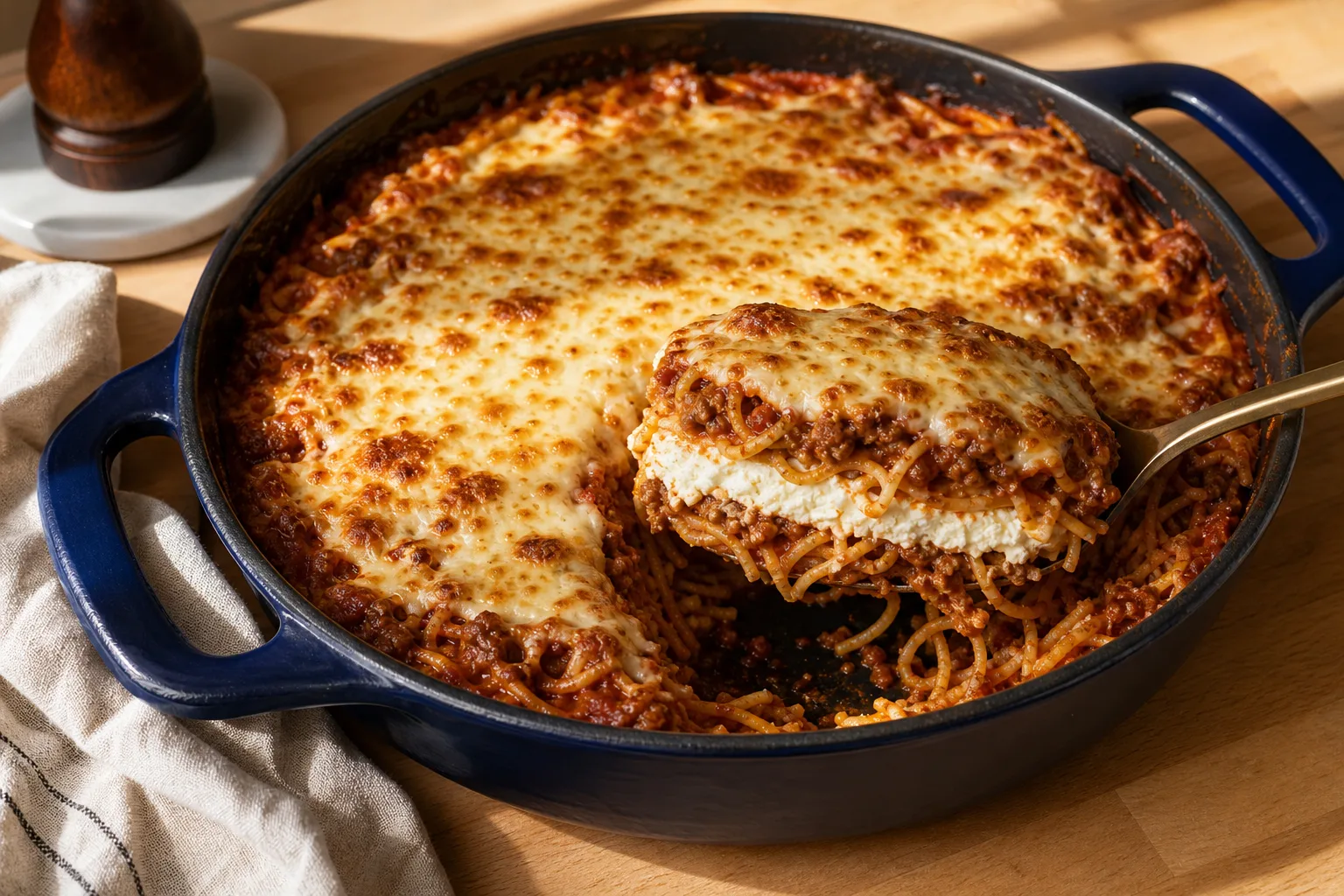

Million dollar spaghetti is a 1970s-style church potluck casserole with a plain premise: spaghetti and meat sauce with a seasoned cream cheese layer hidden in the middle. When it works, that middle layer melts into something between ricotta and alfredo and the whole dish eats like baked pasta with a secret.
When it does not work, it fails in two specific ways. The cream cheese layer stays in cold white lumps that never quite melt, and the spaghetti underneath turns into a single soft mat you serve with a spatula. I made both versions more than once before I worked out that they have the same root cause: things going into the oven at the wrong consistency and the wrong temperature.
So this version front-loads two fixes. The dairy layer gets beaten smooth at room temperature before it ever touches pasta. And the spaghetti comes out of the water three minutes early, because the oven is going to cook it a second time whether you planned for that or not.
Why This Works
Spaghetti is boiled three minutes short of the package time and the meat sauce is deliberately thinned with a splash of pasta water. Those two choices work together: the strands still have starch left to hydrate, and the sauce is loose enough to be the thing they drink instead of each other. Fully cooked spaghetti in a thick sauce has nothing to absorb and nowhere to go but soft.
Ingredients
This is a full 9×13 dish and it is heavy — about ten square portions. The cream cheese layer is rich enough that smaller portions than you expect are usually right.
For the Meat Sauce
- 1 tablespoon olive oil
- 1 1/2 pounds ground beef (85/15)
- 1 medium yellow onion, diced small
- 4 cloves garlic, minced
- 1 (24-ounce) jar marinara, or 3 cups homemade
- 1 (15-ounce) can tomato sauce
- 1 teaspoon dried Italian seasoning
- 1/2 teaspoon sugar
- 1 1/4 teaspoons kosher salt
- 1/2 teaspoon black pepper
- 1/2 cup reserved pasta water
For the Cream Cheese Layer
- 8 ounces full-fat cream cheese, at room temperature
- 1 cup full-fat cottage cheese or whole-milk ricotta
- 1/2 cup sour cream
- 1/2 cup grated Parmesan
- 2 tablespoons chopped fresh chives or parsley
- 1/2 teaspoon garlic powder
- 1/2 teaspoon kosher salt
For Assembly
- 1 pound dried spaghetti
- 4 tablespoons unsalted butter, cut into thin slices
- 2 cups grated low-moisture whole-milk mozzarella
- 1/4 cup grated Parmesan for the top
Easy Swap
Cottage cheese and whole-milk ricotta are interchangeable here. Cottage cheese is tangier and more traditional for this dish; ricotta is milder and slightly sweeter. Whichever you use, go full-fat. Low-fat versions of either one hold more water and will leave a damp seam where the layer meets the pasta.
How to Make It
Prep: 30 minutes | Bake: 45 minutes | Serves: 8 to 10
- Set the cream cheese out at least 45 minutes before you start. This is the step everyone skips and it is the whole difference between a smooth layer and a lumpy one.
- Heat the oil in a large skillet over medium-high. Add the beef, break it up, and let it sit undisturbed 4 minutes to brown. Stir and cook 3 minutes more, then pour off the fat. Add the onion, cook 5 minutes, then the garlic for 30 seconds.
- Add the marinara, tomato sauce, Italian seasoning, sugar, salt, and pepper. Simmer 15 minutes, uncovered, stirring occasionally. Heat the oven to 375°F.
- Bring a large pot of heavily salted water to a boil. Read the package time on the spaghetti, subtract 3 minutes, and boil it for that long — usually 6 minutes rather than 9. Scoop out 1/2 cup of the cooking water before you drain, and stir that water into the sauce. The sauce should now look slightly thinner than you would want on a plate.
- Beat the room-temperature cream cheese with a hand mixer or a stiff spoon for a full minute until it is completely smooth, then beat in the cottage cheese, sour cream, Parmesan, herbs, garlic powder, and salt. No white lumps should be visible at all.
- Drain the spaghetti and return it to the hot pot. Add the butter slices and toss until they melt and every strand is glossy. Butter here is not decoration — it keeps the strands from fusing into a solid sheet in the oven.
- Spread a thin film of sauce in a buttered 9×13 dish. Add half the buttered spaghetti in an even layer. Spread the entire cream cheese mixture over it, going nearly to the edges. Add the remaining spaghetti, then all the remaining sauce, spreading it to cover completely.
- Cover tightly with foil and bake 30 minutes. Remove the foil, scatter the mozzarella and Parmesan, and bake 15 to 18 minutes more until the cheese is browned in patches and the edges bubble. Rest 15 minutes before cutting — cut too early and the layers slide apart.
Don’t Do This
Do not try to spread cold cream cheese, and do not soften it in the microwave to get around it. Cold cream cheese tears the pasta layer and never fully melts. Microwaved cream cheese goes partly liquid while the center is still cold, and it separates in the oven into oil and grain. Room temperature and a minute of beating are the only reliable route.
Can You Make It the Night Before?
Yes — Assemble Up to 24 Hours Ahead
Assemble it fully through step 7, hold back the mozzarella, cover, and refrigerate up to 24 hours. Add 15 minutes to the covered bake and loosen the top with a quarter cup of water or marinara before it goes in, since the spaghetti will have pulled moisture from the sauce overnight.
Let it sit on the counter 45 minutes first. A cold, dense pan of spaghetti takes a long time to come up to temperature in the middle, and the usual failure is browned cheese on top of a lukewarm center. The 45 minutes is also cheap insurance against cracking a glass dish.
There is one real change with the overnight version: the cream cheese layer firms up in the refrigerator and comes out of the oven a little more sliceable, a little less molten. I slightly prefer it that way, but if you want the melted-into-the-pasta effect, bake it the same day.
I would not freeze this one. Cream cheese and sour cream both separate when frozen and thawed, and what you get is a grainy layer with water sitting around it. The meat sauce freezes beautifully on its own for up to three months, so make a double batch of that instead and assemble fresh.
Long Pasta Behaves Differently Than Tubes
Most baked pasta recipes use a tube or a shell, and those shapes leave air gaps that let steam move around. Spaghetti does the opposite — the strands lie flat against each other and compress into layers. That is actually what makes this dish work, because you need a dense base to hold the cream cheese layer up, but it also means heat and steam travel through it slowly.
Two things keep that density from turning into a brick. The butter toss coats each strand so they slide against each other instead of welding together, and the deliberately loose sauce gives the compressed middle something to absorb. Skip either one and you get a pasta cake.
Test the Strand
Lift one strand out of the water at the six-minute mark and bite through it. You should see a distinctly paler line in the center of the cross-section and feel it snap rather than bend. If it droops and chews soft, it is already done and the bake will take it past.
Where the Cream Cheese Layer Should Sit
Put it in the middle, not on the bottom and not on top. On the bottom it scorches against the dish and tastes faintly burnt. On top it dries into a skin and blocks the mozzarella from browning properly. In the middle it is insulated on both sides and melts evenly into the pasta it touches.
Spread it nearly to the edges but leave about half an inch of bare margin. A layer sealed right to the wall of the dish traps steam underneath and the pasta down there cooks wet. That small gap is where the steam escapes.
The sour cream is doing a specific job, which is acid. Cream cheese plus cottage cheese plus Parmesan is a lot of fat and salt with nothing cutting it, and the dish reads heavy and flat without something sharp. If you do not have sour cream, a tablespoon of lemon juice beaten into the mixture gets you most of the way there.
Keeping the Meat Sauce Honest
Jarred marinara is the standard here and I have no argument with it, but it is formulated to be eaten straight from the jar, which means it is thicker than a baked dish wants. The half cup of starchy pasta water is not a garnish — it is what turns a serving sauce into a baking sauce.
Brown the beef properly first. Ground beef dropped into a pan and stirred immediately releases its water and simmers in it, which gives you gray crumbles with no depth. Four undisturbed minutes gets you actual browning, and that is most of the savory flavor in the finished casserole.
Rachel’s Tip
Break the spaghetti in half before it goes in the water. Nobody will notice in a baked casserole, and it makes the difference between portions you can cut cleanly and portions that pull a six-inch tail of pasta out of the pan. This is the tip I wish someone had told me the first dozen times.
Questions People Ask
Why is my million dollar spaghetti lumpy in the middle?
The cream cheese was too cold when you mixed it. Cold cream cheese does not blend with cottage cheese or sour cream — it breaks into small firm pieces that coat themselves in the thinner dairy and never melt out in the oven. Leave it on the counter 45 minutes and beat it on its own for a full minute before anything else goes in.
Can I use a different pasta?
Linguine and fettuccine both work and behave the same way. Penne or rotini also taste fine but give you a different dish — the gaps between the tubes let the cream cheese layer sink down through rather than sit as a distinct stratum, so you lose the layered cross-section that is the whole point.
Why does mine come out watery?
Usually low-fat dairy. Low-fat cream cheese, light sour cream, and reduced-fat cottage cheese all carry more water, and that water has to go somewhere during a 45-minute bake. The other cause is not draining the beef fat, which pools and makes the bottom layer greasy in a way that reads as watery.
Do I have to cover it with foil?
Yes, for the first 30 minutes. The foil traps steam, and that steam is what finishes the undercooked spaghetti. Bake it uncovered the whole time and the top layer dries into something leathery while the strands in the middle stay firm.
How long will it keep?
Four days covered in the refrigerator. Reheat portions in a covered dish at 350°F for about 20 minutes with a spoonful of water added. The cream cheese layer tightens up as it chills, which makes cold leftovers surprisingly good straight from the pan — a thing my family discovered before I did.
About This Article

Written by Rachel Thompson. Rachel Thompson is a home cook who has spent over 10 years making an unreasonable number of dips, appetizers, and party spreads — no culinary training, just a decade of trial and error and a reputation among friends for always being asked to "bring a dip." She focuses on approachable recipes that combine bold flavors with simple techniques, making entertaining at home accessible to everyone. More about this site.
Scope and limits. Rachel is a home cook with no culinary training. Follow current food safety guidance for holding temperatures and time limits whenever you are serving people other than yourself.
Verify this against a primary source
Specifics change, and your situation may differ from the one described here. These are the authorities worth checking directly:
- FoodSafety.gov — cold holding, hot holding and the two-hour rule
- USDA FoodData Central — ingredient composition and nutrition data
- USDA Food Safety and Inspection Service — safe minimum temperatures and leftovers