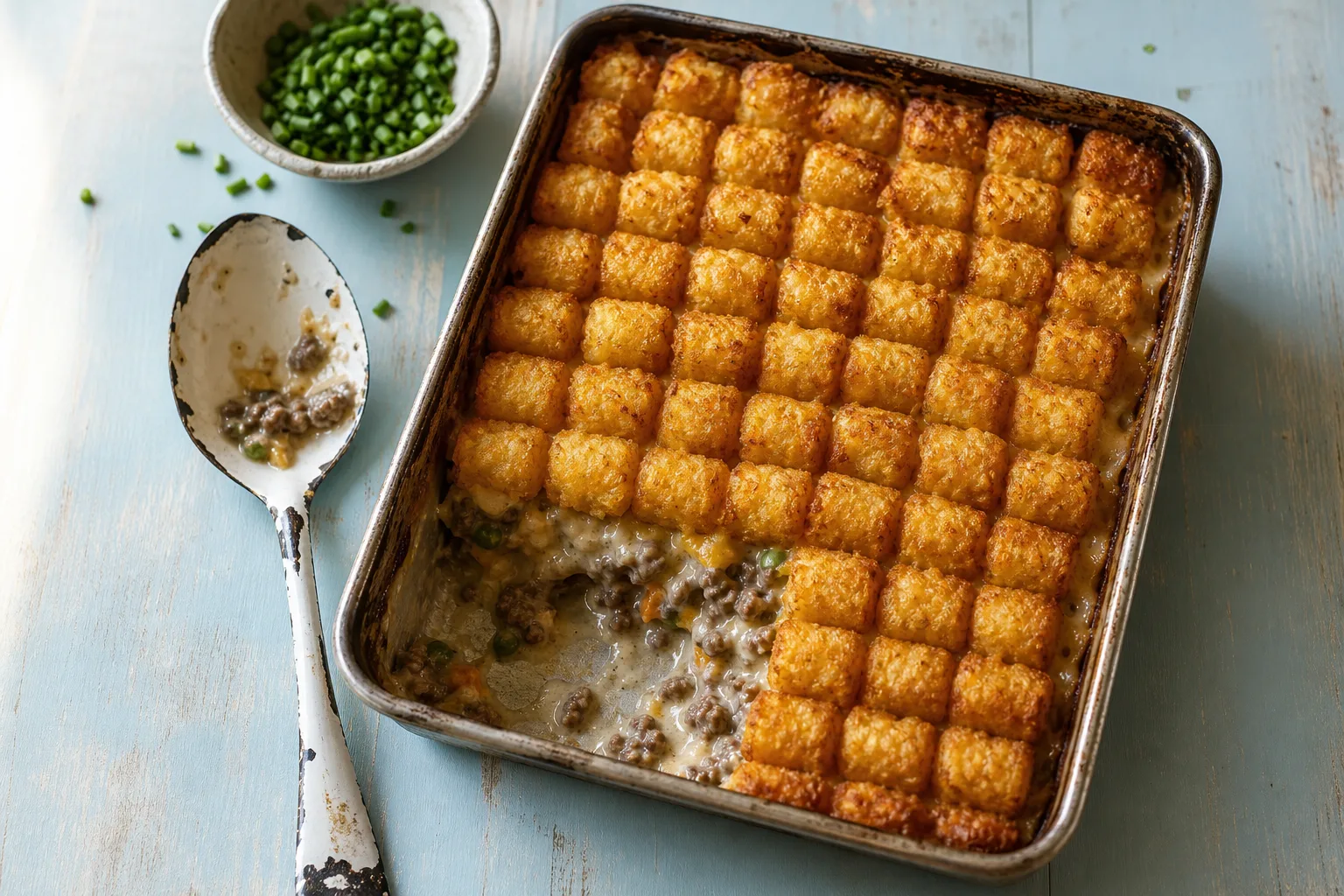

The tots are the whole reason anyone makes this, and the tots are the part that goes wrong. The top looks right coming out of the oven, and then the spoon goes in and comes back up with something closer to mashed potato. That grid was a crust for about four minutes and then it quietly drank the sauce underneath it.
Two causes, neither of them your oven: the filling was too thin, so it wicked upward, and the tots went on thawed or two deep. Fix both and a hotdish behaves the way you remember it — crisp and craggy on top, thick underneath, holding a clean edge when you cut a square out of the pan.
This is the scratch-sauce version. I have nothing against the can, which is genuinely part of this dish’s history, but making the sauce yourself is how you control its thickness — and thickness is the entire game here.
Why This Works
Tater tots are extruded from starchy russet potato, which is why they crisp and also why they collapse: starchy potato drinks liquid fast. So the filling has to mound on a spoon rather than run off it, and the tots go on frozen, flat side down, one layer deep. A frozen tot spends its first ten minutes driving water out. A thawed one spends them pulling water in.
Ingredients
This fills a 9×13 pan about an inch and a half deep: eight generous dinner portions, or ten with a salad.
For the Filling
- 1 tablespoon neutral oil
- 1 1/2 pounds ground beef, 80/20
- 1 large yellow onion, diced small
- 2 ribs celery, diced small
- 8 ounces cremini mushrooms, sliced thin
- 3 cloves garlic, minced
- 1/4 cup all-purpose flour
- 1 1/2 cups low-sodium beef broth
- 1 cup whole milk
- 1/2 cup heavy cream
- 1 tablespoon Worcestershire sauce
- 1 teaspoon soy sauce
- 1/2 teaspoon dried thyme
- 1 1/2 teaspoons kosher salt
- 3/4 teaspoon black pepper
- 2 cups frozen cut green beans, thawed and patted dry
For the Top
- 2 pounds frozen tater tots, left in the freezer until the moment they go on
- 1 1/2 cups shredded sharp cheddar, optional
- 2 tablespoons chopped chives, for serving
Easy Swap
Ground turkey works, but it brings almost no fat: start with 2 tablespoons of oil and skip the draining. Frozen corn replaces the green beans one for one. What I would not swap in is frozen shredded hash browns — shreds mat into a single sheet and give you a damp potato pancake lid instead of a crisp grid.
How to Make It
Prep: 25 minutes | Bake: 45 minutes | Serves: 8 to 10
- Heat the oven to 400°F with a rack in the upper third and butter a 9×13 pan. Leave the tots in the freezer.
- Heat the oil in a large skillet over medium-high. Add the beef in a flat layer and leave it alone for 4 minutes so it browns instead of steaming, then break it up and cook 5 minutes more. Spoon off all but 2 tablespoons of fat.
- Add the onion, celery, and mushrooms. Cook 7 to 8 minutes, until the mushroom liquid has cooked away and the pan looks dry again. Add the garlic for 30 seconds.
- Sprinkle the flour over everything and stir constantly for 90 seconds. It will look pasty and smell toasted.
- Stir in the broth, then the milk, cream, Worcestershire, soy sauce, thyme, salt, and pepper. Simmer 5 to 6 minutes, until a spoon dragged across the pan bottom leaves a track that stays open for a second. Oversalt slightly on purpose — two pounds of unseasoned potato is about to land on top.
- Fold in the dried green beans, scrape everything into the pan, spread it level, and let it sit 5 minutes to set. For cheese inside, scatter half the cheddar on now.
- Set the tots on top straight from the freezer, flat side down, in rows, touching but never overlapping. A 9×13 takes 60 to 70. Any leftovers go back in the freezer.
- Bake 40 to 45 minutes uncovered, until the tots are deep golden and the filling bubbles at the edges. Add the remaining cheddar at 35 minutes.
- Rest 10 minutes. Add the chives at the table — they go dull under residual heat.
Don’t Do This
Do not cover the pan with foil, and do not pile the tots two deep to finish the bag. Foil traps steam against the one component you are drying out, and a second layer never sees direct heat — it stays pale while the layer beneath it turns to paste.
Can You Make It the Night Before?
Yes — Assemble Up to 24 Hours Ahead
Make the filling up to two days ahead, cool it, and refrigerate it right in the baking dish. The tots go on frozen, immediately before baking — never the night before. Cold filling plus frozen tots needs about 55 minutes instead of 45.
The filling genuinely improves overnight — it thickens, and the thyme and Worcestershire settle into the beef, which gives the tots a firmer base to sit on. Pull the dish out 30 minutes ahead so a cold glass dish is not going into a hot oven, which is how glass dishes crack.
What you cannot do is assemble the whole thing ahead. Tots sitting on wet filling overnight arrive waterlogged, and no bake time brings them back. The filling alone freezes for three months; thaw it overnight, top with frozen tots, and add 10 minutes. A baked hotdish reheats acceptably at 375°F uncovered for 25 minutes, but covered it only steams.
Where Hotdish Actually Comes From
Hotdish is older than the tots on it, and the word matters to people. In Minnesota and across the Upper Midwest a hotdish is its own category — one pan, a starch, a protein, a bound sauce, usually headed for a church basement table — and the term turns up in Midwestern community cookbooks well before tater tots existed. Calling it a casserole is the kind of not-wrong that gets you corrected at a family gathering.
Tater Tots were an Ore-Ida product introduced in the 1950s, and the usual story is that they solved the problem of the slivers left over from cutting french fries: grind the scraps, season, bind, extrude, freeze. So this dish is only about seventy years old, and it landed in a region that already built suppers on canned condensed soup. That lineage is why the canned-soup version is the authentic one and the scratch version is the revision.
Why Tots and Not Some Other Potato
This is the one potato dish where the variety has been chosen for you, and it is worth knowing what was chosen. Tots are starchy potato — russet and its relatives, not waxy. Starchy potatoes hold more starch and less moisture, so they fry crisp, go fluffy inside, and soak up surrounding liquid readily. All three traits are in play: the crisp is the appeal, the fluffy interior is the texture, and the absorbency is the failure mode.
Waxy potato cubes scattered on top would hold their shape and shrug off the sauce, but they would never crisp, because there is not enough free surface starch to brown into a shell. That trade-off is the most useful thing to know about potato casseroles generally: starchy browns and absorbs, waxy holds and refuses. The other half is uniformity. Tots are extruded within a hair of each other, so they brown at the same rate. Cut potato by hand and that becomes your job — uneven pieces are why the middle is raw when the top has gone brown.
Worth Knowing
Brands differ more than you would expect. Some tots are packed loosely and brown in 35 minutes; store-brand tots are often denser and need the full 45. The first time you open a new bag, check at 35 minutes and then every 5 after that rather than trusting the clock.
What Else Counts as a Hotdish
Once you have the structure — bound sauce, protein, vegetable, starch on top — the variations are endless and most of them are better than they sound. Tuna hotdish swaps the beef for canned tuna and the tots for crushed potato chips or egg noodles. Wild rice hotdish, which is genuinely a Minnesota thing, replaces the tots entirely with cooked wild rice stirred into a cream sauce with chicken and mushrooms. Cheeseburger hotdish leans into pickles and mustard in the filling. Every one of them lives or dies on the same two variables: sauce thickness and topping moisture.
If you are improvising, the rule I use is that the filling should be about as thick as a canned condensed soup straight from the can — thick enough to hold a spoon upright for a second. Thinner than that and whatever is on top gets wet. Thicker and the dish turns pasty as it bakes, because the starch keeps setting up while it is in the oven and you cannot loosen it once the tots are on.
Rachel’s Tip
For genuinely crunchy tots, broil 2 to 3 minutes at the end with the door cracked and your eyes on the pan. The window between crisp and burnt is about 45 seconds wide.
Questions People Ask
Why are my tater tots soggy on top?
In order of likelihood: the filling was too thin and wicked upward, the tots were thawed or left on the counter while you cooked, or the pan was covered with foil. A distant fourth is a second layer of tots added to finish the bag.
Can I use cream of mushroom soup instead?
Yes, and that is the traditional version. Use two 10.5-ounce cans plus 1/2 cup milk, skip the flour, broth, milk, and cream, and cut the added salt to 1/2 teaspoon, because condensed soup is already heavily salted. Brown the beef and vegetables as written.
Do I cover it while it bakes?
No, uncovered the whole time. The bake exists to crisp the top while the filling heats, and foil defeats the first half of that. If the tots brown well before the filling bubbles, the filling went in too cold.
Can I freeze a tater tot hotdish?
Freeze the filling, not the finished dish. Filling holds three months and comes back unchanged. A frozen and thawed tot top turns uniformly soft, because freezing ruptures the starch structure giving you the crisp shell.
Can I double it, or bake it in a different pan?
Double it into two 9×13 pans rather than one deep roasting pan. Depth is the problem: the whole method depends on a single layer of tots sitting close to the top of the oven, and a 4-inch-deep pan gives you tots that brown long before the filling in the middle is hot. Two pans on the same rack, rotated once, bake in the same 45 minutes.
About This Article

Written by Rachel Thompson. Rachel Thompson is a home cook who has spent over 10 years making an unreasonable number of dips, appetizers, and party spreads — no culinary training, just a decade of trial and error and a reputation among friends for always being asked to "bring a dip." She focuses on approachable recipes that combine bold flavors with simple techniques, making entertaining at home accessible to everyone. More about this site.
Scope and limits. Rachel is a home cook with no culinary training. Follow current food safety guidance for holding temperatures and time limits whenever you are serving people other than yourself.
Verify this against a primary source
Specifics change, and your situation may differ from the one described here. These are the authorities worth checking directly:
- FoodSafety.gov — cold holding, hot holding and the two-hour rule
- USDA FoodData Central — ingredient composition and nutrition data
- USDA Food Safety and Inspection Service — safe minimum temperatures and leftovers