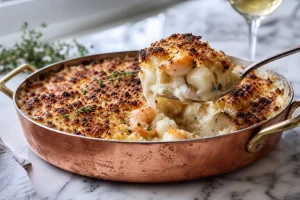

Crab imperial is an expensive dish to get wrong. A pound of jumbo lump costs real money, and the entire point of paying for it is the lumps — big sweet pieces that fall apart on the fork and not before. Turn it into a casserole and you put all of that in a deep dish in a moderate oven for half an hour, which reliably gets you shredded crab in a slightly curdled sauce.
The fix is geometry and heat. A shallow dish and a hot oven, 425°F for twenty minutes, so the binder sets before the crab has time to dry out. Deep dish, moderate oven, forty minutes is the same amount of heat delivered slowly, and slowly is what ruins it.
This is the Maryland version I settled on after making it for too many holiday tables: no breadcrumbs stirred into the body of the dish, a thin cracker crown on top, and a fold so gentle you can count the strokes.
Why This Works
Lump crab is sold already cooked, so the oven’s only job is setting the egg-and-mayonnaise binder around it. A shallow dish at 425°F does that in twenty minutes, while a deep dish at 350°F needs forty — and those extra twenty minutes are spent squeezing water out of crab you paid a lot for.
Ingredients
Use a shallow 2-quart dish — an 11×7 or a 9-inch square, about two inches deep. Not a 9×13 and definitely not a deep casserole; depth is the enemy here.
For the Imperial
- 1 1/2 pounds jumbo lump crab meat, picked over and drained
- 3/4 cup good mayonnaise
- 1 large egg, beaten
- 1 tablespoon Dijon mustard
- 1 teaspoon Worcestershire sauce
- 2 teaspoons Old Bay seasoning
- 1/4 teaspoon white pepper
- 1 tablespoon fresh lemon juice
- 1/2 small red bell pepper, diced very fine
- 3 tablespoons finely sliced chives
- 2 tablespoons chopped flat-leaf parsley
For the Top
- 1/2 cup crushed buttery crackers
- 2 tablespoons unsalted butter, melted
- 1/4 teaspoon paprika
- Lemon wedges, for serving
Easy Swap
Backfin or lump will both work and cost roughly half what jumbo lump does. The dish is genuinely good with them — you just lose the dramatic forkful. What I would not use is claw meat, which is darker and stronger and disappears under the mayonnaise, or imitation crab, which goes rubbery and sweet.
How to Make It
Prep: 20 minutes | Bake: 20 minutes | Serves: 6 as a main, 10 as an appetizer
- Heat the oven to 425°F with a rack in the upper third. Butter a shallow 2-quart dish.
- Tip the crab into a colander and let it sit five minutes. Then spread it on a paper-towel-lined sheet pan and go through it with your fingers for shell — even expensive crab has a few pieces. Keep the lumps whole as you work.
- Whisk the mayonnaise, egg, Dijon, Worcestershire, Old Bay, white pepper, and lemon juice together in a wide bowl until completely smooth. Stir in the bell pepper, chives, and parsley.
- Add the crab all at once. Now fold, don’t stir: cut down through the middle with a rubber spatula, sweep along the bottom, turn the mass over. Eight strokes, maximum. It will look underdressed and a little dry. That is correct — mayonnaise loosens in the oven.
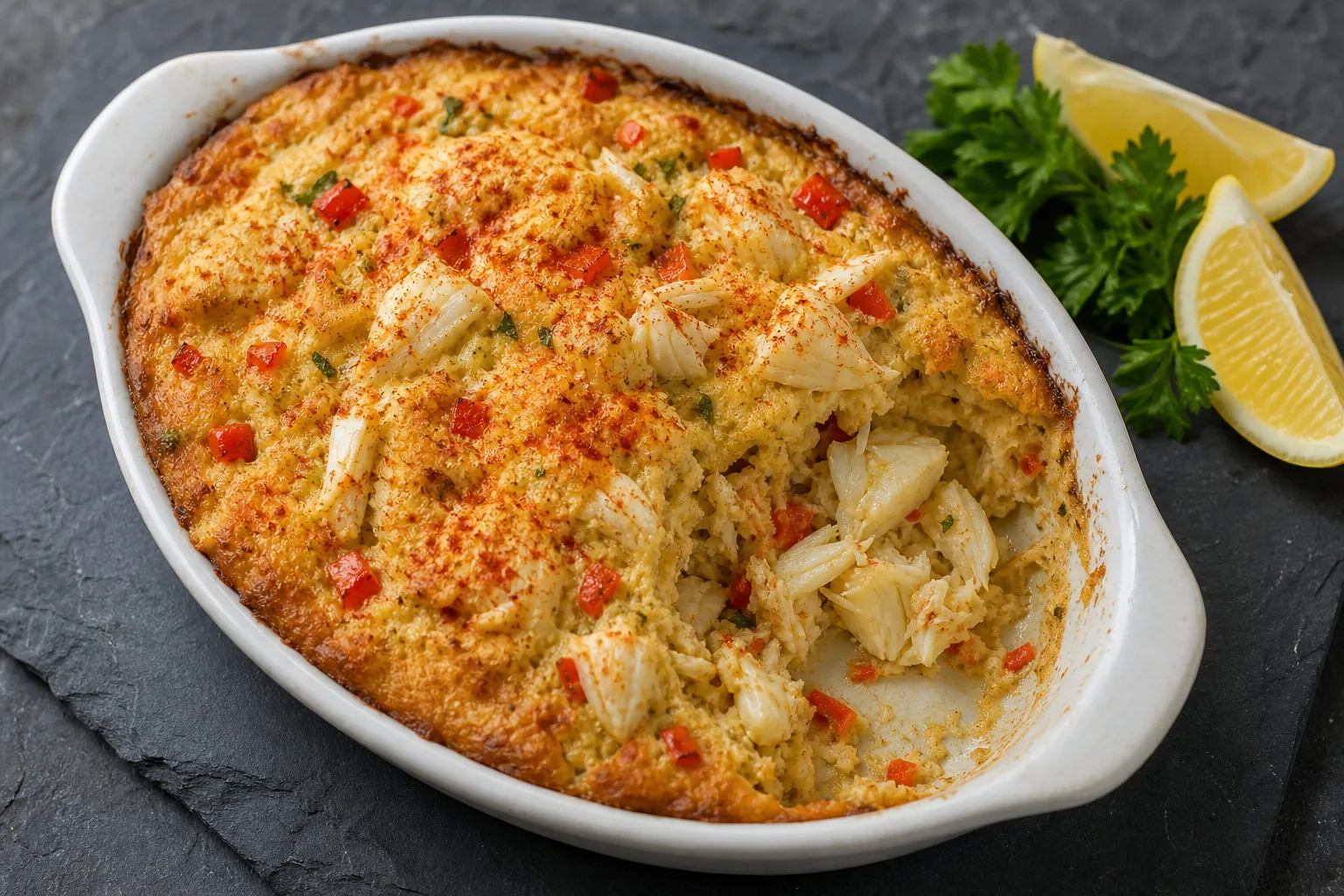
- Transfer it to the dish in sections rather than pouring, and level the top with the spatula without pressing. You want it loose and slightly mounded, about an inch and a half deep.
- Toss the crushed crackers with the melted butter and scatter them over the top in a thin layer — you should still see imperial through the gaps. Dust with paprika.
- Bake 18 to 20 minutes, until the crackers are golden and the surface has puffed slightly and lost its wet sheen. If you jiggle the dish the center should move as one piece, not slosh. Rest five minutes and serve with lemon wedges.
Don’t Do This
Do not stir breadcrumbs into the imperial itself, even though plenty of recipes tell you to. They act like a sponge, pull the binder away from the crab, and leave you with something closer to a stuffing. Breadcrumbs belong on top, where they get butter and heat and stay crisp.
Can You Make It the Night Before?
Not Fully — Here Is What You Can Prep
No — and this is the one I get asked about most. Mayonnaise, egg and salt sitting on lump crab overnight draw liquid straight out of the meat, so you bake a soupy dish and the lumps have already broken down from the weight of sitting. What you can do is make the binder up to two days ahead, pick the crab the morning of, and have the dish buttered and the crackers crushed. Then it is a four-minute assembly.
The binder actually improves on day two — the Old Bay hydrates, the Worcestershire settles in, and the raw-Dijon edge softens. Keep it covered in the refrigerator and whisk it briefly before the crab goes in.
Picked crab keeps about 24 hours on a paper-towel-lined tray, loosely covered, in the coldest part of the refrigerator. It will keep weeping a little, which is fine and is the point of the towel. Do not rinse it and do not let it sit in its own liquid.
Freezing is worse than making ahead. Crab meat freezes into something stringy, and an egg-and-mayonnaise binder splits on thawing. If you need a crab dish you can build days in advance, make a hot crab dip instead — a cream cheese base is far more forgiving than this one.
Why Shallow Beats Deep
Heat moves through a casserole from the outside in, so the thing that sets your bake time is the distance from the surface to the middle. An inch and a half of imperial has a center that gets hot in about fifteen minutes. Pile the same amount into a deeper dish and the middle is still cool at twenty-five, so you leave it in longer, and the crab at the edges keeps cooking the whole time.
This is also why I bake it in the upper third of the oven rather than the middle. The top is where the color comes from, and the closer the dish sits to the top element the sooner the crackers brown — which means I can pull the dish on the crackers’ schedule instead of waiting for them.
What the Crab Grades Actually Mean
The labels at the fish counter are not marketing, they are a real sorting system, and knowing them is most of knowing what to buy. Jumbo lump is the two large muscles that connect to the swimming legs — whole, pale, and the most expensive thing in the case. Lump, sometimes sold as backfin lump, is smaller body pieces plus broken jumbo. Special is the shredded body meat left after the lumps are picked out. Claw is darker, stronger-tasting meat from the claws.
For this dish the money question is jumbo lump versus lump, and the honest answer is that lump makes a very good crab imperial for about half the price. What you lose is the forkful where a single piece of crab holds together all the way to your mouth. That is a real pleasure and it is the reason the dish exists, so if this is the centerpiece of a holiday table I buy jumbo lump and do not pretend otherwise.
Special and claw both go wrong here for the same reason: there are no lumps to protect, so the twenty-minute hot bake has no purpose and the meat simply dries out inside a mayonnaise binder. Those two grades are what hot crab dip is for, where the meat is supposed to disappear into the base. Buying claw meat for imperial is spending less money on a worse version of a dish you could have made better.
Draining Crab Without Losing It
Pasteurized crab comes packed in liquid, and a pound of it can carry a quarter cup. Pour that into your binder and the dish will never set properly. But crab is also fragile, so you cannot press it or wring it out.
The colander-then-tray method is the gentlest thing I have found. Five minutes in a colander takes the loose liquid, and five more spread on paper towels takes the surface film with no pressure at all. Resist patting it dry from above — let gravity and the towel do it.
Worth Knowing
Picking shell out of crab is easier on a dark tray than a white one. The shell fragments are pale and translucent, and they are nearly invisible against white paper towels on a white sheet pan.
Rachel’s Tip
Taste the binder before the crab goes near it, and over-season it slightly. Once it is mixed you cannot taste-and-adjust without stirring, and stirring is exactly what you are trying to avoid. Fix the seasoning while it is still just mayonnaise.
Questions People Ask
Why did my crab imperial come out watery?
Almost always undrained crab, which can carry a quarter cup of packing liquid per pound. The other cause is holding the assembled dish before baking — salt and mayonnaise pull moisture out of crab within an hour or two, so assemble and bake in the same half hour.
Can I use canned crab from the shelf-stable aisle?
You can, but drain it hard and expect a different dish. Shelf-stable canned crab is finer and saltier than the refrigerated pasteurized tubs, so cut the Old Bay to a teaspoon and skip added salt. At that point you are closer to a baked crab dip than to imperial.
How do I know when it’s done without cutting into it?
Two signs together: the crackers are properly golden, and the surface has gone from wet-looking to matte and slightly risen. Then nudge the dish — a set imperial moves as one piece and a raw one ripples. If the crackers brown before the center sets, tent the top with foil and give it another five minutes.
Can I make this in individual dishes?
Yes, and it is better that way for a dinner party. Divide it between six shallow gratin dishes and bake at 425°F for 12 to 14 minutes. They are shallower still, so they set faster — the whole principle of the recipe, one step further.
What do you serve with crab imperial?
Something plain, because the dish is rich and the crab is the point. I put out a green salad with a sharp lemon dressing, roasted asparagus, and good bread for scraping the dish. Skip a starchy side — potatoes or rice flatten it. If you are serving it as an appetizer instead, crackers and nothing else.
About This Article

Written by Rachel Thompson. Rachel Thompson is a home cook who has spent over 10 years making an unreasonable number of dips, appetizers, and party spreads — no culinary training, just a decade of trial and error and a reputation among friends for always being asked to "bring a dip." She focuses on approachable recipes that combine bold flavors with simple techniques, making entertaining at home accessible to everyone. More about this site.
Scope and limits. Rachel is a home cook with no culinary training. Follow current food safety guidance for holding temperatures and time limits whenever you are serving people other than yourself.
Verify this against a primary source
Specifics change, and your situation may differ from the one described here. These are the authorities worth checking directly:
- FoodSafety.gov — cold holding, hot holding and the two-hour rule
- USDA FoodData Central — ingredient composition and nutrition data
- USDA Food Safety and Inspection Service — safe minimum temperatures and leftovers