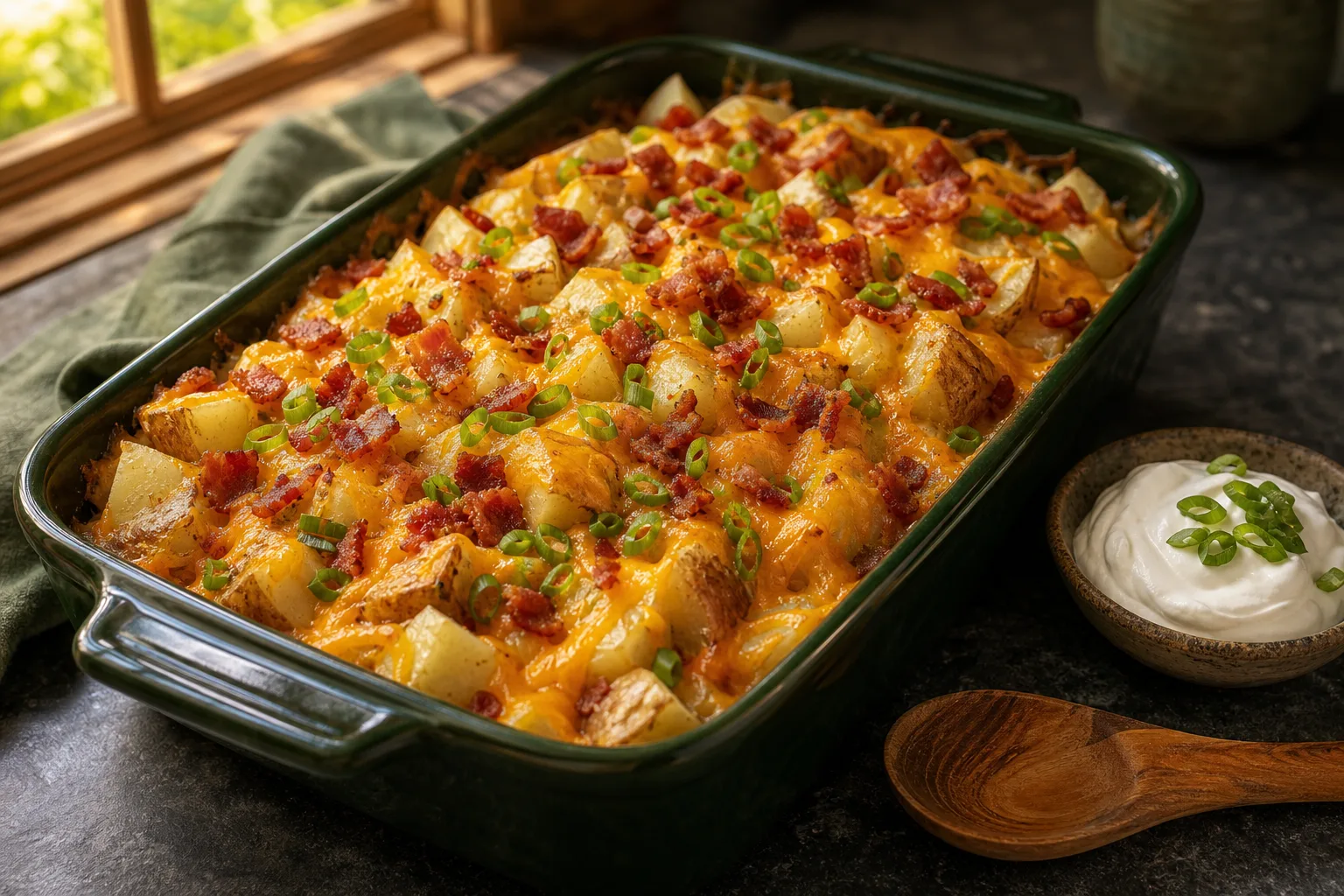

Most recipes with this name are mashed potatoes wearing a costume. You boil potatoes, mash them with sour cream and cheese, bake the result, and get a pan of dense, slightly gummy puree with bacon on it. It is not bad. It is also not a baked potato in any sense that matters.
The version worth making keeps the potato in chunks with the skins on, and the way you get there is to bake the potatoes instead of boiling them. A boiled potato absorbs water and then gives it back in the casserole dish. A baked potato loses water, concentrates, and holds its edges when you fold it into sour cream.
It takes an extra hour, almost all of it unattended, and it is the difference between a side dish people take seconds of and a pan of beige that comes home half full.
Why This Works
A whole potato baked dry in its skin loses moisture and sets up a fluffy, intact interior. Boiling does the opposite — it pushes water into the starch, and that water leaves again in the oven, which is what turns these casseroles both watery and gluey at once. Bake, cool, then cube. Cooling matters as much as baking: a hot potato falls apart the moment a spoon touches it.
Ingredients
This fills a 9×13 and feeds eight as a substantial side, or ten alongside something rich.
For the Casserole
- 4 pounds russet potatoes, about 6 large, scrubbed and dried
- 2 tablespoons neutral oil
- 1 tablespoon kosher salt, for rubbing the skins
- 12 ounces thick-cut bacon, cut crosswise into 1/2-inch pieces
- 1 1/2 cups full-fat sour cream
- 1/2 cup whole milk, warmed
- 4 tablespoons unsalted butter, melted
- 10 ounces sharp cheddar, grated from a block
- 1 1/2 teaspoons kosher salt
- 1 teaspoon black pepper
For the Top
- 4 ounces sharp cheddar, grated
- 6 scallions, thinly sliced
- Sour cream, for serving at the table
Easy Swap
Diced ham or browned smoked kielbasa stand in for the bacon, though you lose the rendered fat, so add an extra tablespoon of butter. Smoked gouda in place of a third of the cheddar is genuinely worth doing. What does not work is Monterey Jack on its own — it melts beautifully and tastes like almost nothing against this much sour cream.
How to Make It
Prep: 30 minutes | Bake: 85 minutes | Serves: 8 to 10
- Heat the oven to 400°F. Rub the potatoes all over with the oil and the tablespoon of salt, prick each one twice with a fork, and bake them directly on the rack for 55 to 60 minutes, until a knife slides into the center with no resistance at all.
- While they bake, cook the bacon in a skillet over medium heat for 10 to 12 minutes until crisp. Drain it on a rack and save 2 tablespoons of the fat.
- Let the potatoes cool 20 minutes, until you can handle them without flinching. This is not optional — hot potato disintegrates.
- Cut them into 1-inch cubes, skins on, keeping the pieces as even as you can manage.
- Whisk the sour cream, warm milk, melted butter, reserved bacon fat, salt, and pepper together in a very large bowl.
- Add the potato cubes, the grated cheddar, and two-thirds of the bacon. Fold, do not stir. A few broken cubes are fine and actually help bind it; a mashed bowl is a different recipe.
- Scrape it into a buttered 9×13 dish and spread it level without pressing down. Bake at 350°F for 25 minutes, scattering the topping cheddar on for the last 10.
- Scatter the remaining bacon and the scallions over the top, rest 10 minutes, and put a bowl of cold sour cream on the table beside it.
Don’t Do This
Do not boil the potatoes to save the hour, and never bring a mixer near this bowl. Boiled cubes carry water into the dish and collapse when folded. A hand mixer or a stand mixer ruptures the starch cells and turns the whole pan to wallpaper paste in about fifteen seconds — there is no recovering it.
Can You Make It the Night Before?
Yes — Assemble Up to 24 Hours Ahead
Bake the potatoes up to two days ahead and refrigerate them whole and uncut — that is the slow part, and it is the part that keeps best. Cube and fold on the day, because cut potato in sour cream goes pasty overnight as the starch continues to swell.
If you need the whole thing assembled ahead, it will survive 12 hours in the refrigerator, but expect a softer, denser result and add 10 minutes to the bake. The cubes keep absorbing moisture from the sour cream the entire time they sit, which is exactly the texture this recipe is set up to avoid.
Cook the bacon up to three days ahead and keep it in an airtight container at room temperature, not the refrigerator, where it goes limp. Grate the cheese the day before. Slice the scallions the morning of — any earlier and they turn slimy at the cut ends.
This one does not freeze. Sour cream splits when it thaws and the potato cubes go mealy, so you get both failures at once. If you need a freezer-friendly version of these flavors, a shredded hash brown casserole bound in a flour-thickened cheese sauce holds up far better.
Russet or Yukon Gold? This Is the One Dish Where Both Work
Russets are the default and they give you the familiar thing: fluffy, absorbent interiors that drink up the sour cream and bind the casserole together. The trade-off is that russet cubes are fragile, and a heavy hand while folding will break half of them. That is survivable — broken cubes act as a binder — but it is why the folding instruction is worded the way it is.
Yukon Golds are in between waxy and starchy, and they behave differently here in a way you might prefer. The cubes stay intact and glossy, the flavor is a little buttery, and the dish reads as chunkier and less rich. What they will not do is absorb much — you need about a quarter cup less sour cream, or it pools. True waxy potatoes like red bliss are the one bad choice: the cubes stay firm and separate, and the dish never comes together into anything.
Cube Size, and Why the Middle Comes Out Cold
One inch is the number. Larger than that and the centers of the cubes never get properly hot in a 25-minute bake, so you serve something that is bubbling at the edge and lukewarm in the middle. Smaller than that and the cubes break down into the sour cream and you are back at mashed potatoes with extra steps.
Evenness matters more than the exact size. A pan holding both half-inch scraps and two-inch chunks will give you mush and cold spots in the same spoonful, and no amount of extra oven time fixes it — the small pieces just keep overcooking while the big ones catch up. Cut each potato in half lengthwise, then in strips, then across. It is faster than cubing freehand and the pieces come out consistent.
Making It the Whole Dinner
This crosses from side dish to main course with very little effort, because the structure is already there. Two cups of shredded rotisserie chicken folded in with the cheese turns it into something my family eats out of bowls with a green salad. Steamed broccoli florets work the same way, though you have to dry them properly first or they thin out the sour cream exactly the way wet potatoes would. Either addition means you should go up by about half a cup of sour cream, since there is more surface to coat.
What I would not do is add anything with its own liquid — no canned corn, no fresh tomato, no sautéed vegetables that have not been cooked dry. The binding here is sour cream and melted cheese, not a flour-thickened sauce, and that means it has no capacity to absorb extra moisture. A flour sauce can carry a wet ingredient. This one cannot, and the failure shows up as a pool at the bottom of the dish about ten minutes after you serve it.
Rachel’s Tip
Bake the potatoes directly on the oven rack, not on a sheet pan and definitely not wrapped in foil. Foil steams the skin, which is the one part of a baked potato you are paying the extra hour for. A pan underneath catches drips; wrapping just undoes the method.
Questions People Ask
Can I use leftover baked potatoes?
Yes, and that is the best shortcut here. Cold baked potatoes from the refrigerator cube more cleanly than fresh ones, because the starch has had time to firm up. You need about 4 pounds, which is six large potatoes or roughly nine cups of cubes.
Why did my loaded baked potato casserole turn gluey?
Either the potatoes were boiled, or they were overworked. Boiling drives water into the starch, and that water comes back out in the oven. Overworking — stirring hard, or any mechanical mixer — ruptures starch cells and releases the starch directly into the sour cream, which is the glue you are tasting.
Do I peel the potatoes?
No. The skins are most of the point of a baked potato casserole: they hold the cubes together, they add a little chew against all that dairy, and they are why this does not read as mashed potato. Scrub them well and leave them on.
Can I make this with mashed potatoes instead?
You can, but it becomes a different dish — a mashed potato casserole, which is good but much denser and needs about 20 minutes longer to heat through. If you go that way, skip the warm milk entirely, because mashed potatoes already carry plenty of liquid.
Can I assemble it in individual dishes?
Yes, and it is a good way to serve this. Divide it among eight 8-ounce ramekins and bake at 350°F for 18 minutes instead of 25, adding the cheese for the last 8. The ratio of crisp top to creamy middle improves, and ramekins reheat far better than a dug-into 9×13 does.
About This Article

Written by Rachel Thompson. Rachel Thompson is a home cook who has spent over 10 years making an unreasonable number of dips, appetizers, and party spreads — no culinary training, just a decade of trial and error and a reputation among friends for always being asked to "bring a dip." She focuses on approachable recipes that combine bold flavors with simple techniques, making entertaining at home accessible to everyone. More about this site.
Scope and limits. Rachel is a home cook with no culinary training. Follow current food safety guidance for holding temperatures and time limits whenever you are serving people other than yourself.
Verify this against a primary source
Specifics change, and your situation may differ from the one described here. These are the authorities worth checking directly:
- FoodSafety.gov — cold holding, hot holding and the two-hour rule
- USDA FoodData Central — ingredient composition and nutrition data
- USDA Food Safety and Inspection Service — safe minimum temperatures and leftovers