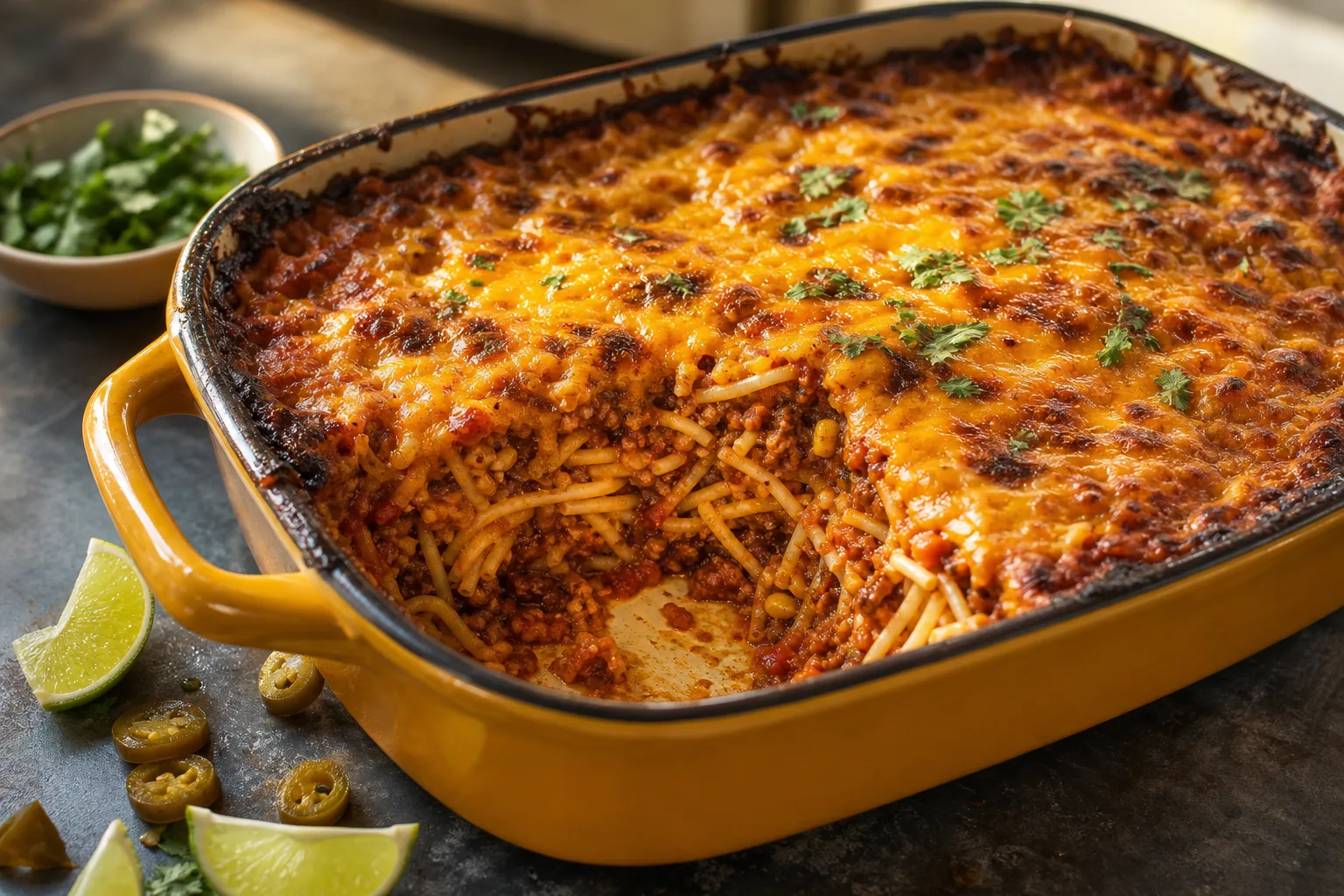

Taco spaghetti goes wrong in two opposite directions and almost never lands between them. One version comes out as a single tomato-colored brick: push a spoon in and the whole pan shifts as one piece. The other is a shallow pond of orange liquid with pasta sitting in it. I made both before I understood they have the same cause.
Taco seasoning is almost entirely ground dry spice, and ground dry spice is thirsty. Four tablespoons will claim half a cup of liquid and keep it — fine in a skillet, a problem in a casserole where a pound of undercooked pasta wants the same water. So this is a liquid problem, plus one rule about timing: the strands get coated the moment they leave the water, not after. It is also not the tortilla-layered version, which is a different dish built in sheets and cut in squares. This one is a single sauced mass with the cheese melted through it.
Why This Works
Spaghetti goes into the water three minutes short of the package time and comes out into a sauce that looks far too thin — loose enough to pour. Both numbers exist because two thirsty things share one water supply: the pasta still has starch left to hydrate, and four tablespoons of ground spice will take half a cup on their own. Build a sauce that looks correct in the pot and the pan is dry in thirty minutes.
Ingredients
A 9×13 dish, eight real portions. The cold finishing things are listed separately because they go on after the bake.
For the Meat Sauce
- 1 1/2 pounds ground beef, 85/15
- 1 medium yellow onion, diced small
- 3 cloves garlic, minced
- 2 tablespoons chili powder
- 1 tablespoon ground cumin
- 2 teaspoons smoked paprika
- 1 teaspoon dried oregano
- 1/2 teaspoon cayenne, or leave it out
- 2 teaspoons kosher salt
- 1 teaspoon black pepper
- 1 tablespoon tomato paste
- 1 (10-ounce) can diced tomatoes with green chiles, undrained
- 1 (15-ounce) can tomato sauce
- 1 1/4 cups low-sodium beef or chicken broth
For the Pasta and Cheese
- 1 pound dry spaghetti
- 1 cup pasta water, reserved before draining
- 8 ounces sharp cheddar, grated from a block (about 2 cups)
- 8 ounces Monterey Jack, grated from a block (about 2 cups)
- 4 ounces cream cheese, cubed and softened (optional, see below)
To Finish
- Sliced green onion and chopped cilantro
- Lime wedges
- Pickled jalapenos, sour cream, and hot sauce at the table
Easy Swap
Two store-bought taco seasoning packets stand in for the dry spices, but add them to the hot fat with the onions and skip their water instructions entirely — you are already adding plenty. Rotini or penne work and are easier to serve, though you lose what makes this dish distinctive.
How to Make It
Prep: 25 minutes | Bake: 30 minutes | Serves: 8
- Heat the oven to 350°F and butter a 9×13 dish. Put a large pot of well-salted water on to boil, but do not add the pasta yet.
- Brown the beef hard in a wide heavy pot over medium-high heat, in two batches, then drain it and return 1 tablespoon of the rendered fat to the pot. If draining is where your Tex-Mex bakes usually go greasy, the taco casserole post covers it properly and the same rule applies here.
- Cook the onion in that tablespoon of fat over medium heat for 6 minutes, add the garlic for 1 minute, then add all the dry spices with the salt and pepper and stir constantly for 30 to 45 seconds. The pot will look nearly dry and smell sharply of toasted cumin. Stop before a minute — chili powder turns bitter past that and it does not cook out.
- Add the tomato paste and stir it for a minute, then pour in the diced tomatoes with their juice, the tomato sauce, and the broth. Scrape the bottom clean, return the beef, and simmer uncovered for 10 minutes on a low bubble.
- Correct the consistency now, before the pasta is near it. Drag a spoon across the bottom: the trail should close up in about two seconds. If it holds open, add broth a quarter cup at a time. Taste and oversalt slightly — a pound of pasta and four cups of cheese flatten seasoning fast.
- Boil the spaghetti three minutes short of the low end of the package time, which for most dry spaghetti means 7 to 8 minutes. Bite one: bendable through, with a distinctly chalky core. Reserve a mug of the water, drain, and do not rinse.
- Move fast. Tip the hot spaghetti straight into the pot of sauce and toss with tongs until every strand is coated, which takes about 30 seconds of real effort. Add pasta water a splash at a time until the mass slides rather than clumps, usually 1/2 to 3/4 cup. Kill the heat, scatter in the cream cheese if you want it, and fold until it disappears.
- Fold in 2 cups of the mixed cheese off the heat. Pour everything into the dish, level it with the back of the spoon without packing it down, and scatter the remaining 2 cups over the top.
- Bake uncovered 25 to 30 minutes, until the cheese browns at the edges and the sauce bubbles up the sides rather than just steaming. Rest 15 minutes before cutting, then finish with green onion, cilantro, and a hard squeeze of lime.
Don’t Do This
Do not lay drained spaghetti in the dish and pour the sauce over it. It is the obvious way to build a casserole and it is exactly how you get the brick. Bare strands cool and fuse to each other within a minute, and no liquid poured on afterward gets between them again. Everything is tossed in the pot first.
Can You Make It the Night Before?
Not Fully — Here Is What You Can Prep
Assembling the whole pan a day ahead works less well here than for most casseroles, for the same reason the dish is good: the sauce is deliberately loose, so overnight the strands keep drinking and you wake up to paste. Make the meat sauce up to three days ahead instead — that is the part that takes time — and boil and dress the pasta on the day.
The sauce reheats to exactly where it was. Warm it in a wide pot over medium, add a splash of broth to bring the spoon trail back to two seconds, and carry on from the boiling step. That puts the dish twelve minutes from the oven, which is how I do it on a weeknight. Grate the cheese ahead and it is closer to eight.
If you truly have to assemble in advance, hold the window to about four hours in the refrigerator, add an extra half cup of broth before the pasta goes in, keep the top cheese back, and bake covered 20 minutes before uncovering for the last 20. The loss is texture, not flavor. Baked leftovers hold up well: four days refrigerated, two months frozen in cut portions.
The Liquid Budget, Written Out
Treat this as arithmetic rather than instinct. A pound of spaghetti pulled three minutes early still wants roughly a cup of water to finish. Four tablespoons of ground spice holds close to half a cup once it swells. Thirty uncovered minutes at 350°F takes another cup off the surface. That is two and a half cups of demand before anyone eats, which is why the sauce starts near four and a half cups of liquid for a dish that should not end up soupy.
What Too Thin Actually Looks Like
Right before the pasta goes in, the sauce should move like thin minestrone — you can see the beef shifting in it, not sitting on it. If it looks like a good Bolognese you are a cup of broth short. Every version of this I have ruined was ruined at that moment, by a sauce that looked correct.
Dress the Strands While They Are Hot
Long pasta in a casserole has a failure mode tubes and shells do not. Spaghetti leaves the water carrying a wet starchy film, and that film stays sticky for about a minute while the surface is hot. Let it sit in the colander and it sets strand to strand, pulling the whole mass into a solid raft — permanently, because the gaps the sauce needs are already glued shut.
Tossing it into the sauce the second it drains uses the same window in your favor: the sticky film grabs sauce instead of other pasta, and the strands end up individually coated and held apart by a thin layer of liquid. The starch in the reserved pasta water helps that sauce cling rather than run off. Have the pot hot and the tongs in hand before you drain, and toss hard for thirty seconds — until lifting a tangle brings up strands that fall back individually instead of coming up as a sheet.
Cheese Through It, and the Dairy Question
Four cups of cheese is deliberate, but where it goes matters more than how much. Half melts into the sauce off the heat and does structural work, thickening something intentionally loose into something that holds a cut edge. The other half goes on top and browns. Put all of it on top and you get a cheese lid over wet pasta, which is the version most people have had and why so many think they dislike this dish.
On the cream cheese or sour cream most versions call for — genuinely useful, and also how this goes gluey. Four ounces of cream cheese folded in off the heat binds the sauce and rounds off the edge of that much chili powder. Eight ounces, or any sour cream stirred in while the pot is still on heat, gives you a dairy paste coating the strands instead of sauce, and it tastes flat. For richer than that, add another cup of Jack. Worth saying plainly: the better-known million dollar spaghetti is Italian-American and hides its cream cheese as a layer in the middle of the pan. Here there is no layer — the dairy and cheese melt through the sauce, and the seasoning is Tex-Mex rather than oregano and basil.
Rachel’s Tip
The 15-minute rest is not about temperature. At 5 minutes the cheese is still liquid and a spoon pulls a gluey rope out of the pan; at 15 it has set enough that a square lifts out with a visible cut face. Cover it loosely with foil if your kitchen is cold, but leave it alone.
Questions People Ask
Why did my taco spaghetti come out dry?
The spice and the pasta drank more than you gave them. A packet is the usual culprit, being mostly ground spice plus thickener. Build to around four and a half cups of liquid per pound of pasta and check the spoon trail before the pasta goes in. If it is already baked, stir a half cup of hot broth through the pan and give it five minutes covered.
Why is mine one solid clump I cannot serve?
The strands went in bare. Spaghetti fuses to itself within a minute of draining, while the starchy film is still hot, and sauce poured over the top cannot reach between strands that are already stuck. Toss the pasta into the hot sauce the moment it drains. Boiling it to the package time instead of three minutes short makes it worse.
Do I have to add cream cheese or sour cream?
No, and plenty of the time I skip it. Four ounces of cream cheese folded in off the heat mellows the spice and helps the sauce bind. Past that it turns gluey, and sour cream stirred into a hot pot is liable to split and go grainy. If you want sour cream, put it on the table instead.
Can I make it with ground turkey or chicken?
Yes, with one adjustment. Lean ground poultry renders almost no fat and the spices need fat to bloom in, so add a tablespoon of neutral oil before the onions. Brown it in two batches the same way. It comes out lighter in flavor, so I add an extra half teaspoon of salt and more lime.
About This Article

Written by Rachel Thompson. Rachel Thompson is a home cook who has spent over 10 years making an unreasonable number of dips, appetizers, and party spreads — no culinary training, just a decade of trial and error and a reputation among friends for always being asked to "bring a dip." She focuses on approachable recipes that combine bold flavors with simple techniques, making entertaining at home accessible to everyone. More about this site.
Scope and limits. Rachel is a home cook with no culinary training. Follow current food safety guidance for holding temperatures and time limits whenever you are serving people other than yourself.
Verify this against a primary source
Specifics change, and your situation may differ from the one described here. These are the authorities worth checking directly:
- FoodSafety.gov — cold holding, hot holding and the two-hour rule
- USDA FoodData Central — ingredient composition and nutrition data
- USDA Food Safety and Inspection Service — safe minimum temperatures and leftovers