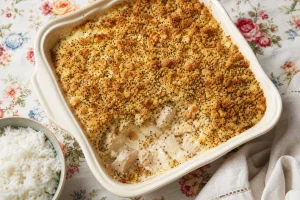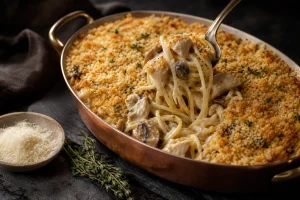


Most buffalo chicken casseroles are built on pasta or rice, and most of them are fine. The reason I stopped making them that way is that the starch soaks up the hot sauce and mutes it, so you end up adding more sauce, which makes the dish wetter, which makes it taste thinner. It is a loop you cannot win.
This version uses cauliflower instead, roasted hard at 425°F before it ever touches the sauce. Roasting drives off the water that would otherwise end up in the bottom of the dish and browns the edges, which gives you something that can stand up to three quarters of a cup of hot sauce. Added raw, cauliflower releases roughly a half cup of water during the bake — that is the orange soup people complain about.
It is also a casserole most people eat over three or four days, so I have put the real effort below into the thing nobody writes about honestly: how to store and reheat chicken in a thin, acidic sauce without it turning into dry orange threads.
Why This Works
Roasting the cauliflower first removes water before it can dilute the sauce, instead of asking the casserole to cope with it afterward. A head of cauliflower is around 90 percent water by weight, and twenty minutes at 425°F drives off enough of it that the florets go from spongy to dense and slightly sweet. That is the entire difference between this and a watery buffalo bake.
Ingredients
A 10-inch cast iron skillet or a 2-quart dish is right. Six servings, and it does not scale up gracefully — a doubled batch in a 9×13 steams rather than bakes, and the cauliflower softens back toward where you started.
For the Cauliflower
- 1 large head cauliflower (about 2 1/2 pounds), cut into 1 1/2-inch florets
- 3 tablespoons olive oil
- 1 teaspoon kosher salt
- 1/2 teaspoon black pepper
For the Buffalo Sauce Base
- 4 tablespoons unsalted butter
- 2 ribs celery, diced small
- 1/2 medium yellow onion, diced small
- 3 cloves garlic, minced
- 8 ounces cream cheese, cut into cubes and at room temperature
- 3/4 cup cayenne pepper hot sauce, the thin vinegar kind sold for wings
- 1/2 cup sour cream
- 1/3 cup chicken broth
- 1 teaspoon smoked paprika
- 1/2 teaspoon celery seed
- 1/2 teaspoon black pepper
For Assembly and Serving
- 4 cups cooked chicken, pulled into thumb-sized chunks (about 1 1/4 pounds)
- 2 cups shredded sharp cheddar
- 1 cup shredded Monterey Jack
- 1/3 cup crumbled blue cheese, for finishing
- 3 scallions, sliced thin
- Celery sticks and ranch dressing, for serving
Easy Swap
If cauliflower is not happening, use 1 1/2 pounds of Yukon Gold potatoes cut into 3/4-inch cubes and roasted the same way for 30 minutes. Broccoli works but roast it only 14 minutes or the florets turn to ash. If you want the starchy version after all, use 8 ounces of short pasta boiled 3 minutes shy of al dente and add 1/4 cup more broth, not more hot sauce.
How to Make It
Prep: 25 minutes | Bake: 45 minutes | Serves: 6
- Heat the oven to 425°F. Toss the cauliflower with the olive oil, salt, and pepper and spread it on a sheet pan in a single layer with space between the pieces — crowded florets steam instead of roasting. Roast 20 to 22 minutes, until the edges are properly browned and a fork goes in with a little resistance. Do not stir them.
- While that roasts, melt the butter in a large skillet over medium heat. Add the celery and onion with a pinch of salt and cook 7 minutes, until softened. Add the garlic for 30 seconds.
- Turn the heat to low and add the cream cheese cubes, stirring until they melt into the vegetables with no lumps left — about 3 minutes. Low heat matters here; cream cheese breaks into grains if you rush it.
- Take the pan off the heat. Stir in the hot sauce, sour cream, broth, smoked paprika, celery seed, and pepper. It should be loose and pourable, roughly the consistency of a thick salad dressing. Taste it: it should be noticeably hotter and saltier than you want the finished dish, because four cups of chicken and a head of cauliflower are about to absorb a lot of it.
- Fold in the chicken. Drop the oven to 375°F.
- Combine the roasted cauliflower and the chicken mixture in a 10-inch cast iron skillet or 2-quart dish, folding gently so you do not break the florets apart. Level the top.
- Scatter the cheddar and Jack evenly over the surface and bake 25 minutes, until the cheese is browned in patches and the sauce is bubbling around the edge of the dish.
- Rest 10 minutes, then finish with the blue cheese and scallions. Serve with celery and ranch on the side — the cold crunch is doing real work against this much richness.
Don’t Do This
Do not add the hot sauce while the pan is still on the heat. Buffalo sauce is mostly vinegar, and acid plus heat is precisely how a cream cheese and sour cream sauce curdles — you get visible white specks in an orange liquid. Pull the pan off the burner first, every time. This is the most common failure in the whole recipe and it is completely avoidable.
Can You Make It the Night Before?
Yes — Assemble Up to 24 Hours Ahead
Roast the cauliflower and make the sauce base up to two days ahead and keep them in separate containers. Combining them and refrigerating the assembled dish also works for up to 24 hours, but the cauliflower gives back a little of the water you just roasted out of it, so it is the slightly worse option.
Separate is better here than assembled, which is unusual for a casserole. Roasted cauliflower keeps its texture well in the refrigerator on its own, and the sauce base thickens but reheats smooth with a splash of broth. Combine them cold, top with cheese, and bake 35 minutes at 375°F instead of 25.
If you do assemble it ahead, take it out of the refrigerator 40 minutes before baking and add 10 to 12 minutes. Hold the cheese back until it goes in the oven — cheese sitting on cold acidic sauce overnight weeps oil when it finally melts.
I would not freeze this one. Cauliflower cell walls collapse when frozen and thawed, so what you roasted firm comes back limp and watery, and cream cheese sauces split with no flour or starch in the dish to hold them. The sauce base alone freezes fine for two months.
Storing and Reheating So the Chicken Survives
The dryness problem with leftover chicken casserole starts in the refrigerator, not the microwave. When the dish cools, the sauce thickens and pulls away from the meat, and the chicken sits in contact with air inside the container. Over two days it loses surface moisture to that air and firms up, so by the time you reheat it the chicken is already partway to dry — and then you heat it again.
So store it submerged. Portion leftovers into containers and spoon sauce over each one until the chicken is covered rather than exposed, taking it from the edges of the dish where it pools. If there is not enough to go around, stir two tablespoons of broth into the dish first. Press plastic wrap directly onto the surface, then lid it. It takes ninety seconds and it is the difference between good leftovers and the dish you throw out.
The reheat itself has one rule: never let the chicken get hotter than the sauce around it. In the microwave that means 50 or 60 percent power and stirring once, because at full power the meat races ahead of everything else. In the oven it means covered, at 300 to 325°F, for 25 to 30 minutes — longer than feels necessary, at a temperature low enough that the dish arrives at serving heat all at once.
There is a third option that works better here than for any other casserole in this category, because there is no pasta or rice to abuse: a skillet. Put a portion in a nonstick pan with a tablespoon of broth, cover it, and warm it over medium-low for about six minutes, stirring once. The cheese re-melts, the sauce comes back together, and you can hear whether it is simmering too hard, which you cannot do in a microwave. It is the only reheat where the dish comes out better than it went in.
The Fat Is Not Optional
Light cream cheese and low-fat sour cream both work on day one and both fall apart on the reheat. The fat in a full-fat sauce coats the chicken and physically slows moisture loss; reduced-fat versions replace it with water and starch, which breaks and weeps the second time it is heated. If you make this for leftovers, use the full-fat versions.
Which Chicken, and How Much Salt It Brings
Rotisserie chicken is the obvious choice and what I use, but buffalo sauce is already salty and so is a store rotisserie bird, so this is the one recipe here where I pull back. With rotisserie, skip the teaspoon of salt in the cauliflower and taste the sauce before adding any. Poaching your own, salt both normally.
Dark meat is worth seeking out here. Thigh meat has more fat and more connective tissue, which means it holds up through the bake and through two or three reheats, and its stronger flavor is not lost under a thin vinegar sauce the way breast meat can be. A mix of pulled thigh and breast from one rotisserie chicken is close to ideal and requires no decision at all.
Rachel’s Tip
Use the thin vinegar-based cayenne sauce sold for wings, not a thick chili-garlic or habanero sauce. Thick sauces are built with gums and sugar, and three quarters of a cup makes this cloying and oddly sticky. With only a thick sauce, cut it to a half cup and add a tablespoon of white vinegar for the sharpness.
Questions People Ask
Why is my buffalo chicken casserole watery?
Raw or undercooked cauliflower, almost always. A 2 1/2-pound head holds well over two cups of water and it releases it during the bake if you have not roasted it off first. Steamed or boiled cauliflower is worse than raw, because it adds water on top of its own. If it is already watery, bake it uncovered another 10 minutes to reduce it — and roast properly next time.
How spicy is three quarters of a cup of hot sauce?
Medium-hot — about like eating medium wings, not hot ones. The cream cheese, sour cream, and three cups of cheese blunt a lot of it. For milder, drop to a half cup of hot sauce and add 2 tablespoons of broth to keep the sauce loose. For genuinely hot, keep the three quarters of a cup and add a teaspoon of cayenne rather than more sauce, so you are not also adding more liquid.
Why did my sauce turn grainy and orange-speckled?
The hot sauce went in over heat. Vinegar plus a hot pan curdles cream cheese and sour cream, and once the proteins have clumped there is no whisking them back. Pull the pan off the burner, let it stop steaming, and make sure the cream cheese was at room temperature to begin with. Cold cream cheese in a warm pan is the other half of that failure.
Can I make this in a slow cooker instead?
Partly. The sauce and chicken do well on low for two hours, but the cauliflower does not — a slow cooker is a sealed, moist environment, the opposite of what roasting accomplished. Roast it in the oven and stir it in for the last twenty minutes. You get no browned cheese top this way, so broil it in a dish afterward if that matters.
Does the blue cheese have to go on?
No, and plenty of people would rather it did not. It goes on at the end rather than baked in because oven heat turns it flat and faintly bitter, and because that way you can put it on half the dish and leave the rest alone. Extra scallions and a squeeze of lemon cover the same job.
About This Article

Written by Rachel Thompson. Rachel Thompson is a home cook who has spent over 10 years making an unreasonable number of dips, appetizers, and party spreads — no culinary training, just a decade of trial and error and a reputation among friends for always being asked to "bring a dip." She focuses on approachable recipes that combine bold flavors with simple techniques, making entertaining at home accessible to everyone. More about this site.
Scope and limits. Rachel is a home cook with no culinary training. Follow current food safety guidance for holding temperatures and time limits whenever you are serving people other than yourself.
Verify this against a primary source
Specifics change, and your situation may differ from the one described here. These are the authorities worth checking directly:
- FoodSafety.gov — cold holding, hot holding and the two-hour rule
- USDA FoodData Central — ingredient composition and nutrition data
- USDA Food Safety and Inspection Service — safe minimum temperatures and leftovers