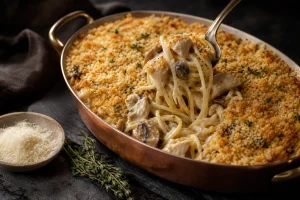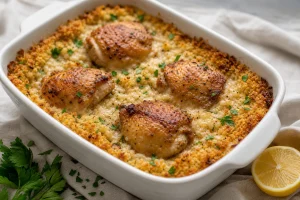
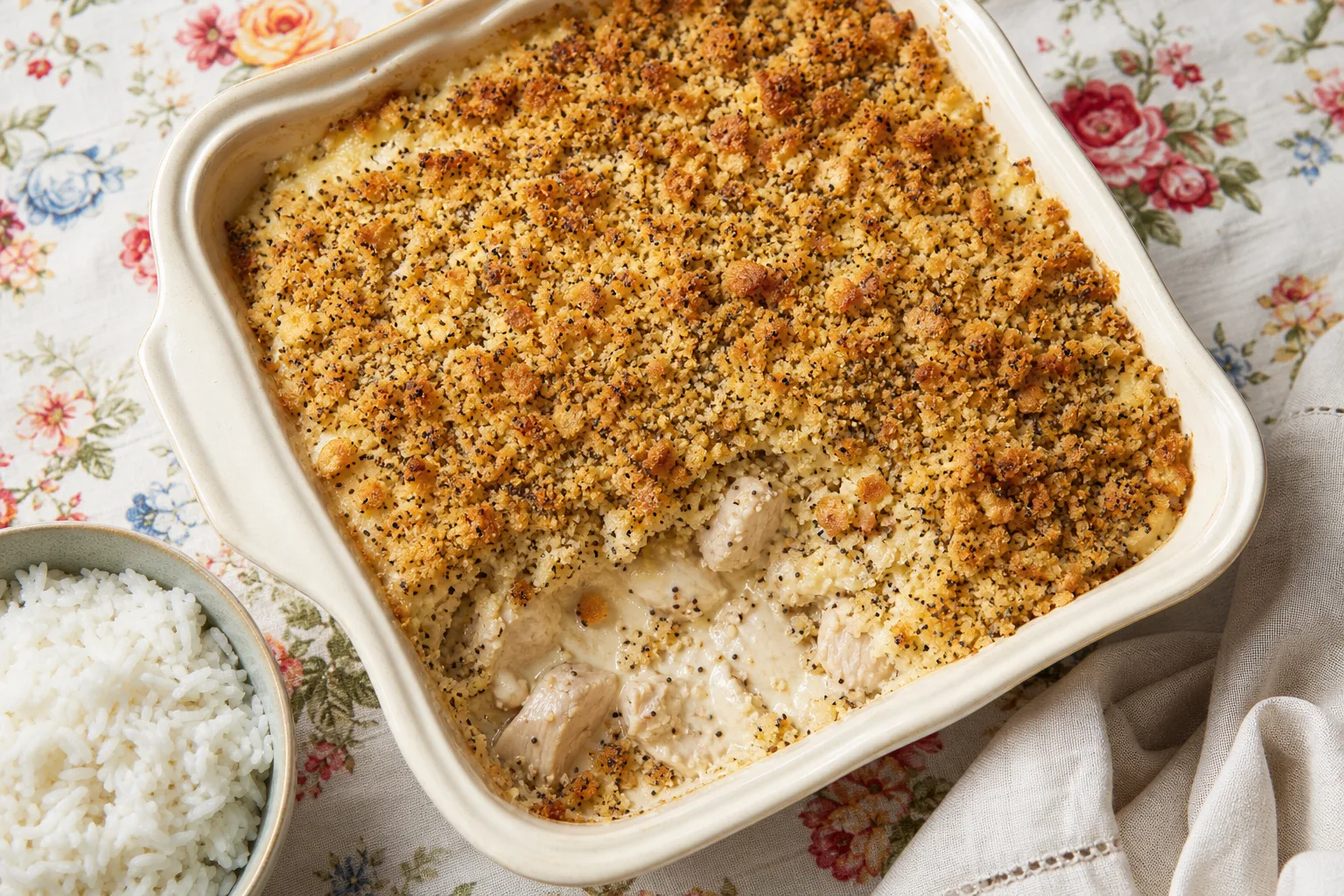

Poppy seed chicken is the casserole that shows up at every church potluck in the South, and the recipe has barely changed in fifty years: shredded chicken, a can of cream of chicken soup, sour cream, poppy seeds, and a sleeve of crushed butter crackers on top. It is beloved for good reason and it has two flaws. The sauce tastes like the can it came from, and by the time it reaches the table the cracker topping has gone soft.
The sauce is a ten-minute fix — butter, flour, broth, and sour cream off the heat, with lemon zest doing the job the canned version does with additives. The topping is a timing fix, and I will be specific about it, because buttered cracker crumbs have a window of about twenty minutes where they are perfect and they are not perfect on either side of it.
The chicken is the part most recipes wave at — two cups cooked and shredded, then they move on. How you cook it and how finely you pull it apart changes this dish more than the poppy seeds do.
Why This Works
Butter crackers crisp when their own fat renders out and the starch dries, and they go soft again as soon as they absorb liquid from below. Scattering them on for only the last twenty minutes of the bake gives them time to brown and no time to drown. Crumbs added at minute zero sit on hot sauce for thirty-five minutes and arrive at the table as a paste.
Ingredients
A 9×13 is traditional but this is better in a 2-quart or 8×8 dish, slightly deeper, because the sauce-to-topping ratio is more generous. Serve it over rice — that is how it is meant to be eaten and it stretches six servings to eight.
For the Chicken
- 1 3/4 pounds boneless, skinless chicken breasts or thighs
- 6 cups water or chicken broth
- 1 tablespoon kosher salt
- 1 bay leaf and a few black peppercorns
For the Sauce
- 4 tablespoons unsalted butter
- 1 small yellow onion, minced fine
- 1/4 cup all-purpose flour
- 1 1/2 cups chicken broth, warm (use the poaching liquid)
- 1 1/4 cups full-fat sour cream, at room temperature
- 2 tablespoons poppy seeds
- Zest of 1 lemon plus 1 tablespoon juice
- 1 teaspoon Worcestershire sauce
- 1/2 teaspoon celery salt
- 1 teaspoon kosher salt
- 1/2 teaspoon black pepper
For the Cracker Top
- 1 sleeve butter crackers (about 35), coarsely crushed — not to dust
- 5 tablespoons unsalted butter, melted
- 1 teaspoon poppy seeds
Easy Swap
Butter crackers are traditional and worth keeping, but crushed cornflakes, panko, or crushed potato chips all work with the same butter. Full-fat Greek yogurt can stand in for the sour cream, though it is tangier and thinner — cut the lemon juice to a teaspoon. Avoid light sour cream, which has enough added starch and water to break in the oven.
How to Make It
Prep: 30 minutes | Bake: 35 minutes | Serves: 6 to 8
- Put the chicken in a pot with the water or broth, the salt, the bay leaf, and the peppercorns. The liquid should cover it by an inch. Bring it up over medium heat until the surface is just trembling — you want a few lazy bubbles at the edge of the pot, around 170°F, never a boil. Cut the heat, cover, and leave it: 15 minutes for breasts, 20 for thighs.
- Lift the chicken out and let it rest on a board for 10 minutes before you touch it. Strain and reserve 1 1/2 cups of the poaching liquid. Pull the chicken into pieces roughly the size of the end of your thumb — see the section below on why you should not shred it finer.
- Heat the oven to 350°F. Melt the 4 tablespoons of butter in a saucepan over medium heat, add the onion with a pinch of salt, and cook 6 minutes until soft and translucent with no color on it.
- Stir in the flour and cook 90 seconds, then whisk in the warm poaching liquid in two additions until smooth. Simmer 4 minutes, until it thickly coats a spoon.
- Take the pan off the heat and let it stop steaming, about 3 minutes. Stir in the sour cream, poppy seeds, lemon zest and juice, Worcestershire, celery salt, salt, and pepper. Taste it — it should be bright and a little over-seasoned, because the chicken will mute it.
- Fold in the chicken, transfer to a buttered 2-quart or 8×8 dish, and smooth the top. Bake uncovered for 15 minutes.
- While it bakes, toss the crushed crackers with the melted butter and the teaspoon of poppy seeds until every crumb is coated. Scatter them over the casserole and bake another 20 minutes, until the crumbs are deep golden and the sauce is bubbling up around the edges.
- Rest 10 minutes. Serve over rice.
Don’t Do This
Do not boil the chicken. A hard boil is the reason poached chicken has a reputation for being dry and chalky — at a rolling boil the outside hits 200°F and the muscle fibers wring themselves out long before the center is done. You are aiming for water that is barely moving. If it is bubbling vigorously, the heat is too high.
Can You Make It the Night Before?
Yes — Assemble Up to 24 Hours Ahead
Assemble the chicken and sauce in the dish, cover, and refrigerate up to 48 hours — it is one of the better make-ahead casseroles because there is no pasta or rice in it to degrade. Keep the cracker crumbs and the melted butter separate and do not combine them until the casserole is already in the oven.
From the refrigerator, bake it uncovered for 30 minutes before the crumbs go on, then 20 minutes after. Take the dish out of the fridge 40 minutes ahead so a cold ceramic dish is not going straight into a hot oven.
Buttered crumbs made the night before are the single thing that will ruin this. The butter soaks into the cracker and sets, and instead of crisping they go dense and slightly waxy. Crush the crackers ahead if you want — they keep fine in a bag — but add the butter at the last minute.
It freezes well without the topping: assemble in a foil pan, freeze up to three months, thaw 24 hours in the refrigerator, bake 35 minutes before the crumbs and 20 after. Sour cream sauces thaw slightly grainy, and a minute of gentle stirring fixes it.
How to Poach Chicken So It Isn’t Dry, and How Finely to Pull It
Poaching has a bad name because most people do it as a hard simmer, which is just boiling with better manners. Chicken muscle starts contracting and expelling water around 150°F and does it violently by 180°F. If the pot is at a rolling boil, the surface of the meat is sitting at close to 212°F for the entire cook, and the outer half inch is ruined before the middle is safe.
The method that works is to bring the liquid up to a bare tremble — roughly 170°F, where you see a few bubbles at the edge of the pot and the surface shivers but does not break — then cut the heat entirely and let the covered pot coast. A pot of hot water holds its temperature for a long time, and the chicken comes up to 165°F slowly and evenly. Fifteen minutes does boneless breasts; thighs want twenty. There is a lot of margin here, which is the point: five minutes extra in a 170°F pot barely matters, while five minutes extra in a boiling one is the difference between dinner and erasers.
The second decision is shred size, and it matters more than people expect. Poppy seed chicken recipes almost all say shredded, and if you take that literally and pull the meat into fine threads with two forks, you have multiplied its surface area several times over. All that surface dries out during a thirty-five-minute bake and dries out again on the reheat, which is how a creamy casserole ends up full of stringy little fibers. Pull the chicken by hand into irregular chunks about the size of the end of your thumb. They hold their own moisture, they give the dish something to chew on, and they are far more forgiving.
If you would rather not poach, one large rotisserie chicken gives you about 4 cups of pulled meat, slightly more than this needs. Use good store-bought broth, add 1/4 teaspoon more salt to make up for the unseasoned liquid, and keep every time the same.
Breasts or Thighs?
Breasts give you the pale, tender texture people associate with this dish and are the traditional choice. Thighs are harder to overcook and taste more like chicken, but they tint the sauce slightly and bring a bit of fat to the surface. I use thighs when the casserole is getting reheated later in the week and breasts when it is being eaten the same night.
What Happens to the Topping in the Refrigerator
The cracker top is the only part of this casserole that does not survive storage, and there is no trick that changes it. Overnight in the refrigerator, the crumbs pull moisture out of the sauce underneath and go from crisp to damp and slightly chewy. A reheat in the microwave makes it worse, because steam has nowhere to escape under a covered plate.
The workable approach is to reheat covered with foil at 325°F for 25 minutes, pull the foil, and scatter a handful of fresh buttered crumbs on for the last 8 minutes. Four crackers and a teaspoon of butter brings it most of the way back. For a single portion, microwave at 60 percent power for about two minutes with a tablespoon of broth stirred in, and accept that the topping is now a texture you are eating rather than enjoying.
Rachel’s Tip
Save the poaching liquid and use it as the broth in the sauce. It has picked up salt, gelatin, and real chicken flavor, and it costs nothing because you were about to pour it down the drain. This single swap is most of the difference between a from-scratch sauce that tastes worth the effort and one that tastes like thickened milk.
Questions People Ask
Why did my sauce curdle or go grainy?
Sour cream went into liquid that was too hot, or it went in cold. Both do the same thing — the proteins clump and squeeze out water, which reads as grainy curds in a thin sauce. Pull the pan off the burner, give it a full three minutes, and have the sour cream sitting out on the counter beforehand. Once it has broken, you cannot whisk it back.
Can I use cream of chicken soup instead?
You can — two cans in place of the butter, flour, and broth, with the sour cream still added off the heat. It saves about ten minutes. It also tastes distinctly canned, because condensed soup leads with salt and modified starch rather than browned onion and lemon. If you do use it, cut the added salt to 1/4 teaspoon and taste before you add any more.
What do poppy seeds actually taste like here?
Faintly nutty, a little bitter, and mostly textural — a slight grit that keeps a very creamy dish from feeling one-note. They are not a strong flavor, and two tablespoons in a 2-quart casserole is not an accident of restraint. If you leave them out entirely, the dish still works; it just becomes a generic creamy chicken bake.
Can I add vegetables?
A cup of frozen peas or a cup of chopped steamed broccoli folded in with the chicken works well and is how a lot of families stretch it into a one-dish dinner. Add them already cooked and well drained. Raw broccoli releases water for the whole bake and thins the sauce, and raw mushrooms are worse — cook those in the pan with the onion first.
Is it supposed to be served over rice?
Traditionally yes, and I think it needs it. There is no starch in the casserole itself, so a plain scoop on a plate is a lot of cream at once. White rice is standard, egg noodles are the usual alternative, and a split biscuit underneath is the version I like best.
About This Article

Written by Rachel Thompson. Rachel Thompson is a home cook who has spent over 10 years making an unreasonable number of dips, appetizers, and party spreads — no culinary training, just a decade of trial and error and a reputation among friends for always being asked to "bring a dip." She focuses on approachable recipes that combine bold flavors with simple techniques, making entertaining at home accessible to everyone. More about this site.
Scope and limits. Rachel is a home cook with no culinary training. Follow current food safety guidance for holding temperatures and time limits whenever you are serving people other than yourself.
Verify this against a primary source
Specifics change, and your situation may differ from the one described here. These are the authorities worth checking directly:
- FoodSafety.gov — cold holding, hot holding and the two-hour rule
- USDA FoodData Central — ingredient composition and nutrition data
- USDA Food Safety and Inspection Service — safe minimum temperatures and leftovers