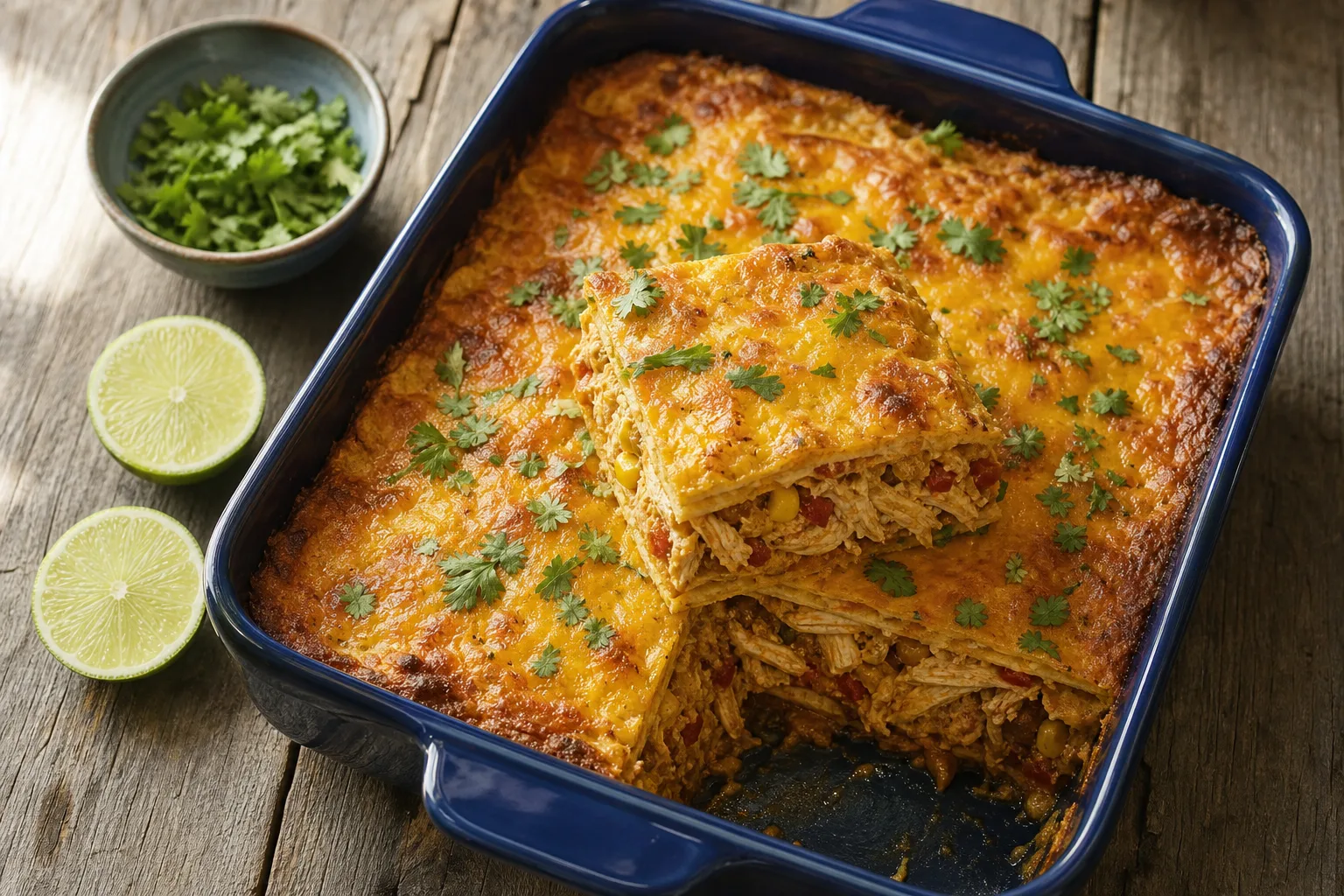

Every King Ranch casserole I ate growing up had the same two problems. The sauce came out of two cans and tasted like it, and the corn tortillas had dissolved into a gray paste somewhere between the chicken and the bottom of the dish. You could not find a tortilla with a spatula. It was all one texture.
The fix for the sauce is a twelve-minute roux with real chicken broth, sour cream, and a can of tomatoes with green chiles. The fix for the tortillas is stranger and more important: you toast them first. Dry, in the oven, until they smell like a tortilla chip. Then they can sit in sauce for forty minutes and still be a distinct layer when you cut into it.
This is also the casserole where the kind of chicken you start with matters most, because it goes in already cooked and then has to survive forty more minutes in the oven. I go into that properly below.
Why This Works
Toasting the corn tortillas drives off their surface moisture and firms up the starch, so they absorb sauce slowly instead of all at once. An untoasted tortilla is already soft and wet — it starts breaking down the second it touches warm liquid, which is why the classic version turns into one undifferentiated layer.
Ingredients
This fills a 9×13 dish. It cuts cleanly into ten squares, or eight if you are feeding people who consider a casserole dinner rather than a side.
For the Chile Cream Sauce
- 4 tablespoons unsalted butter
- 1 large yellow onion, diced small
- 1 green bell pepper, diced small
- 1 poblano pepper, seeded and diced small
- 4 cloves garlic, minced
- 1 tablespoon chili powder
- 2 teaspoons ground cumin
- 1 teaspoon dried oregano
- 1/3 cup all-purpose flour
- 2 1/2 cups chicken broth, warmed
- One 10-ounce can diced tomatoes with green chiles, drained but keep the liquid
- 1 cup full-fat sour cream, at room temperature
- 1 1/2 teaspoons kosher salt
- 1/2 teaspoon black pepper
For Assembly
- 12 corn tortillas, 6-inch
- 4 cups cooked chicken, pulled into bite-sized pieces (about 1 1/4 pounds; see the chicken section below)
- 3 cups shredded sharp cheddar
- 2 cups shredded Monterey Jack
- 1/2 cup chopped cilantro, plus more for serving
- Lime wedges, for serving
Easy Swap
No poblano? Use a second green bell pepper plus a seeded, minced jalapeño. What I would not swap is flour tortillas for corn — they bring no corn flavor and go slick and gummy in sauce instead of staying distinct. If corn tortillas are the problem, use thick restaurant-style tortilla chips and skip the toasting step entirely.
How to Make It
Prep: 30 minutes | Bake: 40 minutes | Serves: 8 to 10
- Heat the oven to 350°F. Cut the tortillas into quarters, spread them on two baking sheets, and toast them for 7 to 8 minutes, until they are dry to the touch and smell toasty. They should still bend, not snap. Set them aside.
- Melt the butter in a large skillet or Dutch oven over medium heat. Add the onion, bell pepper, and poblano with a big pinch of salt and cook 8 minutes, until the onion is translucent and the peppers have slumped. Add the garlic, chili powder, cumin, and oregano and stir for 1 minute — the spices need to hit the hot fat or they taste dusty.
- Sprinkle the flour over the vegetables and stir constantly for 90 seconds. It will clump around the vegetables and look wrong. Keep going.
- Pour in the warm broth in three additions, whisking smooth between each one. Add the reserved liquid from the canned tomatoes. Bring it to a bare simmer and cook 5 minutes, until it thickly coats a spoon.
- Take the pan off the heat and let it stop steaming, about 3 minutes. Then stir in the sour cream, the drained tomatoes, the salt, and the pepper. Taste it. It should be a little saltier and a little spicier than you want the finished casserole to be, because four cups of chicken and a stack of tortillas are about to mute it.
- Fold the chicken and the cilantro into the sauce.
- Butter a 9×13 dish. Lay down a third of the toasted tortilla pieces, overlapping, then a third of the chicken mixture, then a third of the combined cheeses. Repeat twice, ending with cheese.
- Cover tightly with foil and bake 25 minutes. Remove the foil and bake another 15, until the cheese is browned at the edges and the sauce is bubbling up the sides of the dish.
- Let it sit 15 minutes before you cut it. This is not optional — straight out of the oven the sauce is still loose and the layers will slide apart on the spatula. Serve with extra cilantro and lime.
Don’t Do This
Do not stir the sour cream into a simmering pan. It will break into visible white curds and a thin, weepy liquid, and no amount of whisking brings it back. Pull the pan off the heat, give it three minutes, and make sure the sour cream itself is not fridge-cold. Cold dairy into hot sauce is the other half of that failure.
Can You Make It the Night Before?
Yes — Assemble Up to 24 Hours Ahead
Assemble it completely, cover, and refrigerate up to 24 hours. Toast the tortillas as usual — they hold up better after an overnight in the fridge than untoasted ones do in a fresh bake. Add 12 to 15 minutes to the covered portion of the bake and check that the center is hot before you pull the foil.
Take the dish out of the refrigerator 45 minutes before it goes in the oven. A cold 9×13 full of dairy sauce heats from the outside in, so rushing it gets you scorched edges around a lukewarm middle — and it is how glass dishes crack.
Overnight, the tortillas pull in sauce and soften in a way I like better than the same-day version — the layers stay separate but stop being chewy. The sauce will look thick and a bit pasty when you uncover the cold dish. Ignore it; it loosens as soon as it is warm.
For the freezer, assemble in a disposable foil pan and freeze unbaked up to two months. Sour cream sauces split a little on thawing, which shows up as a grainy surface, but thaw it in the refrigerator for a full 24 hours and bake covered 45 minutes and the grain mostly cooks back out. Frozen-then-baked beats baked-then-frozen here.
The Chicken Question: Rotisserie, Poached, or Raw
Four cups of cooked chicken can come from three places, and they are not interchangeable. The whole bake is forty minutes at 350°F, so whatever you put in there is going to spend forty minutes getting hotter. That is the part people forget.
Rotisserie chicken is what I use most of the time, and it is the most forgiving. One large bird gets you right around four cups of meat off the breast, thighs, and legs. It is already seasoned, the dark meat brings fat that protects it during the bake, and because it was cooked fast at high heat, it has not been sitting in liquid losing flavor. Pull it in pieces with your fingers rather than shredding it into threads — chunks the size of the end of your thumb stay juicy, wispy shreds do not. Keep the bake time exactly as written.
Poached chicken is the better option if you want to control the salt or you only have raw breasts. Put about a pound and a half of boneless breasts or thighs in a pot, cover with cold water or broth by an inch, add salt, and bring it to barely 170°F — you want lazy bubbles at the edge of the pot, never a boil. Cut the heat and let it sit covered for 15 minutes. Breasts will be done; thighs want about 20. Poached chicken is wetter than rotisserie, so after you pull it, let it drain in a colander for five minutes or it thins your sauce. Bake time stays the same.
Raw chicken changes the recipe, and I would not use it here. Forty minutes is not enough for raw meat to cook through under a lid of cheese and tortillas, and stretching the bake to the 60 to 70 minutes it would need breaks the sour cream sauce and finishes off the tortillas. Poach it or roast it first.
A Quick Note on Volume
Four cups of pulled chicken is about 1 1/4 pounds of cooked meat, which comes from roughly 1 3/4 pounds of raw boneless breast or one large rotisserie bird. Cooked chicken loses about a quarter of its raw weight to water, and that is the single most common reason a casserole comes out short on chicken.
Keeping the Leftovers Worth Eating
This reheats better than most chicken bakes because of the sauce — there is enough liquid that the chicken sits in something instead of drying in open air. Even so, the microwave will find a way to ruin it. Add a tablespoon of broth down the side of the square, cover it loosely, and reheat at 60 or 70 percent power for about two and a half minutes. Full power drives water out of the chicken fibers faster than the rest of the dish warms up, which is how you get tender sauce around stringy meat. For the whole dish, cover with foil and give it 25 to 30 minutes at 325°F. It keeps four days, and the tortilla layers are still identifiable on day four.
Rachel’s Tip
Drain the canned tomatoes but keep the liquid and add it to the sauce. Most recipes dump the whole can in, which adds about a half cup of thin tomato water to a sauce you just spent five minutes thickening. Using the liquid in the roux and the solids at the end gets you the flavor without the slump.
Questions People Ask
Why did my King Ranch casserole turn out watery?
Two usual suspects. The first is undrained canned tomatoes — a 10-ounce can carries close to a half cup of thin liquid, and dumping it in at the end thins a sauce you already thickened. The second is poached chicken that went in wet. Let poached meat drain in a colander for five minutes before it meets the sauce. If it is already watery in the pan, simmer the sauce two or three minutes longer before the sour cream goes in.
Can I use cream of chicken soup instead of making the sauce?
You can — two cans of condensed soup plus a cup of sour cream in place of the butter, flour, broth, and sour cream here. It saves twelve minutes and it tastes flat and slightly metallic, because condensed soup is built on salt and stabilizers rather than browned vegetables and toasted spices. The sauce is the part of this recipe I would not give up.
Do I really have to toast the tortillas?
If you want to see layers, yes. Untoasted corn tortillas are soft and damp and they start dissolving on contact with warm sauce. Seven minutes in a 350°F oven costs you almost nothing — the oven is already on — and it is the difference between a layered casserole and a thick chicken porridge.
How spicy is this, and can I make it hotter?
Mild as written — the poblano brings almost no heat and canned tomatoes with green chiles are gentle. For real bite, add a minced jalapeño with the onion and a half teaspoon of cayenne with the other spices. Taste the sauce before the chicken goes in, because that is the last easy chance to fix the seasoning.
About This Article

Written by Rachel Thompson. Rachel Thompson is a home cook who has spent over 10 years making an unreasonable number of dips, appetizers, and party spreads — no culinary training, just a decade of trial and error and a reputation among friends for always being asked to "bring a dip." She focuses on approachable recipes that combine bold flavors with simple techniques, making entertaining at home accessible to everyone. More about this site.
Scope and limits. Rachel is a home cook with no culinary training. Follow current food safety guidance for holding temperatures and time limits whenever you are serving people other than yourself.
Verify this against a primary source
Specifics change, and your situation may differ from the one described here. These are the authorities worth checking directly:
- FoodSafety.gov — cold holding, hot holding and the two-hour rule
- USDA FoodData Central — ingredient composition and nutrition data
- USDA Food Safety and Inspection Service — safe minimum temperatures and leftovers