
The chicken and rice casserole I grew up with involved a packet, a can, and the specific crunch of rice that never finished cooking. When I started making it from scratch, the first version dirtied a skillet for the onions, a saucepan for the sauce, and a bowl for the chicken, and then went into the oven anyway. Most of that work was habit. Very little of it was doing anything the oven couldn’t do by itself.
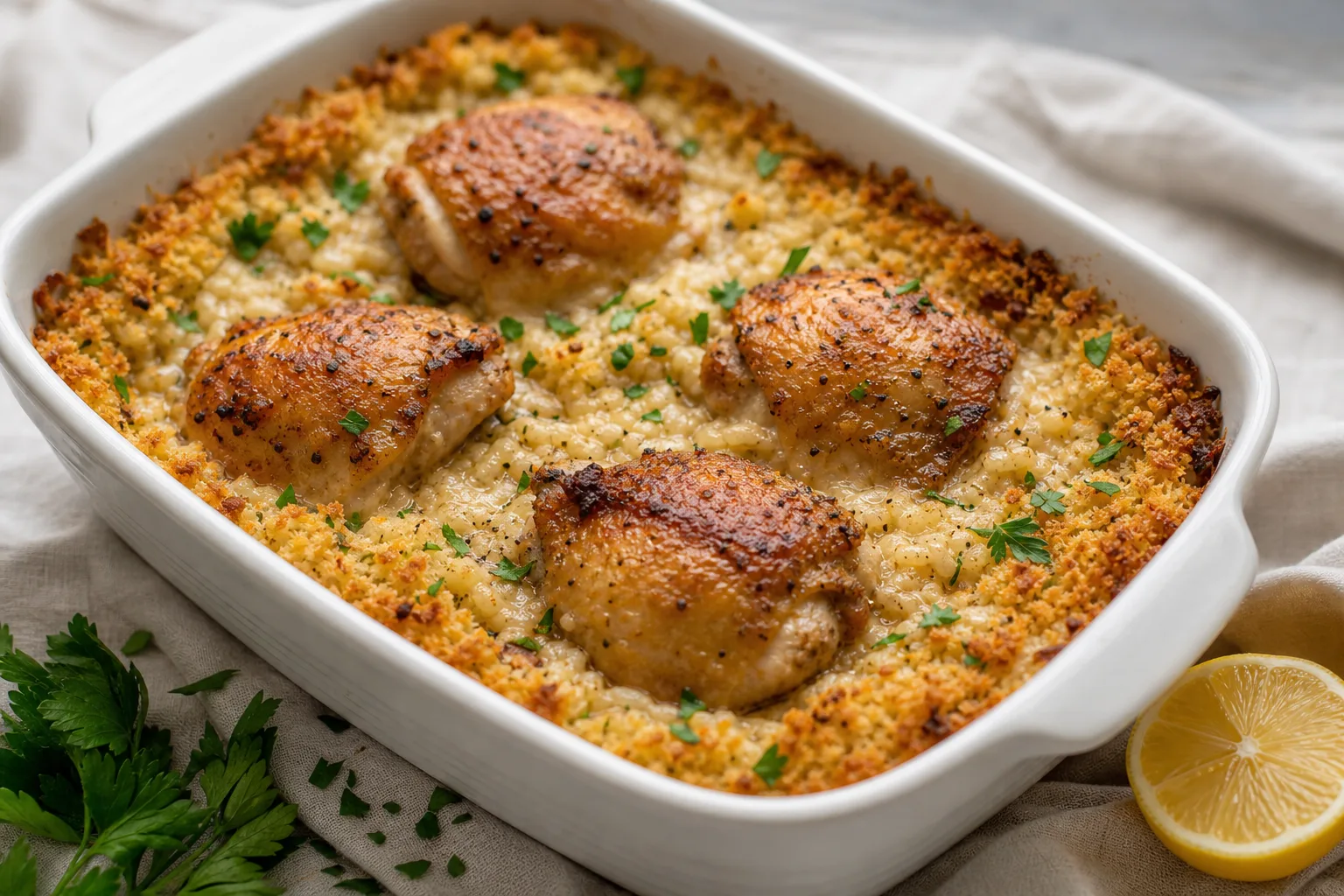
This version has no skillet and no saucepan. The rice, the chicken, the diced vegetables and a sauce whisked together in a bowl all go into one dish raw, under foil, and come out as creamy rice with tender chicken. It works because of a number: a little under two parts liquid to one part rice, which is less than plain baked rice gets, because two pounds of chicken give up about a half cup of juice and the raw vegetables release some water of their own. Measure the liquid as if none of that were happening and you get rice pudding.
It is also the rare casserole where raw chicken is the right answer rather than a shortcut. Below I explain exactly where the bake time comes from, so you can swap in whatever cut you actually have.
Why This Works
Everything cooks in the same sealed dish at the same time, so the chicken’s juices and the vegetables’ water become part of the liquid measurement rather than a problem to drain away. Whisking the flour into cold broth until it is smooth means it hydrates and thickens inside the oven, so there is no roux to make. Covering the dish tightly is what makes it work. Foil with a loose corner lets steam escape, and the rice at that end of the pan comes out crunchy while the rest is perfect.
Ingredients
A 9×13 dish is right for this. The rice needs to sit in a shallow, even layer, about three quarters of an inch deep, or the bottom overcooks before the top is done.
For the Rice
- 1 1/2 cups long-grain white rice, rinsed until the water runs clear
- 1 medium yellow onion, diced small (about 1/4 inch)
- 2 ribs celery, sliced thin
- 2 cloves garlic, minced
- 2 tablespoons unsalted butter, cut into small cubes
- 2 cups cold chicken broth
- 2 tablespoons all-purpose flour
- 1/2 cup heavy cream
- 1 teaspoon dried thyme
- 1 1/4 teaspoons kosher salt
- 1/2 teaspoon black pepper
For the Chicken
- 2 pounds boneless, skinless chicken thighs (about 6 to 8), or breasts, see the note below
- 2 teaspoons kosher salt
- 1 teaspoon paprika
- 1/2 teaspoon garlic powder
- 1/2 teaspoon black pepper
For the Top
- 3/4 cup panko breadcrumbs
- 2 tablespoons unsalted butter, melted
- 1/2 cup grated Parmesan
- Chopped flat-leaf parsley and lemon wedges, for serving
Easy Swap
Long-grain white rice is what the liquid ratio here is built around. Basmati works with no changes. Jasmine is softer and wants about 2 tablespoons less broth. Do not substitute brown rice, instant rice, or arborio one-for-one. Brown needs roughly 40 extra minutes and a half cup more liquid, instant turns to mush in fifteen, and arborio releases starch until the whole dish is risotto.
How to Make It
Prep: 15 minutes | Bake: 80 minutes | Rest or cool: 10 minutes | Serves: 6 to 8
- Heat the oven to 350°F. Toss the chicken with the salt, paprika, garlic powder and pepper and leave it on the counter while you do everything else. Twenty minutes of dry salt on the surface is enough to season past the outer layer.
- In a large bowl or an 8-cup measuring pitcher, pour in the cold broth and sprinkle the flour over the top. Whisk until there isn’t a single lump. Whisk in the cream, thyme, salt and pepper. Taste it and make it slightly too salty. The rice will take care of that.
- Butter a 9×13 dish. Spread the rinsed rice across the bottom in an even layer. Scatter the diced onion, celery and garlic over the rice, then dot the butter cubes across the top.
- Whisk the sauce again, since the flour settles quickly, and pour it over the rice. Stir gently so everything is evenly distributed and every grain of rice is fully submerged. Shake the dish flat.
- Lay the chicken on top in a single layer, pressing each piece down until it is about halfway into the liquid. Do not bury it. The exposed top is what browns later.
- Cover the dish tightly with foil, crimping it around the whole rim. Bake 55 minutes without opening it. The covered bake is longer than you might expect because the sauce starts cold, and this is the stretch where the flour thickens the sauce.
- Mix the panko with the melted butter and the Parmesan. Uncover the casserole. The rice should have absorbed almost all the liquid and the chicken should be opaque. Scatter the panko mixture around the chicken, over the exposed rice.
- Bake uncovered 20 to 25 minutes, until the crumbs are deep golden, the rice is tender all the way to the corners and the thickest piece of chicken reads 165°F. Rest 10 minutes, then finish with parsley and a squeeze of lemon.
Don’t Do This
Do not lift the foil to check on it during the first 55 minutes. Every peek dumps the steam that is cooking the rice, and the dish cannot build it back fast enough. If you are worried, trust the timer. The rice is covered, submerged and in a 350°F oven, and there is nothing you can usefully fix at minute twenty.
Can You Make It the Night Before?
Not Fully — Here Is What You Can Prep
No, and this is the one casserole in this category where I’d tell you so flatly. Raw rice sitting in liquid overnight swells unevenly and goes chalky in the oven, and raw chicken shouldn’t sit in broth for a day. What you can do ahead is dice the onion and celery, grate the Parmesan and season the chicken the night before.
The honest trade here is that this version has no cooked sauce you can make ahead and reheat. That also means there is no skillet and no saucepan to wash. If you want the dish to be one thing you can assemble at noon and bake at six, this is the wrong recipe.
Seasoning the chicken a day ahead is actually better than twenty minutes. Salt it, cover it, and refrigerate it, and it holds noticeably more moisture through the bake. It is the one head start that improves the dish rather than just saving time. The diced onion and celery keep two days in a covered container.
If you need a true make-ahead, bake it completely, cool it, and refrigerate up to three days. Baked rice reheats far better than unbaked rice bakes. The reheating section below covers bringing it back without turning the grains to paste.
What I Stopped Doing, and Why the Rice Doesn’t Care
I used to sauté the onion and celery in butter, stir in flour to make a roux, whisk in hot broth and simmer the sauce before it ever touched the rice. Every one of those steps turned out to be optional.
The onion and celery soften in a covered dish at 350°F for nearly an hour in warm, steaming liquid. The only rule is that you dice the onion small, about 1/4 inch. A coarse chop stays crunchy in the middle. I also use two cloves of garlic where the sautéed version used three, because raw garlic baked in a sealed dish gets sharper rather than mellower.
The roux was only there to thicken the sauce, and flour whisked into cold liquid does the same job in the oven. The keys are whisking until it is completely smooth before it goes in, and baking it covered. A covered bake traps the steam that hydrates the starch. Uncovered, it would skin over and stay thin underneath. The sauce ends up barely thickened, the consistency of heavy cream, which is exactly right for rice that is still drinking it.
The hot broth mattered when I was starting a skillet sauce, but here the cold start just means a longer covered bake, which is why it is 55 minutes instead of 45. Because the vegetables are going in raw and release some of their own water, the broth is down to 2 cups from the 2 1/4 the sautéed version used. That is the entire adjustment.
Check the Corners, Not the Center
The last rice to finish is in the corners of the dish, where the layer is slightly thicker and the foil seal is weakest. Taste a few grains from a corner before you call it done. If the center is perfect and the corners still click against your teeth, splash two tablespoons of hot broth into each corner, re-cover, and give it 8 more minutes.
Raw Chicken, Cooked Chicken, and Where the Bake Time Comes From
Seventy-five to eighty minutes is a long bake for a casserole, and the reason is that the rice sets the clock, not the chicken. Raw rice in a cold-start covered dish needs about 55 minutes at 350°F to absorb its liquid and go tender. Boneless thighs on top of it need roughly 35 to 40 to reach 165°F. The rice is the slower ingredient, which is the whole trick: raw chicken fits inside the time the rice already needs, so you are not adding a step.
Boneless thighs are the best cut for this and what I use. They hold up to the full bake without drying out because dark meat has more fat and more connective tissue, and they are forgiving if your oven runs hot. Boneless breasts are the cut I’d talk you out of. They hit 165°F long before the rice is done and are stringy by the time it is. If breasts are what you have, bake the rice and sauce covered on their own for 25 minutes, then lift the foil once, lay the seasoned breasts on top and re-cover for the remaining 30. Buy them even in thickness, or butterfly the fat end of a thick one.
Bone-in, skin-on thighs are excellent if you want crisp skin. This is one case where I keep a skillet step, because browning the skin is the point and the oven alone won’t do it under foil. Sear them skin-side down for 6 minutes first, then set them on the rice skin-up and leave the skin above the liquid the whole time. Add 10 minutes to the uncovered stage.
Already-cooked chicken is the swap that goes wrong. If you use rotisserie or leftover roast chicken, do not put it in at the start, because an hour of oven will reduce it to dry fibers. Bake the rice covered with the sauce alone for 55 minutes, then stir in 3 cups of pulled cooked chicken, add the crumb topping and bake uncovered just 15 minutes. You lose the chicken juices from the liquid calculation, so add an extra 1/4 cup of broth to compensate.
The one version to avoid entirely is chicken going in frozen. It thaws into the rice, adds an unpredictable amount of water, and the rice drowns while the meat is still cold in the middle.
Reheating Rice Without Killing It
Cooked rice goes firm and chalky in the refrigerator as the starch recrystallizes, the same thing that makes day-old bread stale. It is reversible, but only with steam, and only if you add liquid back.
A portion on a plate wants a tablespoon of broth stirred through it, a loose cover, and 70 percent power for about two minutes. Stir once halfway. For the whole dish, add a quarter cup of broth around the edges, cover with foil, and bake at 325°F for 25 minutes. The crumb topping will have gone soft either way; pull the foil for the last five minutes to bring some of it back.
Rachel’s Tip
Rinse the rice and actually mean it: four or five changes of water, until it runs clear instead of cloudy. The cloudiness is loose surface starch, and in a covered dish with nowhere to go it is what glues the grains together. Rinsed rice in a casserole comes out as separate grains in a creamy sauce. Unrinsed rice comes out as one block.
Questions People Ask
Does the rice really cook through from raw in the oven?
Yes, as long as the dish is sealed and every grain is under the liquid. The covered bake is 55 minutes because the sauce starts cold. If the foil isn’t crimped all the way around the rim, steam escapes and the rice at the leaky edge stays hard, so seal it well and leave it alone until the timer goes off.
Why is my rice still crunchy when the chicken is done?
Almost always a steam leak. If the foil wasn’t crimped all the way around the rim, or if you lifted it to look, the rice lost the moisture it needed. The fix in the moment is to add a couple of tablespoons of hot broth to the dry spots, cover it tightly again, and give it 8 to 10 more minutes. The fix next time is a proper seal and no peeking.
Why is my sauce thin or lumpy?
Lumps mean the flour wasn’t fully whisked into the cold broth before the cream went in, so smooth it out first and whisk again right before pouring, since flour settles. A thin sauce usually means the dish wasn’t covered tightly for the full 55 minutes, because the steam is what thickens the starch. The sauce should look loose and creamy rather than gravy-thick when you uncover it.
Can I use uncooked brown rice?
Yes, but it changes the recipe rather than substituting into it. Brown rice needs about 2 3/4 cups of broth instead of 2, and roughly 90 minutes covered instead of 55. That is far longer than boneless chicken can survive, so bake the rice covered on its own for 60 minutes first, then add the chicken and cover again for 30 more, then uncover with the topping for the last 20.
Can I add vegetables?
Frozen peas or corn, yes. Stir in a cup when you uncover the dish, not at the start, or they turn gray and release water into rice that has already been measured. Broccoli florets also go in at the uncovering. Raw sliced mushrooms can go in at the start, but they release a lot of water, so cut the broth by half a cup per 8 ounces. I’d skip zucchini entirely, because it turns to mush under a long covered bake.
Do I have to use heavy cream?
No. Whole milk works and makes a lighter dish, though the rice is less creamy, and half-and-half splits the difference. Skip skim milk or thin plant milks. There isn’t enough fat to carry the thyme and the onion, and it ends up tasting like seasoned rice rather than a casserole.
How do I know the chicken is safe without cutting into it?
An instant-read thermometer in the thickest part of the largest piece, not touching the dish, should read 165°F. Without one, cut into the thickest piece at the 75-minute mark. The juices should run clear and the meat should be opaque through to the center. Cutting one piece costs you nothing, since it goes straight back in the dish.
About This Article

Written by Rachel Thompson. Rachel Thompson is a home cook who has spent over 10 years making an unreasonable number of dips, appetizers, and party spreads — no culinary training, just a decade of trial and error and a reputation among friends for always being asked to "bring a dip." She focuses on approachable recipes that combine bold flavors with simple techniques, making entertaining at home accessible to everyone. More about this site.
Scope and limits. Rachel is a home cook with no culinary training. Follow current food safety guidance for holding temperatures and time limits whenever you are serving people other than yourself.
Verify this against a primary source
Specifics change, and your situation may differ from the one described here. These are the authorities worth checking directly:
- FoodSafety.gov — cold holding, hot holding and the two-hour rule
- USDA FoodData Central — ingredient composition and nutrition data
- USDA Food Safety and Inspection Service — safe minimum temperatures and leftovers