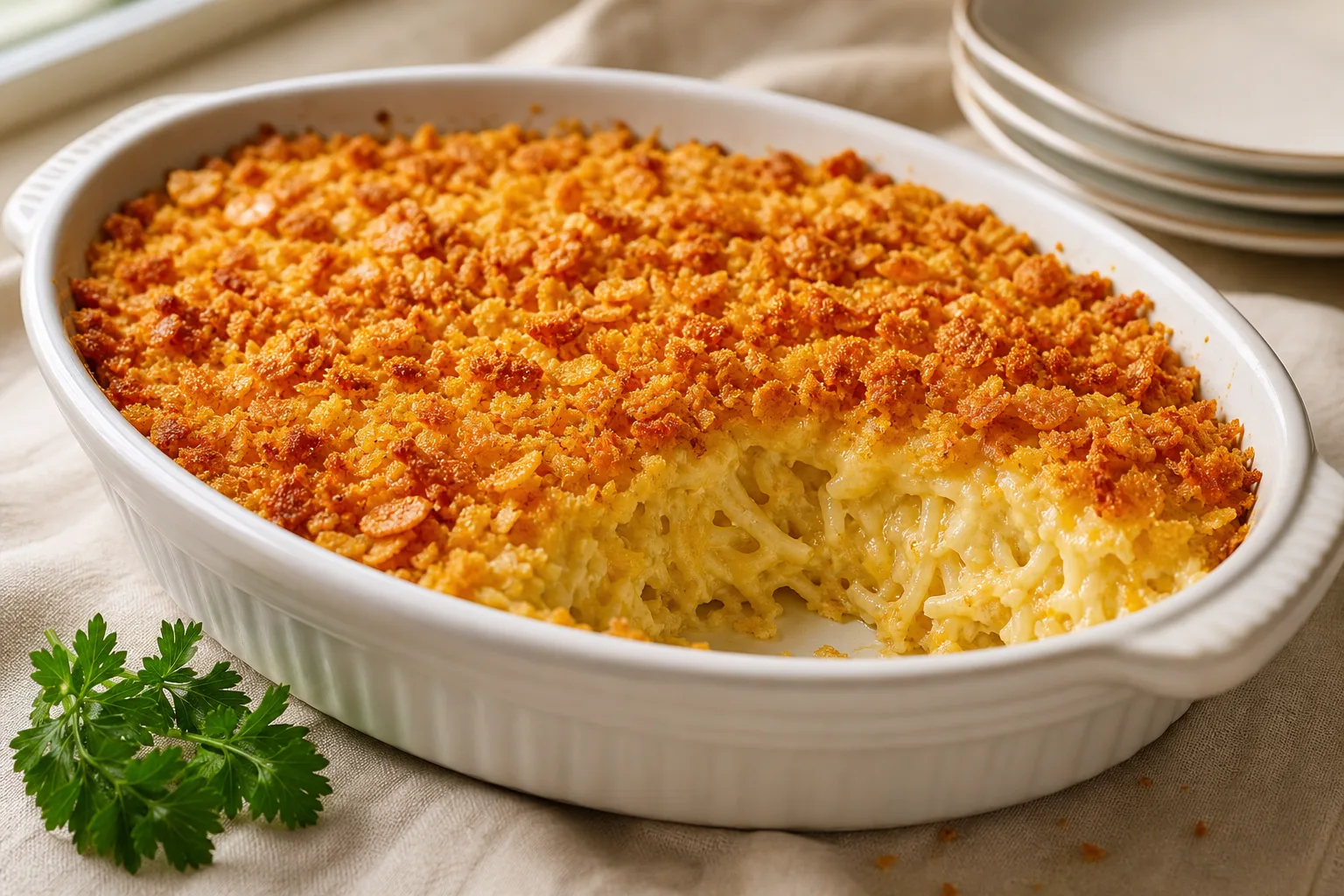

Funeral potatoes have one failure mode and everyone has met it: you scoop into the dish and a thin, grayish liquid runs into the hole you just made. The potatoes taste fine. The sauce has separated into water and grease, and the topping has gone soft from the steam coming up underneath.
It is almost never the recipe. It is water — a two-pound bag of frozen shredded potatoes carries a startling amount of it, and if that water leaves the potatoes in the oven rather than in your sink, it ends up thinning your cheese sauce into broth.
This version uses a real cheese sauce instead of condensed soup, which takes about nine minutes and gives you something that stays emulsified through an hour in the oven and a long afternoon on a table. The cornflake topping stays on, because that part is not negotiable.
Why This Works
Frozen shredded potatoes are shredded russet — starchy, absorbent, and about three-quarters water by weight. Thaw them and press the water out before they meet the sauce, and the shreds spend the bake absorbing cheese sauce instead of diluting it. Skip that step and you are essentially adding a cup of water to your sauce in a covered dish.
Ingredients
This is a full 9×13, which is twelve side portions at a holiday table or ten if it is the main starch.
For the Casserole
- 2 pounds frozen shredded hash brown potatoes, thawed
- 4 tablespoons unsalted butter
- 1 medium yellow onion, diced small
- 1/4 cup all-purpose flour
- 2 cups whole milk, warmed
- 1 cup chicken broth
- 12 ounces sharp cheddar, grated from a block
- 1 1/2 cups full-fat sour cream
- 1 1/2 teaspoons kosher salt
- 3/4 teaspoon black pepper
- 1/2 teaspoon garlic powder
- 1/4 teaspoon ground mustard
For the Topping
- 3 cups cornflakes, crushed to coarse crumbs
- 3 tablespoons unsalted butter, melted
- 1/4 teaspoon kosher salt
Easy Swap
Crushed Ritz crackers, panko, or crushed kettle chips all work in place of cornflakes. Crispy fried onions also work, but add them for the last 8 minutes only or they go bitter. If you want the classic canned shortcut, two 10.5-ounce cans of condensed cream of chicken soup replace the butter, flour, milk, and broth — cut the salt to 1/2 teaspoon.
How to Make It
Prep: 20 minutes | Bake: 55 minutes | Serves: 10 to 12
- Thaw the potatoes, then press the water out. Work in two batches: pile the shreds in a clean kitchen towel, gather it, and squeeze hard over the sink. You should get out somewhere around a cup of liquid in total.
- Heat the oven to 350°F and butter a 9×13 dish.
- Melt the butter in a large saucepan over medium heat. Cook the onion 5 minutes until soft and translucent but not browned. Sprinkle in the flour and stir constantly for 90 seconds.
- Whisk in the warm milk a splash at a time, then the broth. Simmer 4 to 5 minutes until it thickly coats a spoon. Pull the pan off the heat before any cheese goes in.
- Add the cheddar in three handfuls, stirring until each disappears before adding the next. Stir in the sour cream, salt, pepper, garlic powder, and ground mustard. Taste it — it should taste slightly too salty on its own, because two pounds of plain potato is about to join it.
- Fold the pressed potatoes into the sauce until every shred is coated, then spread it into the dish. It will look loose. It firms up in the oven.
- Cover tightly with foil and bake 40 minutes.
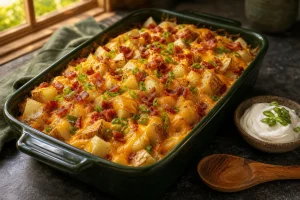
- Toss the crushed cornflakes with the melted butter and salt. Uncover the dish, scatter the crumbs over the top, and bake another 15 minutes until deep golden and bubbling at the edges. Rest 10 minutes before serving.
Don’t Do This
Do not use pre-shredded bagged cheese, and do not add cheese to a simmering pan. Bagged shreds are dusted with potato starch or cellulose to stop them clumping, and that coating makes a grainy sauce. Direct heat makes cheese tighten and weep its fat. Off the heat, grated from a block, three handfuls at a time.
Can You Make It the Night Before?
Yes — Assemble Up to 24 Hours Ahead
Assemble through the end of step 6, cover, and refrigerate up to 24 hours. Keep the cornflake topping dry and separate until the dish comes out from under the foil, and add about 10 minutes to the covered bake if it goes in cold from the refrigerator.
Let the dish sit on the counter for 30 to 40 minutes first. A cold 9×13 going straight into a hot oven is how glass dishes crack, and it also widens the gap between the edges, which overcook, and the middle, which has not warmed through yet.
The sauce will look thick and set when it comes out of the refrigerator — that is the flour doing what flour does when it is cold, and it loosens within ten minutes of heat. Do not thin it with extra milk, which is the most common way people turn a make-ahead version watery.
These freeze better than most dairy casseroles because the sour cream and cheese are carried in a flour-thickened sauce rather than loose cream. Assemble without topping, freeze up to two months, thaw overnight in the refrigerator, and bake as written plus 15 minutes. Frozen and baked from solid, the middle never catches up.
Why They Are Called Funeral Potatoes
The name is genuinely literal. The dish is strongly associated with Utah and with Latter-day Saint congregations, where Relief Society volunteers have long organized the food for funeral luncheons, and a pan of cheesy potatoes is close to a perfect dish for that job: it is cheap, it feeds twelve, it is assembled a day ahead by someone who has other things on their mind, and it survives a car ride and an hour on a folding table without falling apart.
Outside Utah the same casserole shows up under plainer names — cheesy potatoes, potato casserole, hash brown casserole — and in the Upper Midwest it lands on the same potluck tables as the funeral sandwiches and the dip bowls. The pattern is consistent everywhere: starch, dairy, cheese, a crunchy lid, and a shape that holds up for people who are not thinking about food.
Shreds, Cubes, and Why the Cut Matters
You can buy frozen potatoes shredded or diced, and the two make noticeably different casseroles. Shreds have enormous surface area, so they drink sauce, soften fully, and knit into something you can cut into squares. Diced potatoes stay distinct, give you a chunkier bite, and need roughly 15 minutes more covered bake time to get tender all the way through — a half-inch cube in a 350°F oven takes longer than a shred does, and no amount of browning on top changes that.
If you shred your own, use russets, not red or Yukon Gold. Russets are starchy, which is what lets them soak up sauce and bind the dish together. Waxy potatoes hold their shape and refuse to absorb, so you get firm potato sitting in a pool of sauce rather than a casserole. Shred them on the large holes of a box grater, rinse until the water runs clear, then dry them properly — freshly shredded raw potato carries even more water than the thawed frozen kind.
Scaling It Up Without Ruining It
This is a dish people make for twenty-five, not eight, and the scaling has one rule: add pans, not depth. Doubling into a single deep roasting pan sounds efficient and produces a casserole that is scorched at the edges, cold in the middle, and topped with cornflakes that went soft waiting for the center to catch up. Two 9×13 pans side by side on the same rack bake in the same 55 minutes, rotated once at the halfway mark.
The sauce scales cleanly — double everything, but use a wider pot rather than a taller one so the flour cooks out properly and the milk comes up to temperature evenly. The one thing I would not double is the salt by rote. Taste the finished sauce and adjust it there, because a doubled batch of sharp cheddar varies more in saltiness between brands than you would think, and salt is the one thing you cannot fix after the potatoes go in.
Rachel’s Tip
The quarter teaspoon of ground mustard is the ingredient nobody can identify. You will not taste mustard — you will taste cheddar that tastes more like cheddar. It is doing the same sharpening job a splash of white wine does in fondue, and it is the single cheapest upgrade available to any cheese sauce.
Questions People Ask
Why are my funeral potatoes watery?
Undrained potatoes, nine times out of ten. Thawed frozen shreds hold close to a cup of water, and under foil it has nowhere to go but into your sauce. The other cause is a broken cheese sauce — cheese added over direct heat separates into grease and liquid, which reads as watery even though it is really split.
Can I use fresh potatoes instead of frozen hash browns?
Yes. Shred about 2 1/2 pounds of russets on a box grater, rinse off the surface starch, and squeeze them dry in a towel. They work the same and taste slightly better, but they oxidize fast, so shred them right before they go into the sauce rather than an hour ahead.
What is the difference between funeral potatoes and cheesy potatoes?
Nothing structural. Funeral potatoes is the regional name, most strongly tied to Utah, for the same shredded-potato-and-cheddar casserole sold elsewhere as cheesy potatoes or hash brown casserole. The cornflake or cracker topping is the one near-universal marker of the funeral potatoes version.
Can I make them in a slow cooker?
The potatoes, yes — 3 hours on low in a greased crock. The topping, no. A slow cooker lid traps steam, so crumbs go soft within minutes. Toast the buttered cornflakes separately in a dry skillet and scatter them on just before serving.
How far ahead can I make them for a funeral or a potluck?
A day, comfortably, which is the entire reason this dish exists in the form it does. Assemble and refrigerate, carry the dry cornflake topping in a separate bag, and bake at your destination if you can. If you have to bake at home and travel, the dish holds its heat for about ninety minutes wrapped in a towel inside a cooler, and the topping stays crisp for roughly the first hour of that.
About This Article

Written by Rachel Thompson. Rachel Thompson is a home cook who has spent over 10 years making an unreasonable number of dips, appetizers, and party spreads — no culinary training, just a decade of trial and error and a reputation among friends for always being asked to "bring a dip." She focuses on approachable recipes that combine bold flavors with simple techniques, making entertaining at home accessible to everyone. More about this site.
Scope and limits. Rachel is a home cook with no culinary training. Follow current food safety guidance for holding temperatures and time limits whenever you are serving people other than yourself.
Verify this against a primary source
Specifics change, and your situation may differ from the one described here. These are the authorities worth checking directly:
- FoodSafety.gov — cold holding, hot holding and the two-hour rule
- USDA FoodData Central — ingredient composition and nutrition data
- USDA Food Safety and Inspection Service — safe minimum temperatures and leftovers