
The classic scalloped potato disaster browns beautifully on top and then hits a wall of raw potato about an inch down. Second place goes to the pan that is cooked through but swimming — thin, milky liquid pooling around slices that never thickened into anything.
Both problems come from the same two decisions, and neither has anything to do with your oven. The slices were too thick or too uneven, and the potatoes were rinsed after slicing. Scalloped potatoes have no cheese and no flour in them, which means the only thickener in the dish is the starch that comes off the potatoes themselves. Rinse that away and there is nothing left to set.
This is the plain version, the one that tastes like potato and cream and nutmeg. If you are looking for a cheese sauce and a browned crust on top, that is au gratin, and the difference is covered further down.
Why This Works
Potato starch is the entire sauce. Slice the potatoes 1/8 inch thick, do not rinse them, and simmer the slices in the cream on the stovetop for eight minutes before they see the oven. That simmer pulls surface starch into the cream and visibly thickens it in the pot, so the dish goes in already sauced instead of hoping to get there.
Ingredients
This fills a 3-quart oval dish or a 9×13 about two inches deep: ten holiday portions, or eight if it is the only starch.
For the Potatoes and Cream
- 3 1/2 pounds russet potatoes, peeled
- 2 1/2 cups heavy cream
- 1 cup whole milk
- 4 cloves garlic, smashed
- 3 sprigs fresh thyme
- 1 bay leaf
- 1/2 teaspoon freshly grated nutmeg
- 2 1/2 teaspoons kosher salt
- 3/4 teaspoon white pepper
To Finish
- 2 tablespoons unsalted butter, plus more for the dish
- Flaky salt and chopped parsley, for serving
Easy Swap
Half-and-half works in place of the cream, but you lose some insurance: fat is what keeps the sauce stable through a 75-minute bake. If you use it, stay with russets and do not skip the simmer. A smashed shallot alongside the garlic is a quiet improvement.
How to Make It
Prep: 25 minutes | Bake: 75 minutes | Serves: 8 to 10
- Heat the oven to 350°F and butter a 3-quart baking dish generously, sides included.
- Combine the cream, milk, garlic, thyme, bay leaf, nutmeg, salt, and pepper in a wide pot and bring to a bare simmer. Taste it — it should taste a shade too seasoned, because three and a half pounds of unseasoned potato is about to go in.
- Peel the potatoes and slice them 1/8 inch thick, on a mandoline if you have one. Do not rinse the slices, and do not hold them in water. The cloudy starch clinging to them is your sauce.
- Slide the slices into the simmering cream, stirring gently so they separate. Simmer 8 to 10 minutes, until the cream coats a slice and a slice bends without snapping.
- Fish out the thyme sprigs and bay leaf. Leave the garlic in if you want it, or remove it.
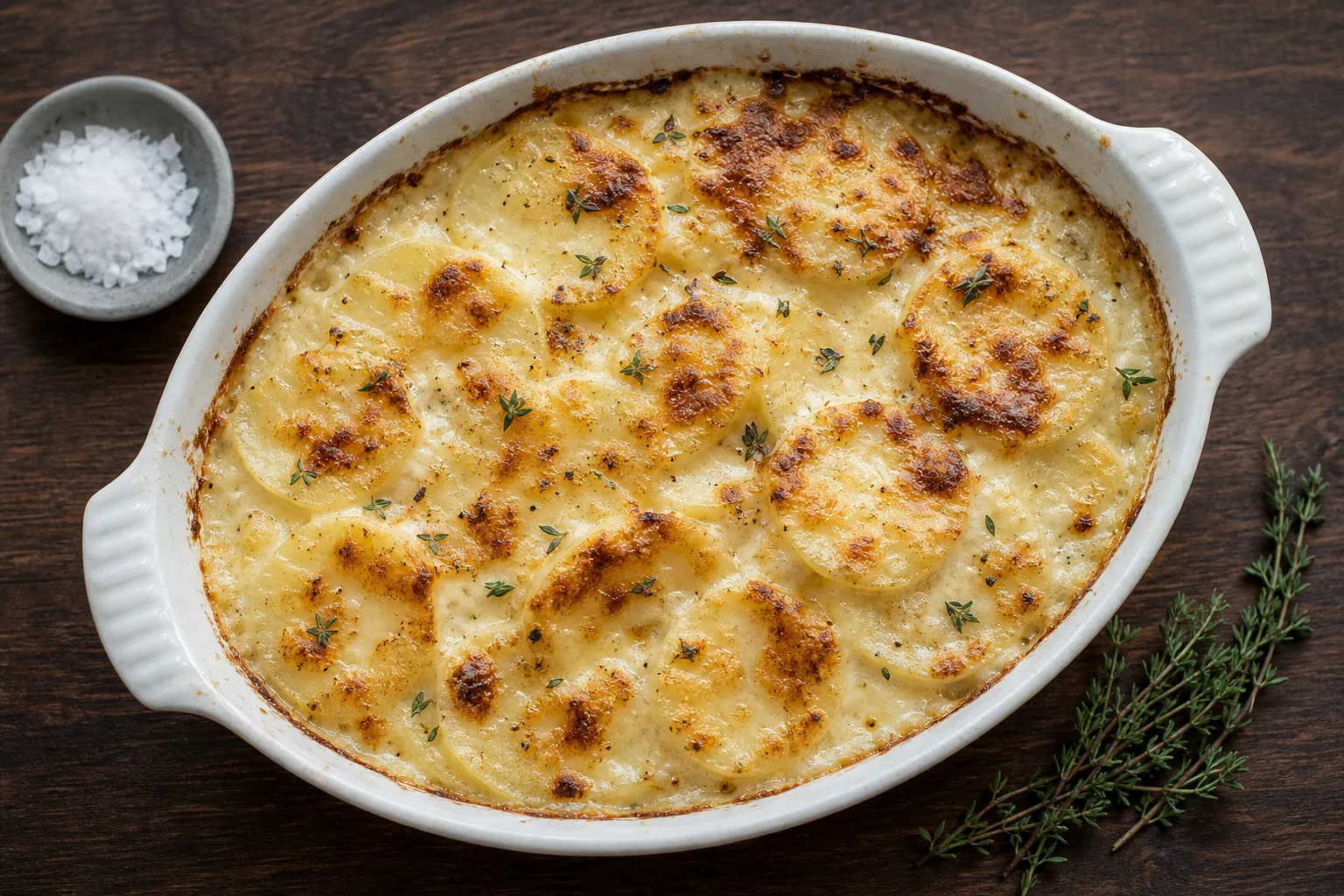
- Pour the mixture into the buttered dish, spread it level, and arrange the top layer in neat overlapping rows. The cream should come to just below that top layer — if it covers the slices, the surface will never brown.
- Cover tightly with foil and bake 40 minutes. Uncover, dot the top with the butter, and bake 30 to 35 minutes more, until a knife slides through the center with no resistance and the top is freckled brown.
- Rest 15 to 20 minutes. This is the step everyone skips. Straight out of the oven it runs; twenty minutes later it holds a clean edge on a spoon.
Don’t Do This
Do not rinse the sliced potatoes, and do not hold them in a bowl of water while you work. Every potato recipe that involves frying tells you to rinse off the surface starch, and that instruction is exactly backwards here. Rinsed slices give you potatoes sitting in warm milk — no thickening, no body, nothing to hold the dish together.
Can You Make It the Night Before?
Yes — Assemble Up to 24 Hours Ahead
Fully bake it up to a day ahead, cool it, cover, and refrigerate — this reheats better than almost any casserole, because the starch sets overnight into something sliceable. Reheat covered at 325°F for 30 minutes, then uncovered for 10 to crisp the top back up.
What does not work is assembling it raw and refrigerating it. Raw sliced potato sitting in cream oxidizes gray at the edges, and the cream slowly leaches water out of the slices, so you start the bake with a thinner sauce than you finished the simmer with.
If you only have time to get partway, do the stovetop step: simmer the potatoes in the cream, cool the whole pot, and refrigerate it up to 24 hours. The potatoes are par-cooked and the sauce is already thickened, so the next day you just spread it in the dish and bake, adding about 10 minutes for the cold start.
It freezes acceptably once baked, which is unusual for a cream dish — the potato starch holds the emulsion together through a thaw in a way loose cream cannot. Freeze in portions up to two months, thaw overnight, reheat covered. The texture comes back slightly grainier and the top will not re-crisp fully.
Scalloped or Au Gratin? The Difference Is the Thickener
These two get used interchangeably on menus, and they are genuinely different dishes. Scalloped potatoes are potatoes baked in cream or milk, thickened by nothing but the potato’s own starch. No cheese inside, no cheese on top, no breadcrumbs. Potatoes au gratin adds cheese to the sauce and finishes with a browned crust — usually cheese, often breadcrumbs — and the word gratin refers to that crust, not to the potatoes.
The practical consequence is how you season them. A scalloped dish has nothing covering for it, so the cream needs real salt, white pepper, and nutmeg or it tastes like warm potato. The nutmeg in particular is doing structural work: it is the thing that keeps a bowl of potato and cream from reading as flat. An au gratin gets its backbone from aged cheese instead, which brings its own salt and sharpness and makes nutmeg feel like too much.
Slice Thickness Is the Whole Recipe
An eighth of an inch is thin enough that a slice cooks through in the time the dish takes to brown, and thick enough that it does not dissolve into the cream. A quarter-inch slice needs roughly 25 extra minutes, and by then the top layer has gone dark. That gap is why the standard failure is a brown lid over hard potato.
Uniformity matters even more than the number. A dish holding both paper-thin slices and thick ones cooks unevenly in both directions at once — the thin ones dissolve into mush while the thick ones are still crunching. A mandoline is the easy answer and a cheap one is fine. Freehand, cut a flat side off each potato first so it cannot roll, then check yourself every ten slices.
One More Thing to Avoid
Waxy potatoes — red bliss, new potatoes, most of what is sold as salad potatoes — will not work in this dish. They hold their shape and release very little starch, so the cream stays thin no matter how long you simmer it. Russets, or Yukon Golds at a push.
The Dish You Bake It In Matters More Than You Think
Depth is the variable nobody mentions. A 2-inch layer of sliced potato in cream cooks through in about 75 minutes at 350°F. The same volume crammed into a narrower, deeper dish needs well over an hour and a half, and by then the top has gone past brown. If the only dish you own is deep, either split the recipe across two or accept that you will be adding 25 to 30 minutes with foil on.
Material matters less, but it is not nothing. Ceramic and stoneware heat slowly and evenly, which suits a long covered bake. Glass is fine and lets you see whether the bottom is actually bubbling, which is useful. Bare aluminum is the one to avoid: it reacts with dairy over a long bake and can leave a faint metallic edge on the flavor. Whatever you use, butter the sides as well as the bottom — the cream climbs, and anything stuck to an unbuttered wall tears the first slice apart.
Rachel’s Tip
Season the cream, not the layers. Salting as you layer sounds careful but reliably gives you a dish that is salty at the bottom and bland on top, because salt does not travel upward. Get the cream right in the pot, taste it there, and everything the potatoes absorb is seasoned correctly.
Questions People Ask
Why are my scalloped potatoes still hard in the middle?
The slices were too thick, or uneven, or the dish was too deep. A 350°F oven heats a 2-inch dish from the outside in, and anything much thicker than 1/8 inch near the center will not catch up before the top overbrowns. The stovetop simmer is the fix.
Can I use milk instead of cream?
Partly. All milk is far likelier to break into grainy curds over a long bake, because there is not enough fat to hold the sauce. Whole milk plus at least a cup of cream is the floor. Lower than that, you need a flour-thickened sauce — a different dish.
Why did my scalloped potatoes curdle?
Too little fat, too high a heat, or something acidic in the pan. Keep the stovetop step at a bare simmer rather than a boil, hold the oven at 350°F, and leave out wine, mustard, and tomato. Once broken it cannot be reassembled, though it still tastes fine.
Do I have to peel the potatoes?
For this one, yes. Skins float loose in a cream sauce instead of binding into it, and they interrupt the clean overlapping layers that are half the appeal. Skins earn their place in a chunky potato casserole, not a sliced one.
Can I add cheese to scalloped potatoes?
You can, and the moment you do you have made au gratin potatoes, which is a perfectly good outcome. If that is where you are heading, do it properly: build a flour-thickened cheese sauce off the heat rather than scattering cheese between the layers, which tends to go stringy and oily in a dish this wet.
About This Article

Written by Rachel Thompson. Rachel Thompson is a home cook who has spent over 10 years making an unreasonable number of dips, appetizers, and party spreads — no culinary training, just a decade of trial and error and a reputation among friends for always being asked to "bring a dip." She focuses on approachable recipes that combine bold flavors with simple techniques, making entertaining at home accessible to everyone. More about this site.
Scope and limits. Rachel is a home cook with no culinary training. Follow current food safety guidance for holding temperatures and time limits whenever you are serving people other than yourself.
Verify this against a primary source
Specifics change, and your situation may differ from the one described here. These are the authorities worth checking directly:
- FoodSafety.gov — cold holding, hot holding and the two-hour rule
- USDA FoodData Central — ingredient composition and nutrition data
- USDA Food Safety and Inspection Service — safe minimum temperatures and leftovers