
Every au gratin recipe I grew up with started the same way: a saucepan, a roux, a pot of warm milk, and then cheese stirred in one handful at a time while the whole thing waited to break. It is a lot of standing at the stove for a side dish that is going to spend the next hour and a half in the oven anyway.
The oven is perfectly capable of making the sauce. Potatoes shed starch as they bake, flour thickens in liquid held at a steady temperature, and cheese melts without any help from me. So this version has no saucepan at all. I whisk flour into cold milk in a measuring cup, toss the raw slices with the grated cheese, pour the milk over, cover it, and let it go.
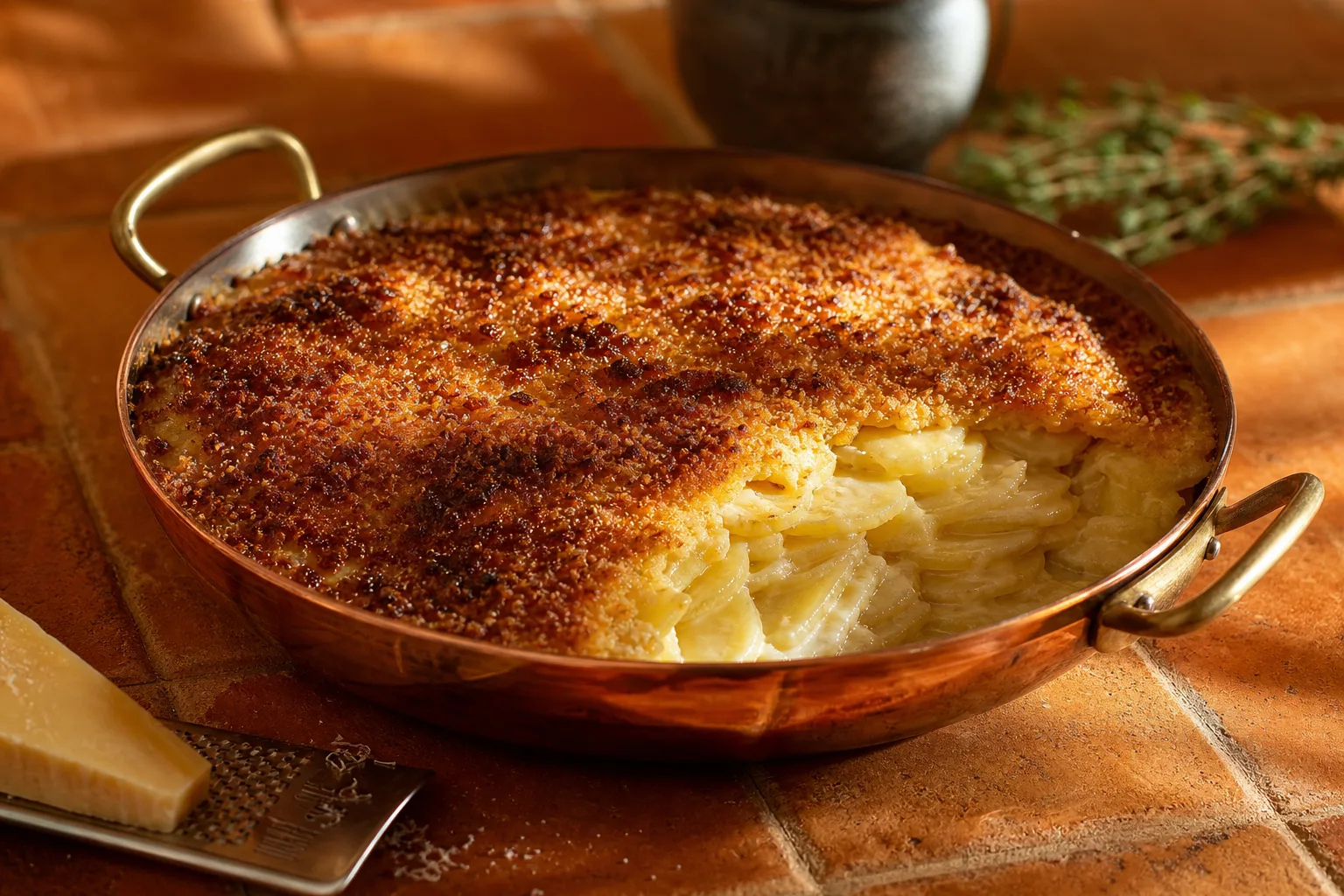
The word gratin refers to the browned crust, not the potatoes, so the crust still gets full attention here. The dish goes in wide and shallow, and the foil comes off for the last half hour. That is the only part of the process that needs your judgment.
Why This Works
The foil does the thickening. Covered for the first hour, the milk, flour, and starch from the potatoes cook together at a steady heat, and the cheese melts slowly into liquid that is already holding it in place. Take the foil off early and the surface dries out before the middle sets, so the sauce stays thin underneath. Leave it on for the full hour and the crust is the only thing left to do.
Ingredients
Use a wide shallow dish, around 3 quarts and no more than 2 inches deep. A 9×13 works; a deep casserole does not.
For the Potatoes
- 3 pounds Yukon Gold potatoes, peeled
- Butter, for the dish
- 8 ounces Gruyère, grated from a block
- 4 ounces aged white cheddar, grated from a block
- 3 tablespoons cold unsalted butter, cut into small pieces
For the Cold Slurry
- 1/4 cup all-purpose flour
- 3 cups whole milk, cold
- 1 cup heavy cream
- 1 small shallot, minced very fine
- 1/2 teaspoon Dijon mustard
- 1/4 teaspoon freshly grated nutmeg
- 2 teaspoons kosher salt
- 1/2 teaspoon black pepper
For the Gratin Crust
- 1 cup panko breadcrumbs
- 1/2 cup finely grated Parmesan
- 2 tablespoons unsalted butter, melted
Easy Swap
Gruyère is the classic and it browns beautifully, but aged white cheddar, Comté, or a mix of Emmental and Parmesan all work. Torn sourdough tossed in butter can replace the panko for a rougher, more rustic crust. What you cannot do is build this on mozzarella or young Jack. They go stringy and taste like very little once they are in a quart of milk and cream.
How to Make It
Prep: 20 minutes | Bake: 90 minutes | Rest or cool: 15 minutes | Serves: 8 to 10
- Heat the oven to 375°F with a rack in the middle, and butter a wide, shallow 3-quart baking dish. Set it on a rimmed baking sheet, because this dish likes to bubble over a little.
- Slice the peeled potatoes 1/8 inch thick, as evenly as you can, and put them in a large bowl. Do not rinse them. The surface starch is what helps the sauce thicken.
- Pour the cold milk into a large measuring cup or bowl and whisk in the flour until no lumps remain, about 30 seconds. Whisk in the cream, shallot, Dijon, nutmeg, salt, and pepper. Taste it: it should be a shade saltier than comfortable, because three pounds of plain potato is about to dilute it.
- Add the Gruyère and cheddar to the potatoes and toss with your hands, separating any slices that stick together, until every slice has a little cheese on it.
- Pack the potatoes into the dish no deeper than 2 inches, then press the top layer flat with the back of a spoon so the slices lie down instead of curling up. Whisk the milk mixture again right before you pour, since flour settles within seconds. Pour it slowly over the potatoes until the liquid comes nearly to the top of the slices. Tap the dish on the counter to settle it, then dot the top with the cold butter pieces.
- Cover tightly with foil and bake 60 minutes. Check by sliding a knife into the center: it should meet no resistance, and the liquid should have thickened to a loose cream. If it still feels firm, give it another 10 minutes covered before you move on.
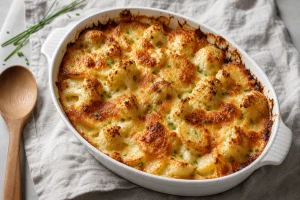
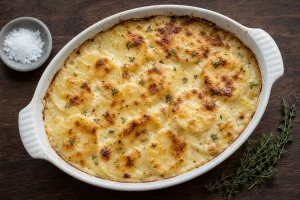
- Toss the panko with the Parmesan and melted butter. Uncover the dish, scatter the crumbs evenly over the top, and bake another 30 minutes, until the crust is deep golden brown and the sauce is bubbling at the edges.
- Rest 15 minutes before serving. The sauce is loose straight from the oven and sets into something sliceable as it cools.
Don’t Do This
Do not pour dry flour into the dish or sprinkle it over the potatoes to save the whisking step. It clumps into pale, pasty pockets that the oven will not fix. The flour has to be whisked into cold milk first, and whisked again right before it goes in, because it settles within seconds.
Can You Make It the Night Before?
Yes — Assemble Up to 24 Hours Ahead
Bake it completely up to a day ahead, cool, cover, and refrigerate. Reheat covered at 325°F for 30 minutes, then uncovered for 10 to bring the crust back. If you would rather assemble ahead, keep the slurry in a jar and shake it hard right before pouring, and hold the crumb mixture dry and separate.
A gratin that has baked through reheats well. The flour in the sauce keeps it together, and it is far more forgiving than a plain cream sauce. What does not survive is the crust. Panko that has been refrigerated under foil goes soft and never fully re-crisps, so if you care about the top, add it fresh on reheat day.
You can assemble ahead if you need to, with some care. Slice the potatoes up to a few hours early and hold them in cold water, then dry them well before tossing with the cheese, because they brown when left out. Mix the slurry in a jar and refrigerate it separately. The flour will sink to the bottom and set up, so shake it hard or whisk it before you pour, not after it is already in the dish. Add 15 minutes to the covered bake if the dish goes in cold.
Freezing works for about two months, with one caveat: Gruyère and aged cheddar both tolerate the freezer, but the potato slices come back slightly grainy at the edges. Thaw overnight in the refrigerator rather than on the counter, and reheat covered so the surface does not dry out before the middle warms.
Why a Sauce You Never Cooked Still Comes Out Smooth
I did not believe this would work the first time. A roux is supposed to be cooked, and cheese is supposed to be stirred into something hot and silky. But the thing a roux does is get raw flour hydrated and swollen so it thickens a liquid. A hot oven does exactly that, just more slowly, as long as the dish is covered and the liquid is not allowed to boil away.
The cheese is the part I worried about most, because the usual way to ruin a cheese sauce is to hit it with too much heat too fast. Here it is the opposite. The cheese is tossed into the potatoes, so it melts gradually as the dish warms, surrounded by liquid and flour rather than sitting alone in a hot pan. I have not had the grainy, oily mess I used to get from a pot of cheese sauce. A little butterfat sometimes shows at the edges of the dish, which a paper towel takes care of in seconds.
The first time I made this I did not whisk the milk again before pouring, and about a tablespoon of flour landed in a lump at the bottom of the dish. That is the one step worth being fussy about.
Au Gratin vs. Scalloped: What the Words Actually Mean
A gratin is defined by its top. The word comes from the French for the browned, crusty layer you scrape off a dish, and anything baked under enough top heat to form that crust can be gratinéed: cauliflower, pasta, onion soup. Potatoes au gratin, in American usage, means potato slices in a cheese sauce, finished with a crust of cheese, breadcrumbs, or both. There is an actual cheese sauce in the dish, and there is a deliberate crust on it.
Scalloped potatoes have neither. They are potatoes baked in plain cream or milk, thickened by nothing but the starch the potato slices release, with no cheese inside and nothing crunchy on top. That is not a lesser dish. It is a quieter one, and it is seasoned very differently because there is no aged cheese doing the heavy lifting. Restaurant menus use the two names interchangeably, which is how most of us learned them wrong.
There is a wrinkle worth knowing, which is that the French original runs the other way. Gratin dauphinois, the dish from the Dauphiné that all of this descends from, is classically potatoes, milk or cream, garlic and nutmeg, and traditionally no cheese at all. By that standard the American scalloped potato is the closer relative, and what we call au gratin is nearer to a gratin savoyard, which does bring cheese. None of that makes the American usage wrong, but it does explain why the two names have been tangled together for a century.
Yukon Gold Beats Russet Here, and That Is Backwards
In a scalloped dish you want starchy russets, because the potato’s own starch is the only thickener in the pan. Here you have a spoonful of flour doing part of that work, so you can choose a potato for texture instead, and that changes the answer. Yukon Golds sit between waxy and starchy. They hold their slices distinct instead of blurring into the sauce, they taste faintly buttery, and they release enough starch to help the sauce set without turning it to paste.
Russets still work, and plenty of good recipes use them, but the result is softer and the layers lose definition. Genuinely waxy potatoes, like red bliss or new potatoes, are the one real mistake: they stay firm and slick, and the sauce slides off them rather than clinging. On thickness, 1/8 inch matters more than anything else in the recipe. Uneven slices cook unevenly, and in a 2-inch gratin the thick ones at the bottom are the ones still crunching when the crust is ready.
The other thing that matters with raw potatoes is that the slices must be mostly submerged when you pour. Anything poking well above the liquid line stays firm and chalky under the foil. If your dish is a little deeper than 2 inches, press down firmly or go wider rather than piling higher.
Rachel’s Tip
If the potatoes are tender but the crust is still only tan at the end of the bake, move the dish to the top rack and broil 2 to 3 minutes with the door cracked. Watch it the entire time. Panko and Parmesan go from golden to black faster than cheese alone does.
Questions People Ask
Does the sauce really thicken without cooking a roux?
Yes, as long as the dish is covered. Flour whisked into cold milk swells and thickens as the dish heats, and the potatoes add their own starch on top of that. The foil is what makes it work: uncovered, the surface skins over and the liquid underneath stays thin.
What is the difference between au gratin and scalloped potatoes?
Au gratin has a cheese sauce and a browned crust on top. Scalloped potatoes are baked in plain cream or milk with no cheese and no topping, thickened only by the starch from the potatoes themselves. The word gratin refers to the crust, which is why a dish without one is not really a gratin at all.
Why is my sauce thin or my potatoes still hard?
Usually the slices were cut too thick, the dish was too deep, or the foil was not sealed tightly. All three let steam escape or leave potatoes above the liquid line. Slice to 1/8 inch, keep it to 2 inches deep, and crimp the foil over the edges. If the center is still firm after the covered hour, give it more time covered before you add the crumbs.
Can I use only cheddar?
Yes, if it is aged: a sharp or extra-sharp block. Mild cheddar disappears into this much milk and cream. Aged cheddar can release more oil than Gruyère, so you may see a little more butterfat at the edges, which blots off easily.
Do I have to use breadcrumbs?
No, but you do need something that browns. A cheese-only gratin works well: hold back 3 ounces of the Gruyère and scatter it on for the final 30 minutes. What does not work is leaving the top bare, which gives you a dish of potatoes in cheese sauce, good but not a gratin.
About This Article

Written by Rachel Thompson. Rachel Thompson is a home cook who has spent over 10 years making an unreasonable number of dips, appetizers, and party spreads — no culinary training, just a decade of trial and error and a reputation among friends for always being asked to "bring a dip." She focuses on approachable recipes that combine bold flavors with simple techniques, making entertaining at home accessible to everyone. More about this site.
Scope and limits. Rachel is a home cook with no culinary training. Follow current food safety guidance for holding temperatures and time limits whenever you are serving people other than yourself.
Verify this against a primary source
Specifics change, and your situation may differ from the one described here. These are the authorities worth checking directly:
- FoodSafety.gov — cold holding, hot holding and the two-hour rule
- USDA FoodData Central — ingredient composition and nutrition data
- USDA Food Safety and Inspection Service — safe minimum temperatures and leftovers