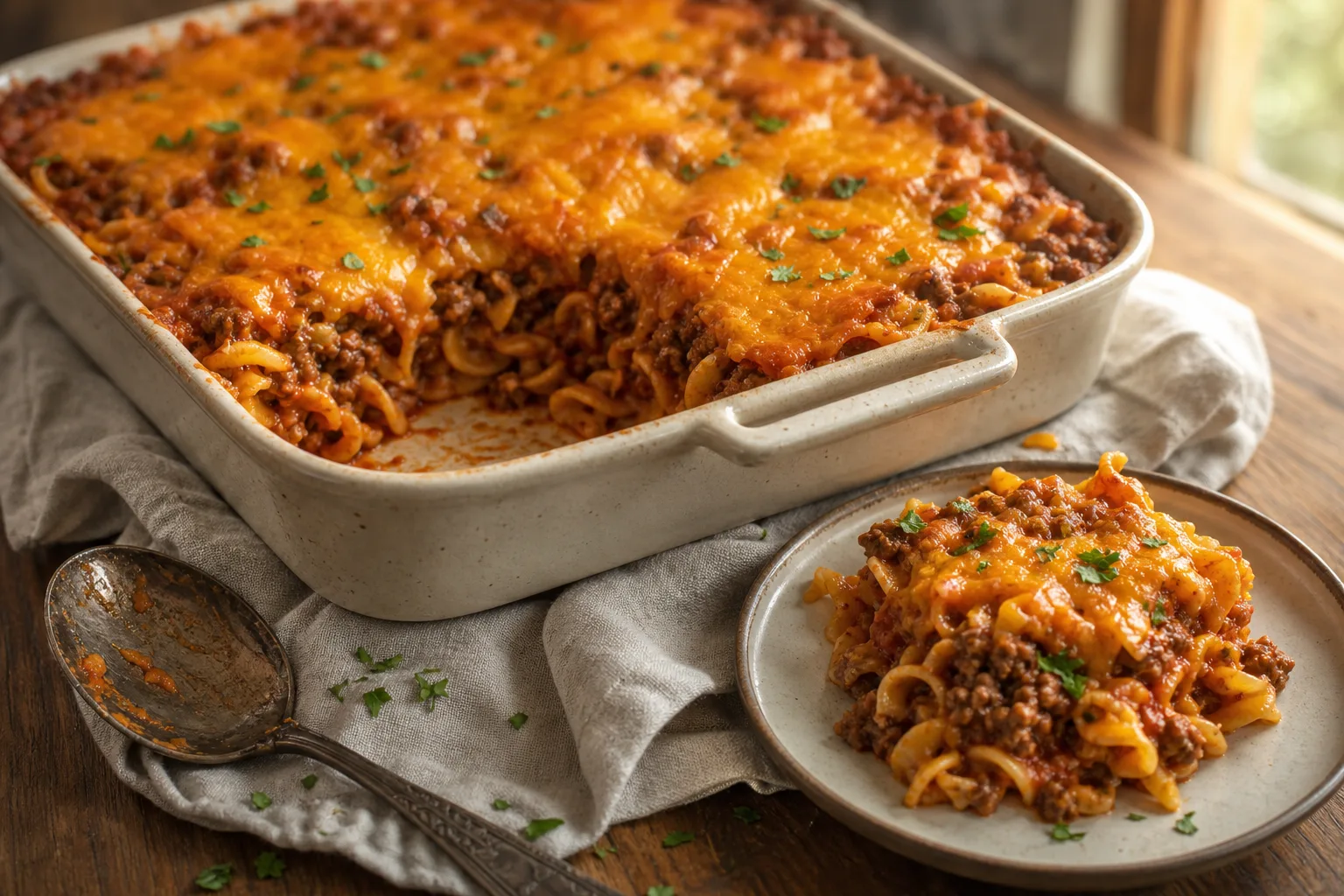

Hamburger casserole has a reputation problem, and it earned it honestly. The bad version is a pan of pale gray crumbles sitting in a slick of orange fat, with noodles that have turned into a single soft mass. I made that casserole for years without understanding that two steps I was rushing were the whole problem.
The two steps are browning and draining, and neither one is optional. Browned beef tastes like beef; steamed beef tastes like salt. And a pound of 80/20 ground beef releases close to a quarter cup of rendered fat, which has to go somewhere. If it doesn’t go into the sink, it goes into your noodles.
What you get when you do both properly is a casserole that tastes like a cheeseburger rather than like a cafeteria. My family asks for this one about twice a month through the winter, which is more than I can say for most things I cook.
Why This Works
Beef browns at around 300°F and steams at 212°F, and a crowded pan never gets above the second number. Working in two batches in a wide skillet keeps the surface hot enough for the crust that carries almost all the flavor in this dish — then draining the rendered fat means that flavor isn’t swimming in grease when it reaches the noodles.
Ingredients
This fills a 9×13 dish and feeds six generously or eight if there’s bread and a salad on the table.
For the Casserole
- 2 pounds ground beef, 80/20
- 12 ounces wide egg noodles
- 1 large yellow onion, diced
- 4 cloves garlic, minced
- 2 tablespoons tomato paste
- 1 (28-ounce) can crushed tomatoes
- 2 teaspoons Worcestershire sauce
- 1 1/2 teaspoons smoked paprika
- 1 teaspoon dried oregano
- 1/2 teaspoon red pepper flakes
- 2 teaspoons kosher salt, plus more for the noodle water
- 1 teaspoon black pepper
- 3/4 cup sour cream, at room temperature
For the Top
- 10 ounces sharp cheddar, grated from a block (about 2 1/2 cups)
- 2 tablespoons chopped flat-leaf parsley, for after it comes out
Easy Swap
Ground turkey works, but it brings almost no fat, so brown it in a tablespoon of oil and skip the draining step entirely. What doesn’t work is leaner beef: 93/7 browns into dry pellets in the oven because there’s no fat left to carry it through 25 minutes of baking. If 80/20 is more fat than you want in the dish, the answer is draining it properly, not buying lean.
How to Make It
Prep: 35 minutes | Bake: 35 minutes | Serves: 6 to 8
- Heat the oven to 375°F and butter a 9×13 baking dish. Bring a large pot of well-salted water to a boil and cook the egg noodles two minutes short of the low end of the package time — about 5 minutes for most brands. Drain them and leave them in the colander.
- Set a large heavy skillet over medium-high heat and let it get genuinely hot, about 3 minutes. Add half the ground beef and press it into a flat, even layer. Now leave it alone for 4 minutes. It will look wrong and underdone on top. Ignore that and let the bottom crust.
- Break the beef into large chunks with a stiff spatula and cook 3 minutes more, turning only twice. You want deep brown patches, not uniform gray. Scrape it into a colander set over a bowl and repeat with the second half of the beef.
- Let the beef drain in the colander for a full 2 minutes while you wipe the skillet out with a paper towel. Return 1 tablespoon of the rendered fat to the pan and discard the rest once it cools — never down the drain.
- Cook the onion in that tablespoon of fat over medium heat for 6 minutes until soft and translucent, then add the garlic and cook 1 minute more. Add the tomato paste and stir it around the hot pan for 2 full minutes until it darkens from red to brick.
- Add the crushed tomatoes, Worcestershire, smoked paprika, oregano, red pepper flakes, salt, and pepper. Scrape the browned bits off the bottom of the pan and simmer 10 minutes, until the sauce pulls back from the spatula instead of running.
- Take the pan off the heat and stir in the drained beef, then the sour cream. Taste it. It should be a shade saltier than you want, because 12 ounces of unsalted noodles are about to join it. Fold in the noodles and 1 cup of the cheddar.
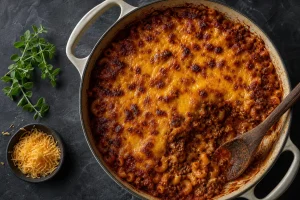
- Spread it into the dish, scatter the remaining cheese over the top, and bake uncovered 25 minutes until the edges bubble and the cheese has brown spots. Rest it 10 minutes before you cut into it, then scatter the parsley over the top.
Don’t Do This
Do not tip the skillet and spoon the fat out while the beef is still in the pan. It looks like it works and it removes maybe half. The crumbles hold rendered fat in every crevice, and only a colander and two minutes of gravity get it out.
Can You Make It the Night Before?
Yes — Assemble Up to 24 Hours Ahead
Assemble it completely, cover, and refrigerate up to 24 hours — but hold back half a cup of the crushed tomatoes and stir that in just before baking. Cold noodles keep drinking sauce overnight, and that extra half cup is the difference between saucy and dry.
Take the dish out of the refrigerator 45 minutes before it goes in the oven, and add about 12 minutes to the bake time. A fridge-cold 9×13 dish needs that long to get its middle up to temperature, and sliding cold glass into a 375°F oven is a reliable way to crack a dish.
The noodles will be softer than in a same-day casserole. There’s no trick that fully prevents it — which is exactly why you undercook them by two minutes in the first place. If you’re assembling a day ahead, pull them a minute earlier still.
It freezes well, better than most casseroles with dairy in them, because sour cream folded into a hot tomato sauce is more stable than a flour-thickened cream sauce. Wrap the unbaked dish tightly and freeze up to two months. Thaw it overnight in the refrigerator, then bake as written plus 15 minutes. Baking it from frozen takes well over an hour and the top burns before the middle is hot.
Why It Comes Out Greasy, and How to Know You Fixed It
Two pounds of 80/20 beef carries roughly 6 ounces of fat. Some of it stays in the meat where it belongs, and somewhere between a third and half a cup renders out into the pan. That rendered fat has nowhere to go in a casserole: it can’t evaporate, it won’t emulsify into a tomato sauce, and 25 minutes in the oven just makes it thinner and more mobile. It pools.
The visible test is the surface of the baked dish. A properly drained hamburger casserole has bubbling sauce at the edges and matte browned cheese on top. An undrained one has a thin, glossy, slightly orange film sitting on the cheese, and when you cut the first square the hole fills with liquid fat rather than sauce.
The other half of the fix is browning, and the two are connected. Beef that’s been browned hard has already rendered most of what it’s going to render, in the skillet, where you can get rid of it. Beef that was stirred constantly over medium heat never got hot enough to render much at all, so it does it later, in the oven, in your dinner.
A Trick for the Last of the Fat
If you’re using a cut of beef fattier than you expected, lay a folded paper towel flat on top of the drained beef in the colander and press down gently for a few seconds. It pulls off another tablespoon or so. Don’t scrub or twist it — you want the fat, not the browned crust.
The Noodle Question
Egg noodles in a casserole get cooked twice, and nobody tells you that on the box. Five minutes in boiling water plus 25 minutes in a hot dish of liquid is well past al dente, and it’s the reason so many of these bakes come out as a solid mass you serve with a spoon instead of a spatula.
Pulling them two minutes early feels wrong. They’ll be stiff in the middle and taste faintly of flour. That’s correct for this dish. They finish in the oven, in the sauce, and the sauce they absorb while finishing is where the seasoning gets in.
Don’t rinse them, either. The starch on the outside of hot noodles is what helps the sauce cling instead of sliding off into a layer at the bottom of the dish. Just drain them and let them sit in the colander while you deal with the beef.
What Makes This Taste Like a Cheeseburger
Three things, and none of them is a secret ingredient. The first is the tomato paste cooked in the dry pan until it turns brick-colored, which takes a full two minutes and tastes scorched and bitter for about the first thirty seconds of eating if you stop at one. The second is Worcestershire, which is doing an umami job rather than a recognizable flavor job — you won’t taste it, you’ll taste more beef.
The third is the sour cream, and it goes in off the heat for a reason. Sour cream has far less fat than heavy cream and its proteins curdle into visible grains if you boil it. Stirred into a sauce that’s hot but no longer simmering, it stays smooth and does what the mayonnaise-and-cheese layer does on a diner burger: it rounds off the acidity of the tomato.
Rachel’s Tip
Grate the cheddar from a block. Pre-shredded cheese is coated in potato starch and cellulose to keep it from clumping, and on top of a casserole that coating turns into a slightly grainy skin instead of a molten layer. It takes 90 seconds on a box grater and it is the most visible change you can make to this dish.
Questions People Ask
Why is my hamburger casserole watery?
Usually it isn’t water, it’s rendered fat, which separates at the bottom and looks the same when you cut into the dish. Drain the beef in a colander for two full minutes rather than tipping the pan. If it really is thin liquid rather than grease, your sauce didn’t reduce long enough — it should pull back from the spatula in a visible line before the noodles go in.
Can I use a different pasta?
Yes, as long as it’s short and sturdy. Rotini, elbows, and medium shells all work and hold up better than egg noodles overnight. Stay away from anything long or anything delicate: spaghetti clumps into a brick, and thin pasta like angel hair disintegrates completely in 25 minutes of baking. Whatever you use, cook it two minutes short.
Do I have to brown the beef in two batches?
In a standard 12-inch skillet with two pounds of beef, yes. The pan can hold about a pound in a single layer, and past that the beef releases moisture faster than it can evaporate, so the temperature drops to a simmer and you get gray crumbles. If you have a 14-inch pan or a wide Dutch oven you can do it all at once. The batches cost you about six extra minutes.
Can I leave out the sour cream?
You can, and the casserole is still good — just sharper and more tomato-forward. If you want the creaminess without sour cream, four ounces of cream cheese cut into cubes and stirred into the hot sauce does a similar job and is actually more heat-stable. Skip Greek yogurt here; it’s thinner than it looks and it breaks.
How do I reheat leftovers without drying them out?
Cover the portion, add a tablespoon of water or crushed tomatoes per serving, and reheat at 325°F for about 20 minutes. The noodles keep absorbing liquid in the refrigerator overnight, so leftovers genuinely need that extra moisture back. A microwave works for a single square but tends to make the edges rubbery while the middle is still cold.
About This Article

Written by Rachel Thompson. Rachel Thompson is a home cook who has spent over 10 years making an unreasonable number of dips, appetizers, and party spreads — no culinary training, just a decade of trial and error and a reputation among friends for always being asked to "bring a dip." She focuses on approachable recipes that combine bold flavors with simple techniques, making entertaining at home accessible to everyone. More about this site.
Scope and limits. Rachel is a home cook with no culinary training. Follow current food safety guidance for holding temperatures and time limits whenever you are serving people other than yourself.
Verify this against a primary source
Specifics change, and your situation may differ from the one described here. These are the authorities worth checking directly:
- FoodSafety.gov — cold holding, hot holding and the two-hour rule
- USDA FoodData Central — ingredient composition and nutrition data
- USDA Food Safety and Inspection Service — safe minimum temperatures and leftovers