
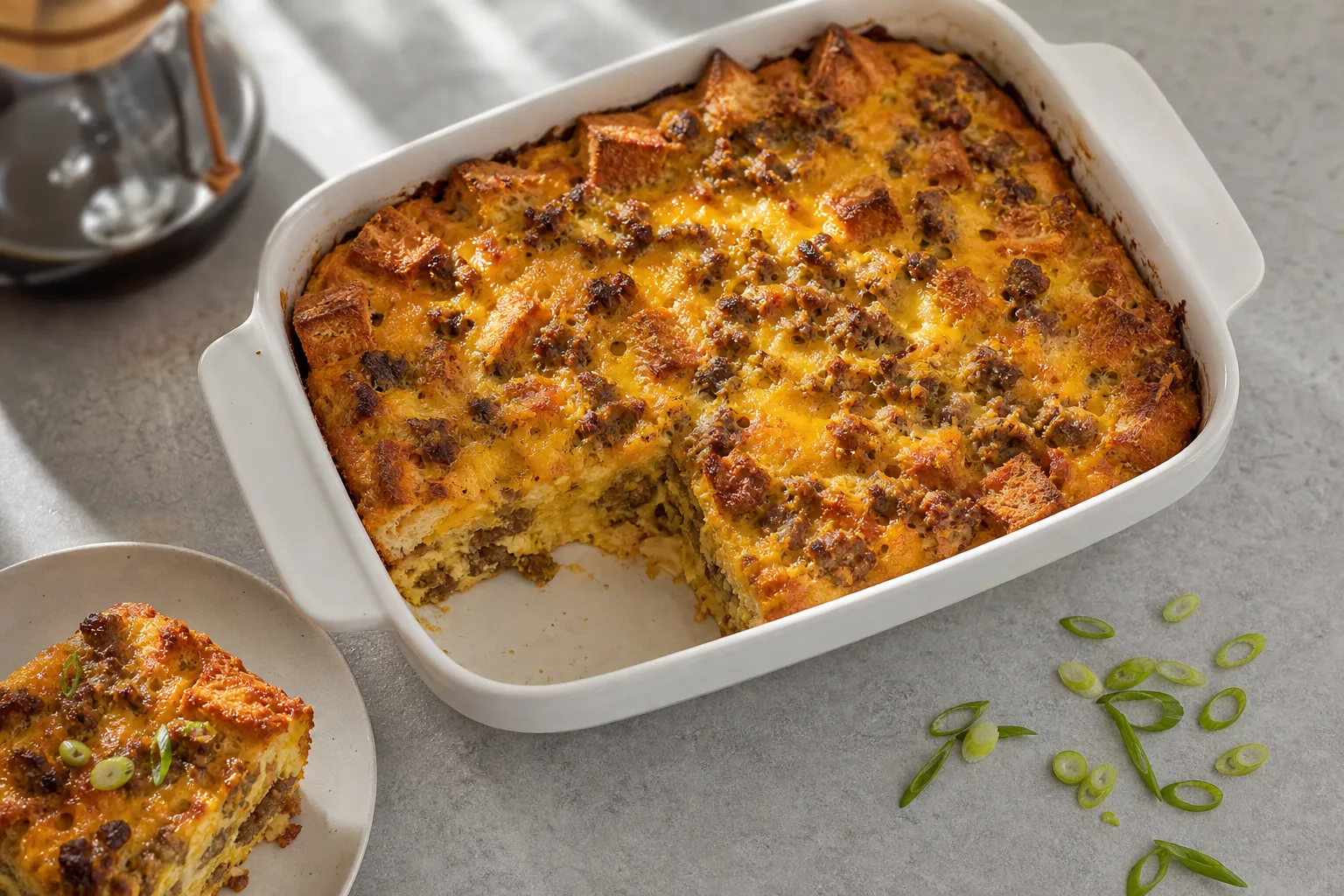

Breakfast for a full house has a scheduling problem built into it. Everyone wants to eat at the same time, and whoever is cooking is standing at the stove with a spatula while the rest of the room drinks coffee. The whole appeal of a breakfast casserole is that it solves that — one dish, one oven, nobody tied to the range.
The catch is that most of them come out of the oven in one of two disappointing ways. Either the bottom is a wet gray layer of bread that never absorbed anything, or the eggs seize into something rubbery and weep water onto the plate. Both failures have the same cause, and it is not the recipe. It is timing.
This is the version I have landed on after making it for most of a decade of holiday mornings, plus one long stretch of weekends when my sister and her kids were staying with us. Sausage, good bread, two cheeses, and a custard that sits overnight. You do all the work the night before, and in the morning you turn on the oven.
Why This Works
Bread does not absorb custard quickly — it absorbs it slowly, over hours, as the starch softens. Eight hours in the refrigerator turns the cubes into something closer to a savory bread pudding, where the bread and the eggs have become one material. Bake it forty minutes after assembling and you get the other thing: dry bread on top, a puddle of plain scrambled egg underneath.
Ingredients
This fills a 9×13 dish to about three-quarters depth, which cuts into ten square portions or eight generous ones.
For the Casserole
- 1 pound bulk breakfast sausage (sage or hot, your call)
- 10 ounces day-old sturdy white bread, cut into 3/4-inch cubes (about 8 cups)
- 2 cups shredded sharp cheddar (about 8 ounces), divided
- 1 cup shredded Monterey Jack (about 4 ounces)
- 4 scallions, sliced thin, white and green parts kept separate
- 10 large eggs
- 2 1/2 cups whole milk
- 1/2 cup heavy cream
- 1 tablespoon Dijon mustard
- 1 1/2 teaspoons kosher salt
- 3/4 teaspoon black pepper
- 1/4 teaspoon freshly grated nutmeg
For the Dish and the Table
- 1 tablespoon unsalted butter, softened, for the baking dish
- 1/2 teaspoon flaky salt, for finishing
- Hot sauce, for anyone who wants it
Bread Swaps That Work, and One That Does Not
A plain country loaf, sourdough, or a split and cubed baguette all hold up. Brioche or challah makes a richer, sweeter version that I like with hot sausage. What does not work is soft sliced sandwich bread — it has almost no crumb structure, and after an overnight soak it collapses into a uniform paste with no distinction between bread and egg.
How to Make It
Prep: 25 minutes | Bake: 55 minutes | Serves: 8 to 10
- Butter a 9×13 baking dish well, corners included. If your bread is genuinely stale, cube it and move on. If it is fresh from the bag, spread the cubes on a sheet pan and dry them in a 300°F oven for 12 minutes, then let them cool — they should feel dry and light, not toasted.
- Cook the sausage in a large skillet over medium-high heat, breaking it into rough bite-sized pieces rather than crumbs, about 8 to 10 minutes until there is real browning on the pieces. Pour off all but about a tablespoon of fat, add the scallion whites, and cook 1 minute more. Let it cool for 10 minutes off the heat.
- Put the bread cubes in the buttered dish and add the sausage, 1 1/2 cups of the cheddar, all of the Monterey Jack, and the scallion greens. Toss it with your fingers right in the dish, then spread it into an even layer.
- Whisk the eggs in a large bowl until the yolks and whites are completely uniform — a solid 60 seconds, with no ribbons of clear white left. Whisk in the milk, cream, Dijon, salt, pepper, and nutmeg.
- Pour the custard evenly over the dish and then press the whole surface down with a spatula for a few passes, until every exposed cube has gone wet and slightly darker. Cover tightly and refrigerate at least 8 hours and up to 24.
- In the morning, take the dish out of the refrigerator and leave it on the counter for 30 to 40 minutes. Heat the oven to 350°F. Scatter the remaining 1/2 cup of cheddar over the top.
- Bake uncovered for 50 to 60 minutes. It is done when the top is deeply browned and puffed, a knife slid into the middle comes out clean, and the center does not wobble like liquid when you nudge the dish. If the top browns before the center sets, lay a sheet of foil loosely over it for the last 10 minutes.
- Let it rest 10 to 15 minutes before cutting. This is not optional — the custard keeps firming as it cools, and a casserole cut straight out of the oven slumps on the plate. Finish with flaky salt and cut into squares.
Don’t Bake It Covered
Foil over the dish for the whole bake traps steam, and steam is the enemy here. The custard stays loose well past an hour, the top never browns, and when you finally cut it water runs out of the sides. Bake it uncovered and only tent it late if the top gets ahead of the center.
Can You Make It the Night Before?
Yes — Assemble Up to 24 Hours Ahead
This one is designed for it. Build the whole thing through the custard pour, press the bread down, cover tightly, and refrigerate 8 to 24 hours. The only thing you hold back is the last 1/2 cup of cheddar, which goes on just before baking so it browns instead of dissolving into the surface during the soak.
Take it out of the refrigerator 30 to 40 minutes before it goes in the oven. A cold 9×13 dish of custard needs roughly 10 extra minutes to set, and the sharp temperature jump from refrigerator to a 350°F oven is also how glass dishes crack. If you forget and bake it straight from cold, just plan on 65 minutes and start checking at 55.
An overnight soak genuinely changes the texture rather than just saving you time. At one hour, you can still see individual bread cubes and the layers behave like separate ingredients. At eight hours the cut edge is uniform and slightly glossy and it slices cleanly. Past 24 hours it starts going the other direction — the bread gives up its structure entirely and the center turns dense and a little pasty.
Freezing works, but only after baking. Bake it fully, cool it completely, then cut it into portions and freeze them wrapped, up to two months; reheat covered at 325°F for about 25 minutes from frozen. Do not freeze it unbaked. Raw egg custard separates as it thaws and releases a surprising amount of water into the dish, and you cannot whisk it back together once the bread is in there.
Day-Old Bread Matters More Than Which Bread You Buy
Fresh bread is already holding about as much water as its crumb can carry. Drop it into custard and it does not absorb much of anything — it just sits there getting slick on the outside while the eggs pool underneath. Stale bread has lost that water, and the empty space is what the custard moves into.
You do not need to plan three days ahead for this. Twelve minutes in a 300°F oven does the same job, and it is the single most reliable fix for a soggy-bottomed breakfast casserole. The cubes should feel dry and sound hollow when you drop a handful back on the pan, but they should not be toasted brown — color means flavor you did not ask for, and toasted edges stay chewy even after a long soak.
What a Properly Set Egg Casserole Looks Like
The top tells you less than you would think, because the cheese browns long before the middle is done. The reliable signal is movement. Nudge the side of the dish and watch the center: liquid sloshes, set custard jiggles as one piece, like gelatin. If you see any slosh at all, it needs more time.
The knife test backs it up. Slide a thin knife into the center and pull it straight out — a few moist crumbs are fine, wet streaks of egg are not. And expect the thing to deflate noticeably in the first five minutes out of the oven. A puffed, souffléd top that falls a half-inch is normal, not a mistake.
If You Did Not Plan Ahead
You can make this the same morning, but treat it as a different dish rather than a rushed version of this one. Cut the bread smaller, into 1/2-inch cubes, so the custard has less distance to travel, and warm the milk to about body temperature before whisking it in — that speeds absorption considerably. Then give it 45 minutes on the counter, pressing the top down twice along the way.
The result is good, closer to a strata with visible bread than a bread pudding. What you will not get is the uniform, sliceable cut edge, and the bottom quarter-inch is likelier to stay custardy. If you are serving it with a spoon rather than slicing it onto plates, nobody will notice.
Taste the Sausage Before You Commit Ten Eggs
Breakfast sausage varies enormously in salt from brand to brand. Once it is browned, taste a piece. If it is aggressively salty, drop the custard salt to 1 teaspoon. If it tastes flat, go to 1 3/4. You get exactly one chance to season this, and it is before the eggs go in.
Questions People Ask
Why is my breakfast casserole watery on the bottom?
Three usual suspects, in order of likelihood. Bread that was too fresh, so it never absorbed the custard and the eggs sank. Baking it covered, which traps steam the dish cannot shed. Or vegetables added raw — mushrooms, spinach, and tomatoes all release a lot of water in the oven, and they need to be cooked and squeezed dry first.
Can I use fresh bread instead of day-old?
Yes, but dry it first. Cube it, spread it on a sheet pan, and give it 12 minutes in a 300°F oven, then cool it. Skipping that step is the most common reason an overnight casserole comes out with a wet gray layer underneath.
Do I really have to let it sit overnight?
Four hours is the practical minimum for the texture this recipe is going for. Under about two hours, you have a pan of scrambled eggs with bread in it, which is perfectly edible but not what the long soak is for. The sweet spot is 8 to 12 hours, and I would not push it past 24.
Can I add vegetables?
Yes, with one rule: cook them first and get them dry. Sauté sliced mushrooms until the pan goes dry, wring thawed frozen spinach out in a kitchen towel until it stops dripping, and roast or sauté peppers and onions rather than adding them raw. Roughly 2 cups of cooked vegetables is as much as this amount of custard will carry.
Can I halve it or double it?
Halve it in an 8×8 dish and start checking at 40 minutes. Doubling is harder — one very deep dish takes well over 90 minutes and the edges overcook before the center sets. Use two 9×13 dishes side by side on the same rack and rotate them once halfway through.
Prefer the same custard in flat, distinct layers rather than tossed cubes? That version is a strata, and it wants a full twelve hours instead of eight: Ham and Cheese Breakfast Strata: Layered, Not Tossed.
About This Article

Written by Rachel Thompson. Rachel Thompson is a home cook who has spent over 10 years making an unreasonable number of dips, appetizers, and party spreads — no culinary training, just a decade of trial and error and a reputation among friends for always being asked to "bring a dip." She focuses on approachable recipes that combine bold flavors with simple techniques, making entertaining at home accessible to everyone. More about this site.
Scope and limits. Rachel is a home cook with no culinary training. Follow current food safety guidance for holding temperatures and time limits whenever you are serving people other than yourself.
Verify this against a primary source
Specifics change, and your situation may differ from the one described here. These are the authorities worth checking directly:
- FoodSafety.gov — cold holding, hot holding and the two-hour rule
- USDA FoodData Central — ingredient composition and nutrition data
- USDA Food Safety and Inspection Service — safe minimum temperatures and leftovers