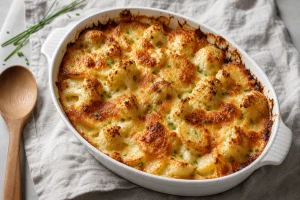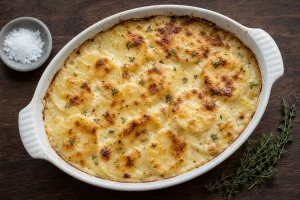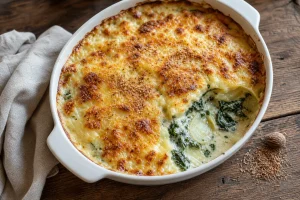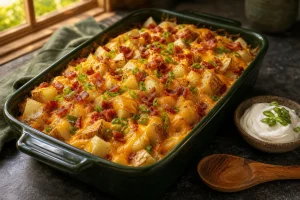
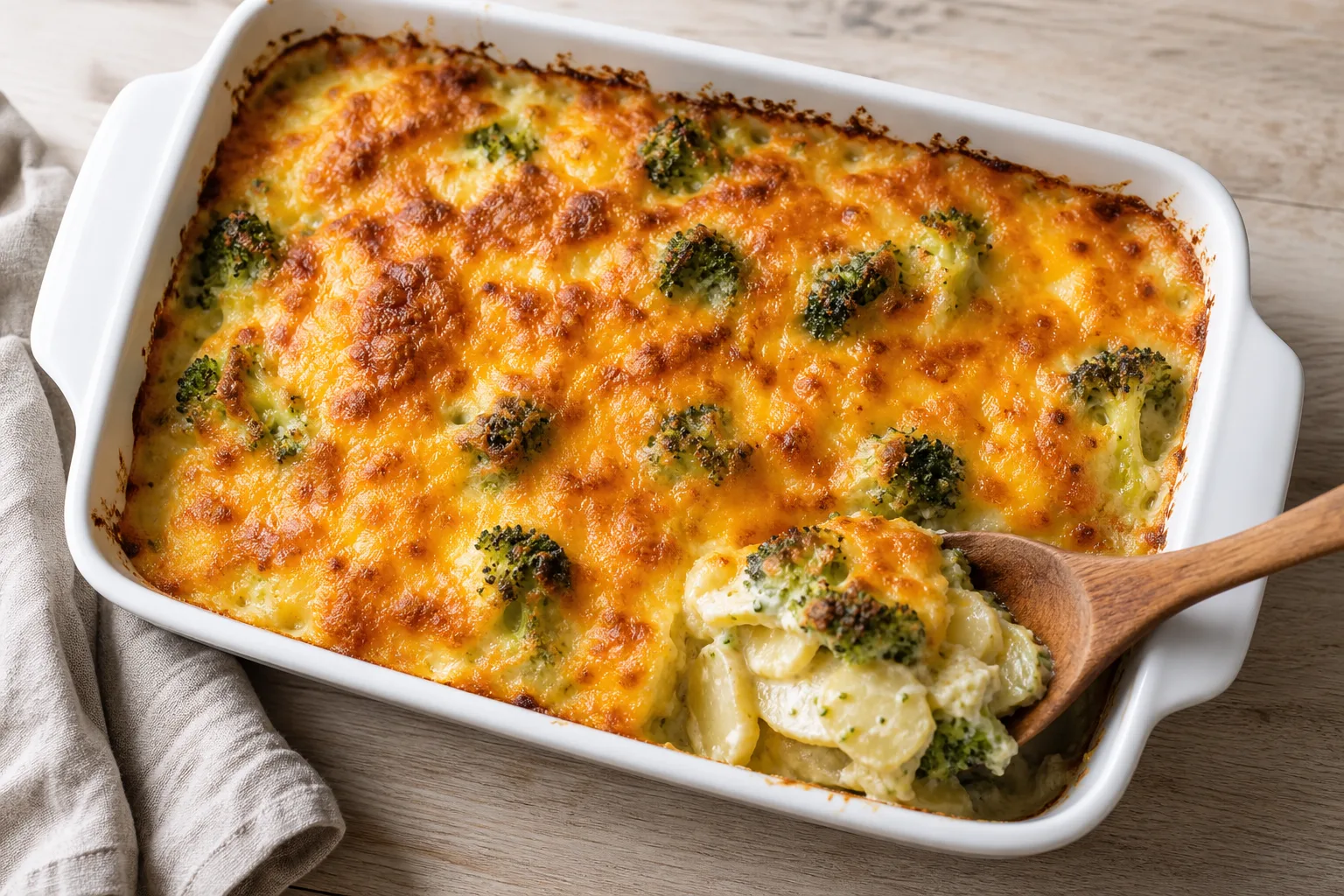

The first time I put frozen broccoli into a gratin, I treated it like any other ingredient. Same amount of milk as my usual potato version, same bake time, and I pulled out a dish that looked beautiful on top and had a puddle of thin, greenish liquid sitting underneath it. The potatoes were fine. The broccoli had simply dumped its whole freezer-burned life story into the sauce.
Broccoli is the wettest vegetable you can put in a gratin, and frozen broccoli is wetter still. The thick stem pieces hold more water than the florets, and they let it go all at once as the oven heats up. My first instinct was to bake it longer. That does not work, because by the time the water has cooked off, the cheese on top is dark and the potatoes at the edges have gone dry and tough.
The fix turned out to be arithmetic, not time. Take a half cup of milk out of the sauce before it goes in, and break up the biggest stem pieces so they are not sitting in steam pockets. That is the whole recipe. The rest is a bag of frozen hash browns, a bag of frozen broccoli, cheddar, and a cold milk-and-cream slurry that thickens itself under foil.
Why This Works
Frozen broccoli arrives already blanched and already holding a lot of water, and it releases that water in the oven right when your sauce is trying to thicken. If you start with less liquid, the water the broccoli gives up brings the sauce back up to the right level instead of pushing it past it. You are letting the vegetable make up the difference, not fighting it.
Ingredients
This fills a 9×13-inch baking dish and serves 8 to 10 as a side. Use a straight-sided dish, not a deep casserole, so the liquid does not pool in one spot.
For the Gratin
- 1 bag (32 ounces, 2 pounds) frozen Southern-style diced hash brown potatoes, straight from the freezer
- 1 pound frozen broccoli (florets and cuts, not chopped fine), straight from the freezer
- 3 cups (12 ounces) shredded sharp cheddar, divided, from a block if you can
- 3 tablespoons all-purpose flour
- 1 1/2 cups whole milk, cold
- 3/4 cup heavy cream, cold
- 1 teaspoon kosher salt
- 1/2 teaspoon black pepper
- 1/2 teaspoon garlic powder
- 1/4 teaspoon ground nutmeg
- 1 tablespoon butter, for greasing the dish
For the Topping (Optional)
- 1/2 cup panko breadcrumbs
- 2 tablespoons butter, melted
Easy Swap
If you want a tighter, less saucy gratin, thaw the broccoli in a colander for 20 minutes, press out the water with a clean dish towel, and put the milk back to the full 1 3/4 cups. Skip the thawing if you are in a hurry; the recipe as written does not need it.
How to Make It
Prep: 15 minutes | Bake: 75 minutes | Rest or cool: 12 minutes | Serves: 8 to 10
- Heat the oven to 375°F with a rack in the middle. Grease a 9×13-inch baking dish with the tablespoon of butter, getting into the corners.
- Put the frozen broccoli in a large bowl and break apart any stem pieces thicker than your thumb. You can do this with your hands while the pieces are still frozen and brittle; they snap. You do not need a knife. Aim for no stem chunk bigger than a large grape.
- Scatter the frozen potatoes over the bottom of the dish in an even layer, then scatter the broken-up broccoli over the potatoes. Sprinkle 1 1/2 cups of the cheddar over the top of the broccoli, tossing lightly with your fingers so some of it falls between the pieces.
- In a large measuring cup or bowl, whisk the flour into the cold milk until there is not a single lump. Take your time; a lump now is a lump on the plate later. Whisk in the cream, salt, pepper, garlic powder and nutmeg. The total liquid is 2 1/4 cups, which is a half cup less than I would use with a fresh vegetable.
- Pour the slurry evenly over everything. Give the dish a couple of firm taps on the counter so the liquid settles down through the pieces. Do not stir; the flour will settle a little, and that is fine.
- Cover the dish tightly with foil, crimping it to the rim. Bake for 50 minutes. The covered phase is cooking the potatoes and thickening the sauce at the same time, so do not peek.
- Remove the foil. The sauce should look loose and bubbling around the edges. Scatter the remaining 1 1/2 cups cheddar over the top. If using the topping, toss the panko with the melted butter and sprinkle it over the cheese.
- Bake uncovered for 22 to 25 minutes, until the cheese is melted and golden and the sauce is bubbling thickly in the center, not just at the edges. If the top is browning too fast, rest a sheet of foil loosely over it.
- Let the gratin rest on the counter for 12 minutes before serving. This is not optional. The sauce finishes setting as it cools, and if you cut into it straight from the oven it will run across the plate.
Don’t Do This
Do not add more bake time to fix a watery gratin. By the time the extra water has cooked off, the top is dark and the edges of the potatoes have dried out. If the dish looks too loose when you pull the foil, take 10 minutes off the covered phase next time and trim the milk a little further. Adjust the liquid, not the clock.
Can You Make It the Night Before?
Yes — Assemble Up to 24 Hours Ahead
Assemble the whole dish up to 24 hours ahead, cover it, and refrigerate it. Hold back a quarter cup of the milk, stir it in before baking, and add 10 to 15 minutes to the covered bake.
Because the potatoes and broccoli thaw in the refrigerator overnight, they release water into the dish while it sits. That is why I hold back about 1/4 cup of the milk when I assemble it ahead. The overnight version is slightly looser and a little slower to bake than one assembled and baked straight away, and I would not claim otherwise.
Before it goes in the oven, give the dish a gentle stir to redistribute the flour that has settled to the bottom, then smooth the top and cover with foil. Take it out of the refrigerator 30 to 45 minutes before baking so a cold glass or ceramic dish does not crack from the temperature change, then bake covered for 60 to 65 minutes instead of 50.
Frozen potatoes are already blanched, so unlike raw sliced potatoes they will not darken overnight. That is the real advantage here. You are buying back attention on the day, not minutes: with the counter rest and longer bake, the make-ahead version still takes close to 90 minutes from the fridge to the table.
Leftovers keep in the refrigerator, covered, for 4 days and reheat well in a 350°F oven. I do not recommend freezing the baked dish; the sauce turns grainy.
Why Frozen Broccoli Is So Wet, and What to Do About It
A head of fresh broccoli loses water slowly. It sits in a hot oven and gradually softens. Frozen broccoli has already been blanched and frozen, which ruptures the cell walls, and as it thaws it lets go of what it was holding all at once. The florets give up some, but the thick stem pieces hold the most, and they release it in a rush as the dish heats up.
In a gratin, that rush happens right when the flour in your sauce is trying to thicken. If you started with a normal amount of milk, you end up with a loose, watery sauce that never recovers. That is the dish I made the first time.
Here are the actual numbers I use. For 2 pounds of frozen potatoes and 1 pound of frozen broccoli, I use 2 1/4 cups of total liquid: 1 1/2 cups of milk plus 3/4 cup of cream. A fresh-vegetable version of this same gratin would use 2 3/4 cups, so I am taking out a half cup of milk. The broccoli puts that half cup back as it cooks.
The second half of the fix is the stems. Snap anything thicker than your thumb into smaller pieces while it is still frozen. Large stem chunks create steam pockets in the middle of the dish, and those pockets are where the liquid pools and the potatoes around them stay undercooked. Smaller pieces spread the water out evenly.
If You Only Have Chopped Broccoli
Bags labeled chopped broccoli have already done the stem-breaking for you, and the pieces are smaller. Keep the milk at the lower amount, but expect slightly more water from the finer pieces; you may need to let the dish rest a full 15 minutes at the end.
Which Dish Is Which
If you searched for broccoli cheese casserole and landed here, you may be looking for the other one. This is a potato gratin with broccoli in it, so the potatoes carry the dish and the broccoli is the supporting vegetable. If you want broccoli as the main event with no potato underneath, that is a different post, and you will probably be happier there.
This gratin is also not the one to make if you want thin, delicate, restaurant-style layers. The other gratin on this site uses fresh potatoes peeled and sliced an eighth of an inch thick, and it looks better on a plate. It also takes 20 to 25 minutes of knife work before the dish goes in the oven. This one skips the peeling, the slicing, the saucepan and the cutting board. It is the version I make on a Tuesday.
Frozen diced hash browns are a plain product: cubes of potato, no seasoning, no onion. That blandness is useful. They are a blank base, so the cheese and the broccoli decide what the dish tastes like. Potatoes are bland and cheddar is salty, so I keep the salt in the slurry modest and taste a corner before serving.
Rachel’s Tip
Frozen broccoli bags are not consistent. Some are mostly florets and some are mostly stems. Open the bag and look. If more than a third of it is thick stem pieces, snap them smaller than I describe above, or pull a few out and eat them as a cook’s snack.
Questions People Ask
Why is my broccoli potato gratin watery?
Almost always because the liquid was not cut back for the broccoli. Frozen broccoli releases a lot of water as it thaws in the oven, and that water ends up in the sauce. Use 2 1/4 cups of total liquid for this size dish, break up the thick stem pieces, and keep the dish covered for the full 50 minutes.
Do I need to thaw the frozen broccoli first?
No. The recipe is written for broccoli straight from the freezer, with the milk reduced to account for it. If you do thaw and press it dry, put the milk back up by about half a cup, since the broccoli will no longer be adding water of its own.
Can I use fresh broccoli instead?
Yes, but the liquid math changes. Fresh broccoli gives up much less water, so go back to about 2 3/4 cups of total liquid, and cut the florets small and blanch them briefly so they cook in the same time as the potatoes. That is more work, which is the reason I wrote this one with frozen.
Can I make it ahead and bake it the next day?
Yes. Assemble it up to 24 hours ahead, hold back about 1/4 cup of the milk, and stir the dish before it goes in the oven. Let it sit out 30 to 45 minutes first, and add 10 to 15 minutes to the covered bake. The frozen potatoes will not darken overnight.
About This Article

Written by Rachel Thompson. Rachel Thompson is a home cook who has spent over 10 years making an unreasonable number of dips, appetizers, and party spreads — no culinary training, just a decade of trial and error and a reputation among friends for always being asked to "bring a dip." She focuses on approachable recipes that combine bold flavors with simple techniques, making entertaining at home accessible to everyone. More about this site.
Scope and limits. Rachel is a home cook with no culinary training. Follow current food safety guidance for holding temperatures and time limits whenever you are serving people other than yourself.
Verify this against a primary source
Specifics change, and your situation may differ from the one described here. These are the authorities worth checking directly:
- FoodSafety.gov — cold holding, hot holding and the two-hour rule
- USDA FoodData Central — ingredient composition and nutrition data
- USDA Food Safety and Inspection Service — safe minimum temperatures and leftovers