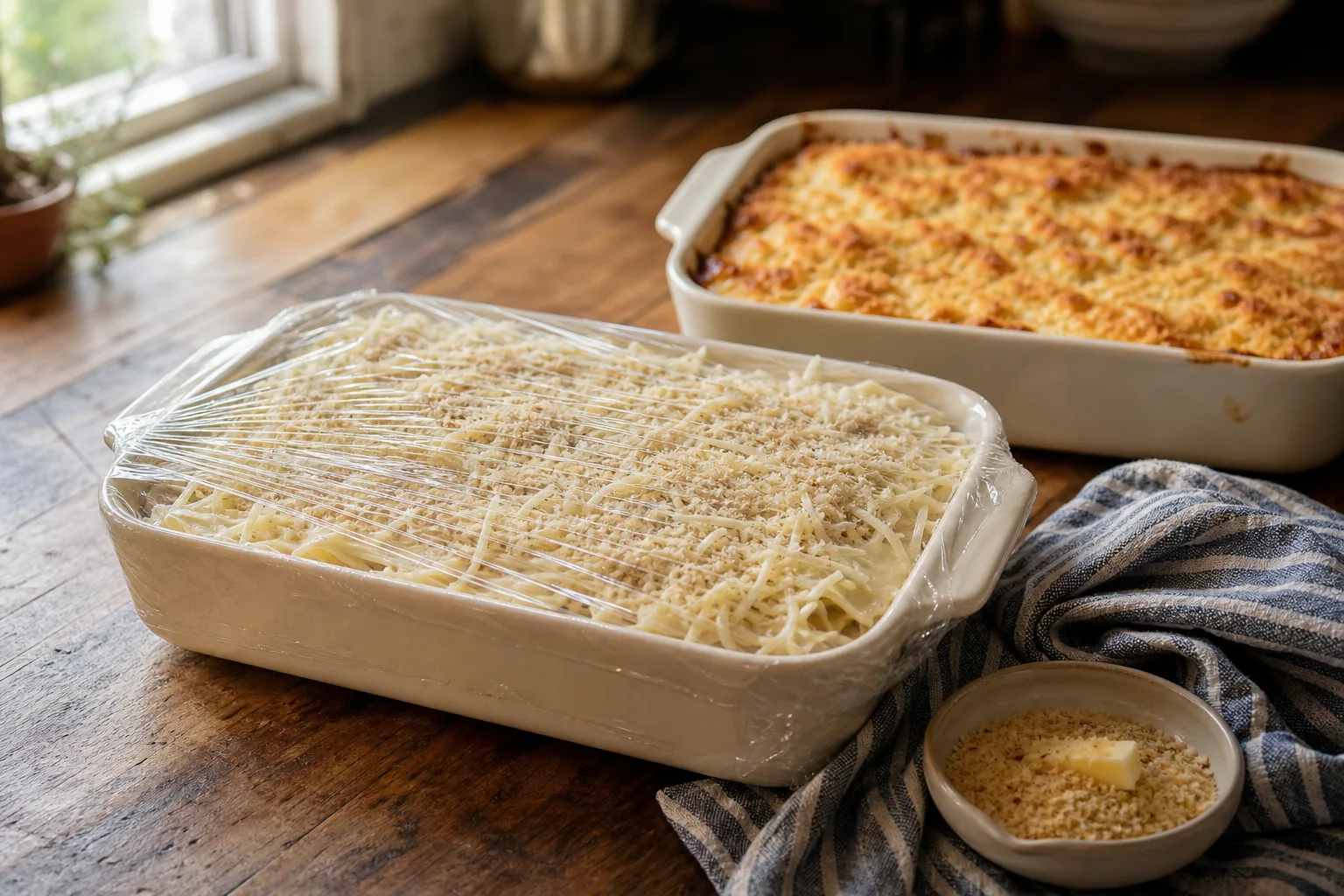

Every casserole recipe on this site has a make-ahead section, because it is the first thing anyone asks and the thing recipes are vaguest about. So I went back through all 56 of them and counted. Fourteen can be built completely the night before, covered, refrigerated, and baked the next day. This is that list, along with the groups that nearly make it and the 32 that genuinely do not.
The list is shorter than it used to be, and the next section explains why. The short version is that I rewrote the recipes so you stop cooking things twice, and that change cost about a dozen of them their overnight head start. I would still make that trade, but you should know it was a trade.
Two things fail overnight and nothing gets around either one. Starch keeps drinking liquid, whether it is cooked pasta, raw rice or dry bread, so a dish that looked right at nine at night can be dry and bloated by six the next evening. And anything crisp sitting on wet filling arrives waterlogged. Every dish below either has no starch problem or has one small enough to fix with a splash of liquid and a few extra minutes.
Why This Works
A cold 9×13 is a heat-transfer problem, not a recipe problem. The oven has to bring four or five pounds of dense, refrigerated food from refrigerator temperature up past 165°F in the middle, and it does that from the outside in. That is where all the extra time goes, and it is why every dish below asks for ten to fifteen minutes more in the oven and half an hour on the counter first. Nothing about the recipe changed. The starting temperature did.
Why This List Got Shorter
This post used to be longer. Since it first went up, I rewrote the casseroles on the site so you no longer boil the pasta in a separate pot, make a roux on the stove, or cook the onions before they go in the dish. Readers kept pointing out that they were cooking everything twice and washing three pans for one casserole, and they were right. The recipes now go together in one dish, mostly with raw aromatics and dry pasta.
That change broke the overnight version of about a dozen recipes, and it is not something I can patch with a note. Dry pasta cannot sit assembled in the refrigerator overnight. It drinks the carefully measured liquid cold and unevenly, and by morning there is not enough left to finish cooking it in the oven. You get a dry top, a gummy bottom and a dish that needs rescuing. Boiling the pasta first would fix it, but that is the step I took out.
This was a deliberate trade. You do less active work on the night you serve the dish, and in exchange you lose the overnight head start on those recipes. For a weeknight dinner I think that is the better deal, but if overnight assembly is what you need, it is not the right deal for you, and I would rather say so than pretend otherwise.
If you wanted the overnight version, here is what still does it. There are 14 casseroles you can assemble completely ahead, below. There are two that are better baked tonight and reheated tomorrow, two that work with a trade-off, three where you prep the components only, and three breakfast bakes built for the refrigerator. Stuffed shells are the one pasta dish that still holds overnight, because the shells are boiled short first, which is exactly what the others no longer do.
The 90-Minute Window Nobody Mentions
A casserole coming out of the refrigerator is not a 45-minute dish any more. Take it out, give it half an hour on the counter to lose the worst of the chill, then bake it ten to fifteen minutes longer than the recipe says. Add those up and you are looking at about 90 minutes from refrigerator to table, not the 45 on the recipe card.
That is the part that ruins dinner, because the person who built the casserole the night before assumes they bought themselves time. They did, but only on the night they built it. Start the counter rest at the point in the evening when you would normally be starting to cook, and the timing works out. Check the middle with a thermometer or a knife before you trust the top, because the top will look done long before the center is.
The One Rule: The Crunchy Part Goes On Last
Wet filling and a crisp topping cannot share a dish overnight. The topping pulls moisture out of the filling and turns to paste, and no oven time brings it back. So whatever is crunchy, whether chips, tots or streusel, stays in its bag on the counter until the dish is going into the oven.
This is why the Dorito chicken and the tater tot hotdish are on the list and the walking taco and Frito pie casseroles are not. The first two keep the crunch separate from the filling. The others build the corn chips into the filling, and they go soft overnight. Biscuits and gravy fails for a related reason, because dough will not sit under wet filling.
Beef, Chicken and Taco Casseroles That Hold Overnight
These seven assemble completely, covered and refrigerated, up to 24 hours ahead, with one adjustment noted below.
- Salisbury Steak Casserole — assemble through the point where the patties sit on the gravy, then cover.
- Taco Casserole — assemble completely, cover, and refrigerate.
- King Ranch Chicken Casserole — assemble completely, cover, and refrigerate.
- Poppy Seed Chicken Casserole — mix the sauce and chicken in the dish, cover, and refrigerate.
- Dorito Chicken Casserole — sauce and raw chicken go in the dish ahead, and the chips wait until baking.
- Chicken Taco Casserole — stir in an extra 1/4 cup of broth first, because the rice keeps drinking sauce all night.
- Tater Tot Hotdish — assemble the filling in the dish up to a day ahead, and the tots go on at baking.
Pasta, Stuffing and Ham Casseroles That Survive It
Only three of the 14 sit in this group, and one of them is the best make-ahead dish in the whole category.
- Stuffed Shells — the best make-ahead dish in the category, because the shells are boiled five minutes short.
- Sausage and Stuffing Casserole — assemble fully and refrigerate; it improves overnight because the bread has all night to hydrate evenly.
- Ham and Broccoli Casserole — stack the broccoli, ham, onion and cheese in the dish and refrigerate, covered.
Potato and Vegetable Sides, Where This Matters Most
The holidays are where overnight assembly earns its keep, because the oven is busy and the counter is full. Four sides hold up completely.
- Funeral Potatoes — assemble through the end of step 5, cover, and refrigerate.
- Sweet Potato Casserole — spread the filling in the dish up to two days ahead, the longest window on this list.
- Yellow Squash Casserole — one of the best make-ahead dishes on the Thanksgiving table, because the water is already out.
- Broccoli Cheese Casserole — assemble the broccoli and cheese in the buttered dish, cover, and refrigerate.
Two That Are Better Baked Tonight and Reheated Tomorrow
Both of these are potato dishes, and for both of them the make-ahead method is to bake the whole thing first. Cool it, cover it, refrigerate it up to a day, and reheat.
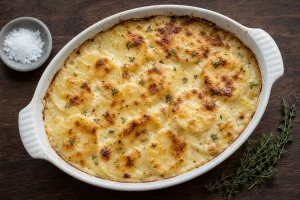
Scalloped potatoes reheat better than almost any casserole, because the starch sets overnight into something sliceable. Au gratin potatoes work on the same principle.
- Scalloped Potatoes — bake fully, cool, cover, refrigerate, and reheat.
- Au Gratin Potatoes — bake completely up to a day ahead, then cool, cover and refrigerate.
Two That Work, But You Give Something Up
These two can be prepped two days ahead, but not as one assembled dish. You keep the components in separate containers and put them together on the night, so you still do a final assembly and the work is not fully done in advance.
- Buffalo Chicken Casserole — roast the cauliflower and make the sauce base ahead, and keep them in separate containers.
- Kielbasa and Cabbage Bake — roast the cabbage and brown the sausage ahead, and refrigerate them separately.
Three Where You Only Prep the Components
In these you do the slow part ahead and finish the dish on the night.
- Guinness Beef and Colcannon Casserole — make the braise a day ahead. It improves overnight, and chilled fat lifts off in one piece.
- Loaded Baked Potato Casserole — bake the potatoes up to two days ahead and refrigerate them whole and uncut.
- Green Bean Casserole From Scratch — prep the pieces up to 24 hours ahead, but keep the dairy mixture separate until baking.
Three Breakfast Bakes Built for the Refrigerator
Breakfast is where overnight is not a workaround but the method. These three are designed around it.
- Overnight Sausage, Egg and Cheese Casserole — designed for assembling tonight and baking tomorrow.
- Overnight French Toast Casserole — not just make-ahead friendly; it requires the overnight.
- Ham and Cheese Breakfast Strata — overnight is the method, and the one dish here with a real minimum rather than a suggestion.
32 You Should Not Assemble the Night Before
That is 32 of the 56. Most of the reasons come down to dry pasta or raw rice drinking liquid cold, or a topping that cannot sit on wet filling. Bake these the day you serve them. Where the reason is not a one-liner, the recipe’s own make-ahead section explains it.
- Hamburger Casserole — raw pasta drinks the liquid cold.
- Beer Cheese Chicken Casserole — raw pasta drinks the liquid cold.
- Baked Ziti — raw pasta drinks the liquid cold.
- No-Boil Baked Mac and Cheese — raw pasta drinks the liquid cold.
- Taco Spaghetti — raw pasta drinks the liquid cold.
- Shrimp Tetrazzini — raw pasta drinks the liquid cold.
- Ham Tetrazzini — raw pasta drinks the liquid cold.
- Mushroom Tetrazzini — raw pasta drinks the liquid cold.
- John Wayne Casserole — dough will not sit under wet filling.
- Biscuits and Gravy Casserole — dough will not sit under wet filling.
- Walking Taco Casserole — corn chips go soft overnight.
- Frito Pie Casserole — corn chips go soft overnight.
- Chicken and Rice Casserole — raw rice swells unevenly.
- Hamburger Helper Cheeseburger Macaroni — pasta cooked in its own sauce turns to a slab.
- Hamburger Helper Beef Stroganoff — pasta cooked in its own sauce turns to a slab.
- Hamburger Helper Lasagna — pasta cooked in its own sauce turns to a slab.
- Crab Imperial Casserole — raw seafood half-cures in a salted sauce.
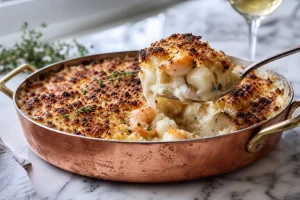
- Seafood au Gratin — raw seafood half-cures in a salted sauce.
- Shrimp and Grits Casserole — raw grits settle into a packed layer.
- Ham and Potato Casserole — raw potato slices darken.
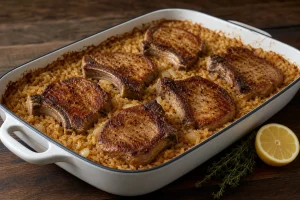
- Pork Chop and Rice Casserole — reheated pork chops go dry.
- Corn Casserole From Scratch — the leavened batter starts spending itself.
- Johnny Marzetti — the recipe explains why.
- Beer Brat and Sauerkraut Casserole — the recipe explains why.
- Hash Brown Breakfast Casserole — the recipe explains why.
- Chicken Tetrazzini — the recipe explains why.
- Million Dollar Spaghetti — the recipe explains why.
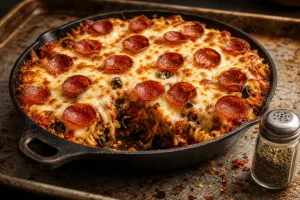
- No-Boil Pizza Casserole — the recipe explains why.
- Tuna Noodle Casserole — the recipe explains why.
- Salmon Casserole — the recipe explains why.
- Taco Tater Tot Casserole — the recipe explains why.
- Turkey Tetrazzini — the recipe explains why.
Questions People Ask
How far ahead can I actually assemble a casserole?
For most of the 14, up to 24 hours, covered and refrigerated. The sweet potato casserole filling stretches to two days, and the component-only dishes run up to two days for the slow parts. Breakfast bakes are built for overnight.
Do I really have to let it sit out before baking?
Yes. Half an hour on the counter takes the worst of the chill off, and you still add ten to fifteen minutes in the oven. The middle has to get past 165°F, and a cold dish gets there much more slowly than the top suggests.
Why is my make-ahead version drier than when I make the same recipe fresh?
Starch keeps drinking liquid overnight, whether it is rice, pasta or bread. Chicken taco casserole is the clearest case, so it calls for an extra 1/4 cup of broth before it goes in the refrigerator. If a dish still looks tight, add a splash of liquid and a few extra minutes.
Can I freeze these instead of refrigerating them?
Nothing in this guide was written for the freezer, so treat freezing as untested. The timings and fixes here are all for the refrigerator. If you try freezing one, expect dairy-heavy sauces to behave differently.
What about make-ahead breakfast casseroles?
There are three, and they are different from the rest because they need the overnight. The sausage, egg and cheese casserole is designed for it, the French toast casserole requires it, and the ham and cheese strata has a real minimum rather than a suggestion.
About This Article

Written by Rachel Thompson. Rachel Thompson is a home cook who has spent over 10 years making an unreasonable number of dips, appetizers, and party spreads — no culinary training, just a decade of trial and error and a reputation among friends for always being asked to "bring a dip." She focuses on approachable recipes that combine bold flavors with simple techniques, making entertaining at home accessible to everyone. More about this site.
Scope and limits. Rachel is a home cook with no culinary training. Follow current food safety guidance for holding temperatures and time limits whenever you are serving people other than yourself.
Verify this against a primary source
Specifics change, and your situation may differ from the one described here. These are the authorities worth checking directly:
- FoodSafety.gov — cold holding, hot holding and the two-hour rule
- USDA FoodData Central — ingredient composition and nutrition data
- USDA Food Safety and Inspection Service — safe minimum temperatures and leftovers