
I made this with an IPA once, because it was what was in the refrigerator. Two hours later the sauce tasted like grapefruit peel steeped in gravy. Nothing had burnt and nothing had broken — it was just bitter in a hard, drying way that no amount of salt or sugar could fix.
That failure is worth more than the recipe. Hop bitterness does not cook off, and almost everyone assumes it does. Stout works here for a specific reason, and the reason tells you which stout to buy and how much of it to use.
The other half is the colcannon. This is not a shepherd’s pie with mash spooned over as a lid — the potato is a real component with its own failure mode, and whether the top browns or steams comes down to how much water you drive out of it beforehand.
Why This Works
Stout is strong-tasting because of roasted malt, not hops. Roasted malt tastes of coffee and cocoa, and those notes deepen as the liquid reduces. Hop bitterness concentrates too — but concentrated bitterness just tastes acrid. That is why this dish is traditional with stout and would be close to inedible with a pale ale.
Ingredients
Fills a 9×13 dish or a 4-quart braiser. Beef and colcannon should be close to equal by volume — a thin smear of potato is not colcannon.
For the Stout Braise
- 3 pounds beef chuck roast, cut into 2-inch cubes
- 2 teaspoons kosher salt, plus more to taste
- 1 teaspoon black pepper
- 3 tablespoons all-purpose flour
- 2 tablespoons neutral oil
- 2 large yellow onions, sliced thin
- 3 medium carrots, 2 cut into coins and 1 grated
- 4 garlic cloves, minced
- 2 tablespoons tomato paste
- 1 can dry Irish stout, 11 to 12 ounces
- 2 cups beef broth, low sodium
- 1 tablespoon Worcestershire sauce
- 1 tablespoon dark brown sugar
- 2 bay leaves
- 4 sprigs fresh thyme
For the Colcannon Top
- 3 pounds russet potatoes, peeled and quartered
- 6 tablespoons butter, plus 1 more for the top
- 1/2 small savoy cabbage, shredded, about 5 cups
- 4 scallions, sliced, whites and greens separate
- 3/4 cup whole milk, warmed
- Kosher salt and black pepper, to taste
How to Make It
Prep: 50 minutes | Bake: 150 minutes | Serves: 8
- Pat the beef dry, toss with the salt and pepper, then dust with the flour until no floury pockets remain. Heat the oil in a heavy pot over medium-high for 3 minutes and sear the beef in three batches, 3 minutes a side, until two or three faces of each cube are deep brown. Do not crowd the pot.
- Lower the heat to medium, add the onions and a pinch of salt, and cook 12 minutes, scraping the browned film off the bottom, until golden at the edges. Add both carrots and the garlic for 3 minutes, then the tomato paste for 1 minute. Pour in the stout and bubble it hard for 4 minutes, until the foam collapses and the liquid looks syrupy rather than fizzy.
- Return the beef with its juices and add the broth, Worcestershire, brown sugar, bay, and thyme. The liquid should come two-thirds up the meat, not cover it. Bring it to a bare simmer, lid on, and move it to a 325°F oven for 2 hours, checking at 90 minutes for fork-tender, not shredded.
- Meanwhile, cover the potatoes with cold salted water, boil 18 to 20 minutes until a knife goes through with no grab, then drain them and return them to the dry pot over low heat. Shake it for 2 minutes until the surfaces go chalky and stop steaming. This step decides whether the top browns.
- Melt 2 tablespoons of the butter in a skillet, add the cabbage and scallion whites with a pinch of salt, and cook 8 minutes over medium, until the cabbage has collapsed to a third of its volume and the pan is dry.
- Mash the potatoes with the remaining butter and the warm milk — by hand or through a ricer, never a food processor, which turns them to glue. Fold in the cabbage and the scallion greens and season hard. The mash should be stiff enough to hold a ridge.
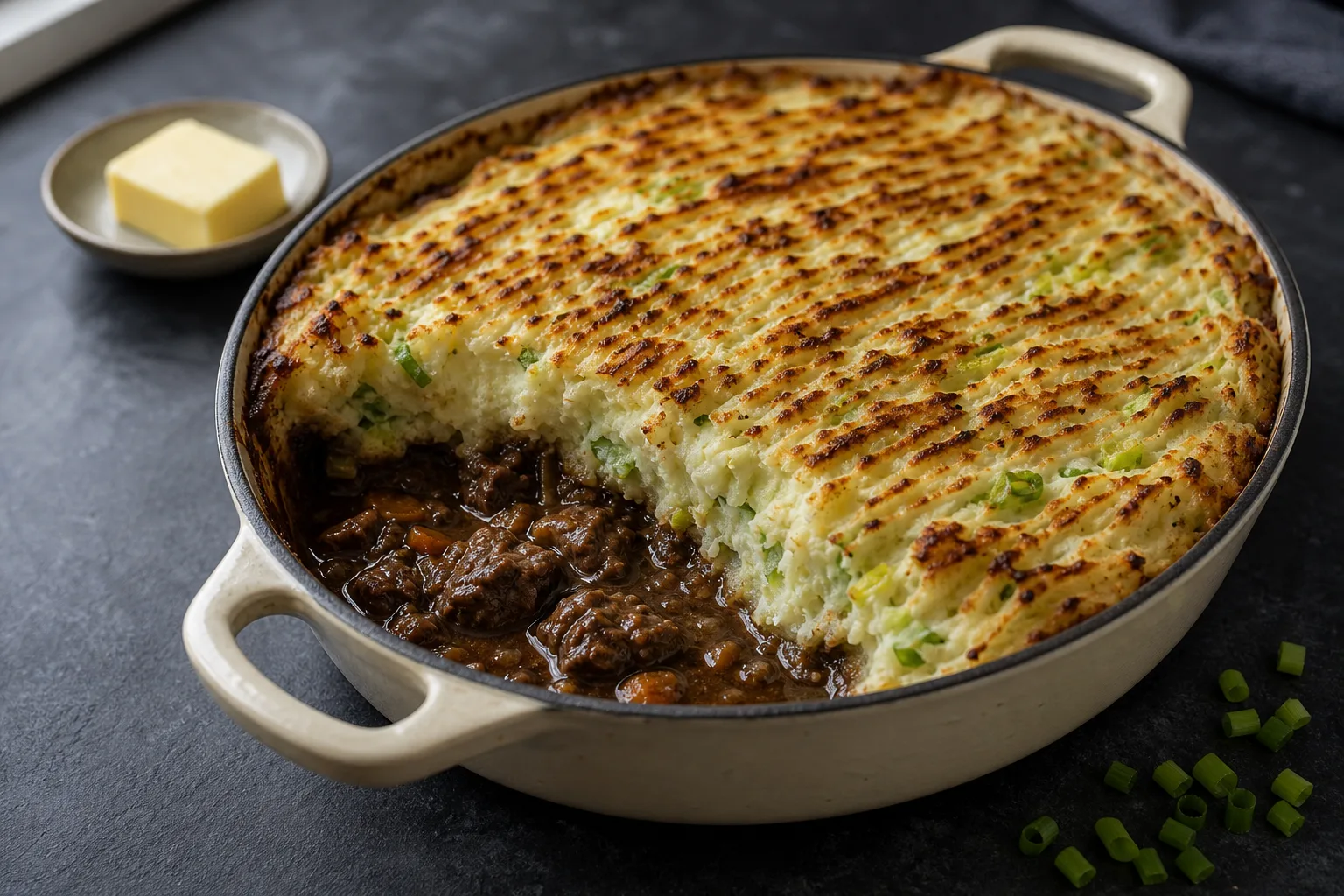
- Lift the beef out, fish out the bay and thyme, and taste the sauce. If it is thin, simmer it uncovered 5 to 10 minutes until it coats a spoon. Combine everything in the baking dish, spread the colcannon over the top, drag a fork the length of the dish in deep ridges, and dot with the last tablespoon of butter.
- Bake uncovered at 400°F for 30 minutes, until the ridges are browned and the sauce bubbles at the edges. If the top is still pale, broil 2 to 3 minutes and watch it the whole time. Rest 10 minutes before serving.
Don’t Do This
Do not braise this in beer alone. A full 22-ounce bottle in place of the beer and broth sounds like a shortcut to more flavor and it is not — you get a sauce that is one-dimensionally roasty with no savory floor under it. One 12-ounce can against 2 cups of broth is about a third beer by volume, and that is where the stout reads as depth rather than as beer.
Can You Make It the Night Before?
Yes — Assemble Up to 24 Hours Ahead
Make the braise a day ahead — it genuinely improves overnight, and chilling it lets you lift the solidified fat straight off, which beats skimming it hot. Do the colcannon on the day. A cold stiff mash tears the beef layer as you spread it and browns noticeably less well.
Cool the braise, cover it, and refrigerate up to three days. Overnight, the gelatin from the chuck sets the sauce into something you could almost slice, and the roast-malt flavor rounds off and stops tasting like beer and beef as separate items. Reheat it loose and warm before the potato goes on — cold braise plus 30 minutes will not heat through.
If you must make the colcannon ahead, hold back a splash of the milk and beat it in warm the next day. What I would not do is assemble more than two or three hours before baking, because the potato wicks liquid up out of the braise and the bottom half inch turns to paste. The braise alone freezes for three months; assembled it does not, since mashed russet thaws grainy.
Why Stout Works and a Hoppy Beer Does Not
Hop bitterness is not volatile. It does not evaporate, it does not mellow with heat, and it does not cook off — it stays in the pot while the water leaves, so a two-hour braise concentrates it. A beer that is pleasantly bitter in the glass can be genuinely acrid reduced by half, and there is no fixing it afterward. Bitterness is not something sugar or cream covers up.
Stout and porter are strong-tasting for a different reason. Their flavor comes from malt roasted dark, the way coffee beans are, which gives coffee, cocoa, and a faint burnt-sugar edge. Those notes behave like the fond on the bottom of your searing pot: they deepen under reduction instead of turning harsh. Dry Irish stout is also lightly hopped, so there is little bitterness there to concentrate in the first place.
So buy a dry Irish stout, the ordinary 4-percent kind in the four-pack, and not an imperial or a barrel-aged one. Those are built to be sipped — high alcohol, a lot of residual sugar, often vanilla and oak — and reduced into a braise they go cloying and openly boozy. Skip milk and sweet stouts for the same reason. Murphy’s and Beamish behave exactly like Guinness here.
The Balance Lever
Stout brings roast and a little bitterness, so the braise needs something sweet to sit against. That is the job of the caramelized onions, the brown sugar, and the grated carrot, which dissolves into the sauce in a way the coins do not. Skip all three and it is not bitter exactly — it tastes flat and slightly ashy, like the bottom of a coffee pot.
Does the Alcohol Cook Off?
Mostly, but not entirely, and I would rather say that plainly than repeat the usual line. A two-hour covered braise drives off most of the alcohol from one can of beer spread over eight servings, and what is left is a trace — but it is not zero. A lid holds vapor in, and a braise never gets hot enough to boil alcohol away completely. If you are cooking for small children, or for anyone avoiding alcohol, the honest answer is that this dish contains some.
The non-alcoholic version is not a sad compromise, because the flavor you want was never coming from the alcohol. Non-alcoholic stout is made from the same roasted malt, so swap it one-for-one and the dish is close to identical. Failing that, use 1 1/2 cups of broth with a teaspoon each of instant espresso powder, unsweetened cocoa, and molasses — an impression of roasted malt rather than the real thing, but far better than leaving the beer out and adding nothing.
Chuck, and What Fork-Tender Actually Looks Like
Chuck is the cut because it is full of connective tissue, and that is the point: two hours of moist heat turns collagen into gelatin, which gives the braise body and makes the meat succulent rather than merely soft. Round or sirloin has very little, so it never gets tender with time — the fibers contract, squeeze out their water, and go stringy. Cut 2-inch cubes and resist going smaller; one-inch pieces hit tender at 70 minutes and then shred for another 50.
Fork-tender is specific and easy to overshoot. A fork pushed into a cube should meet no resistance, and you should be able to twist a corner away with a turn of the wrist, but the cube should still be a cube until you press it. If pieces collapse into threads as you lift them out, you have gone past it. Trim the hard gristle and leave the soft fat and silvery seams alone — that is the gelatin.
Rachel’s Tip
The ridges are not decoration. A flat potato surface traps the steam rising out of the braise and stays damp and pale however long you bake it. Fork ridges give you raised edges that sit above that moisture, dry first, and brown while the valleys stay soft. Drag them the full length of the dish, about half the depth of the potato layer.
Questions People Ask
Can I use a different beer?
Another dry stout or a porter, yes, and a brown ale at a stretch. Anything noticeably hoppy — IPA, pale ale, most American ambers — turns the sauce acrid as it reduces, because hop bitterness concentrates instead of cooking off. If it tastes bitter in the glass, it will taste much worse after two hours.
Why is my colcannon top pale and damp?
Water, from one of three places: potatoes that went straight from the colander into the bowl instead of drying two minutes in the hot pot, cabbage that was not cooked until the pan went dry, or a flat top with no ridges to sit above the steam coming up out of the braise.
Can I use Yukon Golds, or kale instead of cabbage?
Russets are better here because they are floury: they mash loose, shed moisture, and dry into a top that browns. Yukons hold more water and bake denser, and red or new potatoes go gummy. Kale is the other traditional colcannon green and holds up better if the dish sits — shred it fine and give it 10 minutes in the butter instead of 8.
Is this the same as shepherd’s pie?
A cousin. Shepherd’s pie is ground lamb in a thin gravy under plain mashed potato. This is whole cubes of chuck braised in stout under colcannon — mash with cabbage or kale and scallion folded through it. The braise and the greens in the topping make it a separate dish rather than a variation.
About This Article

Written by Rachel Thompson. Rachel Thompson is a home cook who has spent over 10 years making an unreasonable number of dips, appetizers, and party spreads — no culinary training, just a decade of trial and error and a reputation among friends for always being asked to "bring a dip." She focuses on approachable recipes that combine bold flavors with simple techniques, making entertaining at home accessible to everyone. More about this site.
Scope and limits. Rachel is a home cook with no culinary training. Follow current food safety guidance for holding temperatures and time limits whenever you are serving people other than yourself.
Verify this against a primary source
Specifics change, and your situation may differ from the one described here. These are the authorities worth checking directly:
- FoodSafety.gov — cold holding, hot holding and the two-hour rule
- USDA FoodData Central — ingredient composition and nutrition data
- USDA Food Safety and Inspection Service — safe minimum temperatures and leftovers