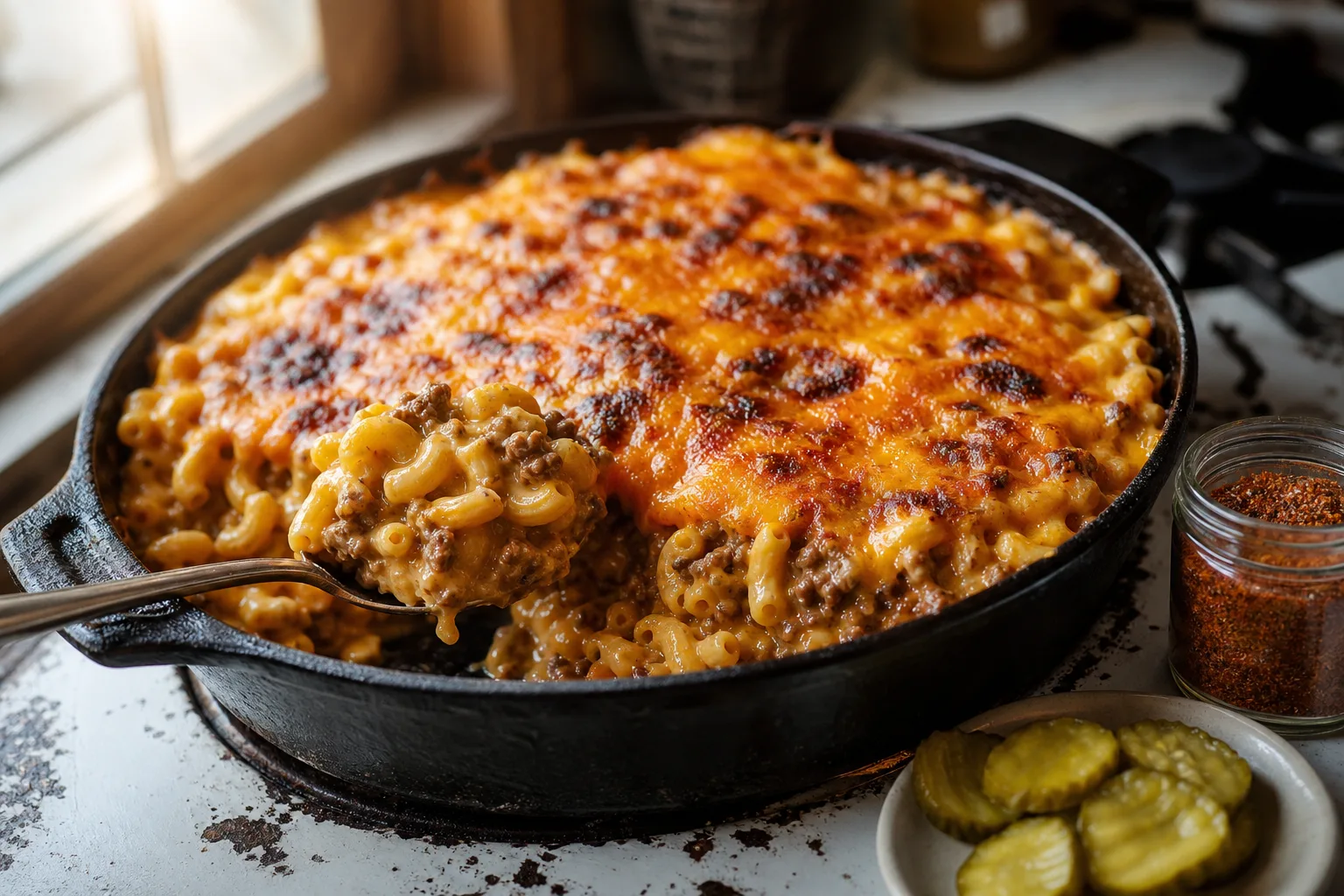

I can still describe the exact taste of Cheeseburger Macaroni from the box, which is a strange thing to be able to do about a powder. Tangy, salty, faintly sweet, sharp at the back from mustard, and thick in a way nothing I made from scratch as a kid ever was. It was Thursday dinner at my house for a decade.
The box was good at its job and I will not pretend otherwise. One pan, fifteen minutes, and a flavor consistent enough to taste from memory twenty years later. What scratch improves is narrow: you control the salt, the cheese is real cheddar, and the sauce tastes like beef rather than beef flavoring. It is not faster.
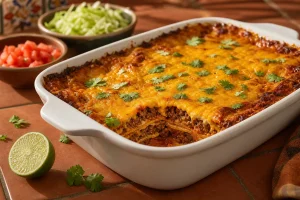
Sort one thing out first, because this site has two dishes that look identical on paper. My Classic Hamburger Casserole is a baked casserole: noodles boiled separately, folded into a tomato and sour cream sauce, baked under cheddar in a 9×13 dish. This never leaves the skillet, the macaroni cooks in the sauce instead of a pot of water, and it finishes under the broiler. That one is the better beef-and-noodle bake. This one is a copy of something specific.
Why This Works
The pasta cooks in the sauce, and that is the whole trick. Dry elbows shed surface starch as they hydrate, and that starch is what gives boxed Hamburger Helper its clinging, glossy body. Boil the pasta separately and you pour it down the sink, which is why a scratch cheese sauce over cooked macaroni tastes like macaroni and cheese and nothing like the box.
Ingredients
The blend makes about four skillets’ worth. The recipe below uses 3 tablespoons and feeds four to five from one 12-inch pan.
For the Seasoning Blend (Makes About 4 Batches)
- 1/4 cup cornstarch
- 2 tablespoons sweet paprika
- 2 tablespoons onion powder
- 2 tablespoons fine sea salt
- 1 tablespoon garlic powder
- 2 teaspoons granulated sugar
- 2 teaspoons mustard powder
- 1 teaspoon black pepper
For the Skillet
- 1 pound ground beef, 85/15
- 3 tablespoons seasoning blend from above
- 1 small yellow onion, finely diced
- 2 tablespoons tomato paste
- 2 teaspoons Worcestershire sauce
- 2 cups water
- 1 1/2 cups whole milk
- 2 cups dry elbow macaroni (8 ounces)
- 6 ounces sharp cheddar, grated from a block
- 4 ounces medium cheddar, grated, for the top
- Sliced dill pickles and chopped scallion, for serving
Easy Swap
If the tomato paste is not quite reaching the sour edge the box has, stir 1 tablespoon of dill pickle brine in with the Worcestershire. It sounds like a stunt and it was the one change that made my version taste right rather than merely good. For a smokier jar, swap 1 teaspoon of the paprika for smoked.
How to Make It
Prep: 15 minutes | Cook: 30 minutes | Serves: 4 to 5
- Make the blend first. Whisk all eight dry ingredients until the color is even, with no pale streaks of cornstarch, and funnel it into a jar. You should have a scant 3/4 cup: four batches of 3 tablespoons.
- Heat a 12-inch skillet over medium-high 2 minutes, add the beef, press it flat, and leave it alone 4 minutes. Break it up and cook 3 minutes more, until there are brown patches rather than uniform gray. Drain in a colander, wipe the pan, and return 1 tablespoon of the fat.
- Cook the onion in that fat over medium heat 4 minutes until soft. Add the tomato paste and stir it against the hot pan 2 full minutes, until it darkens from bright red to brick.
- Return the beef and sprinkle the 3 tablespoons of blend over everything. Stir constantly 45 seconds. The cornstarch grabs the fat and looks pasty and alarming, which is correct. Toasting paprika and mustard powder in fat beats any amount of simmering later.
- Pour in the water and milk, add the Worcestershire, and scrape the bottom hard until nothing is stuck. Bring it to a bare simmer. A hard boil scorches milk solids on the bottom and gives the whole dish a burnt edge.
- Stir in the macaroni, submerge every piece, and hold that bare simmer 12 to 14 minutes, uncovered. Stir every 2 minutes and scrape the bottom. Around minute eight the sauce turns from milky to visibly thickened, which is the starch doing its job.
- Taste at 12 minutes. When the pasta is just past al dente, pull the pan off the heat and wait a minute for the bubbling to stop. Add the 6 ounces of sharp cheddar in three handfuls, stirring each in fully. Cheddar dropped into a simmering sauce breaks into grease and curds.
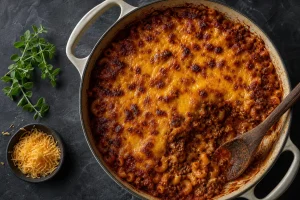
- It will look loose. Three minutes of sitting tightens it to the consistency you remember. Scatter the remaining cheddar on top and broil 4 inches from the element for 3 to 4 minutes, until blistered. Longer than that and the sauce underneath returns to a simmer and breaks.
Don’t Do This
Do not boil the pasta separately and stir it into a finished sauce. It is the tempting shortcut because it feels controllable, and it wrecks the dish: you lose the starch that thickens the sauce, compensate with more cornstarch or cheese, and end up claggy instead of glossy. That version is the baked casserole.
Can You Make It the Night Before?
Not Fully — Here Is What You Can Prep
Not the finished skillet. Pasta cooked in a starchy dairy sauce keeps absorbing it overnight and reheats into a pasty block. What you can front-load is nearly everything else: the seasoning jar keeps six months, and the browned beef and tomato paste base holds three days, making this a twenty-minute weeknight job.
The blend is the real make-ahead, and the reason I bother with this recipe at all. Mix a jar on Sunday and the dish is competitive with the box on Tuesday. Store it airtight at room temperature. Paprika fades first: once the jar smells like dust rather than sweet pepper, the whole blend tastes flat.
For a real head start, do steps two and three ahead. Brown and drain the beef, cook the onion, cook out the tomato paste, then cool and refrigerate up to three days. On the night, scrape the base into a hot skillet and carry on from step four.
Leftovers keep three days. Reheat a portion in a small saucepan with 2 tablespoons of milk per cup of pasta, covered, over low heat about 5 minutes; the milk re-loosens the starch. Do not freeze it. Cooked elbows in a dairy sauce thaw grainy and swollen.
What Was in the Packet, and What Each Part Is Doing
Cornstarch is the structural piece, and the one people leave out when they wing this. The packet is largely starch. A tablespoon per batch gives the sauce body in the first minute after the liquid goes in, before the pasta has released any of its own, and it clings to the beef in a way pasta starch does not.
Paprika does color before flavor: sweet paprika is why boxed cheeseburger macaroni is orange rather than beige, and two tablespoons across the jar carries that without tasting like paprika. Onion and garlic powder are not stand-ins for fresh. Powdered alliums dissolve into the liquid and season every bite identically, which is the flat, consistent background the box has. Fresh onion goes in too.
Sugar works out to half a teaspoon per skillet and will not read as sweet; it rounds the acidity of the tomato paste so the sauce lands tangy rather than sour. Mustard powder is the sharp note at the back of a mouthful. Salt is the honest one: two tablespoons across the jar is a lot, and still less than the packet. Cut it to 1 1/2 tablespoons if you are salt-sensitive.
Whisk Until the Streaks Are Gone
Cornstarch is finer than the spices and settles into pale pockets if you stir the bowl only a few times. Those pockets become lumps: a clump of dry starch hitting hot liquid gels on the outside and stays powdery within. Whisk a full 30 seconds, until the jar is one uniform rust color.
Why the Pasta Cooks in the Sauce, and the Ratio That Makes It Work
Dry pasta is coated in loose surface starch and sheds more as it hydrates. Boil it in a big pot and all of that goes down the drain, which is right for spaghetti and wrong here. Cooking the elbows in the sauce keeps it in the pan, so pasta and sauce thicken each other at once — a glossy coating instead of noodles sitting in liquid.
The ratio is the only thing you must get right: 1 3/4 cups of liquid per cup of dry elbow macaroni. Two cups of elbows wants 3 1/2 cups, which is where 2 cups water plus 1 1/2 cups milk comes from. The split matters too: all milk scorches over 13 minutes of simmering, all water gives a thin sauce no cheese fixes.
That assumes standard elbows, a bare simmer, and a 12-inch pan with the lid off. A wider pan evaporates faster and wants another quarter cup; a lid leaves it soupy. Shells and mini penne drink differently, so check at 11 minutes. Skip whole wheat, which sheds a gritty amount of starch.
If It Goes Gluey or Soupy
Gluey has two causes. Too much heat: a hard boil drives off water faster than the pasta absorbs it, so the sauce over-concentrates while the elbows are still firm. Too much stirring: every pass knocks starch loose, and constant agitation turns the sauce to paste by minute ten. Stir every 2 minutes, not every 20 seconds, at a lazy simmer.
To fix it, add warm water or milk a quarter cup at a time off the heat and stir gently until it loosens. Warm, not cold — cold liquid hitting a hot starch gel makes it seize. A gluey skillet is almost always recoverable. Overcooked pasta is not, so pull it a shade early.
Soupy usually means it needs longer off the heat, not more on it. This sauce thickens sharply as it cools, and the skillet I am happiest with always looks too loose when I kill the burner. Give it the full 3 minutes before you judge. If it is still thin, simmer 2 more minutes uncovered rather than adding cornstarch.
Rachel’s Tip
Use a flat-edged spatula, not a spoon, and scrape the actual bottom of the pan every time you stir. Milk proteins and cornstarch both settle and stick, and a rounded spoon rides straight over the film they form. You will taste it later as a scorched note.
Questions People Ask
How is this different from the baked hamburger casserole on this site?
The groceries overlap almost entirely; the technique does not. That one boils egg noodles separately, folds them into a tomato and sour cream sauce, and bakes it under cheddar in a 9×13 dish. This one never leaves the skillet, the macaroni cooks in the sauce, and it finishes under the broiler. Pick the bake to cut into squares; pick this for the flavor of the box.
How much seasoning blend do I use per pound of beef?
Three tablespoons, a quarter of the jar. Doubling to two pounds of beef means 6 tablespoons of blend, 4 cups of dry elbows, and 7 cups of liquid, in a wide Dutch oven — a 12-inch skillet cannot hold a double batch at a simmer without boiling over.
Why did my cheese sauce turn greasy and stringy?
The cheddar went in while the sauce was still simmering. Cheese is fat and protein held together loosely, and once it gets hot enough the proteins tighten and squeeze the fat out — a slick on top, clumps below. Pull the pan fully off the burner, wait a minute, then add cheese in three handfuls. If it has broken, a tablespoon of cold milk and a fresh handful of cheese off the heat usually saves it.
Can I make this with ground turkey or leaner beef?
Turkey works if you brown it in a tablespoon of oil and skip the draining, since it renders almost nothing. Lean beef is harder: 93/7 browns into dry pellets, and the returned tablespoon of fat is what the cornstarch and paprika bloom in. With very lean beef, add a tablespoon of butter at step three.
About This Article

Written by Rachel Thompson. Rachel Thompson is a home cook who has spent over 10 years making an unreasonable number of dips, appetizers, and party spreads — no culinary training, just a decade of trial and error and a reputation among friends for always being asked to "bring a dip." She focuses on approachable recipes that combine bold flavors with simple techniques, making entertaining at home accessible to everyone. More about this site.
Scope and limits. Rachel is a home cook with no culinary training. Follow current food safety guidance for holding temperatures and time limits whenever you are serving people other than yourself.
Verify this against a primary source
Specifics change, and your situation may differ from the one described here. These are the authorities worth checking directly:
- FoodSafety.gov — cold holding, hot holding and the two-hour rule
- USDA FoodData Central — ingredient composition and nutrition data
- USDA Food Safety and Inspection Service — safe minimum temperatures and leftovers