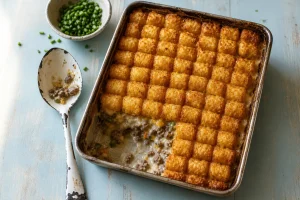
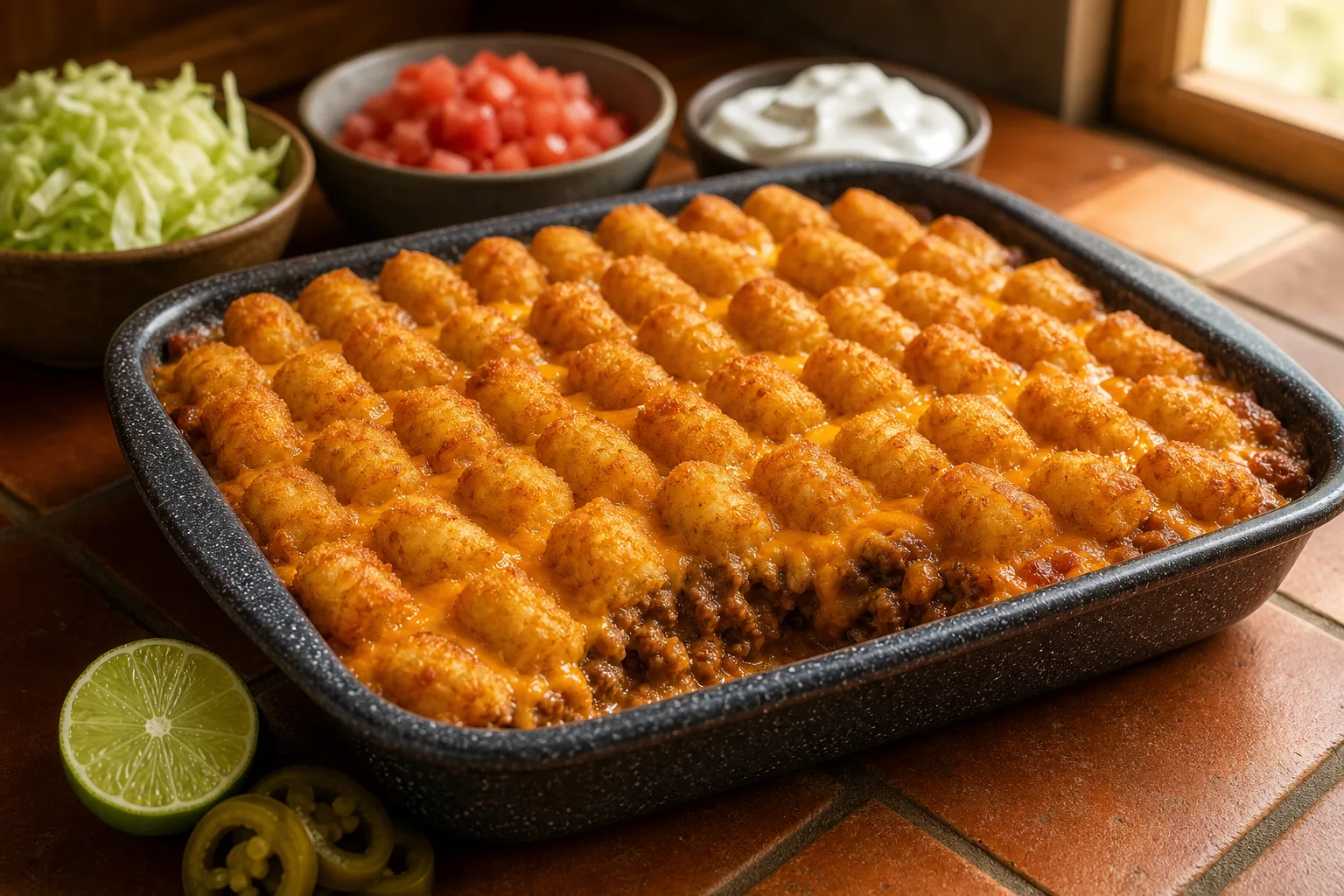

I have made the Tex-Mex version of this dish more times than the Minnesota one, and for a long time it came out worse. Same tots, same pan, same oven, and the top still went soft in a way the hotdish never did. I blamed the tot brand, then the rack position, then the oven, before working out that the problem was never the top of the casserole at all. It was what I had put underneath it.
A hotdish binder is condensed soup or a flour-thickened cream sauce: thick, stable, already holding its water in a starch mesh. Taco-seasoned beef is none of that. It carries salsa, canned tomato, chiles, and whatever fat you did not drain, and that loose water has one direction to go in a hot oven — straight up, as steam, into two pounds of starchy potato. So the recipe comes down to two things done before the dish sees heat: cook the filling down further than feels necessary, and lay a sheet of cheese between the filling and the tots.
Why This Works
Taco filling has far more free water to give off than a cream-of-mushroom binder does, and steam is what ruins a tot. Two moves handle it: reduce the filling until no liquid seeps back into a channel you drag through it, and spread a cup and a half of grated cheese between the filling and the tots. Melted cheese is roughly a third fat, and fat does not pass water vapor the way bare beef does.
Ingredients
A 9×13 pan, eight generous portions. The cold toppings are listed separately because none of them go in the oven.
For the Filling
- 2 pounds ground beef, 80/20
- 1 large yellow onion, diced small
- 1 poblano or green bell pepper, diced small
- 4 cloves garlic, minced
- 2 tablespoons chili powder
- 1 tablespoon ground cumin
- 2 teaspoons smoked paprika
- 1 teaspoon dried oregano
- 1/2 teaspoon cayenne, or less
- 2 tablespoons tomato paste
- 1 (4-ounce) can diced green chiles, drained
- 1 (14.5-ounce) can diced tomatoes, drained well
- 1 (15-ounce) can black beans, drained and rinsed
- 1/2 cup thick salsa, not a thin restaurant-style one
- 2 teaspoons kosher salt
- 1 teaspoon black pepper
For the Barrier and the Top
- 12 ounces sharp cheddar, grated from a block (about 3 cups)
- 4 ounces Monterey Jack, grated (about 1 cup)
- 2 pounds frozen tater tots, left in the freezer until the moment they go on
For the Table, Added Cold
- Shredded iceberg or romaine
- Diced tomato, sliced radish, pickled jalapenos
- Sour cream and lime wedges
- Chopped cilantro and sliced green onion
Easy Swap
Ground turkey works but brings almost no fat, so start with 2 tablespoons of oil and skip the draining. Pinto beans replace black beans one for one. What I would avoid is frozen shredded hash browns in place of the tots: shreds mat into one damp sheet over a wet filling, which is the exact texture this method exists to prevent.
How to Make It
Prep: 30 minutes | Bake: 40 minutes | Serves: 8 to 10
- Heat the oven to 425°F with a rack in the upper third. Butter a 9×13 pan and leave the tots in the freezer until the pan is ready to go in.
- Set a wide heavy skillet over medium-high for 3 minutes. Add half the beef, press it flat, leave it alone for 4 minutes, then break it up and cook 3 minutes more. Tip it into a colander and repeat with the second pound. You want about a third of a cup of fat out of the meat and not in the casserole.
- Return 1 tablespoon of the drained fat to the skillet. Cook the onion and poblano over medium heat for 7 minutes, until the onion is translucent and the pan looks dry. Add the garlic for 1 minute, then the spices, salt, and pepper, stirring constantly for 40 seconds until the smell turns toasted — past a minute the chili powder goes bitter.
- Add the tomato paste and cook it 1 minute, then the green chiles, drained tomatoes, beans, salsa, and the drained beef. Bring it to a lively simmer.
- Reduce it uncovered for 8 to 10 minutes, stirring every couple of minutes. Drag a spoon through the middle to the pan floor. When the channel holds open for three full seconds with no liquid running back in, the filling is dry enough — glossy and slightly sticky rather than saucy. Taste and oversalt it very slightly, because two pounds of unseasoned potato is about to land on top.
- Scrape the filling into the pan while it is still hot and press it level. Scatter 1 1/2 cups of the cheddar evenly over the whole surface, corner to corner, no bare patches — grate it from a block, because pre-shredded cheese is dusted with starch and melts patchy instead of flowing into one sheet. Let it sit 3 minutes so the residual heat starts it melting.
- Set the tots on top straight from the freezer, flat side down, in tight rows, touching but never overlapping. A 9×13 takes 60 to 70. Extras go back in the freezer, not onto a second layer.
- Bake uncovered 30 minutes. Scatter the remaining cheddar and all the Jack over the tots and bake 8 to 10 minutes more, until the tots are deep golden and the cheese between them has browned at the edges.
- Rest 10 minutes, then put every cold topping on the table in its own bowl and let people build their own squares. Nothing cold goes on the pan in the kitchen.
Don’t Do This
Do not add the water a taco seasoning packet calls for, and do not stir in an extra cup of salsa at the end for flavor. Every tablespoon of liquid added after the reduction has to leave through the tots. And nothing cold goes near the oven: lettuce wilts to something slick and khaki, sour cream splits into grainy curds, and fresh tomato releases water onto the crust you spent forty minutes building.
Can You Make It the Night Before?
Not Fully — Here Is What You Can Prep
The beef filling is an excellent make-ahead; the assembled dish is a bad one. Cook the filling up to three days in advance and refrigerate it. On the day, spread it in the pan, add the cheese and the frozen tots, and bake about 12 minutes longer. Assembling the whole casserole the night before is the one version I would tell you not to try.
The reason is the same reason the recipe works. Even a reduced taco filling is wet compared to a cream sauce, and tots sitting on it overnight pull that moisture in through their thin fried shell. The cheese barrier buys you a lot in a hot oven, where water leaves as steam and the fat blocks its path. It buys you almost nothing over twelve hours in a cold refrigerator, where the water simply migrates. Tots assembled the night before bake up pale and dense, and no extra time brings them back.
The filling alone is better on day two, once the chili powder and cumin have lost their raw edge, and it freezes for two months. If you need the whole thing ready in advance, par-bake the tots separately instead of assembling: cold filling in the covered pan, tots on a sheet pan, combined for the last fifteen minutes. That is the version I take to other people’s houses.
How Dry Is Dry Enough
Reduce the filling is the kind of instruction that sounds obvious and gives you nothing to aim at, so here is the test I use. Push the spoon down to the floor of the skillet and drag a straight line through the middle. Watch the channel, not the filling. If liquid runs back in and closes the gap, keep going. If it holds for three full seconds and the edges look glossy rather than wet, stop.
Eight to ten minutes of hard simmering is usually what it takes, and it will feel like overcooking. You are aiming at the thickness condensed soup has straight from the can — which a hotdish gets for free and this one has to earn. If you would rather layer tortillas than tots, that is the tortilla-layered taco casserole, a different dish with a different failure mode.
The Cheese Layer Is Structural, Not Decorative
Most recipes that put cheese under the tots treat it as a flavor decision. It is a good one, but that is not its main job. Melted cheddar is around a third fat by weight, and when a cup and a half of it flows together over a flat surface it becomes a continuous greasy film. Water vapor off hot beef does not cross that film anywhere near as freely as it crosses bare filling — it gets deflected sideways toward the edges of the pan, where it escapes without touching anything you wanted crisp. That is why coverage matters more than quantity: a thick pile in the middle with bare filling at the corners gives you four soggy corners. The cheese also glues the base of each tot down, so the top bakes into a lid rather than loose gravel, and a cut square comes up as a square.
425 Degrees, and Whether to Par-Bake the Tots
This bakes hotter than a hotdish, and the reason is what is in the pan. A cream-based binder at 425°F breaks — the sauce separates and the edges scorch where milk solids catch — which is why cream hotdishes sit at 350 to 400°F and accept a slower bake. A tomato-and-beef filling has no dairy to split, and it goes in already hot and already reduced, so the bake is barely cooking the filling. It exists to drive water out of two pounds of frozen potato and brown it, and that wants high dry heat with a rack near the top of the oven.
There is also an option that crisps better than this one, and I want to be straight about it. Spread the tots on a sheet pan in a single layer, bake them at 425°F for about 20 minutes until they are set and coloring, and add them for only the last 12 to 15 minutes. Nothing beats it for crunch. What it costs is the baked-together texture: the tots never fuse into a cheesy lid, and their undersides pick up none of the spiced filling. I use the sheet pan when the dish has to travel. For dinner at home I bake it together every time, because the cheese barrier gets most of the way there and the lid is worth the last ten percent of crunch.
Questions People Ask
How is this different from tater tot hotdish?
The binder, which changes everything downstream. Hotdish is Upper Midwest comfort food bound with cream of mushroom soup or a scratch cream sauce, seasoned with thyme and Worcestershire, baked around 400°F. This one is Tex-Mex: chili powder and cumin, tomato and chiles, cheese in the middle and on top, 425°F, and cold taco toppings at the table. A hotdish filling is thick to begin with, so the fight over reducing and sealing it never comes up there.
Why did my tots turn out soft on top?
Start with the filling. If it was still saucy when the tots went on, the top steamed from below for forty minutes and nothing else matters. After that: a patchy cheese layer, tots that thawed on the counter while you cooked, a second layer of tots to finish the bag, or foil over the pan. Oven temperature is the last thing to suspect.
Can I use taco seasoning packets instead of the spices?
Yes, two packets for two pounds of beef. Add them dry to the fat with the onion and pepper so they get the same 40 seconds of toasting, cut the added salt to 1/2 teaspoon because packets are heavily salted, and ignore the water step.
Can I freeze the assembled casserole?
Freeze the filling, not the finished dish. Tots frozen in contact with a wet filling, thawed, then baked come out uniformly soft, because the freeze-thaw wrecks the crisp fried shell. Freeze the filling flat in a bag and buy tots on the day.
About This Article

Written by Rachel Thompson. Rachel Thompson is a home cook who has spent over 10 years making an unreasonable number of dips, appetizers, and party spreads — no culinary training, just a decade of trial and error and a reputation among friends for always being asked to "bring a dip." She focuses on approachable recipes that combine bold flavors with simple techniques, making entertaining at home accessible to everyone. More about this site.
Scope and limits. Rachel is a home cook with no culinary training. Follow current food safety guidance for holding temperatures and time limits whenever you are serving people other than yourself.
Verify this against a primary source
Specifics change, and your situation may differ from the one described here. These are the authorities worth checking directly:
- FoodSafety.gov — cold holding, hot holding and the two-hour rule
- USDA FoodData Central — ingredient composition and nutrition data
- USDA Food Safety and Inspection Service — safe minimum temperatures and leftovers