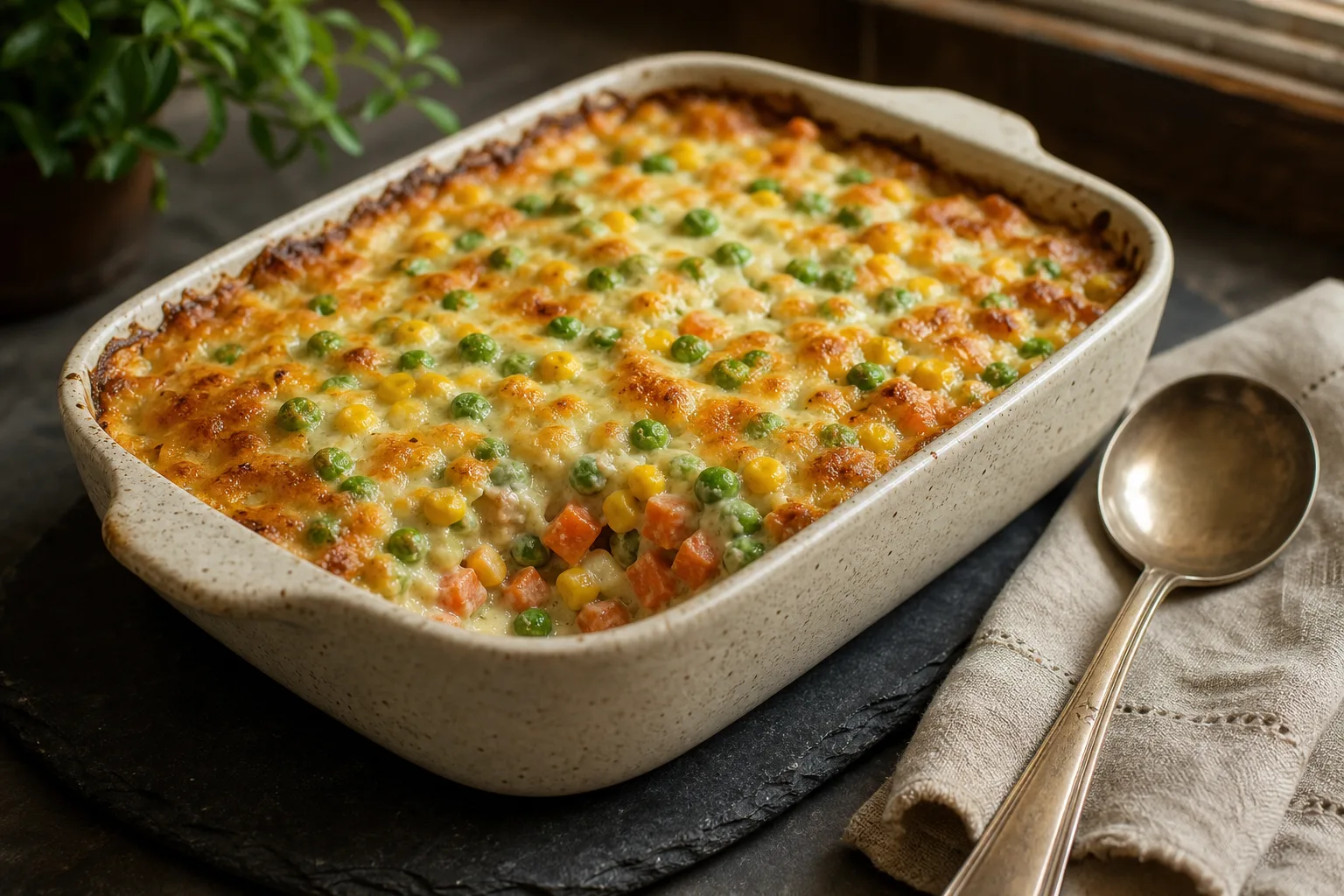

For years I treated a bag of frozen mixed vegetables as a single ingredient. Rip it open, pour it in, bake for an hour and ten minutes. And for years it came out the same: peas wrinkled and pasty, green beans the color of a wet olive, and a few carrot cubes still firm in the middle. I blamed the sauce, my oven, the brand. It took me far too long to see that the bag was fine. The mistake was expecting four different vegetables to want the same amount of heat.
This is a frozen-everything gratin: a 2-pound bag of diced hash browns, a 1-pound bag of mixed vegetables, a cold milk-and-cream slurry, and plenty of cheese. No peeling, no slicing, no saucepan. The one extra job is sorting the bag into four small piles, which takes about two minutes because carrots, corn, peas and green beans are easy to tell apart even frozen. Then each vegetable goes into the dish when it needs to, and everything comes out cooked and still tasting like itself.
If you want neat, fanned layers of thin-sliced potato, the fresh-potato gratins on this site are prettier, and I stand by them. They also mean twenty minutes of knife work. This one is for the Tuesday when you have fifteen minutes and a freezer.
Why This Works
Frozen vegetables are blanched before they are bagged, so they arrive already cooked. The oven is not cooking them, it is reheating them, and then it keeps going past the point where each one was at its best. That point is different for every vegetable in the mix. Carrot dice is the only piece that can sit in a 375°F dish for the whole bake and come out right. Green beans want about a third of that, corn about a fifth, and peas less than a tenth. So they go in on a schedule, slowest to quickest.
Ingredients
Makes one 9×13-inch gratin. Use a dish at least 2 inches deep. Do not thaw anything: the potatoes go in straight from the freezer, and the vegetables stay frozen until their turn.
For the Gratin
- 1 tablespoon unsalted butter, for the dish
- 1 (32-ounce) bag frozen Southern-style diced hash brown potatoes (2 pounds), straight from the freezer
- 1 (16-ounce) bag frozen mixed vegetables (carrots, corn, peas and cut green beans)
- 1/4 cup all-purpose flour
- 1 1/2 cups whole milk, cold
- 3/4 cup heavy cream, cold
- 3/4 teaspoon kosher salt
- 1/2 teaspoon freshly ground black pepper
- 1/2 teaspoon garlic powder
- 1/2 teaspoon onion powder
- 1/2 teaspoon dry mustard
- Pinch of ground nutmeg
For the Topping
- 8 ounces sharp cheddar, freshly grated (about 2 cups)
- 4 ounces Gruyère, freshly grated (about 1 cup)
- 1/2 cup panko breadcrumbs
- 1 tablespoon unsalted butter, melted
- Flaky salt, for finishing
Easy Swap: The Two-Pile Shortcut
If sorting four piles feels like too much, sort one. Pull out the carrots and bake them in from the start, then add the green beans, corn and peas together at the foil change, pressed under the surface. The peas and corn will be softer and sweeter than ideal, but it is still far better than putting the whole bag in at the start.
How to Make It
Prep: 15 minutes | Bake: 75 minutes | Rest or cool: 15 minutes | Serves: 8 to 10
- Heat the oven to 375°F with a rack in the center. Butter a 9×13-inch baking dish and set it on a rimmed baking sheet to catch drips. Tip the bag of mixed vegetables onto a plate and sort it into four piles: carrots, green beans, corn and peas. Leave the carrots out. Put the green beans, corn and peas into three small covered bowls and return them to the freezer until you need them.
- In a large bowl or pitcher, whisk the flour into the cold milk a splash at a time until completely smooth. Whisk in the cream, salt, pepper, garlic powder, onion powder, dry mustard and nutmeg. A lump of dry flour will bake into a gummy pocket, so keep whisking until there are none.
- Pour the frozen potatoes straight from the bag into the dish and scatter the carrots over them. Stir once so the carrots are spread through the potatoes. Whisk the slurry again, since the flour settles, and pour it evenly over the top. It will look like too little liquid. That is the right amount.
- Cover the dish tightly with foil, crimping it over the edges. Bake for 50 minutes without peeking. Every time the oven door opens the temperature drops, and this stage depends on steady heat.
- Pull back the foil away from you, because the steam is hot. The sauce should be bubbling at the edges and visibly thickened. Scatter the frozen green beans over the top and press them just under the surface of the sauce with the back of a spoon. Bake uncovered for 10 minutes.
- Toss the cheddar, Gruyère, panko and melted butter together. Scatter the frozen corn over the gratin, then spread the cheese mixture evenly over the top. Bake for 8 minutes, until the cheese has melted and started to color.
- Scatter the frozen peas over the cheese and press them in lightly. Bake 7 minutes more, until the edges bubble hard and the cheese is browned in spots. For deeper color, broil for 1 to 2 minutes, watching closely.
- Rest the gratin on the counter for 15 minutes so the sauce sets and the portions hold together when you cut them. Finish with a pinch of flaky salt. A carrot cube pierced with a paring knife should give easily without falling apart.
Don’t Dump the Whole Bag In at the Start
It is the easiest move, and it is why mixed-vegetable casseroles disappoint. By the time the carrots are tender, the green beans are limp and olive-colored and the peas are pasty. And do not put the cheese on before the foil comes off. Under the foil it steams and turns rubbery instead of browning.
Can You Make It the Night Before?
Yes — Assemble Up to 24 Hours Ahead
Assemble up to 24 hours ahead. Put the potatoes, carrots and slurry in the dish, holding back about a quarter cup of the milk, then cover and refrigerate. Keep the green beans, corn and peas frozen in their own bowls. Add 10 to 15 minutes to the covered bake.
The staggered method makes this unusually easy to prep, because three of the four vegetables are still in the freezer until you are ready for them. Do not add them to the dish early. A green bean that sits overnight in the dairy has started cooking a day before the oven is on, which defeats the whole idea. Frozen diced potatoes are already blanched, so unlike raw potato slices they will not darken overnight.
Set the dish on the counter for 30 to 45 minutes before baking, since glass and ceramic can crack going from the fridge into a hot oven. Stir gently to redistribute the flour that has settled, then bake from the covered step, adding 10 to 15 minutes. The honest math is about 30 to 45 minutes on the counter plus roughly 90 minutes in the oven, so making it ahead saves your attention on the day, not the clock. The overnight version comes out a little looser and a little slower than the same-day one.
Leftovers keep four days in the fridge. Reheat covered at 325°F for 20 to 25 minutes, or microwave individual portions. I do not freeze the baked gratin: potatoes in a cream sauce turn grainy, and the peas do not survive.
What Each Vegetable Does on a 75-Minute Clock
Think of the bake as a timeline and ask where each vegetable stops being good. Here is what happens to each one.
Carrots (in at the start, about 75 minutes). The small frozen carrot cubes are the densest thing in the bag, and the only piece that actually needs the whole bake. Put them in with the potatoes and they go in firm, finish tender, and still hold their shape. Added late, they come out with a cold, raw crunch in the center that people push to the edge of the plate.
Green beans (pressed in at the foil change, about 25 minutes). This is the one that hurts most. A green bean that spends the full bake under foil in hot dairy goes from green to dull olive and turns limp and stringy. At 25 minutes it is cooked through, still looks like a green bean, and has a little snap left. Press them just under the sauce so they cook instead of drying out on top.
Corn (with the cheese, about 15 minutes). Corn is more forgiving than people think, but not endlessly. After a long bake the kernels go soft and a little leathery and lose the pop that makes corn taste like corn. Fifteen minutes under the cheese heats it through and keeps it sweet.
Peas (the last 7 minutes, scattered on top). Peas are the most delicate thing in the bag. They need barely any time, and every extra minute makes them wrinkle and go mealy. Scattered over the melted cheese for the final seven minutes, they come out bright, round and sweet. It is the step people want to skip, and it is the one that makes the dish look like someone cared.
Sorting the Bag Without Losing Your Mind
Do this while the oven preheats. Spread the bag on a plate or sheet pan and pick through it. Carrots are orange cubes, corn is yellow, peas are small round green balls, and green beans are the longer green pieces. Pull the beans, corn and peas into three small bowls, cover them, and put them back in the freezer so they stay frozen and out of the warm kitchen.
Bags are never perfectly even. Mine usually leans heavy on carrots and corn and light on green beans. Do not try to rebalance it, just use what is there. If your bag has lima beans, which some Southern-style blends do, treat them like carrots, since they are dense and want the full bake. And if the whole thing still feels like too much fuss, the Easy Swap box has a shortcut.
Rachel’s Tip: Label Your Timers
Set three timers on your phone and name them BEANS, CORN and PEAS. I line the bowls up next to the oven in the order they go in. The first time I made this without doing that, I stood in the kitchen wondering whether the peas were already in the dish.
Questions People Ask
Can I skip the sorting and stir the whole bag in?
You can, and it will still be an edible gratin, but expect soft peas and olive-colored green beans. If you do any sorting at all, pull out the carrots, put them in at the start, and add everything else at the foil change. That one move fixes most of the damage.
Why do the carrots go in first and not the green beans?
Frozen carrot dice is the densest piece in the bag and the only one that needs the entire bake to turn tender. Green beans are far more fragile. The same long bake that finally softens a carrot cube leaves a green bean limp and olive-drab.
Can I use a different frozen vegetable blend?
Yes, with the same logic: dense pieces go in at the start, delicate ones go in later. Cauliflower is sturdy and can go in with the potatoes. Broccoli behaves like green beans, so press it in at the foil change. Keep the total at about a pound.
How do I know the carrots are done?
Pierce a carrot cube with a paring knife at the end. It should slide in with a little resistance, like a carrot at dinner: not crunchy and not collapsing. If the carrots are still hard but everything else is finished, tent the dish loosely with foil and give it 5 more minutes.
About This Article

Written by Rachel Thompson. Rachel Thompson is a home cook who has spent over 10 years making an unreasonable number of dips, appetizers, and party spreads — no culinary training, just a decade of trial and error and a reputation among friends for always being asked to "bring a dip." She focuses on approachable recipes that combine bold flavors with simple techniques, making entertaining at home accessible to everyone. More about this site.
Scope and limits. Rachel is a home cook with no culinary training. Follow current food safety guidance for holding temperatures and time limits whenever you are serving people other than yourself.
Verify this against a primary source
Specifics change, and your situation may differ from the one described here. These are the authorities worth checking directly:
- FoodSafety.gov — cold holding, hot holding and the two-hour rule
- USDA FoodData Central — ingredient composition and nutrition data
- USDA Food Safety and Inspection Service — safe minimum temperatures and leftovers