
Almost every casserole worth eating has something crunchy on it, and almost every soggy casserole got that way because the crunchy part was chosen badly or added at the wrong moment. Those are two separate mistakes and they have two separate fixes.
I have put every one of these on something at some point, usually more than once, and a few times in the same week trying to work out why one batch came out golden and the next came out beige and damp. What follows is what I actually reach for now, and the reasoning behind each one.
The short version: match the topping to how wet the dish underneath it is, and add anything delicate in the last ten minutes rather than at the start.
Why This Works
A crunchy topping fails for exactly one reason — it absorbs water faster than the oven can drive that water off. Everything below follows from that. A dense, low-surface-area topping like a tater tot resists moisture for an hour. An open, airy one like a corn flake gives in within twenty minutes. Neither is better; they just belong on different dishes.
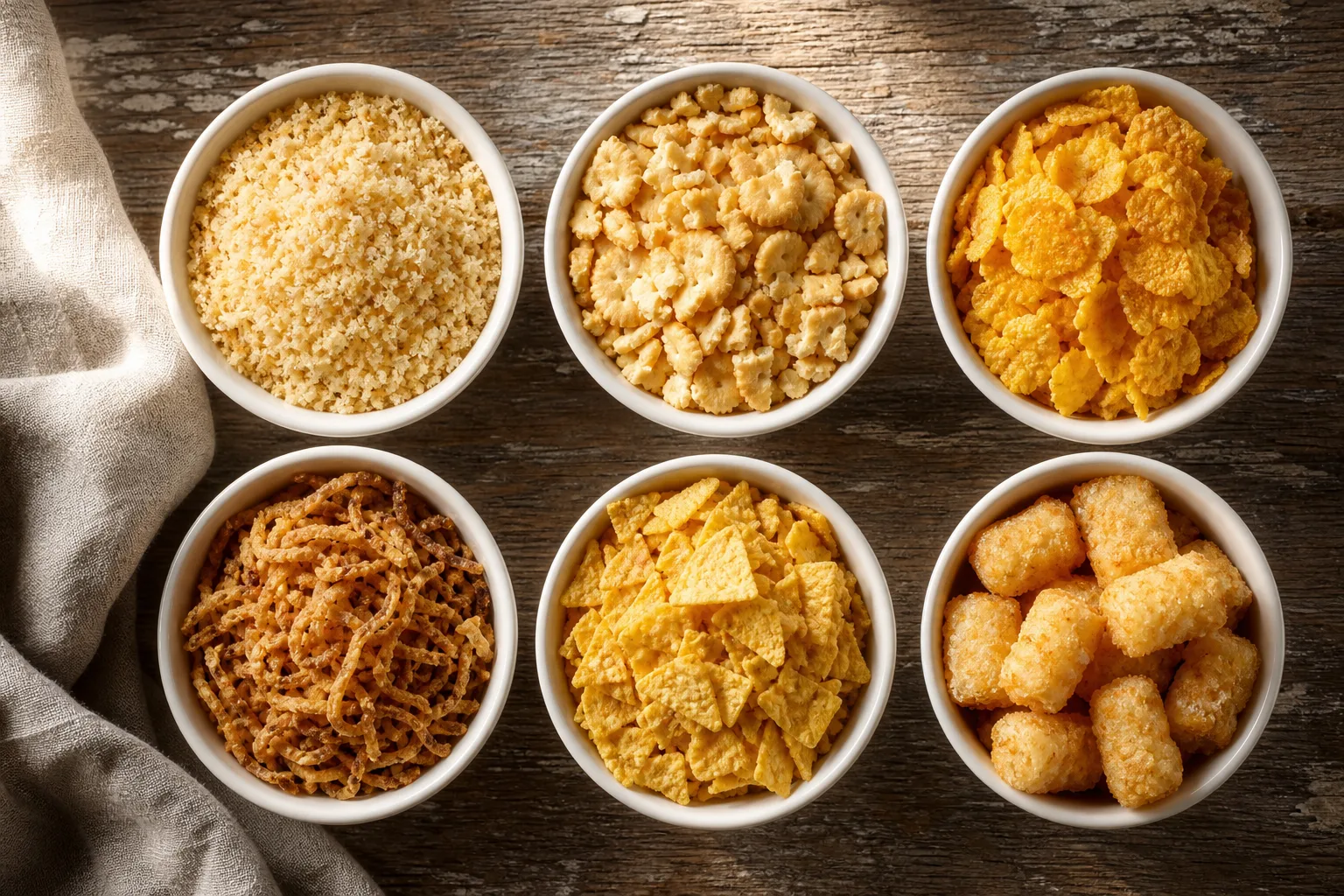
Panko: The Default, and Why It Earns That
Panko is made from crustless bread dried without much compression, so the flakes are large, jagged and full of air. That structure is what makes it stay crisp — there is very little dense starch to go gummy, and the jagged edges give you a lot of browned surface for very little weight.
It is also the most forgiving. Panko tolerates being added at the beginning of a 30-minute bake in a way that corn flakes and crackers do not, which is why it turns up on so many of the dishes here. Toss it with melted butter first. Dry panko on a wet dish will drink the sauce from below and toast on top, and you get a layer that is simultaneously burnt and soggy.
It is the right call on anything with a béchamel or cheese sauce, where the surface is thick enough that moisture travels upward slowly.
- Baked Mac and Cheese — buttered panko over a thick cheese sauce, the textbook case
- Au Gratin Potatoes — panko is half of what the word gratin actually means
- Broccoli Cheese Casserole — holds up over a sauce that is wetter than it looks
- Chicken Tetrazzini — where the pasta underneath is still releasing steam
Easy Swap
No panko? Tear day-old bread into rough pieces and dry them in a low oven for fifteen minutes. Do not substitute fine dry breadcrumbs — they are too dense and too absorbent, and they set into a sandy paste rather than a crust.
Corn Flakes and Crushed Crackers: Flavor First, Structure Second
These are the Southern and Midwestern church-supper toppings, and they are chosen for taste, not endurance. Corn flakes bring a toasted-corn sweetness; buttery round crackers bring salt and fat. Both are also far more fragile than panko, because both are built from thin, porous sheets with enormous surface area.
The practical consequence is simple and most recipes skip it: they go on in the last ten to twelve minutes, not at the start. A corn flake topping added at minute zero of a 45-minute bake is not crunchy at minute 45. It is a soft orange blanket.
Crush crackers coarsely and unevenly. Powdered crackers mixed with butter make a paste that bakes into a single sheet, which then shatters into shards instead of crumbling. You want pieces in a range of sizes so the layer has air in it.
- Funeral Potatoes — the canonical corn flake top
- Poppy Seed Chicken — buttery crackers over a sour cream sauce
- Squash Casserole — crackers over the wettest vegetable in this guide
- Crab Imperial — crackers that have to survive a short, hot bake
Fried Onions and Chips: Already Cooked, Already Browned
Fried onions, potato chips and corn chips share a property that changes how you handle them: they have already been fried. They arrive at full color with their moisture already driven out, which means the oven cannot improve them. It can only take them further, and further is burnt.
The window is short and it is narrow. Eight to ten minutes, uncovered, and watch rather than trust the timer. Corn chips in particular go from toasted to acrid faster than anything else here, because the oil they were fried in is already partway to its limit.
There is a second trick with these. Because they are pre-fried, they work just as well scattered on after the dish leaves the oven, where the residual heat warms them without cooking them. On a dish you plan to reheat as leftovers, that is the better choice outright — the first batch is never crisp on day two anyway.
- Green Bean Casserole — the fried onion standard, added for the last eight minutes
- Tuna Noodle Casserole — where crushed chips are a legitimate alternative to crumbs
Don’t Do This
Do not put fried onions on at the start and hope. They will be the color of mahogany and taste bitter by the time the middle of the dish is hot, and there is no recovering it — you cannot scrape off a burnt topping without taking the sauce with it.
Tater Tots and Biscuits: Toppings That Are Really Structure
These two are a different category. A tater tot and a biscuit are not sprinkled over a dish, they are built onto it, and they need real oven time rather than a late finish. They also change the dish from a casserole with a crust into something closer to a pie.
Both fail the same way and for the same reason: steam from below. A tot sitting on wet filling cooks from underneath before it browns on top, and you get a crisp cap over a sodden base. A biscuit does worse — raw dough wicks liquid upward and the underside never sets, which is why it comes out gummy in the middle.
The fixes are the same in both cases. Reduce the filling further than feels necessary, use a cheese layer between filling and topping as a fat barrier against steam, and bake hotter than you would for a crumb topping. Arrange tots in a single layer with their sides touching rather than piled.
- Tater Tot Hotdish — single layer, and why the arrangement matters
- John Wayne Casserole — a biscuit crust that needs the beef bone dry
- Biscuits and Gravy Casserole — where the biscuits deliberately go on last
Matching the Topping to the Sauce
If you take one thing from this, make it this pairing. The wetter and thinner the sauce, the denser and later the topping needs to be.
A thick cheese sauce or béchamel holds its moisture and releases it slowly, so an airy topping added early survives. A thin stock-based sauce, or anything with a lot of vegetables in it, is still actively steaming at minute thirty, and it will defeat corn flakes no matter when you add them.
The dishes that give people the most trouble are the vegetable ones, because vegetables keep giving up water for the entire bake. Squash and broccoli are the worst offenders. That is why those recipes lean on crackers and panko bound with fat rather than on anything delicate, and why salting and draining the vegetables first is not an optional step.
Rachel’s Tip
When you are improvising and genuinely unsure, buttered panko added at the halfway point is the answer that is never actively wrong. It is not always the most interesting choice, but I have never had it fail outright, which is more than I can say for corn flakes.
Getting Crunch Back on Leftovers
No topping survives a night in the refrigerator. It has been sitting on wet food for twelve hours and it has lost. Accept that and plan for it rather than trying to revive what is there.
Reheat covered with foil so the dish itself does not dry out, then pull the foil for the last five minutes and scatter a fresh handful of whatever the topping was over the top. Fried onions, chips and crackers all work straight from the package. A six-ounce can of fried onions covers the original casserole plus two rounds of leftovers, which is the real reason to buy the larger size.
The one thing not to do is put the leftovers under a broiler to crisp the old topping. The topping is saturated, so it will not crisp — it will scorch while the middle of the dish is still cold.
Questions People Ask
When should I add a crunchy topping?
It depends entirely on what it is. Panko and anything bound with butter can go on at the start or halfway. Corn flakes and crushed crackers go on in the last ten to twelve minutes. Already-fried things — fried onions, potato chips, corn chips — need eight to ten minutes at most, and are often better added after the dish comes out of the oven. Tater tots and biscuits are the exception: they need the full bake because they are raw.
Why does my topping always go soggy?
Almost always one of two things. Either it went on too early for what it is, or the filling underneath was too wet to begin with. The second is the more common cause and the harder one to accept, because it means the fix is reducing the sauce before assembly rather than doing anything to the topping. A dish that looks slightly too thick going into the oven is usually right.
Do I have to mix the topping with butter?
For dry crumbs and crushed crackers, yes. Fat coats the starch and slows how fast it takes on water from below, and it is also the only way the topping browns evenly rather than in patches. Already-fried toppings do not need it — they carry their own fat. Tater tots do not need it either.
Can I use gluten-free crackers or breadcrumbs?
Yes, with one adjustment. Most gluten-free crumbs are rice-based, and rice starch browns faster and darker than wheat. Check five minutes earlier than the recipe says, and consider dropping the oven temperature by 25 degrees if the topping is colouring before the middle is hot.
What is the most forgiving topping for someone who has had bad luck?
Buttered panko added halfway through the bake. It has the widest margin for error of anything in this guide, it suits nearly every sauce, and it will not punish you for being five minutes late to the oven.
About This Article

Written by Rachel Thompson. Rachel Thompson is a home cook who has spent over 10 years making an unreasonable number of dips, appetizers, and party spreads — no culinary training, just a decade of trial and error and a reputation among friends for always being asked to "bring a dip." She focuses on approachable recipes that combine bold flavors with simple techniques, making entertaining at home accessible to everyone. More about this site.
Scope and limits. Rachel is a home cook with no culinary training. Follow current food safety guidance for holding temperatures and time limits whenever you are serving people other than yourself.
Verify this against a primary source
Specifics change, and your situation may differ from the one described here. These are the authorities worth checking directly:
- FoodSafety.gov — cold holding, hot holding and the two-hour rule
- USDA FoodData Central — ingredient composition and nutrition data
- USDA Food Safety and Inspection Service — safe minimum temperatures and leftovers